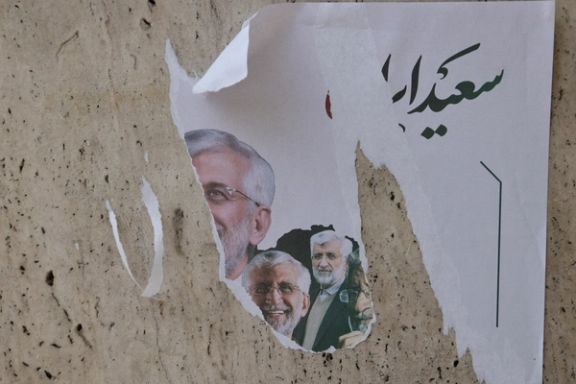
A poster of Iranian presidential candidate Saeed Jalili is seen on a street in Tehran, Iran, June 29, 2024.
With pro-reform Masoud Pezeshkian and ultra-hardliner Saeed Jalili in Iran's July 5 runoff, debates are heating up. Some advocate voting for Pezeshkian to prevent Jalili's win, while others consider boycotting the vote again.
“The unhappy, disillusioned majority made a powerful statement in this election. The boycotters turned the poll into a referendum against the Islamic Republic, while those who voted managed to thwart the political establishment’s plans to install their desired hardliner candidate in the presidential office in the first round,” said 52-year-old businessman Hamed in Tehran, who did not vote on Friday, in an interview with Iran International after the poll results were announced.
At least 60 percent of the 61.5 million eligible voters abstained from voting on Friday, according to official figures. However, many believe the turnout was even lower than reported, possibly as low as 20 percent, suggesting that over 80 percent of voters boycotted the election. Although it borders on a conspiracy theory, Persian social media is buzzing with posts about it.
As proof, they indicate that the votes of the four candidates, the number of void ballots, and the total are all multiples of three. “The probability that five random numbers are multiples of three is less than half a percent. The Islamic Republic has multiplied the votes by three,” one of the many tweets that have gone viral on X in the past 24 hours said.
“Some of my friends now argue that we have made our point. Turnout was the lowest in any presidential elections and the reformists must have also realized that we no longer trust them to go to the polls whenever they tell us. They say, given this, we should now vote in the run-off to stop Jalili’s presidency,” he said. "But there are also those who strongly disagree and say we need to take the boycott act to the next level."
A poster of presidential candidate Masoud Pezeshkian is displayed on a street in Tehran, Iran, June 29, 2024.
Hamed had voted for reformists in every presidential and parliamentary election since the high turnout presidential vote in 1997, when reformist Mohammad Khatami won a landslide victory with 22 million votes (69 %). But he never voted after 2017 when he cast his vote for the moderate Hassan Rouhani whom Khatami had endorsed. Like many other Iranians, he now describes himself as a ‘barandaz’ (proponent of regime change) for the past few years.
This time his resolve to boycott the elections was weakened when Pezeshkian was allowed to run. “Could it be a signal that Khamenei had decided to open up the atmosphere only a little, we asked ourselves,” Hamed recalled.
“We know Pezeshkian’s powers as president would be very limited but there is still a big difference between him and a fundamentalist like Jalili or a corrupt to the bone politician like [Mohammad-Bagher] Ghalibaf,” Hamed added.
After long discussions with close acquaintances, family, and former university friends in WhatsApp and Telegram groups, he and several friends decided not to vote. They even visited a few polling stations on Friday to observe voter turnout. “The turnout was visibly low, even in the evening hours when more people usually go out to vote,” he noted.
“We could regret it later if we didn’t vote and let fundamentalists have an easy win but there came a text message from the interior ministry that said every vote was a vote for the "system" or regime, depending on how one would prefer to translate the Persian word. We didn’t want Khamenei to use our votes as proof of the legitimacy of his rule. So, we decided to go back home without voting,” Hamed said.
According to Hamed, the arguments within his circle of friends and family against voting centered on Pezeshkian's failure to address many of the key issues they, particularly women, expected him to address clearly in the debates. Most also believed that Pezeshkian would have minimal power, if any, to implement meaningful reforms if opposed by Khamenei and the hardline-dominated parliament.
The 34-year-old artist Samaneh spoke of similar arguments in her own circle of family and friends. She was very active in the Woman, Life, Freedom protests of 2022-23 and says she is a ‘barandaz’. “I don’t want to live under any religious rule, let alone one like this which has its arms up to the elbow in the blood of innocent protesters.”
Nevertheless, she decided to vote for Pezeshkian “only for a little improvement” and tried to convince her younger sister and brother who are in their twenties to do so. “Both of them refused. They didn’t even want to hear about it,” she said, adding that to her surprise the outcome of Friday’s poll had changed their minds.
“I can’t believe they are now going around trying to encourage their friends to vote on Friday. Even the thought of Jalili destroying the little that has remained of the economy and social freedoms scares them to death,” Samaneh said.
Arguments like those of Hamed, Samaneh, and their family and friends abound on social media. “Pezeshkian won’t help you overthrow the regime but Jalili can lead us to become North Korea,” Hanieh who indicated that she is a ‘barandaz’ argued in a tweet against those who questioned her motivation for voting and encouragement of others to vote.
Tababaei, who according to her profile is a dentist living between Tehran and London in a short tweet with images of Jalili and Pezeshkiansaid the choice for her was easy: “It is Iran vs. a branch of the Taliban of Afghanistan.”
Bijan Zanganeh, Iran's former oil minister, says he has filed a lawsuit against Iranian presidential candidates Saeed Jalili and Alireza Zakani for “slandering and insulting” him on state TV during the fourth presidential debate on June 24.
During the debate, hardliner Zakani suggested that ‘reformist’ candidate Masoud Pezeshkian was involved in the controversial Crescent deal, a contract signed between National Iranian Oil Company (NIOC) and Sharjah-based Crescent Petroleum which led to a legal dispute at the Hague court and cost Iran $607 million for non-compliance with the agreement.
Zanganeh was Iran's oil minister under President Mohammad Khatami (1997-2005), whose government is known as Iran's reformist administration.
"During Khatami's term, the greatest betrayals in the oil sector happened to the country," Zakani said during the debate.
Jalili also accused Zanganeh of "corruption and plundering billions of dollars" concerning the Crescent deal.
Zanganeh denied these claims. In a post on X, he attached a copy of his complaint filed with Tehran's Public and Revolutionary Prosecutor and pointed to the specific charge of "publication of falsehoods" punishable by law as outlined in the Islamic Penal Code. He demanded "criminal prosecution" of Jalili and Zakani.
The attack by the two hardliners was part of their election campaign to smear Iran's 'reformists' and present themselves as fighters against corruption. Despite the reformist-hardliner dichotomy, over 60% of voters stayed away from the polls on Friday, in what is seen as a big blow to the legitimacy of the Islamic Republic.
As Iran approaches a runoff in its snap presidential election on July 5 between a hardliner and a more moderate candidate, questions arise about whether either would be willing or able to change Tehran's foreign policy.
A recent reportby the Royal Institute of International Affairs, commonly known as Chatham House, a British think tank based in London delves into the complexities surrounding Iran’s presidential election and its potential impact on the country’s foreign relations, particularly with Russia.
The recent deaths of President Ebrahim Raisi and Foreign Minister Hossein Amir-Abdollahian in May following a freak helicopter crash, have left a significant void in Iran’s foreign policy strategy according to Chatham House’s report: The two main supporters of rapprochement with Russia were Raisi and Amir-Abdollahian, the report says.
It also suggests that the future of Iranian-Russian relations, which had been moving towards a more institutionalized partnership, now hinges on the stance of the next Iranian president.
It notes that while acting President Mohammad Mokhber and acting Foreign Minister Ali Bagheri-Kani continue to emphasize the strategic nature of the relationship, incoming leadership may prioritize economic recovery over deepening ties with Moscow: "However, the main candidates in the presidential race are all signaling that their priorities are relieving sanctions and improving the economy – not a special relationship with Moscow."
Supreme Leader’s influence and future directions
Regardless of the outcome of the presidential elections, Iran’s Supreme Leader Ali Khamenei’s influence remains pivotal in shaping the country’s foreign policy. As highlighted by Chatham House, his endorsement of previous initiatives, including the 'turn to the East' strategy – a strategy to strengthen political, economic, and strategic ties with Eastern hemisphere countries, especially with Ruassia and China, aiming to expand alliance networks and reduce Iran’s vulnerability to Western influence – underscores Iran’s approach to navigating international pressures and sanctions.
However, the Chatham House report suggests that Khamenei’s strategic calculus may evolve depending on the election outcome and broader geopolitical shifts. It notes, "Even the Supreme Leader may change course on Russia if the interests of the regime require it."
Iran’s economic crisis
The election takes place against a backdrop of profound economic turmoil in Iran. The country is confronted with a staggering infrastructure deficit amounting to $500 billion, alongside persistent annual inflation rates exceeding 40% for the past five years. The sharp devaluation of Iran’s currency, the rial, has plunged millions of Iranians into poverty, exacerbating socioeconomic challenges. Despite Iran's vast oil reserves, gasoline shortages persist, highlighting ongoing economic complexities.
However, against this backdrop, candidates have not seriously Khamenei's strategic policies of remaining steadfast in expanding Iran's nuclear program or continuing a regional confrontation with Israel and the United States. The "revolutionary" foreign policy has gone unchallenged by the candidates. In fact, Saeed Jalili is the most hardline politician when it comes to a confrontational foreign policy.
“Two problems face whoever wins Iran’s presidential race: to bring the economy out of crisis and to reduce the external pressure exerted on the country through sanctions,” the report emphasized.
Chatham House in its report agrees that Jalili takes a confrontational stance, advocating not only forcing the lifting of sanctions but also for compelling sanctioning countries to repent.
During the fourth presidential debate, Jalili highlighted Russia's conflict with the EU as an opportunity for Iran to boost exports, such as vegetables previously imported by Russia from Europe. This has raised eyebrows in Iran that Jalili is suggesting meager income from vegetable exports, while Tehran's foreign policy has cost the country hundreds of billions of dollars in lost oil revenues and economic development.
The only so-called ‘reformist’ candidate, Masould Pezeshkian has criticized Iran’s ‘turn to the East’ strategy and suggested opening the country to the West, as well as reducing tensions with the US, the Chatham House report said. Despite this, Pezeshkian has consistently maintained that he remains loyal to Khamenei - meaning that should Khamenei decide to continue support for the 'turn to the East' strategy, Pezeshkian would follow suit.
Candidates downplay ties to Russia
The report further notes, "Immediately after Raisi’s death, the Kremlin tried to put the discussion of a long-term bilateral agreement on pause, willing to see the outcome of the presidential race in Iran."
While Russia remains a crucial ally for Iran, particularly in circumventing international sanctions and coordinating on regional security issues, the next Iranian administration’s orientation towards the West could reshape these dynamics: "Any lifting of sanctions and restoration of ties with the West will require Tehran to revise its relations with Russia, although not necessarily immediately."
Contrarily, the report indicated that Jalili offers scant optimism for genuine friendship with Russia. Although he does not prioritize Russia in Iran’s foreign policy discourse, rather mentions Moscow within the broader ‘turn to the East’ context alongside China and India.
Moreover, the report underscores the potential for gradual shifts in Iranian foreign policy depending on internal and external pressures: "The bottom line is that while there is no chance for the immediate and deep revision of Russian–Iranian ties, the erosion of the current format is quite possible in the medium term, should the new president succeed in launching the sanctions-lifting process."
Voter turnout in Iran’s Friday snap presidential election reveals a sharp decline across various provinces, particularly in regions that were centers of protests in 2022 and 2023.
Based on official tallies, significant drops in voter engagement were recorded in Tehran (capital city) and in Kordestan and Kermanshah provinces, all of which were epicenters of recent anti-government protests, as well as in restive Sistan-Baluchestan province, which saw a dramatic 23-percent decrease in turnout.
The nationwide protests, ignited by the death in custody of Kurdish Mahsa Amini, saw Kordestan (Kurdistan) among the first to rise up against the clerical rulers.
In the presidential vote, Kermanshah recorded a mere 19.5 percent participation rate, 28.8 percent less than the 2021 turnout. Greater Tehran and Kordestan also recorded a 23-percent turnout, down from 26 percent and 37.4 percent respectively in 2021.
These regions, at the forefront of protests, reflect citizens’ frustration over systemic corruption, economic hardships, repression and lack of political freedoms.
Voter turnout In Sistan-Baluchestan in southeastern Iran nosedived from 62.8 percent in 2021 to just 40 percent in 2024. This marginalized and underrepresented region faces severe socio-economic challenges and repression.
During Bloody Friday on September 30, 2022, security forces killed around 100 protesters and injured hundreds more. The government has repressed the weekly protests following Friday prayers, leading to the arrest of many Baluch Sunnis.
The northern provinces of Gilan, Mazandaran and Golestan also saw significant decreases of 24.8, 18.5 and 19.4 percent, respectively, while Khuzestan's turnout dropped by 20.4 percent.
The only province that showed a minor increase was Qom, home to Iran's biggest Shia seminary, which saw a three-percent increase in turnout.
The June 28 presidential election marked the lowest voter turnout in the history of the Islamic Republic, with only 39.92 percent participation. This breaks the previous record set during the last election, in which the late President Ebrahim Raisi won with a turnout of 48 percent.
Activists and officials have highlighted that the low turnout is a clear sign of the public's discontent with the ruling autocracy, demonstrated through the widespread boycott of the election.
Mostafa Pourmohammadi, who scored the lowest number of votes in the election, said on X, "Greetings to all of you who came to vote on June 29, and respect to all of you who did not believe us and did not come. Your presence and absence are full of messages that I hope will be heard. Your message is clear and unambiguous.”
As Iran’s low-turnout presidential election moves into a runoff set for July 5, three groups in Iran must make crucial decisions not only about the election but also about the country's future.
The three key groups are, in order of significance, the boycotters, the reformists, and the ultraconservative Paydari party members along with other like-minded hardliners.
At least 60 percent of eligible voters refused to go to the polls, leaving the race to one pro-reform candidate and five conservatives, two of whom withdrew before election day.
Until the final hours before the election, conservative figureheads and even top IRGC officers made extensive efforts to persuade either former nuclear negotiator Saeed Jalili or Parliament Speaker Mohammad Bagher Ghalibaf to withdraw, giving the other a better chance to win in the first round. Despite their efforts, the plan did not succeed.
Now, pro-reform Masoud Pezeshkian and Jalili are off to the runoff election for the final showdown on Friday. In the meantime, the three groups have to make tough decisions to shape the country's future.
The reformists need to put an end to their hesitations and stand firm in big numbers behind Pezeshkian to ensure a victory. At the same time, Paydari and other "revolutionary" hardliners will certainly do everything to support Jalili and enable him to form his ideal non-compromising, non-conformist hardheaded revolutionary government.
The boycotters need to reconsider their stance and decide whether to support a “moderate” who could perhaps marginally improve the country's situation and push back against power-hungry hardliners, or to leave it in the hands of ultraconservatives. The latter's economic and international policies are likely to negatively impact the country, potentially turning Iran into an "Islamic North Korea," as some critics have warned.
Hours after initial election results were out, Iranians started to voice their concerns. Siamak Ghassemi, an economic consultant in Tehran pointed out on multiple social media platforms that only 24 million out of the country's 61.5 million voters took part in the election which means a turnout of just under 40 percent based on unverifiable figures announced by the government.
He warned, "The message is clear. In one of the most competitive presidential elections, where both conservatives and reformists were represented, a 60-percent majority of Iranians chose to abstain. They do not care who occupies the President's Office or who will be in the runoff election. They do not care who will be the country's president." Ghassemi further cautioned the government, "Listen to the 60-percent majority!”
A deep economic crisis, partly triggered by US sanctions, worsening government repression, persistent news of corruption, and a host of other intractable issues have convinced many voters that it makes no difference who becomes president.
Meanwhile, a well-known reformist activist Sadeq Hosseini wrote: "Jalili would have been Iran's president now if we did not take part in the election even as much as we did. Just think of it that with this minimal participation we have stopped him so far."
While Ghalibaf left the race in silence with a temper tantrum after his defeat, another reformist figure, Nasser Torkan called on his voters to "lend their support to Pezeshkian in order to bring the country back on the right track of rationality to focus on the country's development and protect it from radicalism and backwardness."
Pessimists and boycotters, however, do not seem to be convinced that Pezeshkian is reformist enough. One of them said on a foreign-based satellite TV channel that preferring Pezeshkian to Jalili is like deciding whether to be taken to a detention center in a pink or a white Morality Police van.
Minutes after voting concluded in Iran’s presidential elections at midnight Friday, unidentified assailants attacked a vehicle transporting election boxes in Sistan-Baluchistan Province on June 29.
The assault allegedly resulted in the deaths of two security force members, and injuries to several others, according to Iran's state news agency IRNA. Additionally, one of the assailants was also reportedly killed.
Early Saturday conflicting reports emerged from IRGC-affiliated Tasnim News agency, initially identifying the two deceased as ballot security officers but later describing them as border guards.
Quoting Iranian border police commander Brigadier General Ahmad Ali Goudarzi, IRGC-affiliated Tasnim News agency reported that one of the assailants was killed during an “armed conflict between the border guards and a terrorist group in the Jakigor border region, located in the Sistan and Baluchestan province.” Goudarzi further added that two others were injured and fled the scene of the conflict.
Iranian media identified the two killed Farhad Jalili and Ebrahim Marmazi.
Reacting to the news, Iranian Presidential candidate Masoud Pezeshkian referred to the two victims as members of Iran’s “police forces”.
“The news of the oppressed martyrdom of the zealous police forces of Rask city by the criminals, who were attacked in a cowardly way while protecting the people's votes, caused a lot of emotion and pain,” Pezeshkian wrote on X Saturday.
Former Iranian Foreign Minister Javad Zarif responded to the incident, commending the two as "zealous men of the police force" and "martyrs who sacrificed their lives for Iran and protecting democracy."
“They did not allow the theft of the votes of the brave people of Sistan and Baluchistan and in this way, they reached a high level of martyrdom,” Zarif stated.