Iran denies role in Golan rocket attack as Israel prepares to retaliate
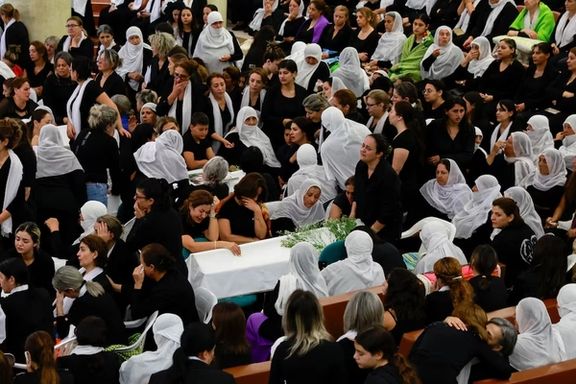
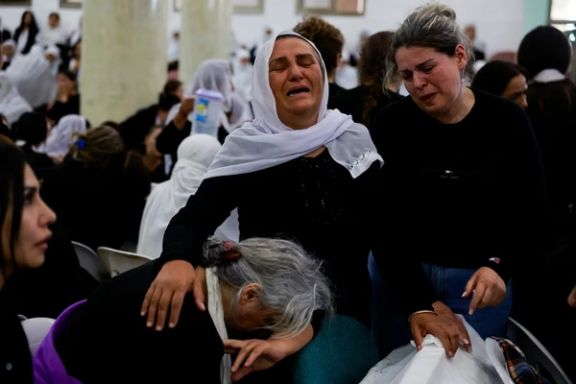
Families whose children were killed at a soccer pitch by a rocket launched across Lebanon's border with Israel react before the funeral in Majdal Shams, a Druze village in the Israeli-occupied Golan Heights, July 28 2024.
In a vague statement on Sunday, Iran denied any role in a rocket attack that killed 12 children and teenagers on a soccer field in a Druze village in Golan Heights, which Israel says was carried out by Tehran-backed Hezbollah.
Israeli military spokesman Daniel Hagari said on Saturday the rocket used in the deadly attack was an Iranian-made Falaq-1 fired by Hezbollah.
Iran's Foreign Ministry spokesman Nasser Kanaani dismissed the accusations on Sunday, stating, "Israel's statements will not be heeded by others." However, Kanaani did not make it clear whether he means no Iranian rocket was used in the attack or the Iranian proxy group did not fire any munition at the civilian target.
Israel has vowed to respond to the suspected Hezbollah attack, with the country's national broadcaster Kann News citing officials as saying that the Israeli response to the attack "might lead to several days of intense fighting."
The attack has also sparked widespread reactions across the world.
The White House condemned the attack and blamed Hezbollah for it, saying, "It was their rocket, and launched from an area they control." It added that Washington has been in discussions with Israeli and Lebanese officials since Saturday's attack, which it described as "horrific."
US Secretary of State Anthony Blinken also said that all signs point to Hezbollah's involvement, emphasizing Israel’s right to self-defense while stating that the United States does not seek an escalation of regional conflicts. At a press conference in Tokyo, Blinken expressed condolences for the loss of life and reiterated the US stance against terrorism.
“There is no justification for terrorism, period, and every indication is that indeed the rockets were from or the rocket was from Hezbollah. We stand by Israel’s right to defend its citizens from terrorist attacks,” he added.
The Saturday attack has left the community of Majdal Shams in deep mourning. Thousands gathered for the funeral of the victims, marking a day of profound sorrow. At the funeral on Sunday, weeping men wearing traditional, red-topped white hats carried 10 white-covered caskets through the crowded streets. Women dressed in black abaya robes cried as they laid flowers on the caskets, with some mourners carrying large photos of the deceased children.
Families whose children were killed at a soccer pitch by a rocket launched across Lebanon's border with Israel react before the funeral in Majdal Shams, a Druze village in the Israeli-occupied Golan Heights, July 28 2024.
Fadi Mahmud, a 48-year-old resident, in an interview with AFP described the incident as a significant loss for the close-knit community. "It was the first time Majdal Shams had experienced such a loss during the war." "Our community is very close-knit. These children are like children of everybody in the village."
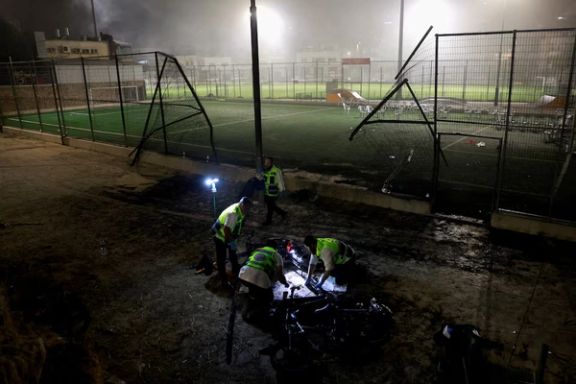
Emergency personnel inspect the area after rockets were launched across Lebanon's border with Israel which, according to Israel's ambulance services, people were killed, at a soccer pitch in Majdal Shams, a Druze village in the Israeli-occupied Golan Heights, July 27, 2024.
In the early 1980s, Iran established Hezbollah in Lebanon as a proxy force to confront Israel. In 2018, the US government reported that Iran annually provides Hezbollah with an estimated $700 million. Earlier, in a 2016 speech, Hezbollah's leader, Hassan Nasrallah, publicly stated that Iran is the source of his organization’s funding. The financial support bolsters Hezbollah’s substantial military capabilities, including an arsenal of roughly 150,000 missiles and rockets targeted at Israel.
Full-blown Israel-Hezbollah war
The deadly attack blamed on Hezbollah has stoked fears of a full-fledged war between Israel and the Lebanese group, with Lebanon's Middle East Airlines delaying some of its Beirut flight arrivals, and several European countries advising citizens to leave Lebanon.
However, Mohammad Ghaedi, a lecturer in international relations at George Washington University, believes a full-scale war between Israel and Hezbollah is unlikely due to the prohibitive cost.
“Despite the threats being made, my analysis is that we are far from a full-scale war between Israel and Hezbollah for several reasons," Ghaedi told Iran International.
He said the 2006 war between Israel and Lebanon cost around three and a half billion dollars. “Today, an attack on Hezbollah could cost more than 50 billion dollars. Additionally, Hezbollah's enhanced capabilities, including precision missiles, position them to retaliate effectively against Israeli targets.”
According to security sources, Hezbollah has preemptively evacuated several key sites in southern Lebanon and the eastern Bekaa Valley in anticipation of a potential attack by Israel.
Ghaedi believes that Israel will likely conduct limited strikes in response to Hezbollah, aiming to resolve political differences within Israel and seek international condemnation of Hezbollah.
He referred to the rocket used in the attack, allegedly an Iranian-made Falaq, as a central point of tension. “If confirmed, it could prompt small-scale Israeli responses within Iran, following Naftali Bennett’s ‘thousand cuts’ strategy against the Islamic Republic."
The conflict might have broader implications, potentially involving other powers such as the United States and Iran. However, Ghaedi finds it unlikely that Iran-backed forces in Iraq and Syria will enter a conflict under current circumstances.
The 2024 US presidential campaign is being closely followed in Iran, as many Iranians believe the outcome will directly impact their lives, especially with Donald Trump once again on the ballot.
Trump’s last tenure was highly 'eventful' for Iranians. The former president withdrew the US from the 2015 nuclear deal, ordered the killing of Qasem Soleimani—arguably Iran’s second most powerful figure after the Supreme Leader — and imposed extensive oil sanctions that put unprecedented pressure on Iran’s economy.
It’s little surprise, then, that many seem to dread Trump’s potential second term. The annual inflation rate is already ‘back-breaking’, as we say in Persian, hovering above 40% for three years. Corruption is rampant. Another round of Trump’s “Maximum Pressure” would push millions off the cliff – or drag the country into war. And still, many say they’d like Trump to win. It is impossible to say how many, but it’s a sizable chunk of the population.
“Trump may be bad for us, but he’s worse for the regime,” says Farhad, an IT technician looking for a job. He was “kicked out” of work after he was arrested during the 2022 protests. “Trump is no Biden,” he says, “and his Iran advisers are not [former Iranian FM] Zarif chums. The pressure he’d exert could hasten the collapse of the regime.” What about ordinary Iranians, I ask, what if there’s a war, what would happen to their lives? “You call this a life?” he snaps back.
Trump signing the US withdrawal from the JCPOA nuclear deal in May 2018
Farhad is 23. He’s visibly angry and has little to lose –materially at least. Those who do have something to lose, the ‘better-off’, see things differently.
“People have suffered enough these past years. We need the sanctions lifted, and that’s more likely with a Democratic administration. Trump has shown no goodwill towards Iran,” says Arash, an engineering student who actively campaigned for Iran’s new president, Masoud Pezeshkian. “Iran cannot prosper with anti-Americanism. I voted for Pezeshkian because he seems less aggressive and might be able to negotiate a deal with the US and attract the foreign investment our country desperately needs.”
That may very well be wishful thinking, given what US officials have said on record and the fact that Iran’s foreign policy is dictated by Supreme Leader Ali Khamenei, not the president. Still, many Iranians share Arash’s hope for a miracle. However, a Trump victory this November seems much more likely. This prospect terrifies Arash as much as it thrills Farhad.
And then there’s Farkhondeh, a 29-year-old journalist who avidly follows US politics. She believes both the fear and hope that Trump would put more pressure on Iran may be exaggerated, if not entirely misplaced. “I think Trump is as likely to enter negotiations with Iran as [Kamala] Harris,” Farkhondeh says. “Trump’s record is not that of a warmonger. He’s a businessman. I think he wouldn't hesitate to talk to Khamenei if the latter was willing. That said, I don’t think any good for ordinary Iranians would come out of such a negotiation. Both sides would be more than happy to sell us out for their own interests.”
Curiously, almost everybody I talked to focused on Trump. There are no polls on this, but it seems rather clear that most Iranians believe the former US president would win again. Neither in social networks nor among my acquaintances have I seen anyone who sees Harris defeating Trump. This could be a result of Trump’s aggressive demeanor, which makes his opponent appear weak, or it could be because he’s a former president. But it’s also because Harris is a woman.
Sex or gender may be less of an issue in the US, but it remains significant in Iran, where no woman has ever passed the vetting process to enter a presidential race. The highest position a woman has reached in the Islamic Republic is Minister of Health—and that only once. Strangely, many view this as a ‘capability’ issue rather than a direct result of fanatical religious orthodoxy.
“America and Iran may differ socially, but I think being a woman will work against a candidate even there.” Sima, a 40-year-old woman who works at a publishing house said. She regularly posts about women's rights on Instagram, but takes little interest in the US election, even though a woman is in the race. “I like Harris to win,” Sima says, “but it won’t make much difference to us here either way.” She believes the impact of US elections on Iran is “exaggerated” – and it benefits the government.
“Iranian officials fuel this notion by constantly referring to the US as the enemy,” Sima says. “America is a scapegoat for their incompetence and corruption. Many have bought this idea, thinking that either disaster or redemption awaits us if Trump wins. Both are misguided, in my view. We better focus on our own rulers and let the Americans worry about theirs.”
Following widespread public outcry, Iranian writer and anti-hijab activist Sepideh Rashnu, has had her prison sentence postponed.
Rashnu was summoned to begin serving three-years and 11-months on Saturday for defying mandatory hijab laws.
However, writing on X on Saturday, her brother, Saman, announcedthat the execution of her prison sentence has been deferred until August 3. He added that a request for a second retrial has been filed while expressing hope that the sentence would not be enforced.
Despite Iranian authorities bringing forward multiple cases against her, Rashnu appeared before Evin prison on Saturday without wearing the mandatory hijab, risking further fines and charges.
On Friday evening, rights groups and Iranians flooded social media with protests against Rashnu's summons to begin her prison term. The surge of support followed a video she released in which she announced that, having exhausted all legal avenues, she was forced to turn herself in at Tehran’s Evin Prison on Saturday.
“I haven't committed any act that justifies being removed from the city and the streets, denied my education, and imprisoned. Evil has such a grip on our lives that our bodies, our individuality, and our existence have been criminalized,” Rashnu added in the video in a post on her Instagram.
Despite being summoned to prison, Rashnu stated that what is more important than her prison sentence, is supporting political prisoners facing the death penalty in Iran.
“Right now, many prisoners in various prisons are going on hunger strikes every Tuesday to voice their protest against the death penalty to society, and they will continue until they bring society and humanity along with them. I believe the most important issue now is to end this evil as soon as possible,” Rashnu stated.
Support has been global. On Friday, the US-based Abdorrahman Boroumand Center for Human Rights in Iran condemned Rashnu’s prison sentence, stating that her case “highlights the ongoing suppression of women's rights and freedom of expression in the Islamic Republic.”
PEN America also voiced its support for Rashnu, stating that "Dissidents like Sepideh embody the role that writers and artists often play in defending human rights."
Criticizing the sentence as based on "fabricated national security charges", the US-based Center for Human Rights in Iran (CHRI) also expressed support for Rashnu.
Human rights activist and former Evin detainee, Atena Daemi wrote on X on Fridaythat in Iran “the war against powerful women continues,” adding that women like Rashnu “continue to fight and civil disobedience despite imprisonment and repression.”
Rashnu was first arrested on July 16, 2022, a few days after national “Hijab and Chastity Day” on 12 July, following the circulation of a video that went viral on social media showing her on a bus without the mandatory hijab.
The video also captured her in an argument with a woman identified as Rayeheh Rabi’i - an Islamic Republic loyalist, who was attempting to force her to wear a hijab. During the altercation, Rashnu was assaulted by Rabi’i.
Following her arrest state-run television (IRIB)aired a forced confessionof Rashnu on July 30, 2022, showing visible signs of torture with bruised eyes and reportedly taken to hospital after the video was recorded.
On August 15, 2022, Rashnu’s case was referred to Tehran Revolutionary Court for charges including "gathering and colluding against national security", "propaganda against the state" and “promoting immorality and prostitution.”
Rashnu was eventually released on a bail of eight billion rials ($27,000 according to exchange rates at the time) on August 30, 2022.
An undergraduate painting student at Alzahra University, she was detained for several hours on June 20, 2023, for allegedly not complying with mandatory hijab laws on campus. She was released on bail and subsequently suspended for two semesters for her non-compliance with the hijab mandate.
On November 22, she received a sentence of three years and seven months for “gathering and colluding against national security,” and an additional four months for “propaganda against the state.” She was acquitted of "promoting immorality and prostitution."
In October, Rashnu was denied entry to her trial in Tehran after announcing on social media that she would not wear the hijab during the court session. A new case was opened against her for “unveiling in public,” resulting in a fine of 15 million rials (approximately $260).
Following the postponement of her prison sentence on Saturday, Rashnu took to Instagram to urge support for Iranian prisoners faced with executions.
"I think I can bear these delays, harassments, and even imprisonment but I can't bear watching people lose their lives...let us advocate for the life of those who are in danger of receiving a death sentence or have been sentenced to death," she wrote.
Iran’s President Masoud Pezeshkian has appointed Mohammad-Reza Aref, a ‘reformist’ known for his aloof conduct as a lawmaker, as his first vice president, contrary to earlier reports suggesting a top economist would get the post.
The announcement came immediately after Pezeshkian received his seal of approval from Supreme Leader Ali Khamenei during an inauguration ceremony on Sunday morning, officially assuming the position of President.
Aref, who was the leader of the Reformists in parliament between 2016-2020, became known as the “Sultan of silence” after remaining indifferent to major upheavals in the country. Not only he was less than visible in legislative affairs, he failed to rally his faction when government forces quashed anti-regime protests in 2017-2918 and 2019 killing more than 1,500 civilians.
Aref’s inaction as Reform Front’s Chairman was a major reason why ‘reformists’ lost political credibility with the electorate and received only three percent of the vote in the 2021 presidential election. Hardliners who had already purged others in the 2020 parliamentary elections, were able to put Ebrahim Raisi in the presidential office in August 2021. One result of this major takeover of power was the failure of nuclear talks with the West in 2021-2022.
On Saturday, Nameh News, a major new website had reported that Pezeshkian’s choice for vice-president was Ali Tayyebnia, a respected economic official, who was minister during President Hassan Rouhani’s administration. This scenario would mean that Tayyebnia would coordinate all economy-related agencies at a time when to most pressing problem is to partially improve the ailing economy.
Tayyebnia can still be appointed in the cabinet, but the likelihood that he would expect to return to the same position as he held earlier seems less likely. He could also be appointed as vice-president for economic affairs, since president in Iran have several deputies.
By appointing Aref, Pezeshkian has chosen the least problematic ‘reformist’ from his perspective, as well as that of Khamenei. The new president has repeatedly vowed full allegiance to the Supreme Leader’s agenda, despite attempts by many regime insiders to portray him as a reformist himself.
Pezeshkain reiterated his allegiance to Khamenei once again during his inauguration on Sunday, and his religious devotion by lengthy recitations of Quranic verses in Arabic. An Iranian on social media commented that the ceremony sounded more like an inauguration taking place in Saudi Arabia.
The 73-year-old Aref was a revolutionary university student in the 1970s and was arrested by the secret police for his anti-Shah activities. He studied electronics in Tehran University and then continued his studies at Stanford University, where he received a master’s degree and a PhD in electrical and communication engineering in 1980. He represents the generation that many Iranians now derisively call the "79-ers", referring to those who overthrew the monarchy in 1979.
An increasing number of Iranian filmmakers are defying the country's strict ideological censorship by making movies without seeking the Culture Ministry's permission, for screening abroad.
Many filmmakers are bypassing regulations requiring them to obtain approval at various stages of production, from screenplay inception to final screening and entry into international film festivals.
These new independent films challenge compulsory hijab rules, depicting Iranian women without the mandated headscarf, manteau, or chador, which covers the whole body. This defiance has grown, especially following the 2022 Woman, Life, Freedom movement and protests.
The films are made discreetly, and sometimes in secrecy, which has become possible due to new technologies that enable filming without cumbersome equipment and large reels of film. Transfer of electronic files also facilitate sending copies to international festivals.
Another actress, Layli Rashidi who ran a similar workshopfor children in Dubai had her passport, cell phone and personal computer confiscated at the Tehran airport when she recently returned to visit her mother.
In the past two years, many Iranian film artists took part in the production of movies that are officially "illegal" while knowing that defying the censorship will land them in trouble.
One of the latest examples, “My Favorite Cake” won awards at the Berlin Film Festival in February and is now being prepared for international public screenings starting from Paris and Berlin.
This movie explores the relationship between an elderly couple. In approved Iranian films, actresses wear hijab even at home, which is unrealistic. Additionally, censored films avoid depicting women associating and drinking with men or discussing topics that are considered taboo under the Islamic government.
However, it is not the only Iranian film defying official censorship and government-imposed codes of conduct. In 2023 alone, two dozen such movies have been produced in Iran. These include "Earthly Verses" directed by Alireza Khatami and Ali Asgari, "Café" directed by Navid Mihandoust, "Achilles" directed by Farhad Delaram, and "Critical Zone" by Ali Ahmadzadeh.
These films depict the fact that most people in Iran are living a secular life under a fundamentalist Islamic government. They likely represent the 61 percent of the population who refused to participate in the country's recent stage-managed presidential election.
In interviews with foreign media, at least two actresses emphasized their commitment to independent filmmaking despite potential repercussions. Meanwhile, as the new government selected a new minister of culture, the House of Cinema, the Iranian filmmakers' trade union, objected to "the regulations for issuing filmmaking and screening permits." They criticized the government's treatment of filmmakers, arguing that it treats them like minors or insane individuals needing government direction, calling this attitude "regressive and unethical."
Earlier, Iranian film director Maziar Miri told Etemad Online, "All those who make films of social significance have been barred from filmmaking. Cinema was once important to government officials, but they no longer see it as a significant form of art." Miri added, "The officials want to make us angry and nervous so that we will leave the country."
In the latest Cannes Film Festival earlier this year, internationally acclaimed filmmaker Mohammad Rassoulof who was barred from leaving the country crossed the borders on foot and made it to the festival where his latest film, “The Seed of Sacred Fig”, was premiered and received international recognition. Like many other Iranian filmmakers, Rassoulof is now living in exile.
Iran's Supreme Leader Ali Khamenei gave the official mandate for the presidency to Masoud Pezeshkian on Sunday in a ceremony attended by various officials and dignitaries.
During the ceremony -- called Tanfiz, Khamenei handed over a decree, known as the "decree of confirmation" or "decree of validation", to the president-elect, formally recognizing him as the legitimate president.
In fact, the official government news website, IRNA, used the word "approved" for Khamenei's endorsement of Pezeshkian as President, who is considered to be the chief executive from today, July 28. Therefore, the second inauguration event in the parliament in two days, is indeed a ceremonial swearing-in.
The ceremony started with Interior Minister Ahmad Vahidi delivering a report on the process of snap election following the death of late President Ebrahim Raisi, who died in a helicopter crash on May 19 along with his accompanying delegation including Foreign Minister Hossein Amir-Abdollahian.
Following Vahidi's speech, Mohammad Mohammadi Golpayegani, the head of Khamenei's office, read out the decree issued by the Supreme Leader of the Islamic Republic, officially confirming the appointment.
The new president then delivered a speech, emphasizing that he will follow Khamenei's orders and calling for the resolution of political differences. "The responsibility that the Constitution has placed on me is to move towards the clear path outlined by the Supreme Leader."
Khamenei also delivered a speech notably avoiding attacks on the United States but reiterating his rhetoric against Israel and support for anti-West, anti-Israel militant groups backed by Tehran. He also stated that relations with European countries are not Tehran's priority, while calling for stronger ties with regional neighbors.
In his address, Khamenei launched an unusually long and harsh critique of the pre-1979 monarchy, insisting that the Islamic Republic provides democratic choice, whereas the pro-West king, Mohammad-Reza Pahlavi, relied on the United States and Britain to stay in power.
This attack, during an inauguration ceremony, may reflect Khamenei's realization that the Islamic Republic has lost popularity with many Iranians, who have abstained from voting in several elections since 2020. Khamenei's authoritarian rule has increasingly used military force to quell anti-regime protests, killing thousands of citizens since 2017.
The ongoing economic crisis in Iran has fueled nostalgia for the prosperity of the Pahlavi era, especially in the 1970s.
The Tanfiz ceremony will be followed by Tahlif slated for Tuesday, when Pezeshkian swears in before the parliament. During Tahlif, the newly elected president takes an oath before the Parliament (Majlis) in the presence of the head of the judiciary and the members of the Guardian Council, promising to uphold the constitution and faithfully execute his duties as the head of state. Both ceremonies are essential in the transition of presidential power, ensuring both legal and symbolic legitimacy for the incoming president.
According to IRNA, over 2,500 attendees are expected, including national and military officials, heads and professors from religious and academic institutions, representatives from various sectors, families of martyrs, and foreign ambassadors stationed in Tehran.
The state media also said that 70 foreign delegations from different countries and international organizations will attend the swearing-in ceremony.