Iran struggles with power outages blamed on 'incompetence’
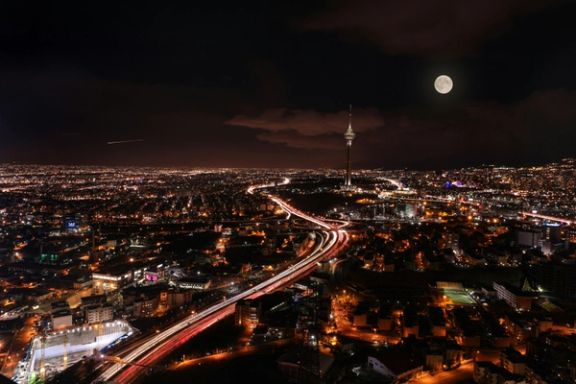
A night-time view of Tehran, 2021.
Amid an escalating electricity crisis in Iran, several citizens have reached out to Iran International, sharing accounts of continuous power outages amid the oppressive heat gripping the country.
These audio and video messages, sent in from various regions, underscore a growing public sentiment that attributes the widespread electricity shortage to what they describe as the "incompetence of Islamic Republic officials."
Over the past several years, the Islamic government has struggled to meet the nation's electricity demand, with repeated failures plunging hundreds of cities and villages into darkness each summer.
This year, however, the situation appears to have reached a critical juncture, as the frequency and duration of blackouts have intensified as the gap between supply and demand has widened.
Citizens, in messages and videos sent to Iran International, have highlighted the ongoing disruptions and expressed their frustration and anger toward the authorities.
Many view the government's mismanagement and misallocation of resources as the root cause of the current predicament.
One resident poignantly remarked, “These officials talk about waging war against Israel, yet they have squandered Iran's resources by funneling money to groups like Hamas and Hezbollah, leaving the nation to suffer the consequences.”
Another citizen from Shahin Shahr, Isfahan, central Iran, sent a video to Iran International highlighting the recurring power cuts in the area. Addressing the country's leadership, he lamented, "For years, you have been waging a global battle over nuclear energy, yet you cannot even ensure a stable electricity supply for the nation." He criticized the government for years of “empty promises about building power plants,” which he says have “only burdened the people with substantial costs.”
"We have made the entire world our enemy—for nothing," he continued. "How long must we live in humiliation? The Islamic Republic only refrains from missteps when it faces external pressure."
On Friday, the ILNA News Agency reported on the growing complaints from residents of Shiraz, who have been enduring frequent and unannounced power outages. These sudden blackouts have disrupted daily life and inflicted heavy financial losses. The report highlighted the cascading effects of these outages, which are manifold—ranging from damage to electrical appliances to the crippling of local businesses.
In some areas, frustration has spilled onto the streets. On Thursday, merchants at the Noor commercial complex in Tehran protested after enduring a six-hour power outage. When their appeals went unanswered, they took their grievances public, blocking traffic and disrupting bus lines until law enforcement arrived and the power was restored.
It appears that the government has prioritized religious ceremonies despite the widespread hardships faced by ordinary citizens and businesses.
On the same day as the Tehran protest, Mohammad Moradi, CEO of the Kermanshah Province Electricity Distribution Company, announced that power supply for Arbaeen pilgrims in the province had been secured. Ninety billion rials had been allocated to ensure stable lighting along pilgrimage routes and facilities.
This announcement has been met with mixed reactions, particularly as it comes at a time when many Iranians are struggling with basic electricity needs.
Each year, Shia pilgrims converge on the Iraqi city of Karbala to observe Arbaeen, a significant religious commemoration. In recent years, many Iranians have begun their pilgrimage from the western regions of Iran, undertaking a long walk to Karbala.
On Tuesday, Tehran City Council member Habib Kashani confirmed that the Electricity Distribution Company had resorted to planned power cuts, acknowledging the necessity of informing residents in advance due to the impact on water supplies in buildings with electric pumps. This admission reflects the broader challenges local and national officials face in managing the country’s energy needs.
In response to the ongoing crisis, some provincial governments have taken drastic measures, continuously shutting down or partially closing government offices since early July. This approach, however, needs to do more to alleviate the underlying issues.
Experts have identified several factors contributing to the current electricity shortfall, including inadequate investment in the power sector, a lack of power plant development, an aging production and transmission infrastructure, and energy prices that have exacerbated the supply and demand imbalance.
As the electricity crisis deepens, the voices of those affected continue to grow louder, painting a stark picture of the challenges facing Iran's energy infrastructure and the mounting public frustration with the government's handling of the situation.
Despite President Masoud Pezeshkian’s defense of his proposed ministers during the first parliamentary confirmation hearing, several lawmakers criticized him for a lack of planning and the "incongruous mix" within the cabinet.
To shield themselves against criticism, Pezeshkian and his ministers emphasized the implementation of the general policies of the Islamic Republic and Supreme Leader Ali Khamenei.
Over the next four days, lawmakers will debate the nominees in alphabetical order by ministry, culminating in a vote of confidence for the entire cabinet on Wednesday.
For each nominee, the relevant parliamentary committee(s) will present their reports, followed by lawmakers speaking for or against the proposed minister after the nominee delivers their address.
Alireza Kazemi, nominated to lead the Ministry of education, was the first nominee to be reviewed. He is one of Pezeshkian’s most controversial nominees for whom reformists have widely criticized him.
In his speech to lawmakers, he enumerated the problems the educational system is facing including lack of money and human resources. He stressed that under his leadership, the ministry would address the “religious identity crisis” and that the “collaboration of home, school, and mosques can create a happier atmosphere for students.
“With Jihadi efforts”, he said, his ministry will educate students to be patriotic and obedient to the Supreme Leader.
Kazemi is an advocate of compulsory hijab and its enforcement in schools.
The Parliament heard from the Education, Research, and Technology Committee's spokesman that the majority of its members had approved Kazemi’s nomination.
Kazemi, who served as acting education minister in President Ebrahim Raisi’s cabinet for several months, met no opposition from the lawmakers none of whom had signed up to speak against him.
Kazemi’s brother, Mohammad Kazemi, heads the Intelligence Organization of the Revolutionary Guard (IRGC).
The second minister to be debated was Sattar Hashemi, the youngest member of the proposed cabinet, nominated to lead the Ministry of Communications and Technology.
The Parliament’s Cultural Committee, dominated by ultra-hardliners from the Paydari (Steadfastness) Party, rejected Hashemi’s nomination in their report to lawmakers, offering little criticism of his plans but presumably opposing him due to his character and political/ideological views.
In contrast, the Industries and Mines Committee unanimously endorsed Hashemi's plans and qualifications in their report.
Several lawmakers who spoke for and against Hashemi brought up the problem of internet anti-filtering software which most Iranians, including online and other businesses, are forced to use to access thousands of blocked websites including social media platforms such as Instagram.
In his speech, Vali Dadashi, an independent who had signed up to speak against Hashemi’s lack of relevant plans to expand access to fast internet, demanded action from the future minister against the so-called “mafia” that controls the hugely profitable anti-filtering software trade.
Many believe those who benefit from the trade have used their influence to impose restrictions on Internet access and will oppose Pezeshkian and his government if they try to lift Internet bans.
The need for anti-filtering software, Dadashi said, doubles the cost of access to the Internet. “Why do people have to pay for anti-filtering software?” he asked.
“Hashemi’s first step should be increasing the speed of the internet and his second to convince the members of the Supreme Cyberspace Council to lift filtering,” Ahmad Fatemi, a lawmaker who supported Hashemi’s nomination, told the Parliament.
The Council formed by Supreme Leader Ali Khamenei’s order in 2012 consists of the president who heads it, the speaker of the Parliament and chief justice, the head of the state broadcaster, and several ministers including the ministers of intelligence and defense. The commanders of the Revolutionary Guards and Police also sit on the Council.
Pezeshkian criticized filtering policies in his campaign speeches and debates. His supporters expect him to oppose these policies as the head of the Council in which hardliners and ultra-hardliners have a near absolute majority now.
In a wave of protests across cities like Arak, Mashhad, and Yasuj, Iranian nurses have taken to the streets, demanding better working conditions, fair pay, and respect for their profession.
The demonstrations, which began on August 5, have escalated into strikes, with nurses chanting slogans like "We've heard many promises, but seen no answers" and "We're the symbol of patience, but our patience has run out." The message is clear: the nurses' patience with the Iranian government’s neglect has reached its limit.
The protests follow the death of Parvaneh Mandani, a 32-year-old nurse at a hospital in Fars Province. Mandani’s death on August 2, attributed to overwork or Karoshi Syndrome, has become a rallying point for healthcare workers across the country.
Mohammad Reza Sharifi-Moghaddam, Secretary-General of the Nursing House, described her death as "suspicious," adding that "another nurse in Kermanshah, west of Iran, also took her own life by ingesting aluminum phosphide tablets."
The nurses’ demands are straightforward: "an immediate increase in wages, elimination of mandatory overtime, proper and immediate implementation of nursing tariffs, payment of arrears, improvement of harsh working conditions, and an end to security crackdowns on protesting nurses." These are not just demands for better pay, but for recognition of the critical role nurses play in Iran’s healthcare system.
However, the Iranian government has a huge budget deficit, estimated to be more than 50% and can ill afford giving in to the nurses' demands. Other sectors have similar grievances with most workers surviving with around $200 per month.
Sahar Motallebi, a physician and researcher in international population health, highlighted the financial struggles facing Iranian nurses. "Nurses earn between $200 to $250 per month, which is well below the poverty line," she explained. Motallebi pointed out that the problem stems from the health ministry’s decision to delegate nurse payments to the facilities where they work, leaving them at the mercy of underfunded hospitals and clinics. "These facilities, funded by their own income, often pay the nurses less than what is expected," Motallebi added.
The situation has become so dire that Fereydoun Moradi, a member of the Supreme Council of the Nursing System, revealed that "150 to 200 nurses migrate monthly" in search of better opportunities abroad. The combination of low pay, unpaid wages, and frequent physical assaults from patients' families has left many nurses feeling abandoned by the government. In Yasuj, for example, a nurse lost an eye after being attacked by a patient's family, and reports of stab wounds and fractures among nurses are becoming alarmingly common.
Despite promises from the University of Medical Sciences to pay overdue claims, the strikes continue. Videos from the protests show nurses chanting "Inflation in dollars, our salaries in rials," a reminder of the economic pressures they face. In Arak, nurses at Vali-Asr Hospital declared, "We are tired of promises" and "If we don't get our rights, we won't go to our shifts," only to be met with threats from the hospital’s security office.
As the protests gain momentum, support is growing from other sectors. The Progressive Student Association has called on all members of society, particularly medical students, to join the nurses' movement. The Teachers' Association of Fars Province has also issued a statement supporting the nurses' strike, emphasizing the legality and necessity of their protest.
Iran’s new president, Masoud Pezeshkian, urged lawmakers on Saturday to approve his cabinet, emphasizing its commitment to "ensuring the civil rights of all Iranians." However, events that same day sharply contrasted with his message, highlighting ongoing repression.
In Nazarabad, Alborz Province, a court sentenced Mashallah Karami, the father of executed protester Mohammad Mehdi Karami, to eight years and ten months in prison, according to pro-Bono legal group Dadban on Saturday.
The court also imposed a fine of 19 billion and 200 million rials (approximately $33,000) and ordered the confiscation of his assets, including a car and a house. Karami was charged with “acquiring property through illegal means” and “participating in money laundering.”
These allegations were linked to public donations that Karami’s lawyer emphasized in an interview with Shargh News were entirely legitimate.
Condemning the sentence, Dadban said that the sentence appears to be an attempt to discourage public support for families of executed protesters, rather than a legally sound decision.
Karami’s son, 21-year-old Mohammad Mehdi Karami, was executed on Jan. 7, 2023, following what rights groups have condemned as an unfair trial based on forced confessions. He was executed in connection with the nationwide 2022 "Woman, Life, Freedom" protests sparked by the death of Mahsa Zhina Amini in police custody.
Rights groups have criticized the detainment of Karami as part of a broader campaign against families connected to the protests.
Simultaneously, Iranian bodybuilder Sahand Nourmohammadzadeh, another protester from the 2022 uprising, was forced to return to Kahnuj Prison in Kerman Province.
Despite needing further medical treatment for his deteriorating vision, he was sent back to the remote and harsh facility where he is serving a 10-year sentence in exile.
Initially sentenced to death in November 2022 for "enmity against God" after allegedly damaging and setting fire to public property, his sentence was reduced following a retrial in April 2023.
His lawyer, Hamed Ahmadi, warned that without proper treatment, his client could lose sight in his right eye.
Nourmohammadzadeh was temporarily released in March 2024 for eye surgery, but he was returned to prison before his treatment could be completed on Saturday, raising serious concerns about his health in prison.
His father, previously revealed that his son was taken to the gallows three times for mock executions, underscoring the psychological torment he endured during his imprisonment.
In a farewell message on Instagram Saturday, before going to prison to serve his sentence Sahad said: "I’m at a loss for words...Goodbye...I hope no one else ever has to feel this way..."
While the president seeks support for his "government of national unity," the harsh treatment of protesters and their families underscores the widening gap between his promises and the reality of repression, casting doubt on the future of civil liberties in Iran.
A recent phone call, a tweet, and a meeting have sparked hope among supporters of Mohammad-Javad Zarif for his potential return to President Masoud Pezeshkian's cabinet.
Zarif announced his departure from the cabineton August 11, less than two weeks after his appointment to the specially created position of “strategic deputy”. He further said in a tweet Wednesdaythat the President had “graciously” phoned him and the two had held a “sincere conversation”, but he fell short of indicating a change in his circumstances.
Twenty-four hours later, the media reported a meeting between the two men and released a short video that showed Zarif leaving the President’s office with a big smile, saying “I have always been, and will be, an admirer of Dr. Pezeshkian.”
Reformists were struck by Zarif’s resignation, which he described as ‘returning to the academia’, and his allusion to Pezeshkian’s controversial choice of a ‘Principlist’ (right-winger) close to Parliament Speaker Mohammad-Bagher Ghalibaf as his interior minister, which many supporters have criticized.
Reportedly, Pezeshkian has not yet accepted the resignation
Zarif’s meeting with Pezeshkian Thursday evening has given them hope that he and the former Communications Minister Mohammad-Javad Azari-Jahromi who campaigned tirelessly alongside Zarif for Pezeshkian will return to the cabinet.
Some media outlets in Tehran denied any rift between Pezeshkian and Zarif, attributing the latter’s resignation to his disqualification rather than a personal choice. Despite his carefully worded expression of deep dissatisfaction with the composition of Pezeshkian’s proposed cabinet, Zarif clarified that he was not leaving due to "disillusionment or disappointment."
They argued that Zarif’s appointment had to be annulled based on an “overlooked” law passed in 2022 prohibiting individuals with dual citizenship, or those whose family members are dual citizens, from being appointed to "sensitive" positions.
The ban applies to Zarif because his children were born in the United States when he was a member of the Iranian delegation at the United Nations in New York and had “acquired US citizenship”.
Many among Pezeshkian’s supporters have since appealed to him not to let Zarif go, or have expressed deep disappointment with him for allowing his departure. Others who believe Zarif resigned due to his discontent with Pezeshkian’s cabinet have appealed to him not to leave Pezeshkian alone.
Zarif would have had a very slim chance of getting a vote of confidence from the hardline-dominated Parliament if he had been proposed as foreign minister.
His appointment as deputy, for which the approval of the Parliament is not required, had initially appeared as a great initiative by Pezeshkian to give him a high position in his cabinet until the “overlooked” law came into the picture.
Referring to the obstacles Pezeshkian will be facing in choosing his men, including possible objections of security and intelligence agencies, the reformist Ham-Mihan newspaper said in an editorial Wednesday that the President not only has to lift Internet filtering but also the “filtering of human resources” that can bar his allies from his government.
“Contrary to many people’s beliefs, our governance system is very exact. For instance, it doesn’t matter what Mr. Zarif has done in the highest and most sensitive positions in the foreign ministry and how he has defended national interests in the past 46 years. What matters is what kind of passport his children who were born two decades ago when he served in the United States hold,” prominent reformist pundit Sadegh Zibakalam sarcastically said in a tweet Thursday.
An online petition addressed to Zariflaunched on August 13 urged him to “stay and to steer this storm-wrecked ship to a safe shore, for the sake of the people, for the sake of Dr. Pezeshkian, and for the sake of honoring the promises that you made.” The petition was signed by 13,500 on August 16.
Argentina's police have dismantled an "Islamist terrorist organization," allegedly plotting attacks on the Jewish community in the city of Mendoza, as detailed in an official statement released on Friday.
The Argentina Federal Police's Anti-Terrorism Unit arrested seven people linked to the suspected terrorist cell following a report of threats against a Jewish journalist by the Delegation of Argentine Israeli Associations (DAIA).
According to authorities, the suspected cell's activities primarily revolved around disseminating hate speech and plotting attacks via encrypted messaging platforms like Telegram and WhatsApp. The content of these messages revealed the cell’s deeply ingrained anti-Christian and anti-Jewish sentiments, along with ideological affiliations to international terrorist organizations such as ISIS and the Taliban, according to Argentine media.
During the investigation, law enforcement conducted eight raids, seizing firearms of various calibers—including shotguns, rifles, and revolvers—as well as knives, daggers, and katanas from the suspects' residences.
This recent incident comes on the heels of January's arrests of three individuals with Syrian and Lebanese citizenship, suspected of planning a terrorist attack.
Argentina, home to Latin America's largest Jewish population, witnessed an attack on a Jewish community center that killed 85 people in 1994, the deadliest incident of its kind in the country's history, along with the 1992 bombing of the Israeli embassy that resulted in 22 deaths.
In April, Argentina's highest criminal court attributed the attacks to Iran, asserting that Hezbollah militants executed them in alignment with Tehran's "political and strategic design." Iran has denied playing a role in either attack.
Since Javier Milei assumed Argentina's presidency in December 2023, there has been an intensified focus on national security, particularly concerning potential threats linked to Iran and its alliances with Bolivia and Venezuela.
In July, Milei announced plans to advance legislation enabling the trial of individuals in absentia of severe crimes, a move designed to facilitate the prosecution of Iranian leaders implicated in the attacks.