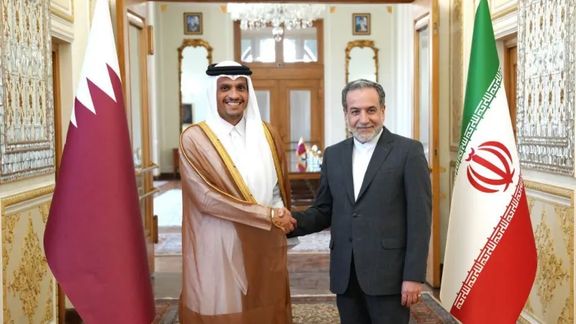
Iran promises Qatar to back any Gaza ceasefire deal agreed by Hamas
Iran will support any ceasefire deal agreed by Hamas, the country’s foreign minister told his Qatari counterpart Monday, as diplomatic efforts to free the hostages and bring an end to the Israeli onslaught on Gaza continue without tangible progress.
The ceasefire talks were halted after Hamas leader Ismail Haniyeh was assassinated in Tehran. Iran vowed to "avenge" his blood but has so far held back, partly because of US pressures and also because it doesn’t want to “jeopardize” ongoing negotiations.
“We will support any agreement that our friends in the Palestinian resistance and Hamas approve”, Iran’s foreign minister Abbas Araghchi told Qatar’s Foreign Minister and Prime Minister Mohammed bin Abdulrahman Al Thani, according to the Iranian Foreign Ministry.
Qatar has been playing a key role in the ceasefire talks and Al Thani has traveled to Tehran to inform the Iranian government of the latest developments and efforts towards a ceasefire deal –led by his country alongside Egypt and the US.
The Qatari prime minister also met Iran’s president Masoud Pezeshkian on Monday, stressing the need to exert diplomatic pressure on Israel and to advance the Palestinian cause. He is the first senior foreign official to visit Iran and meet president Pezeshkian and his top diplomat, Araghchi.
“The two sides affirmed the importance of ending the occupation forces' crimes against Palestinians, the war on the Gaza Strip, and the terrorism practiced by settlers in the West Bank, to spare the region the risks of escalation,” according to a summary of Al Thani’s meeting with Iran’s foreign minister.
Arab countries are most worried that the Iranian-Israeli tensions would lead to an all-out regional war. Iran has so far refrained from its promised retaliatory attack against Israel, while repeating the claim that it has not abandoned the plan to take revenge for the Haniyeh killing.
“Taking revenge for this criminal act, whether by the axis of resistance, or by the Islamic Republic of Iran, is certain,” Major General Mohammad Bagheri said Monday. “Members of the axis of resistance, each based on their capabilities and considerations, will carry out their revenge, some of which we witnessed yesterday,” he added, referring to the attacks on Israel by Hezbollah during the weekend.
Bagheri’s remarks can be read as a sign that Iran could opt out of an attack against Israel from its soil and limit its response to ‘proxy’ operations by Hezbollah and other armed groups in the region. Still, the US is continuing to boost its military presence in the region in anticipation of a major escalation.
On Monday, the Pentagon confirmed that the US thinks the risk of an Iran-led attack against Israel persists. “I would point you to some of the public comments that have been made by Iranian leaders and others,” Pentagon spokesperson Air Force Major General Patrick Ryder told reporters. “We continue to assess that there is a threat of attack.”
Later in the day, White House national security spokesman John Kirby said, "We must assume Iran remains postured and prepared to attack Israel. He described Hezbollah's attack on Israel over the weekend as "sizeable" and said Washington was continuing to maintain a robust force posture in the region.
US Defense Secretary Lloyd Austin has directed two aircraft carrier strike groups to remain in the Middle East, bolstering the US military presence amid Iran-Israel tensions, the Pentagon announced on Sunday.
Nigerian police reported a deadly attack in the capital, Abuja, on Sunday, where two officers were killed and three others left unconscious following an assault by the Islamic Movement of Nigeria (IMN), a Shia group with strong ties to Iran.
The attack, involving machetes, knives, and improvised explosive devices, took place at a police checkpoint and was described as unprovoked by police spokesperson Josephine Adeh.
The attackers, members of the IMN, also set police vehicles on fire during the assault.
Meanwhile, the Islamic movement, in a counter statement alleged that the police attacked the Arbaeen Symbolic Trek in Abuja and killed numerous mourners. Arbaeen is a Shiite religious ceremony invented and financed by Iran's Islamic government, mainly to counter the main Sunni Muslim Hajj pilgrimage to Saudi Arabia.
IMN has a history of violent confrontations with Nigerian authorities and was banned in 2019 after a series of protests demanding the release of its leader, Ibrahim Zakzaky, who has visited Iran and met with Supreme Leader Ali KHamenei.
IMN’s roots trace back to the late 1970s, inspired by Iran’s Islamic Revolution. Despite being outlawed, the group has maintained close relations with Tehran, leading to frequent clashes with Nigeria's secular government. The Nigerian army has previously accused the group of plotting to assassinate a former chief of army staff, which led to a police operation in 2015, resulting in the deaths of over 300 IMN members and the imprisonment of Zakzaky.
Sunday’s attack, condemned by Abuja’s police commissioner Benneth C. Igweh, led to several arrests. Igweh vowed that those responsible would be brought to justice, stating, "The situation is presently under control and normalcy restored."
During his imprisonment, Zakzaky was charged with various crimes, including murder and unlawful assembly, charges to which he pleaded not guilty. He is also accused of receiving ideological and financial support from Iran.
Nigeria’s population of 180 million includes about 50% Muslims, predominantly Sunni, with a small Shia minority, alongside 40% Christians and 10% adherents of indigenous beliefs. The continued activities of IMN, coupled with its connections to Iran, remain a concern for Nigeria’s national security and its relationship with Western allies.
An Iranian journalist who exposed a security flaw in a key government online system has become the target of legal action launched by the Ministry of Roads and Urban Development.
Rather than addressing the serious vulnerabilities exposed in the National Real Estate and Housing System, the Ministry of Roads and Urban Development has opted to file a complaint against the journalist who revealed them. The name of the journalist has not been disclosed to media.
The response underscores the Islamic government’s tendency to punish truth-tellers instead of confronting its own shortcomings.
The incident began when Eghtesad Online, an Iranian news outlet, conducted an investigation into the government's much-touted National Real Estate and Housing System—a platform supposedly designed to bring transparency and accountability to property ownership in Iran.
What they uncovered was not just a glitch, but a security failure: anyone with basic information like a postal code and a national ID could register any property, even that of the Ministry itself, as their own.
To prove the point, the journalist listed the ministry’s headquarters for sale on a popular online marketplace called Divar, turning the issue into a matter of public ridicule and laughter.
Instead of responding with the urgency such a security breach demands, the Iranian government has resorted to its usual playbook of using pressure tactics. The Ministry of Roads and Urban Development’s decision to press charges against the journalist, rather than fix the broken system, is a sign of the system's priorities. This response, according to critics, sends a message to the media and to all Iranians: exposing the truth will not be tolerated, especially when it reveals the government's incompetence.
Over the past few years, the country has suffered a series of cyberattacks that have laid bare the government's inability to safeguard its most sensitive systems. Hacktivists have breached the judiciary's servers, infiltrated the notorious Evin Prison’s surveillance network, and even accessed servers belonging to the Islamic Republic of Iran Broadcasting (IRIB).
Since the 2022 uprising, which shook the foundations of the Islamic Republic, there has been an increase in such activities.
The targeting of a journalist for exposing a security flaw is just the latest example of how the Iranian government prefers to shoot the messenger rather than confront the uncomfortable truths that are increasingly coming to light.
The Iranian parliament's overwhelming vote of confidence in President Masoud Pezeshkian's cabinet ministers on Wednesday is likely to have lasting implications that could reshape part of the country's political landscape.
One significant outcome may be the marginalization of the ultraconservative Paydari Party, whose members had hoped to block at least four of Pezeshkian's ministerial nominees.
The "political purification" process, which began under former President Ebrahim Raisi, was intended to consolidate power within Paydari and other like-minded hardliners, aiming to transform the semi-democratic Islamic Republic into a more fundamentalist, fanatical, and totalitarian state. However, it appears that Supreme Leader Ali Khamenei has opted for a different strategy, steering the government through a carefully engineered political process that began with Pezeshkian's election in a lackluster contest.
Khamenei's 35-year track record as the Islamic Republic's Supreme Leader suggests that he won't completely eliminate Paydari from Iran's volatile political scene. Instead, as he has done with reformists and various ultraconservative and conservative groups, Khamenei is likely to marginalize Paydari and keep it in reserve for a time when he might need the party again. This mirrors his approach with Iran's reformists, whom he sidelined for more than two decades before partially reviving them ahead of the presidential election.
Iranian journalist Sima Parvanehgohar has pointed out that Pezeshkian is the second Iranian Pesident who has had all of his cabinet ministers approved by the parliament. However, she also pointed out that former President Mohammad Khatami’s and Pezeshkian's first cabinets have nothing else in common other than getting their vote of confidence from predominantly conservative parliaments.
Like most other Iranian analysts, she also said that the vote of confidence for all of Pezeshkian's minister by a hardline conservative parliament made it clear that Iran watchers had over-estimated the Paydari Party's power as well as the capability of Pezeshkian's main political rival Saeed Jalili to form a strong opposition at the parliament.
Similarly, the voting outcome highlighted Majles Speaker Mohammad Bagher Ghalibaf's ability to organize and mobilize his supporters, as well as other conservatives in the Majles, to throw their weight behind Pezeshkian.
As political analyst Mostafa Najafi pointed out: "Ghalibaf is one of the few Iranian politicians who understands the rules of the political game in Iran and has the ability to adapt his approach to broader changes. This is how he transformed his major defeat in the presidential election into a significant political victory in the Majles on Wednesday—a victory likely to erase the memory of his previous setback."
Over the past week, Ghalibaf stood firm against Paydari members like Amir Hossein Sabeti, Hamid Rasai, and Malek Shariati, who tried their best to disrupt the discussions and block Pezeshkian's success. According to Parvanehgohar, the lawmakers' votes demonstrated that the Majles overwhelmingly rejected the ideology that Paydari and Jalili have been pushing forward.
Yet another implication of the votes for Pezeshkian's ministers was introducing transparency at the Majles. Pezeshkian revealed how Khamenei intervened in the process of nomination and accreditation of the cabinet ministers. Although the President has been widely criticized for his transparency, and some hardliners called on him to correct his behavior, the President's move could be a welcome first step to share information with the public.
Abbas Araghchi, the newly appointed Iranian Foreign Minister, has declared that the revival of the 2015 JCPOA nuclear deal with the six major world powers is "untenable in its current form."
In a Friday interview, Araghchi stated that rather than merely reviving the deal, "the agreement needs to be reopened" to allow for essential amendments. However, he clarified on Saturday that this does not imply the deal's "death."
However, Iranian experts permitted to speak in Tehran's media offer differing solutions. One expert advocates for comprehensive negotiations between Iran and the United States to resolve all outstanding issues, while another suggests that the West should accept the reality of Iran's uranium enrichment and focus on securing an agreement that prevents the development of nuclear weapons.
In 2015, Iran and major world powers (P5+1) signed the Joint Comprehensive Plan of Action (JCPOA), aiming to curb Iran's nuclear activities in exchange for sanctions relief, with Araghchi playing a key role in the negotiations. In 2018, President Trump unilaterally withdrew from the accord, citing its shortcomings, including its failure to address Iran's missile program.
Efforts to revive the deal in 2021 and 2022 under the Biden administration, which opposed Trump's withdrawal, were unsuccessful. Western countries accused Tehran of rejecting proposals mediated by the European Union.
Araghchi pointed to two significant shifts in the international political landscape—the wars in Ukraine and Gaza—as key factors that have rendered the revival of the JCPOA impossible. He remarked, "The current picture differs from what it was before.”
Since mid-2022, Tehran has provided Russia with weapons, including Shahed drones used in the Ukraine conflict, prompting sanctions from the US, UK, and EU for violating UN Security Council Resolution 2231.
Following Hamas' attack on Israel on October 7, Iran intensified its activities against American and Israeli interests by deploying armed groups it supports across the Middle East. Consequently, in May, the EU broadened its sanctions to include drones, missiles, and Iran's backing of armed groups in the Middle East and the Red Sea region, where Iran-backed Houthi forces have disrupted global shipping since November.
However, a former Iranian diplomat contends that Araghchi's reasons for not reviving the JCPOA are less significant than two other critical factors that complicate any attempt to restore the deal.
“First, Iran's substantial advancements in enrichment technology and related equipment over the past five years may make it challenging, if not undesirable, for Iranian officials to revert to the JCPOA's restrictions. Second, the US may struggle to re-establish the so-called one-year nuclear breakout time, potentially leading to a reluctance to reengage with the JCPOA,” Kourosh Ahmadi, a former Iranian diplomat in United Nations, told Entekhab, a Tehran-based relatively independent outlet.
In July, US Secretary of State Antony Blinken remarked that Iran's nuclear breakout time—the period required to produce sufficient amount of 90% enriched uranium for a bomb—has likely been reduced to "one or two weeks."
Earlier this year, Rafael Grossi, the head of the UN's nuclear watchdog, warned that Iran could be capable of producing a nuclear weapon within weeks rather than months. Meanwhile, under the terms of the JCPOA, uranium enrichment was strictly limited to a cap of 3.67 percent.
In the interview, Ahmadi reiterated his longstanding belief that a broader, more holistic approach would best serve Iran's interests. However, in this latest discussion, he conceded that Iran may not be ready for such an expansive strategy, suggesting that the most practical step would be to rewrite the JCPOA.
Ahmadi’s holistic approach involves negotiating with the US on various issues rather than focusing solely on the nuclear file. He argued that the JCPOA was a "single-issue" agreement centered on nuclear concerns, while sanctions related to terrorism and human rights violations remain in place.
In a bold statement during a July interview, Ahmadi had gone even so far as to describe Donald Trump as a "practical" man, suggesting that Iran could have potentially struck a deal with him.
"Putting aside Trump's shortcomings, we must focus on what our national interests demand. Those interests may require us to engage in dialogue, even with adversaries. After all, even North Korea sat down to negotiate with Trump,” Ahmadi said.
Another foreign policy expert in Tehran, Abdolreza Farajirad, told the semi-official ILNA website that it would be unacceptable for the Islamic Republic to give up 60% enrichment and return to the 3.67% JCPOA limit. Therefore, the West should drop the issue of enrichment in its quest to reach an agreement with Iran. Instead, the emphasis should be a ban on developing nuclear weapons.
Farajirad also acknowledged that Iran's regional activities are a matter that must be addressed. However, his proposal for a ban on nuclear weapons overlooks the fact that if Iran is allowed to maintain a breakout time of just a few weeks, there is no guarantee it won't catch the world off guard in the future.
Iran congratulated the “government and people of Ukraine” on their Independence Day. Some have interpreted this as a response to Russia’s recent shift of policy about the Zangezur transport corridor.
The congratulatory message was postedby the official account of the Islamic Republic’s foreign ministry on X Saturday. Although not unprecedented, the message this year has angered pro-Russia ultra-hardliners in Iran. They accuse the ministry of “humiliating” the country and interpret the move as “self-abasing signals to the West”.
Similar congratulatory messages were sent to Ukraine in 2021 and 2022, but none was extended in 2023. Relations between Tehran and Kyiv have deteriorated significantly since the Revolutionary Guard (IRGC) shot down a Ukrainian airliner in January 2020, killing all 176 people on board. The situation has further worsened due to Tehran's provision of hundreds of Shahed suicide drones to Moscow over the past two years, which have been extensively used to target civilian infrastructure and urban centers in Ukraine.
Pro-Russia ultra-hardliners who are already critical of the newly appointed foreign minister, Abbas Araghchi, and accuse him of following a “diplomacy of indignity” as opposed to his predecessor’s “dignified diplomacy”, have strongly criticized what appears to be an overture to Ukraine on social media.
“Araghchi has revived the diplomacy of humiliation right away!! The congratulatory message on the Independence Day of Ukraine, despite this country’s hostility to Iran and when it is at war with the Russians on behalf of the West, has an important message to the West and Russia!!,” an angry ultra-hardliner took to X to complain.
Baku has been demanding a corridor southern Armenia to connect Azerbaijan’s proper with its Nakhchivan enclave separated by Armenian territor. Moscow and Baku want Russia to monitor and control the corridor, but Yerevan and Tehran are opposed to such a scheme, and argue that even if a transport route were to be established, Armenia should have control over it.
“Observance of Russia’s current behavior indicates that Moscow is probably anticipating some kind of control over Zangezur corridor and reviving its influence in the Caucasus which albeit will not be an easy task,” moderate conservative Entekhab news website which called it “Putin’s green light for geopolitical suffocation of Iran”.
Entekhab suggested that the Islamic Republic not delay launching diplomatic efforts to avoid the loss of its current “geopolitical advantage” threatened by the establishment of the transport corridor.
Iran has always opposed the establishment of the transport corridor which will eliminate Iran's direct access to Armenia, if the corridor is not controlled by Yerevan. In a meeting with Armenian PM Nikol Pashinyan on July 30, Supreme Leader Ali Khamenei reiterated Iran's opposition to Zangezur corridor which he said the Islamic Republic considers it “detrimental” to Armenia’s interests.
It is not clear if the congratulatory message to Ukraine was because of a rift between Tehran and Moscow, or simply an attempt to somewhat improve Islamic Republic's image under a new president.
In December 2023, Moscow also repeated its support for negotiations between Iran and the UAE over the three disputed Islands of Abu Musa, the Greater Tunb, and the Lesser Tunb in the Strait of Hormuz, infuriating the Islamic Republic. Tehran summoned the Russian envoy after Moscow signed a joint statement with Arab nations calling for negotiations.
Russia’s long delay in signing a 20-year comprehensive cooperation agreement with Iran despite the aid Iran has offered to Russia in its war against Ukraine has also irritated the Islamic Republic.