Iranian MP confirms missile shipments to Russia, downplays impact
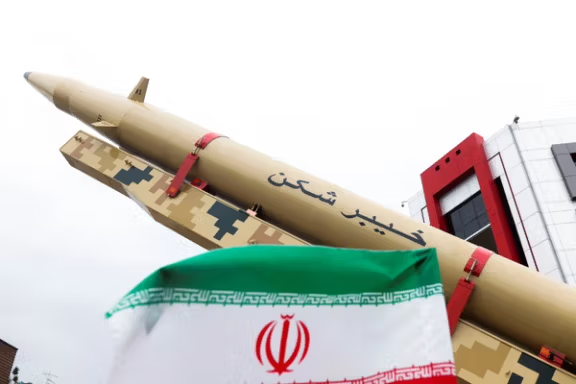
An Iranian Kheybar Shekan solid-fuel medium-range ballistic missile
An Iranian lawmaker has confirmed media reports about Tehran's delivery of ballistic missiles to Russia, but downplayed threats from Ukraine and its Western allies to impose "heavy" costs on Iran.
Ahmad Bakhshayesh Ardestani, a member of the Parliament's National Security and Foreign Policy Committee, acknowledged Iran’s military assistance to Russia amid the ongoing war in Ukraine, less than 24 hours after Iran's UN mission denied a report by The Wall Street Journal about the delivery of short-range ballistic missiles to Russia.
"We have to barter for our needs, including importing soybeans and wheat. Part of the barter involves sending missiles, and another part involves sending military drones to Russia," Ardestani told Didban Iran on Saturday.
When asked whether sending ballistic missiles to Russia might lead to further sanctions or trigger the so-called "snapback" mechanism against Iran, the lawmaker replied, "It can't get any worse than it already is. We give missiles to Hezbollah, Hamas, and Hashd al-Shaabi, so why not to Russia?"
"We sell weapons and receive dollars. We circumvent sanctions through our partnership with Russia. We import soybeans, corn, and other goods from Russia. Europeans sell arms to Ukraine. NATO has entered Ukraine, so why shouldn’t we support our ally by sending missiles and drones to Russia?" Ardestani said.
Later on Sunday, Nasser Kanaani, spokesperson for Iran's Foreign Ministry, addressed the reports of ballistic missile shipments to Russia, stating, "The Islamic Republic has never been part of the Russia-Ukraine conflict." He further added, "Military cooperation between the Islamic Republic and Russia dates back well before the start of the Ukraine war." In effect, Kanaani did not specifically deny the report but repeated Iran's standard response that can be interpreted as a denial.
The Biden administration has informed its allies that Iran delivered short-range ballistic missiles to Russia, providing Moscow with a significant new military tool amid its ongoing war against Ukraine, a Friday report by the Wall Street Journal said citing US and European officials.
"The missiles have finally been delivered," a US official said. The shipment reportedly includes several hundred short-range ballistic missiles, capable of reaching up to 500 miles. These missiles could help bolster Russia’s intensified missile attacks on Ukrainian cities and infrastructure, which have recently led to the deaths of dozens of civilians.
"We have been warning of the deepening security partnership between Russia and Iran since the outset of Russia's full-scale invasion of Ukraine and are alarmed by these reports," said White House National Security Council spokesperson Sean Savett. "Any transfer of Iranian ballistic missiles to Russia would represent a dramatic escalation in Iran's support for Russia's war of aggression against Ukraine."
Ardestani’s comments come amid repeated official denials from Iran regarding the shipment of missiles, drones, and other military equipment to Russia.
Just hours after the Wall Street Journal’s report was published, Iran’s United Nations delegation issued a statement denying any missile or weapon transfers to Russia. The statement asserted, "The Islamic Republic has not provided weapons to any party involved in the conflict in Ukraine and has urged other countries to stop doing so."
In reaction to the reported military shipments, European countries are considering banning Iran’s national airline, Iran Air, from flying to European airports. The new sanctions package is expected to target companies and individuals involved in the missile transfers, including transportation companies linked to these operations.
"If civilians in Ukraine die from these missiles (Tehran delivered to Russia), then Iran will pay a double price for that. The response will be severe," a Ukrainian defense source told The Times, but did not elaborate on the nature of that response.
Russia's access to Iranian ballistic missiles could devastate civilian populations, markinga turning point in the conflict, Farzin Nadimi, a Senior Fellow with the Washington Institute, told Iran International.
He said some of these missiles will have enough range to hit Western Ukraine and strike important targets like railway stations. "It's going to have a really bad effect on civilians."
Nurses and healthcare workers in multiple cities across central Iran, including Isfahan, Qom, and Kashan, held protests on Saturday demanding better wages and improved working conditions.
The demonstrations, sparked by ongoing frustrations over insufficient pay and forced overtime, took place despite heightened security pressures and the recent crackdown on the movement's leaders.
Protesters in Isfahan gathered before the provincial governor’s office, chanting against inadequate overtime compensation, which amounts to only 0.33 cents per hour.
In Qom, nurses rallied with slogans demanding justice and the recognition of their rights, while in Kashan, demonstrators gathered at Beheshti Hospital protesting mandatory overtime and what they described as a lack of justice following their efforts during the COVID-19 pandemic.
Additionally in Kashan, a group of nurses and healthcare workers held a protest rally at Naghavi Hospital, where they chanted slogans such as "We don’t want incompetent officials."
These protests were organized following a call from a coordinating council, which emphasized that nurses’ demands would only be addressed through public demonstrations. The council urged nurses to gather in front of government buildings in various cities, calling for eliminating mandatory overtime and adjusting overtime pay.
Iran’s new Health Minister Mohammad Reza Zafarghandi recently admitted that the government owes nurses a staggering 75 trillion rials (approximately $117 million) in unpaid wages but offered only vague assurances that the payments would be made “as soon as possible.” That amount is a huge sum in Iran where nurses earn just $200 a month.
The Coordinating Council of Nurses' Protests, in its call to action, criticized officials for neglecting the demands of nurses, stating that instead of addressing their grievances, authorities have only made delayed payments in a piecemeal manner, often with tax deductions and meager amounts in select cities and centers.
According to the Coordinating Council of Nurses' Protests, even contract workers were excluded from the already meager back payments, and "humiliating and unequal" compensation practices have only fueled further anger among nurses.
ILNA news agency reported on Wednesday that small amounts of money had been deposited into the accounts of some nurses, but these were far from adequate. According to one nurse quoted by ILNA, she received 1.6 million tomans (around $26), which she described as an attempt to "calm down" the workforce.
The recent wave of protests is part of a broader movement that began in early August, after the death of a young nurse, Parvaneh Mandani, which further fueled anger over working conditions. Nurses in over 40 cities and 70 hospitals have participated in strikes and protests since then, marking one of the largest demonstrations by healthcare workers in recent Iranian history.
As the protests gained momentum, Iranian authorities ramped up their crackdown on these nationwide demonstrations, resulting in multiple arrests of nurses and healthcare workers.
Moreoever, nursing organizations have expressed concern about the increasing migration of nurses from Iran, with around 200 nurses leaving the country each month, according to Mohammad Sharifi-Moqaddam, Secretary-General of the House of Nurses. The economic pressures and demanding working conditions are leading to what Sharifi-Moqaddam described as an exodus of healthcare workers from the country's hospitals.
Currently, Iran has an average of 1.5 nurses per 1,000 people, significantly below the global average of three nurses per 1,000. Many healthcare workers have reported burnout, and the country’s healthcare system is facing growing challenges as fewer people are entering the nursing profession.
Hossein Salami, Commander-in-Chief of Iran’s Islamic Revolutionary Guard Corps (IRGC), claimed responsibility for a series of attacks on 12 ships in the past that he called “Israeli”.
His statement, made during a visit by President Masoud Pezeshkian to the IRGC’s Khatam al-Anbia Construction Headquarters, came in the wake of weeks of tensions following the killing of Hamas's political chief, Ismail Haniyeh, in Tehran.
Salami justified the attacks by claiming they were in retaliation for strikes on 14 Iranian oil tankers in the Red Sea and the Mediterranean—accusations he placed on Israel, albeit with no evidence.
Since 2019, the IRGC has attacked or boarded numerous commercial vessels in the Persian Gulf region, often claiming that they were Israeli ships.
Salami’s remarks, laden with Tehran's usual conspiratorial tone, stated that Israel's attacks were designed to stymie Iran’s oil exports. However, what Salami left out is that when he refers to “Israeli ships,” these were commercial vessels, not military targets, perhaps partially owned by individuals of Israeli descent. This kind of rhetoric usually accompanies Tehran’s attempts to defend and justify its behavior on the international stage.
Israeli officials have so far remained silent on these claims. Salami’s statements follow a pattern of Iran seizing foreign vessels under dubious pretenses. This includes the seizure of oil tankers, such as the British-flagged Stena Impero in 2019 and, most recently, the Marshall Islands-flagged St. Nikolas in the Gulf of Oman.
Iran’s approach to maritime security seems to hinge on hostage diplomacy. The 2019 seizure of the Grace 1 by British authorities, on suspicion of breaching sanctions by transporting oil to Syria, was met with a retaliatory move by the IRGC, which seized the Stena Impero.
In January, Tehran seized the Marshall Islands-flagged oil tanker St. Nikolas and also expanded its maritime provocations, attacking the M/V Pacific Gold tanker, registered in Liberia with a drone in the Indian Ocean.
A photo, purportedly showing the seizure of MSC Aries,belonging to London-based Zodiac Maritime shipping company, owned by Israeli billionaire Eyal Ofer.
IRGC’s chief commander attempted to justify such actions by referencing sanctions, military threats, or even former US President Donald Trump, whom Salami described as being "no less of a threat than COVID-19."
Iranian officials appear to be concerned about Trump's possible return to the presidency, expecting a tougher policy by Washington than what has transpired during the Biden administration.
Vice Adm. Brad Cooper of the US 5th Fleet earlier made it clear that Iran’s actions “violate international law and pose a threat to maritime security and stability.” Yet, despite these warnings, Tehran seems determined to continue its behavior, using the high seas as yet another battlefield in its ongoing quest for regional dominance.
Majid Eshghi, head of Iran’s Securities and Exchange Organization, has officially stepped down following the public outcry over the revelation of billion-rial loans granted to him and several board members at low interest rates.
The resignation came after Shargh daily, a pro-reform newspaper in Tehran, exposed the personal loans, totaling 105 billion rials ($175,000), sparking widespread outrage.
These officials, appointed during President Ebrahim Raisi’s tenure, approved the loans in the final days of his government, bypassing orders from acting president Mohammad Mokhber and president-elect Masoud Pezeshkian. Experts warn that this move undermines investor confidence and further destabilizes Iran’s struggling capital market.
Eshghi personally received the largest share of the loans—27 billion rials ($45,000)—with a lenient 4% interest rate and a 10-year repayment plan. To put this into perspective, an ordinary Iranian worker earns just $200 a month, highlighting the extreme disparity in access to financial resources.
Iran’s exchange market headquarters in Tehran
The loans, initially justified by Eshghi as being "in accordance with laws and regulations" approved by the Supreme Council of the Stock Exchange, have been met with skepticism. Eshghi defended the decision, stating, “The claim that the board of directors approved loans for themselves is a big lie." He argued that the council is responsible for determining board salaries and benefits, and the loan amounts were based on official resolutions.
Despite these defenses, critics were not convinced. The scandal has been dubbed the "Eshghi Loan" and sparked backlash across political lines. Conservative political activist Mohammad Mohajeri called out the government’s audacity, stating, “Not only astronomical loans, but also astronomical audacity; this is what corruption did to the Raisi administration!"
Alireza Salimi, a member of the Iranian Parliament, responded on the social network X, writing: "I once mentioned in parliament that Mr. Eshghi is running the stock exchange based on personal whims. He sent a legion of reporters to attack me to whitewash his performance."
Salimi added, "Now it turns out Eshqi has indeed been taking billions in low-interest loans for himself."
One user on X shared a photo of the Tehran Stock Exchange board and commented: "They ask why the stock market is always in the red. Well, maybe if they gave fewer of these loans to board members, the market might turn a bit green."
The incident has further fueled criticism of Iran's broader financial system, which is already under fire for granting exorbitant loans to bank employees and subsidiaries. A recent report by Iran’s Central Bank revealed that in 2023 alone, major banks funneled over 9,100 trillion rials ($1.5 billion) to their own employees and executives, while ordinary citizens struggle to secure basic loans for housing, marriage, or small businesses.
Iran’s Securities and Exchange Organization in Tehran
As Iran’s economy crumbles under the weight of corruption, mismanagement and sanctions, the elite continue to enrich themselves, leaving ordinary citizens to bear the burden of inflation, poverty, and unemployment. According to observers, Eshghi’s resignation, while symbolic, may do little to restore public trust in a system marred by “kleptocracy”.
This is not the first instance of Iranian officials abusing their positions or embezzling public funds. In many cases, there has been no follow-up or report on whether they were made to return their illicit gains. Similarly, in this latest case, despite widespread criticism, there has been no discussion of requiring them to repay the loan if it was unlawfully allocated.
A tweet from a young Iranian woman sharing images of her designer birthday gifts during a family trip to Switzerland has sparked backlash against the country's rich elite amid a dire economic depression.
A comment on the images went viral, garnering 40 million views, and quickly became an excuse for thousands of Iranians living under the country's darkest economic times to share childhood photos, pairing them with dark humor in a bid to mock the original tweet.
“Stop it you Iranians, a trip [to Europe] is nothing so special. Everyone’s been at least once to Europe as a child,” the comment protested to someone who quoted the original tweetand sarcastically said that only rich people should have children, not those who can’t even afford to buy an ice cream for their kids, a reflection of the challenges facing families in Iran.
The viral comment has been viewed nearly forty million times since August 28 and broken the record of views of any most-viewed Persian language tweet by at least 30 million more views. The original tweet’s views were under 750,000 during the same time.
“The number of this tweet’s views surpassed the total of [Masoud] Pezeshkian and [Saeed] Jalili’s votes [in the presidential elections,” a netizen posted on X.
Caption: A trip to Langjökull glacier in Iceland, one of the largest and most beautiful natural glaciers of Europe
Over 70 percent of Iranians have never traveled abroad according to Ali Mohammadzadeh who was involved in a survey by Iran's Ministry of Culture and Islamic Guidance in 2023.
Caption: Europe is a joke! On a spaceship minutes before travelling to Mars.
In response to those who accused her of “showing off”, Saba, the original tweet's author, explained that she has lived in Germany since childhood and had not meant to show off.
Most of the childhood photos other Twitterati posted showed them as children of very ordinary families in Iran in the 1980s and 90s during imaginary trips abroad.
Caption: Modeling for Gucci in Madagascar with three friends I met during my European trip
Some Iranian journalists also joined in the rich bashing. “1989, Utrecht, Netherlands. If I look angry it’s because of hearing the news of the mess [Mikhail] Gorbachev had made,” Iranian journalist and blogger Foad Shams captioned the photo that showed him as a frowning little boy in a valley of yellow flowers in Iran.
“Racing, Britain’s Grand National, Liverpool, 1975,” expatriate Iranian journalist Mehrdad Farahmand’s caption to the photoof a barefoot little boy on a donkey read.
Caption: Me and my French playmates in a village in Normandy, late 1980s.
Many netizens commented that the genre of hilarious childhood photos on Twitter showed the resilience of Iranians who display such a sense of humor despite the difficulties that they experience in life while others said the tweets evoked a sense of togetherness and nostalgia besides being fun.
A recent report revealed that almost one in every three Iranians is currently living below the poverty line as a result of extreme inflation in the past five years.
Another study by the Parliament Research Center found that families in Iran are struggling as the country's minimum wage fails to meet the poverty line. The report, which analyzed poverty trends from March 2022 to March 2023, has underscored a disparity between the minimum wage and the poverty threshold in Iran's provinces.
Incomes are inadequate to cover the living expenses for a family of three the study said.
Twelve Afghan nationals were arrested on Friday in southwestern Iran, accused of attempting to "abduct several children and teenagers," according to a statement from Iran's Revolutionary Guard Corps (IRGC).
The arrests were conducted by local security forces in collaboration with IRGC during a "surprise operation" also involving the intelligence ministry as reported by the IRGC-affiliated Tasnim News Agency. Following their detention, the suspects, allegedly armed with knives, were handed over to judicial authorities for further legal proceedings.
The IRGC’s history of using trumped-up charges to detain vulnerable populations raises concerns about the legitimacy of these arrests and the broader human rights implications on marginalized Afghan communities.
The arrests come against the backdrop of Iran's intensified efforts to reduce its burgeoning Afghan immigrant population. The Iranian Parliament recently proposed a plan to decrease the number of foreign nationals by 10 percent annually. Although the legislation does not specify any particular nationality, it is widely interpreted as targeting Afghan migrants, who constitute a significant portion of Iran's foreign population. According to a report by state-affiliated ISNA, the proposed policy includes stringent limitations on residence and employment for foreign nationals, with the Ministry of Interior tasked with ensuring compliance and overseeing the population reduction.
Since the Taliban's takeover of Afghanistan in 2021, millions of Afghans have flooded into Iran, exacerbating the country’s own economic crisis and straining its already inadequate education, healthcare, and housing systems. The Afghan population has reportedly surged from 2.5 million to as high as 10 million in just three years. This influx has sparked public anger, with accusations that the Iranian government allows this migration to advance its own agenda, possibly recruiting Afghan fighters, a tactic Tehran has previously employed in Syria for military purposes.
Additionally, these actions reinforce the IRGC’s influence within the Iranian government and its ability to enforce stringent policies under the leadership of the new President Masoud Pezeshkian who during his presidential candidacy campaign in June had promised to seal the borders with Afghanistan to prevent the influx of migrants into Iran.
Recently, there have been reports of mass arbitrary arrests of Afghan nationals, with many Afghan migrants reporting harassment, even when they possess legal residency documents.
Amnesty International has previously raised alarm about Afghan nationals being “routinely arbitrarily detained” in Iran and “subjected to torture and other ill-treatment.”
Last month, the rights organization Hengaw issued a warning about the escalating government and societal racism toward Afghan migrants in Iran, describing the situation as "catastrophic."
Given the current political climate in Iran, where Afghan migrants face increasing scrutiny and the government seeks to reduce their presence, the IRGC’s involvement may reflect its intent to justify its actions and strengthen public support by framing these operations as necessary for protecting social stability—whether the threats are real or fabricated.