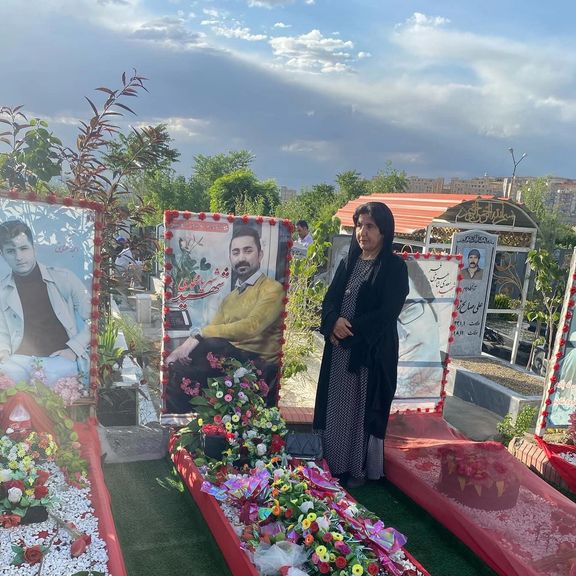
Mina Soltani at her son Shahryar Mohammadi's burying place
Iran’s security forces on Wednesday arrested Mina Soltani, the mother of Shahryar Mohammadi, a protester killed during the 2022 protests in Bukan, West Azarbaijan province.
Soltan's arrest is part of a broader crackdown on activists and victims' families just days before the anniversary of Mahsa Amini’s death, which ignited the Women, Life, Freedom uprising.
It is not clear whether she is being held in intelligence detention at Urmia or Urmia prison according to her family, sparking further concerns for her safety.
"Yesterday, a relative received a call from an unknown number. A man was on the line, then handed the phone to my mother, Mina. My mother was only able to say one sentence that she is being held in Urmia," Soltani’s daughter Asrin Mohammadi told Iran International.
Shahryar Mohammadi was shot by Iran’s security forces in Bukan on November 18, 2022. He later died from his injuries after being transferred to a local hospital. His family including his mother, Mina Soltani, his sister Asrin Mohammadi, and brother Milad Mohammadi have since become outspoken advocates for justice and have faced continuous pressure from the Iranian authorities.
This is not the first time the Mohammadi family has been targeted by security forces. Last year, on November 15, just a few days before the anniversary of Shahryar’s death, his sister, Asrin Mohammadi, was arrested during a raid. Speaking to Iran International from an undisclosed location for her safety, Asrin described the experience as violent, stating:
"Just days before the anniversary, they [security forces] savagely stormed in. Right in front of my mother’s eyes, they beat me, they beat my mother, and then they dragged me away by force."
Asrin recalled the threats her family faced when her brother Shahryar was killed.
"On November 18, 2022, Shahryar was surrounded inside a car by military vehicles, and they opened fire on him. Milad [Asrin and Shahryar’s brother], while holding Shahryar’s lifeless body in his arms and refusing to let them take him away, had a gun pressed to his legs, and they shot him twice. Even then, Milad didn’t let go of Shahryar. This time, they injected Milad with four sedatives. They then threatened my mother, saying, 'If you don’t cooperate and let us bury him now, we will take Milad, kill him, and bury Shahryar in a place where you’ll never know.' They forced the mother to go with them. Milad, after months of living in parks and streets with infected and injured legs, was eventually forced to flee Iran. Now, this year, they have arrested my mother - a woman whose one child was killed, one injured and displaced, and another arrested,” Asrin Mohammadi said.
Soltani’s arrest is part of a broader crackdown by the Iranian authorities on victims’ families as the country approaches the second anniversary of the Woman, Life, Freedom uprising, security forces attempt to stifle any potential unrest.
Last week, Iran's security forces arrested 16-year-old Ramyar Abubakri, brother of 21-year-old Zanyar Abubakri, who was fatally shot by state security forces on October 27, 2022, in Mahabad, Kurdistan. At the same time, security forces also raided the home of Siavash Soltani, son of 52-year-old Kobra Sheikhe-Saqqa, another victim killed by state forces on the same day in Mahabad.
UN’s Independent International Fact-Finding Mission on Iran (FFMI) on Friday reported that between July and September 20224, “arrests and detention of family members of protesters killed in the context of the movement also intensified.”
“These arrests appear to be part of a broader State effort to stifle any potential form of dissent and to harass, intimidate and prevent victims, families and others expressing solidarity, from marking the second anniversary of the protests and the ‘Woman, Life, Freedom’ movement,” the FFMI said.
The Islamic Republic has faced international condemnation for its handling of the protests and its treatment of detainees, with human rights groups expressing concern over the safety of slain protestors' families. The situation remains tense as the uprising anniversary draws near, with the possibility of further unrest and government crackdowns.
Just a day before the fourth anniversary of the execution of champion Greco-Roman wrestler Navid Afkari, the Islamic Republic reportedly hanged a second decorated Greco-Roman wrestler, Morteza Yousefi, on Wednesday.
Iran’s government executed Yousefi in Nowshahr Central Prison after he was sentenced to death on drug-related charges, according to the Norway-based Kurdish human rights NGO Hengaw.
According to Hengaw, Yousefi, who was executed in the northern Mazandaran Province, graduated with a bachelor’s degree in physical education and worked as a Greco-Roman wrestling coach. Greco-Roman is a type of Olympic wrestling that involves upper body grappling, barring lower body attacks.
Hengaw wrote that “Hassan Rangraz, the head coach of the Iranian national Greco-Roman wrestling team, shared a picture of a letter from Morteza Yousefi addressed to the judiciary the night before the execution, urging the head of the judiciary to overturn the death sentence and reduce his punishment."
The explosion of executions for drug-related offenses in Iran prompted, in April, eighty-two Iranian and international human rights groups to demand that the UN agency on drugs and crime suspend its cooperation with Tehran until it ends the use of the death penalty for narcotics-related crimes.
In the early morning hours of September 12, 2020, authorities hastily hanged the innocent wrestler, Navid Afkari. In January 2021, Iran’s government also executed wrestler Mehdi Ali-Hosseini, who had been charged with pre-meditated murder, allegedly committed during a group brawl.
A global campaign among elite wrestlers sought to stop the execution of Afkari who was arrested in 2018 for participating in a protest in Shiraz against the Islamic Republic’s political and economic corruption. According to a widely discredited account by Iran’s judiciary, Afkari killed Hassan Torkman, a water company security employee and Basij member, who tracked demonstrators at the 2018 protest in Shiraz. Afkari declared before his execution: “There is not one shred of evidence … they are looking for a neck for their rope.”
The Human Rights Activists News Agency (HRANA) said at the time that the authorities imposed sustained torture on Navid and his brother, Vahid, to secure phony confessions. Vahid is still incarcerated in Iran. The one organization that was positioned to save Navid’s life and secure the release of Vahid (a third brother, Hamid, was freed in 2022) was the International Olympic Committee (IOC). Yet the IOC and the United World Wrestling (UWW) organization failed to exert their significant leverage on then-President Hassan Rouhani to secure a stay of execution, according to sports experts.
“The IOC has clearly failed to uphold their duty of care for athletes. Navid was brutally executed for peacefully protesting. Athletes around the world called on the IOC to stand up against the Iranian Regime to protect Navid but they refused to,“ Rob Koehler, the Director General of Global Athlete, told Iran International. Global Athlete is an organization fighting to advance the human rights of athletes across the globe.
“With the death of Navid, the IOC had an opportunity to send a strong message by banning Iran from the Olympics - that did not happen as they always favor protecting authoritarian regimes over basic fundamental athlete and human rights," Koehler added.
Numerous Iran International press queries to the IOC and UWW were not answered.
Alireza Nader, an Iran expert, told Iran International on Afkari’s case, “The Islamic Republic should be suspended from all international sporting events until justice for the Afkari brothers is served and regime officials responsible for these crimes are brought to justice.”
Iranian-American lawyer Elika Eftekhari, who specializes in international sanctions, primarily drafted proposed US congressional legislation named the “Toomaj Act” after the incarcerated Iranian rapper Toomaj Salehi to punish Iran’s government. The bill was introduced into the House in late May and aims “to impose sanctions on the judges, prosecutors and investigators of the Islamic Republic of Iran’s Revolutionary Courts.” According to the legislation, “Examples of victims of the Islamic Revolutionary Courts are plentiful.
Eftekhari told Iran International, “The Iranian people’s vigilant demands of justice for Navid and Vahid continue unabated, as can be seen by the fierce social support for the comments of their brother, Saeed Afkari following the death of President Raisi, in which Saeed confirmed their mother’s happiness at the news.”
She added, “In terms of accountability, first, there are sanctions, which should be put on all judges, prosecutors and investigators of the Islamic Revolutionary Courts, as the TOOMAJ Act calls for in the United States. But more importantly even, targeted sanctions policies of Western governments should change to include all immediate family members, to whom assets can be transferred, and can travel freely while their spouses and fathers execute innocent Iranians with false charges derived from torture.”
Eftekhari said, “As for accountability, the IOC and UWW should raise more awareness and demonstrate their support for Navid and Vahid. This can take the form of official statements, awards and ceremonies named in honor of the brothers, observing a minute of silence for Navid, joining other organizations in calling for the release of Vahid, and refusing to award medals to Islamic Republic teams. This latter option provides an opportunity to both shame the regime, and make it face audiences disturbed by their human rights crimes. One thing we know for certain about the Islamic Republic is that it hates to be shamed or embarrassed in international forums.”
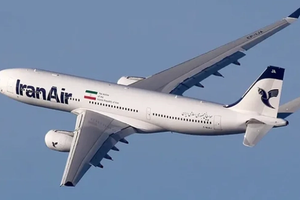
The European Union is weighing sanctions on Iran's aviation sector in response to Tehran's supply of ballistic missiles to Russia for use in the conflict in Ukraine.
EU foreign policy chief Josep Borrell underscored the bloc's resolute position on the issue, stating, "The European Union has repeatedly strongly cautioned Iran against transfers of ballistic missiles to Russia." He further mentioned that the EU would "respond swiftly and in coordination with international partners."
Borrell suggested that the EU’s response would likely include substantial new sanctions aimed at individuals and entities connected to Iran's ballistic missile and drone programs. This action comes on the heels of similar sanctions imposed earlier this week by France, Germany, and the UK.
The escalation follows US Secretary of State Antony Blinken's claim that Russia has received ballistic missiles from Iran, which could be deployed in Ukraine within weeks. In response, Iran denied these allegations and summoned the envoys of Britain, France, Germany, and the Netherlands, heightening the diplomatic standoff.
Iran's Foreign Minister Abbas Araghchi reiterated Tehran's denial, stating on social media, "Once again, US and E3 act on faulty intelligence and flawed logic - Iran has NOT delivered ballistic missiles to Russia. Period - Sanction addicts should ask themselves: how is Iran able to make & supposedly sell sophisticated arms? Sanctions are NOT a solution, but part of the problem."
The situation reflects broader geopolitical tensions, with Iran, North Korea, and Russia increasingly coordinating in support of Moscow's war in Ukraine, according to British Foreign Secretary David Lammy. He noted this emerging "entente" on Wednesday, following the announcement of new Western sanctions against Iran.
This alliance is seen as part of a larger "axis of upheaval" that includes Russia, China, Iran, and North Korea, which the chief of Britain’s army warned in July could necessitate readiness for confrontation within the next three years.
Adding to the tensions, Reuters reported on Friday that Russia started manufacturing a new long-range attack drone last year using Chinese engines and components, which has already been deployed in the Ukraine conflict. According to sources from a European intelligence agency and documents reviewed by Reuters, this development underscores Russia’s continued efforts to bolster its military capabilities.
Meanwhile, Russia's FSB security service announced on Friday that it had revoked the accreditation of six British diplomats in Moscow, accusing them of espionage and sabotage, a move reflecting the Kremlin’s frustration with what it perceives as London’s significant role in supporting Ukraine.
These developments highlight the growing alignment between Iran, Russia, and North Korea against Western interests. Iran's potential pursuit of nuclear capabilities and Russia's aggressive military actions in Ukraine further exacerbate security threats on the global stage.
US federal authorities are moving to charge individuals allegedly connected to the Iranian government for a hack-and-leak operation against Donald Trump’s presidential campaign, the Washington Post reports.
Citing sources familiar with the matter, the news outlet reportedthat the charges could come in a matter of days.
The Washington Post reports that the FBI investigation has focused on an online persona known as "Robert," suspected of acting on behalf of the Iranian government. This “individual” is accused of distributing stolen data from Trump advisers' email accounts to news organizations.
Last month, the FBI and US intelligence agencies confirmed that Iran was responsible for recent attempted hacks into the Trump and Biden-Harris presidential campaigns.
According to AP, which is also reporting the impending criminal charges by the Justice Department, the aim of the hack was to influence or interfere with the outcome of the November presidential election.
On Tuesday, Assistant Attorney General Matthew Olsen, the Justice Department’s top national security official, told reports on Thursday in New York City that Iran “is making a greater effort to influence this year’s election than it has in prior election cycles and that Iranian activity is growing increasingly aggressive as this election nears.”
Last month, the head of DisinfoWatchtold Iran International that as Iran appears to have stepped up its targeting of both presidential campaigns, there also seems to be coordination between Tehran and Moscow's information operations.
“The US and all western democracies need to be paying close attention and exposing them. The combined information and influence operations of Iran, Russia and China represent a serious threat to all western democracies - which we cannot afford to ignore,” Marcus Kolga said.
Trump’s campaign shared last month that it had been hacked and alleged that Iranian actors had stolen and distributed sensitive internal documents.
In August, Meta reported potential hacking attempts on the WhatsApp accounts of US officials by Iranian actors amidst growing concerns over Tehran’s interference in US elections. These officials were associated with both President Joe Biden and former President Donald Trump. The company attributed these attempts to APT42, an Iranian hacker group widely believed to be linked to an intelligence division within Iran's military. This group has a history of conducting invasive surveillance operations, often targeting political figures and activists abroad.
In relation to the latest hack-and-leak attack, Politico, The New York Times, and The Washington Post were reportedly given access to confidential material from inside the Trump campaign, with Politico reporting that that it began receiving emails on July 22 from an anonymous account.
The AOL email account, identified as "Robert," sent what looked like a research dossier that appeared to have been compiled by the campaign on Ohio Senator JD Vance, who became the Republican vice-presidential nominee. The document, dated February 23, was created almost five months before Trump announced Vance as his running mate.
So far, the AP reports, each outlet has refused to reveal any details about what it received.
Three border guards were killed in an attack in southeastern Iran on Thursday, an assault claimed by the Sunni Islamist militant group Jaish al-Adl, according to Iran's state news agency.
The attack took place in Mirjaveh, a city in Sistan-Baluchestan province near the Pakistani border.
According to IRNA, gunmen in a car opened fire on a border regiment vehicle, killing two soldiers and an officer. A civilian was also wounded in the attack.
This incident is part of a broader pattern of violence in Sistan-Baluchestan, a province that has witnessed numerous attacks attributed to Jaish al-Adl.
Earlier this year, Iran launched missiles at targets in Pakistan claiming to have retaliated against Jaish al-Adl. Pakistan, resenting the violation of its territory, conducted airstrikes in Iran against alleged bases of its own Baluch insurgents. These cross-border operations heightened tensions between the two countries, even as they insisted that their primary targets were Baluch separatist factions.
Jaish al-Adl has a history of conducting ambushes, bombings, and other violent operations, leading to the deaths of both civilians and security personnel. In April, at least 22 Iranian policemen were killed in two separate clashes in the province.
The militant group has been designated a terrorist organization by both Iran and the United States, along with several international bodies.
The group has been involved in a series of cross-border attacks, including the abduction of border guards and security personnel, as well as bombings targeting Iranian military forces, particularly the Islamic Revolutionary Guard Corps (IRGC).
Last month, Jaish al-Adl claimed responsibility for the killing of a deputy chief of the Public Security Police Department in Khash, another city within the same province. Over the years, the group has carried out numerous attacks, aiming to highlight the plight of the Baluch minority, who they argue suffer from systematic discrimination, poverty, and lack of political, economic, and social empowerment.
The UN Special Rapporteur has previously highlighted that the Baluch community in Iran faces systemic marginalization and severe socio-economic hardships. The region is one of the poorest in the country, leaving its residents particularly vulnerable to both man-made and natural disasters, which deepens their sense of disempowerment and lack of representation.
The Iranian government has introduced a new €10 fee on international flights from Imam Khomeini International Airport in Tehran leading to allegations of government profiteering.
Saeed Chalandari, CEO of Imam Khomeini Airport City, estimated that the newly imposed fee could generate up to twenty trillion rials (over 33 million dollars). Chalandari defended the move as a step towards implementing Iran's Seventh Development Plan, insisting that it is common practice in airports across the world.
The fee targets travelers over the age of two. Hormatollah Rafiei, head of the Association of Iranian Travel Agencies condemned the latest attempt at revenue generation, calling it “reaching into people’s pockets.” He accused the government of enabling "systematic extortion" in the travel industry, warning that this will only empower airlines and travel agencies to raise prices, further burdening Iranian travelers.
“This decision is opening the door to even more profiteering in the tourism sector,” Rafiei noted, pointing out that in addition to this new charge, Iranians are already paying departure taxes, airport fees, and inflated ticket prices.
Imam Khomeini International Airport in Tehran
It is not the first time Iranians have been forced to contend with excessive travel fees as a pipeline of funds. In 2019, the Iranian Parliament imposed a departure tax meaning citizens would pay 5,200,000 rials ($9) for their first trip abroad, and between 7,800,000 ($13) and over ten million rials ($16) for subsequent trips.
The government's defenders argue that these fees are necessary for development, with Chalandari comparing them to charges imposed in airports across Europe amid Iran’s crumbling infrastructure, inefficient bureaucracy, and rampant corruption.
Social media platforms have become the battleground for a public response. Many Iranians mockingly referred to the fee as "forced payment," highlighting the absurdity of funding "development" in a country where mismanagement has brought nearly all aspects of life to a standstill. One frustrated user on X remarked, “Who doesn’t know there’s no development?” Another sarcastically commented, "Soon enough, they’ll pass a law requiring everyone traveling abroad to bring gifts for parliament members."
The Iranian government’s attempt to draw parallels with practices at airports in countries like Turkey or Saudi Arabia rings hollow for many. "Exactly which development are they talking about?" asked one social media user, alluding to the country's lack of progress in providing basic services.
This new fee comes at a time when travel for most Iranians is already a luxury as inflation and unemployment skyrocket and the currency’s value continues to plummet. One in three Iranians now live below the poverty line, meaning many of those who travel are among the country's wealthy elite.
Turkey’s Ministry of Culture and Tourism recently reported that over 438,000 Iranians entered Turkey as tourists in the first two months of 2024, where they can enter visa free. According to GlobalData’s 2023 Travel & Tourism in Iran report, the most popular destinations for Iranians include Turkey, the UAE, Azerbaijan, Armenia and Georgia.
But traveling abroad is increasingly unaffordable for tens of millions of Iranians, many of whom have taken to social media to call this €10 fee “the final straw” amid the worst economic times since the founding of the Islamic Republic.