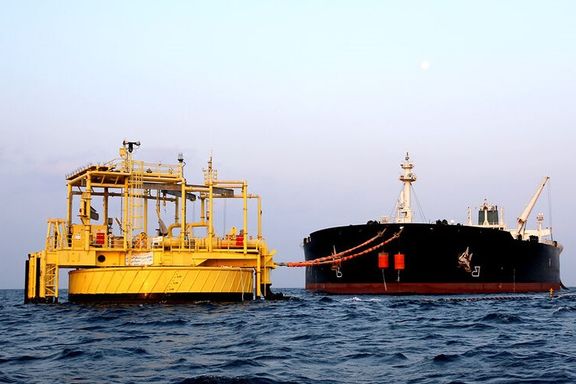
Tanker loading Iranian oil in the Persian Gulf. 2022
Iran's oil loadings plummeted nearly 70% in the first ten days of October, as its tanker fleet dispersed in anticipation of potential Israeli strikes, which may target the country's oil terminals.
Data obtained by Iran International from tanker tracking firms indicates that Iran loaded only 600,000 barrels of oil per day in the first 10 days of October, much less than the 1.5 million barrels shipments volume average in recent months.
Tanker tracking data shows a relative increase in the number of tankers at Iran's Kharg oil terminal after October 10. Armen Azizian, a senior oil risk analyst at Vortexa, told Iran International that while loadings have resumed, they are progressing much slower than usual. Recent estimates suggest that volumes have slightly increased to 800,000 barrels per day since mid-week.
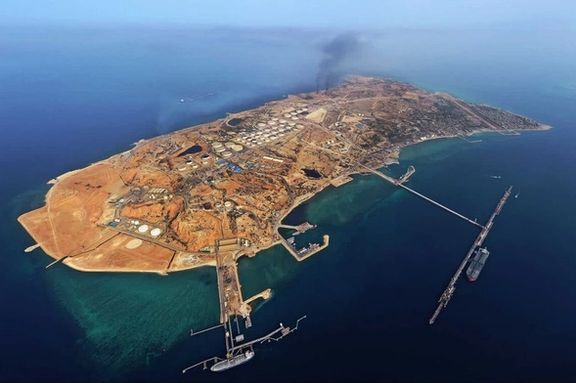
The Kharg oil terminal, located in the western Persian Gulf, handles 90% of Iran’s oil loadings, particularly for Very Large Crude Carriers (VLCC) with a capacity of 2 million barrels. Observers have identified the terminal as a potential target for Israeli strikes.
According to a report, published by Vortexa, a slowdown at Kharg is already visible, with only two VLCCs loaded between October 1-10, compared to an average of 1.1 VLCCs per day in the first nine months of the year. Most of Iran’s oil, shipped despite US sanctions, are purchased by small Chinese refineries.
Iran's Kharg Island serves as the country's main oil loading terminal. File photo
Iran had around 40 million barrels of floating oil storage, out of Persian Gulf in early October, enough to continue exports to China for only one month. Azizian said that during October 1-10, the floating storage has been declining as tankers, which held stored oil, are departing Iran.
It is still unclear whether the Kharg oil terminal is among Israel's targets. However, an attack on this terminal could cripple Iran's economy. Reports suggest that after Iran’s large-scale missile attack on Israel on October 1st, Tehran immediately withdrew its tankers from the Kharg Island to prevent them from being targeted by Israeli retaliatory strikes.
Informed sources have told some Western media that Iran has also made numerous confidential contacts with the regional Arab neighbors over the past week, asking them to urge the US to prevent Israel from attacking Iran’s oil facilities.
Soon after Iran's missile attack on Israel, the Iranian president traveled to Qatar, followed by a rare visit to Saudi Arabia by Iran's foreign minister.
Oil exports make up 65% of Iran’s government budget and 8% of its GDP. However, a recent report by Iran's Court of Audit revealed that in the first five months of the current fiscal year (March 21 to August 22), the government fell short of realizing a quarter of its projected oil revenues.
Additionally, tanker tracking data indicates that in August and September, Iran's daily oil exports dropped by about 300,000 to 400,000 barrels compared to previous months, falling to 1.4 million barrels per day. This suggests a deepening of Iran's oil budget deficit in coming months.
The reason behind this drop was the decline in oil demand from China, a country that purchases over 95% of Iran’s exported oil.
Iran has repeatedly threated regional and western states to blockade Persian Gulf’s Strait of Hormuz, where 20% of oil traded worldwide passes through.
Vortexa reports that with China now accounting for over 95% of Iran’s oil exports as its top trade partner, a blockade of the Strait of Hormuz is unlikely. “Such a move would trigger severe economic instability and jeopardize Iran’s vital relationship with China,” the firm stated.
From January to September, China imported 4.2 mb/d of crude via the Strait of Hormuz, accounting for 43% of its seaborne crude. This included n increased volume of Iranian oil as more Chinese refiners turned to Tehran’s discounted feedstocks to improve refining margins.
Swedish Prime Minister Ulf Kristersson on Sunday called on the European Union to designate Iran's Islamic Revolutionary Guard Corps (IRGC) as a terrorist organization.
The Swedish prime minister's remarks came shortly after reports that Tehran had enlisted criminals to carry out armed attacks on Israeli embassies in Stockholm and Copenhagen.
"We want Sweden to seriously address with the other EU countries the incredibly problematic connection between the IRGC, their destructive role in the region, but also their escalating actions around various European countries, of which Sweden is one of them," said Kristersson.
"The only reasonable consequence is that we get a common terror classification, so that you can act more broadly than the sanctions that already exist," he added, according to a report by Expressen.
In May 2023, the Swedish Parliament voted in favor of designating the Islamic Revolutionary Guard Corps as a terrorist organization. It followed the execution of Swedish-Iranian Habib Chaab (Asyud).
Later in January 2024, the European Parliament called on the EU to list the IRGC as a terrorist entity, blaming it for the harsh repression of domestic protests and the supply of drones to Russia for use in its war against Ukraine.
EU Foreign Policy Chief Josep Borrell said on Jan. 23 before a meeting of foreign ministers in Brussels that there are legal reasons why the EU can't list the organization as a terror entity. "It is something that cannot be decided without a court, a court decision first."
However, a report commissioned by the Hague Initiative refuted the EU foreign policy chief's argument for not listing the IRGC on the EU's terror list, saying the argument that the EU cannot list the IRGC as terrorists until an EU court has determined that they are is baseless.
In late June, the German Press Agency (DPA) quoted diplomats as saying that “multiple EU countries including Germany are pushing to classify the IRGC as a terrorist organization on the basis of a German court ruling.”
The German legal ruling earlier this year is from the High Court in the city of Düsseldorf, stating that a 2022 attack on a synagogue in the city of Bochum was traced to the “Iranian state authorities.”
A senior EU official told the Wall Street Journal on October 4 that the European Union's legal services have said the Dusseldorf decision is grounds enough for a potential IRGC terror listing and that the decision on this is now a political one.
A US air defense battery will be stationed in Israel to bolster air defense against Iran's potential ballistic missiles, the Pentagon confirmed on Sunday, amid preparations for a possible Iranian response to a highly-anticipated Israeli retaliatory attack.
"At the direction of the President, Secretary Austin authorized the deployment of a Terminal High-Altitude Area Defense (THAAD) battery and associated crew of US military personnel to Israel to help bolster Israel's air defenses following Iran's unprecedented attacks against Israel on April 13 and again on October 1," the Pentagon's press secretary announced in a statement.
The THAAD Battery will augment Israel's integrated air defense system, the Pentagon statement said, adding that the deployment "underscores the United States' ironclad commitment to the defense of Israel, and to defend Americans in Israel, from any further ballistic missile attacks by Iran."
On October 1, Iran launched over 180 ballistic missiles at Israel, prompting Israel to vow retaliation. While Israel has yet to respond, a counterattack is widely anticipated. Tehran, in turn, has vowed to retaliate any Israeli strike.
Iran's Foreign Minister Abbas Araghchi on Sunday criticized the Biden administration's decision to deploy the THAAD battery to Israel, saying the deployment will put the lives of American soldiers in danger.
"The US has been delivering record amount of arms to Israel. It is now also putting lives of its troops at risk by deploying them to operate US missile systems in Israel," Araghchi tweeted.
The US military earlier helped Israel intercept Iranian missiles attacks both in April and on October 1. This time, however, the Pentagon seems to be convinced that the current air defenses are not sufficient, and a Terminal High Altitude Area Defense (THAAD) battery needs to be stationed in Israel.
The Pentagon's statement made it clear this is not the first time the US has deployed a THAAD battery to the region, as the President previously directed the military to send a THAAD battery to the Middle East last year following the attacks on October 7, to protect American troops and interests in the area. Additionally, a THAAD battery was deployed to Israel in 2019 for training purposes and an integrated air defense exercise, it added.
Middle East on the brink of war
In a Sunday press conference with his Iraqi counterpart, Araghchi warned that "the likelihood of escalation in the region and the outbreak of a large-scale war is high."
“We are prepared for any kind of circumstances. We are ready for war, but we are also ready for peace. This is the definitive stance of the Islamic Republic. We are entirely ready for a military conflict, we are not afraid of war, but we do not wish for war. We want peace and we will seek a just peace in Lebanon and Gaza," he said.
IRGC Aerospace Commander Amirali Hajizadeh, who received a Fath Medal from Iran's Supreme Leader Ali Khamenei last week for his central role in Iran's October 1 attack on Israel, reiterated threats to retaliate any Israeli response on Sunday.
"We are fully alert and ready to deliver a response that will make the enemy regret any mistake they make," he said.
Iran’s government is reportedly highly nervous, engaging in urgent diplomatic efforts with Middle Eastern countries to assess whether they can limit the scope of Israel’s potential response to its missile attack earlier this month, according to sources familiar with the matter cited by CNN.
Tehran, at the same time, has publicly and privately warned that it will respond to a possible Israeli retaliatory attack. The Biden administration has urged Tehran, through backchannels, to calibrate its response if Israel attacks, CNN reported citing a US official.
While Qatar regularly speaks to the Iranians and relays back to the US what they say, the US official said that ultimately “we just do not know what [Iran] will do.”
Possible targets
US-based analyst Alex Vatanka told Iran International's Eye for Iran podcast this week that the Islamic Republic is extremely concerned about an attack on its nuclear facilities, because the atomic program is its only major accomplishment in 45 years.
However, NBC News reported on Saturday that "there is no indication that Israel will target nuclear facilities or carry out assassinations." US officials believe Israel has narrowed down what they will target in their response to Iran’s attack, which these officials describe as Iranian military and energy infrastructure, the report said.
American officials stressed that the Israelis have not made a final decision about how and when to act.
Damage to private property from Iran’s October 1 missile barrage on Israel amounted to $40 million to $53 million, figures provided by Israel’s tax authority reveal, making it the costliest since the beginning of war a year ago.
Only in the town of Hod Hasharon, over 1,000 homes were damaged, insurance claims cited by Bloomberg show.
Another epicenter of the attack was a commercial and living complex near north Tel Aviv’s coast, where dozens of apartments and a restaurant were hit.
It’s not clear how much of the damage was caused by direct hits and how much from falling debris as missiles were intercepted, the report said.
The October 1 strikes marked Iran's second direct assault on Israel, following an earlier attack in April that involved 300 drones and 100 ballistic missiles. During that attack, only four or five missiles successfully breached Israel's air defense system.
However, Israeli reports indicate that this time, Iran deployed more advanced weaponry, allowing a greater number of missiles to enter Israeli airspace.
One person was killed near the West Bank town of Jericho, while a few others sustained minor injuries in different locations.
Eight people accused of theft in Tehran have been issued indictments recommending hand amputations as the country continues the punishment banned under international law.
The case, which involves allegations of stealing valuable items from homes in northern Tehran, has been referred to the Tehran Provincial Criminal Court, according to a Sunday report by the state-run Iran newspaper.
“As the number of plaintiffs in this theft ring reached 46, police reviewed surveillance footage from around the crime scenes. They discovered that the members of this gang entered homes in groups of four or five,” wrote Iran.
The defendants face charges of stealing gold, jewelry, US dollars, and luxury carpets, with the stolen goods valued at about five hundred billion rials ($800,000). The suspects were identified through police investigations and surveillance footage and arrested shortly after the thefts, which began in the summer of 2022.
The punishment, as described in the indictment by Branch Five of Tehran’s Special Theft Prosecutor’s Office, is rooted in the “hadd” law under Iran's Islamic Penal Code. This law prescribes harsh penalties for theft, including amputation, based on Islamic jurisprudence.
The first offense guidelines mandate the amputation of four fingers from the right hand. For repeat offenders, harsher punishments follow: the second theft results in the amputation of the left foot, the third leads to life imprisonment, and the fourth can result in execution.
The sentencing has drawn attention, particularly from international human rights groups. Pegah Bani Hashemi, a senior legal researcher at the University of Chicago, commented on the severity of the punishments in an interview with Iran International, stating: “While countless embezzlements happen in Iran and the individuals involved often spend just a few years in prison, how can it be acceptable that someone stealing minor items faces amputation?"
Bani Hashemi also highlighted that such punishments go against international human rights conventions, noting, “All punishments that involve torture, including amputation, are considered illegal under international law. This has no place in modern justice systems.”
File photo of a prisoner being amputated by a guillotine-like device in Iran
The practice of amputation as punishment in Iran continues despite mounting criticism from the United Nations, Amnesty International, and other human rights organizations. In July, the Oslo-based Iran Human Rights organization reported that four prisoners at Urmia Central Prison were at risk of amputation for theft. The group has documented similar cases, including a man who had his fingers amputated in February for stealing five sheep.
Iranian civil society organizations report that between January 1, 2000, and September 24, 2020, at least 237 individuals, primarily from impoverished backgrounds, have received amputation sentences in Iran, with at least 129 of those sentences being carried out.
The continued implementation of amputation sentences in Iran occurs despite the country being a member of the United Nations and having signed the International Covenant on Civil and Political Rights.
According to Article 7 of this covenant, “no one shall be subjected to torture or to cruel, inhuman or degrading treatment or punishment.”
Amid the escalating conflict in Lebanon, Israeli Prime Minister Benjamin Netanyahu emphasized in a speech on Sunday that Israel's battle is not with the Lebanese people, but with Iran.
“These days we mark the anniversary of the difficult war that was imposed on us, the war of revival against the axis of evil of Iran,” Netanyahu said on Sunday, just days after the one-year anniversary of the October 7, 2023, attack, when Iran-backed Hamas invaded Israel.
“We are not fighting the Lebanese people. We are fighting the terrorist branch of Iran, Hezbollah, which has taken over Lebanon. All of which is aimed at providing a human shield to Hezbollah terrorists.”
On October 8, 2023, Hezbollah joined the fight with Hamas, forcing Israel to face conflict on its southern and northern fronts.
In Gaza, the Israeli offensive has killed nearly 42,000 people, according to Gaza Health Ministry figures. The Israeli attacks on Lebanon from October 2023 to early September 2024 have also killed over 2,000 people, including at least 137 civilians, figures released by the Lebanese Ministry of Health and the United Nations showed.
Israel has also vowed to retaliate against Iran for a large barrage of ballistic missiles launched by Tehran against its territory earlier this month.
Attack on UNIFIL forces
In his Sunday remarks, Netanyahu also issued a warning to the UN to move the peacekeeping forces from southern Lebanon “out of harm’s way”.
Five peacekeepers have been injured in fighting since Operation Arrow of the North began last month. Israel started with a series of deadly air strikes, targeting Hezbollah’s top ranks, including killing the group's leader, Hassan Nasrallah.
Forty countries contributing to the UN peacekeeping mission in Lebanon on Saturday condemned the Israeli attacks on the mission and called for an investigation of the incidents.
In their statement, the 40 countries said they "strongly condemn recent attacks on UNIFIL peacekeepers" and that "such actions must stop immediately and should be adequately investigated."
The Israeli offensive has expanded this month into what it calls a ‘limited ground operation’, but combined, has now seen 1.4 million Lebanese displaced and hundreds more killed.
During the address in Hebrew, Netanyahu turned to English to address UN Secretary General, Antony Guterres. “Mr. Secretary General get the UNIFIL forces out of harm’s way, it should be done right now, immediately,” he warned.
In Hebrew, he expressed regret for the injuries suffered by the UNIFIL soldiers. "We do everything in our power to prevent this injury, but the simple and necessary way to prevent this is to simply get them out of the danger zone,” he said, warning their presence is also a danger to Israeli soldiers.
Israeli forces asked UNIFIL to withdraw from some of its positions, but "there was a unanimous decision to stay" in the area, AFP reported Saturday citing UNIFIL spokesperson Andrea Tenenti.
UNIFIL, set up in 2006, was designed to keep Hezbollah and other armed groups behind designated lines, and to see the disarmament of all such groups in the area. Neither has since been achieved.
Hezbollah was Iran’s largest and most powerful proxy until a few weeks ago. While a Hezbollah operative earns $1,500 a month, the Lebanese Armed Forces, the only armed power able to challenge Hezbollah, are paid just $300 a month. Limited by resources in the ailing economy, their troops often do not even have funds for gasoline to fuel their patrol trucks.
On Sunday, Israel announced it had captured a Hezbollah militiaman in one of the group’s tunnels, along with huge stashes of armaments, the first such announcement since fighting began. He was taken to custody in Israel while scores more projectiles continued to be fired into Israeli territory.