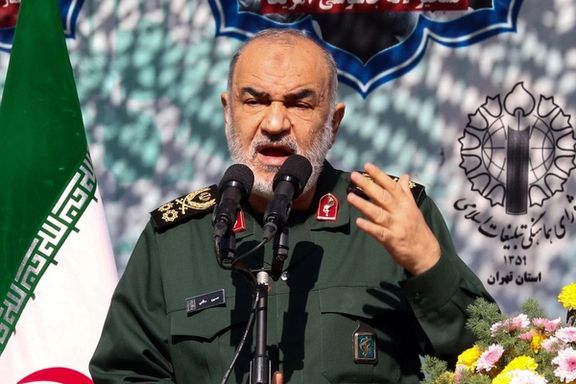
The commander of Iran's Revolutionary Guards Hossein Salami ramped up his rhetoric against Israel on Thursday, hinting at the possibility of a ground operation just as Israel appears poised to launch a strike on Iran.
"We give the Zionist regime this message: look at the operations of Fath al-Mobin and Beit al-Moqaddas and see if it can stand against another Fath al-Mobin," Salami said, referencing grueling Iranian infantry campaigns from the nearly decade-long Iran-Iraq War which ended in 1988.
"If a ground operation begins, can it escape the scale of our Beit al-Moqaddas operation in 1982?" he added. The offensives were critical in forcing Iraqi forces out of southern Iran.
Iran launched two aerial bombardments against Israel this year, once in April and the next in October, in the first direct confrontation with its archenemy in the Islamic Republic's near 50-year history.
It has never fought Israel with ground troops.
Salami also dismissed the US-provided THAAD missile defense system, which has been deployed in Israel in anticipation of further escalation. "Do not rely on the THAAD missiles. They are limited, and you are depending on limited power," he said.
The US deployed 100 troops to the region this month, with President Joe Biden reaffirming his commitment to supporting Israel.
Israel, preparing for possible further conflict, has requested an additional THAAD system from the US, according to Israel's Channel 12. THAAD, designed to work alongside the Patriot system, can intercept threats at ranges of 93-124 miles.
Salami's remarks come as Israel prepares a retaliatory response to Iran's attack with 181 ballistic missiles earlier this month.
The Oct. 1 barrage was retaliation for Israel's assassination of Hezbollah leader Hassan Nasrallah in Beirut last month and likely killing in July of Hamas political chief Ismail Haniyeh in Tehran.
Although most missiles were intercepted, a few hit military and civilian targets, causing minor damage.
After Iran’s first attack in April, Israel responded with air strikes on an air defense site in central Iran. Following the latest missile volley, Prime Minister Benjamin Netanyahu warned Tehran it had made a "big mistake" and promised a counterstrike.
The Biden administration later revealed that it had advised Israel not to target Iran's nuclear facilities, but tensions remain at boiling point as both sides prepare for further escalation.
Israel carried out deadly air strikes on targets in Damascus and a military site near the western city of Homs early on Thursday, Syrian state media reported, and further bombarded Iran-backed Hezbollah in Lebanon.
There was no immediate claim of responsibility from Israel, which often does not detail its role in attacks on other countries.
"Aerial aggression from the direction of the occupied Syrian Golan and northern Lebanon targeted two points in the Kafr Sousa neighborhood in Damascus and a military site in the Homs countryside," SANA quoted a military source as saying.
"(The attack) resulted in the martyrdom of one military member and the injury of seven others, in addition to causing material losses."
While Israel does not usually comment on alleged operations in Syria, the Jewish state has been carrying out strikes against Iranian-linked targets in Syria for more than a decade as Iran has increased its presence since the Syrian civil war began in 2011.
Raids have also ramped up since last year's October 7 attack on Israel by Palestinian militant group Hamas sparked the Gaza war.
Since then, Iran’s armed allies around the region have been targeting the country from across its borders, including Yemen's Houthis and militias in Syria and Iraq which like Hamas have been designated terrorist organizations by the United States and the West.
Syrian state television on Monday reported a missile strike on a car in the Mazzeh area of Damascus. In a rare announcement, Israel’s military said the attack killed a Hezbollah commander responsible for weapons transfer from Iran.
The Israeli military also announced on Wednesday that it was conducting raids on underground hideouts containing weapons belonging to Lebanese Hezbollah’s Radwan Forces.
The bunker had been part of the operation named "Conquer the Galilee,” an alleged plot Israel says it uncovered to replicate October 7 from Israel’s north.
“In the hideout, the troops located bunk beds, storage cabinets, food supplies, infrastructure for long-term stay, a large amount of equipment, weapons, and launch positions left behind by the terrorists,” Israel's military said in a statement.
Since October 8, Hezbollah has launched over 13,000 projectiles from Lebanon in solidarity with Hamas, causing 63,000 Israelis to be displaced from northern Israel.
In south Lebanon, the fighting uprooted around 100,000 and since Israel’s ground invasion has led to hundreds of thousands more fleeing the area.
“In recent days, the troops have located four enemy weapons storage facilities, some of which were placed in civilian homes,” the Israeli military added. “The storage facilities contained a large number of weapons, including AK-47 rifles, ammunition, rockets, mortars, shoulder-fired missiles, RPGs, and advanced anti-tank missiles.”
A police source in Colombo told Iran International that an assassination plot targeting Israelis in Sri Lanka, linked to the ongoing Iran-Israel conflict, has been foiled, and Israeli citizens are now under special protection.
On Wednesday, Israeli authorities warned all citizens to leave Sri Lanka with immediate effect after the plot was uncovered targeting Israelis holidaying in the country.
Two people have been arrested, one of whom Iraqi, with others believed to have been involved, according to a source inside Israel, speaking to Iran International anonymously.
A police source in Sri Lanka told Iran International that currently, 577 Israelis are being given "maximum security" in an operation which spans the police and military.
"They are safe," he said. "But they are targeting Israelis because of the Iran and Israel issue." The investigation is ongoing with fears others involved are yet to be found, he said.
Israel's former head of Interpol, Asher Ben Arzi, said Sri Lanka has become a popular holiday destination for Israelis.
However, he told Iran International that "it's a very easy place for Iran, because Iranian agents can meet Israelis and make them a target there". He added: "Until now, there was never such a security problem relating to Israelis in Sri Lanka."
The US Embassy also warned citizens that they had received “received credible information" warning of an attack targeting popular tourist locations in the Arugam Bay area.
“Due to the serious risk posed by this threat, the Embassy imposed a travel restriction on Embassy personnel for Arugam Bay effective immediately and until further notice,”a statement said.
US citizens were "strongly urged to avoid the Arugam Bay area until further notice.”
Iran expert Ronen Solomon, an Israeli intelligence analyst, said Malaysia has traditionally been a key base for Iran to carry out attacks around Asia, and even allowed them to springboard across to Europe.
"But north India has also harbored Shia groups recruited by Iran," he said.
Since the November 27, 2020, assassination of Mohsen Fakhrizadeh, the head of Iran's military nuclear program, an act attributed to Israel, Iranian security forces have orchestrated attacks against Israeli and Jewish targets across four continents: Asia, Africa, Latin America, and Europe.
Cash for killing plots under the command of specific units in the Quds Force and Ministry of Intelligence who recruited and operated Iranian agents alongside local recruits, have since become common, most recently, even inside Israel.
In 2022, an operation against the Israeli embassy in India led to weeks of security alerts in the country, with dozens more plots uncovered since in countries from Azerbaijan to the UK and Cyprus.
The latest Microsoft Threat Analysis Center (MTAC) research related to the US elections released Wednesday says Iran is gearing up for additional influence operations.
“Iranian groups tasked with targeting the US elections may make an effort—as they have in the past—to run influence operations both shortly before and soon after the election by leveraging cyber intrusions from weeks to months prior,” the report said.
On October 14, the report showed that the MTAC’s findings uncovered an online persona operated by Iran began falsely posing as an American. The online persona had called on Americans to boycott the elections due to both candidates’ support for Israel’s military operations.
A spokesperson for Iran's mission to the United Nations strongly rejected Iran's interference with the US presidential elections Wednesday. "Such allegations are fundamentally unfounded and wholly inadmissible," the spokesperson said.
The spokesperson added that "Iran neither has any motive nor intent to interfere in the US election" and contended that the allegations brought against Iran would only cause the US government to be discredited.
Two weeks ahead of the 2020 US elections, an Iranian hacker group called Cotton Sandstorm, also known as Emennet Pasargad, launched its first cyber-enabled influence operations, the Microsoft report said. It performed reconnaissance and limited probing of election-related websites in some swing states in April and reconnaissance of major US media outlets in May.
Cotton Sandstorm is directed by Iran’s Revolutionary Guards (IRGC), the Microsoft report said, adding that the MTAC has yet not observed activity suggesting that the group has launched influence operations targeting the upcoming elections but expects it to increase its activity closer to the elections.
According to the report, the group ran an email campaign in 2020 posing as the right-wing “Proud Boys”, threatening Florida residents to “vote for Trump or else!”.
This, the report said, was followed by a separate operation following the election which called for violence against election officials who claimed the elections were secure or denied claims of widespread fraud.
Senior US officials told Reuters in 2020 that the hacker group’s email campaign did not affect individual voting systems but aimed to create chaos, confusion, and doubt.
US officials also told Reuters that a mistake the hackers made in a video that they attached to some of the emails helped government analysts and private sector investigators to quickly attribute the cyber operations to Iranian hackers.
Microsoft detected Cotton Sandstorm running its last operation targeting Israel’s participation in the Paris Olympics in late July 2024, the MTAC report said.
Dozens of protesters, organized by a vigilante group, gathered in Tehran on Wednesday, chanting in opposition to President Masoud Pezeshkian's remarks and the growing calls for lifting internet filtering.
On Tuesday, he reaffirmed his commitment to his promise, stating that to prevent future complications, his administration is collaborating with other government institutions, including Parliament and the Judiciary, to remove the obstacles to lifting internet restrictions.
The plan to hold the rally was announced on social media platforms Tuesday by the group calling itself the “Hezbollah umma (people)”.
The poster widely shared by the organizers on various social media platforms invited those opposed to free internet access to convene to demonstrate their opposition to the plans that allow “cultural infiltration of the Zionist regime in the country”.
Videos posted on social media show the protesters chanting and waving flags of the Hezbollah outside the building of the National Cyber-Space Center near a major square in northern Tehran.
A notorious vigilante leader, Hossein Allahkaram, used a loudspeaker to address the participants in the rally from the back of a small pick-up truck parked on the road median.
He urged the authorities not only to continue internet filtering but also to block the bandwidth allocated to Instagram, WhatsApp, and Telegram traffic so that even anti-filtering software could not provide access to them. These platforms are already blocked and people use VPNs to secure access.
“Israeli Instagram, Telegram, and WhatsApp must be shut down” and “No country allows so much freedom to enemy [social media] platforms like Iran”, some of the protesters’ banners read.
Tens of millions of Iranians must use anti-filtering software to access major international social networks, including Google Play, and tens of thousands of websites.
Moreover, millions of Iranians use social media platforms, particularly Instagram, Telegram, and WhatsApp to promote small and medium-sized businesses, particularly those run from home by women or small farms in rural areas.
A report published by the Tehran E-Commerce Association in January contended that the use of anti-filtering software makes users’ equipment more vulnerable to cyber threats and exposes online businesses to greater risks of user data leaks.
Iranian security forces will normally interfere without hesitation and suppress any “unauthorized” protest rallies, even very small, for ‘violating public peace’ but Iranian media say security forces did not interfere with ultra-hardliners’ rally on Wednesday.
Pointing out that the indifference of the security forces, the head of the Reformist Front, Azar Mansouri, asked the authorities in a tweetwhether those who oppose filtering can also enjoy such freedom in holding protests.
Pro-establishment hardliners have on many occasions held similar rallies without any trouble but an article Tuesday in Mashregh newspaper seemed to suggest that authorities are concerned that the vigilante group’s insistence on keeping internet censorship may spark a new wave of anti-government protests and unrest in the country.
Mashregh is a news website with alleged links to the Revolutionary Guard Intelligence Organization (SAS).
The article entitled “Behind the Scenes of Anti-Security Calls to Protest in Iran/ The US Plot for Simultaneous Unrest in Iran and Lebanon” alleged that those who called to protest were “groups feigning to be revolutionary” that sought to “polarize” the society in line with such supposed US plans instead of fostering unity in the face of “current threats”.
The Revolutionary Guard-linked Fars News Agency, along with other conservative outlets, published the Mashregh article in full.
Mashregh News cited the hardliners' protests against former President Hassan Rouhani's economic policies in Mashhad in December 2017 as a historical parallel.
What began as a hardliner-organized demonstration quickly spiraled out of control when disillusioned citizens joined in. This sparked spontaneous, leaderless protests across the country, targeting not just the government’s economic policies but the entire Islamic Republic and its religious authoritarianism, prompting a heavy crackdown.
A dissident cleric and former academic, once a popular figure on Iran’s state television, now asserts that the ruling clerics no longer represent the voice of the people.
Naser Naqavian, once a prominent figure on state TV, has been barred from both speaking on air and teaching at universities. He has spoken about the declining role and status of Muslim clerics in Iranian society, despite the country being officially governed by Shiite clergy.
In an extensive interview with the Khabar Online website, Naser Naqavian said that clerics were increasingly isolated from Iranian society. He remarked that some clerics are so affluent that many people believe their pockets are directly connected to the country’s oil pipelines.
Speaking about his own financial situation, Naqavian said that he had to move from the affluent Pasdaran Avenue in northern Tehran to Fardis, a district outside the industrial town of Karaj some 50 kilometers West of Tehran.
He noted that clerics who became government officials have lost their standing with the broader population, as they no longer speak for the people. He pointed to their hardline stance on enforcing compulsory hijab as a key issue, likening their position to that of the Taliban, which has further alienated them from mainstream Iranian society.
Ayatollah Nasser Naqavian. File photo
Naqavian stressed, however, that he is not a "counter-revolutionary" or a member of the opposition. "I simply oppose the policies I believe are wrong and want those policies to be corrected."
The growing divide between the Iranian public and the ruling clerics has been acknowledged by the country’s seminaries as far back as 2017. A major media outlet from the Qom Seminary, Mobahesat (Discussions), explored this issue and its underlying causes. Studies published by Mobahesat revealed that clerics' popularity has been in decline since the 1979 Islamic Revolution.
Several debates involving prominent Muslim scholars were sparked by the publication, during which high-ranking seminarians concluded that the public’s increasingly negative view of the clergy stems largely from the behavior of clerics who serve as state officials.
In 2023, following a series of physical attacks on clerics in the wake of the 2022 nationwide protests, Ayatollah Mohammad Javad Alavi Boroujerdi argued that these assaults were a direct result of the widening divide between the public and the clerical establishment. He urged officials to avoid further alienating the people by making hardline statements that fuel public resentment.
However, to shield himself from potential government reprisals, Boroujerdi also attributed the growing hostility toward clerics to foreign media "fanning the flames" of discontent.
In contrast, female religious scholar Sedigheh Vasmaghi, a vocal critic of the regime’s compulsory hijab policy, argued that it was already too late to bridge the gap between clerics and the people. She asserted that the clerics’ fundamentalist views had fostered insecurity in Iranian society, adding that they should have anticipated the consequences of their hardline stances and behavior.
In his interview, Naqavian noted that the government labels reformist clerics as counter-revolutionaries. He also revealed that, due to the public's increasingly negative perception of clerics, he often refrains from wearing his traditional clerical robe and turban when going about his daily life.
When asked about the difference in how people react to him in clerical versus non-clerical attire, Naqavian explained, "For those who know me, their reaction doesn’t change regardless of what I wear. But for others, it’s different. When they see me in my clerical robe and turban, they treat me the same way they treat other clerics."
During and for some time after the 2022 protest in Iran "turban tossing" or "turban flipping" was popular among young protesters. Young disgruntled people used to take the turban off the clerics' head and toss it in the street. Compared to violent attacks on clerics at that time, turban tossing was a light-hearted reaction.