Iran sends mixed signals on potential retaliation against Israel
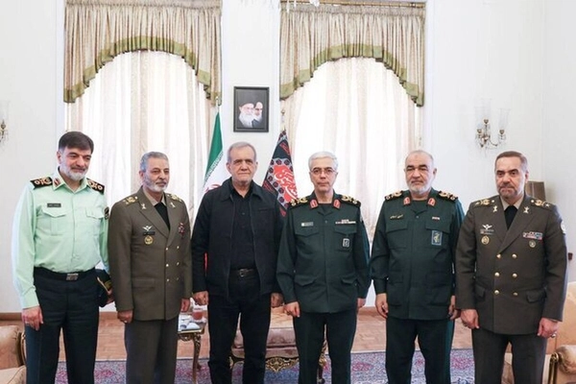
Iran's President Masoud Pezeshkian (third from left) along with Iran's top military commanders from both the IRGC and the Army
Iranian officials are sending conflicting messages about the Islamic Republic's plans to respond to Israel's October 26 airstrikes on Iran, suggesting both a potential for restraint and an intention to escalate.
The Wall Street Journal reported on Sunday that Iran has told Arab countries in the region it is planning a strong and complex response to Israel involving even more powerful warheads and other weapons.
Iran has told Arab diplomats that its conventional army would be involved because it had lost four soldiers and a civilian in Israel’s October 26 attack, the report added, citing Iranian and Arab officials briefed on the plans.
One Iranian official speaking to the Wall Street Journal said Iran could use Iraqi territory for part of the operation and would likely target Israeli military facilities “but much more aggressively than last time."
The WSJ report came hours after President Masoud Pezeshkian said "Iran will in no way leave any violation of its territory and security unanswered," in response to recent Israeli attacks that killed four Iranian army personnel and a civilian.
"They are well aware that any mistake against the Islamic Republic of Iran will be met with a crushing response," Pezeshkian said during a cabinet session.
However, the relatively moderate president left the door open for de-escalation if Israel chooses to cease hostilities. "If they reconsider their actions, accept a ceasefire, and stop the killing of innocent and oppressed people in the region, it may influence the nature and intensity of our response."
Pezeshkian's statement appeared to signal a willingness for a measured approach, potentially allowing for a de-escalation if Israel were to pull back.
The United States has directly warned Tehran against launching another attack against Israel, saying it will not be able to restrain its ally this time, Axios reported Saturday citing an American official, amid reports of Iran's preparations for another strike on Israel.
In a direct message sent to Iran through the Swiss, the Biden administration warned the Islamic Republic that Israel's response to a possible Iranian attack will not be as limited as the one launched last Saturday.
On October 26, in the wake of a four-hour mission involving around 100 pilots, the Israeli military said it had caused significant damage to Iran’s air defense systems, allowing them scope “to do much more”.
The attack was Israel's response to Iran's October 1 missile barrage, following a series of high-level Israeli killings including the leader of Iran’s largest militia, Hezbollah in Lebanon, and the humiliating killing of the Hamas political leader in an IRGC compound in Tehran.
The Iran Human Rights Organization has reported a sharp increase in executions within Iran, with at least 166 people hanged in October alone, marking the highest monthly figure in over 20 years.
The wave of executions comes in the shadows of the escalating tensions between Iran and Israel, a backdrop some rights advocates argue is being used to divert attention from the domestic situation.
Mahmood Amiry-Moghaddam, director of the Norway-based organization, said: “While the world’s attention is focused on the tensions between Iran and Israel, the Islamic Republic is using this opportunity to conduct the largest wave of executions in Iran’s prisons in two decades."
He called on the international community to respond with urgency, warning of potentially even higher execution rates in the coming months under the threat of a regional conflict.
Among those executed were Afghan, Baluch, and Kurdish citizens, and at least six women. Charges varied widely, encompassing intentional murder, drug-related offenses, and ambiguous charges like “enmity against God” and “corruption on earth” with two of the executions conducted publicly.
The group's report touched on the role capital punishment has played in Iran’s judicial system. Iran's use of the death penalty has consistently drawn criticism from global human rights organizations, with Amnesty International recently findings showing that nearly 75% of documented executions worldwide in 2023 took place in Iran.
In a report marking World Day Against the Death Penalty, the Human Rights Activists News Agency (HRANA) documented at least 811 executions in Iran over the past year, a figure that includes Jamshid Sharmahd, a German-Iranian national whose execution last week sparked international outrage.
Citing the International Covenant on Civil and Political Rights, Sato added that the death penalty should be reserved for only the “most serious crimes,” expressing concern over charges like “corruption on earth” being used as grounds for execution.
According to the Iran Human Rights Organization, more than 350 people have been executed in the three months since Masoud Pezeshkian’s presidency began, an acceleration that coincides with growing tensions over Iran’s nuclear program and regional conflicts.
Sholeh Zamini, a women’s rights advocate (where is she based?), commented that Iran’s consistent refusal to allow UN special rapporteurs to conduct in-country investigations prevents an accurate assessment of these human rights violations.
“The Islamic Republic has always blocked UN rapporteurs, likely because it wishes to keep its human rights abuses out of the international spotlight,” Zamini noted.
A masked executioner prepares a noose for a public hanging in Iran
As in previous years, Iran’s execution record has extended to ethnic and religious minorities, with Afghan citizens facing increasing rates of execution since the Taliban’s rise to power in Afghanistan.
The report shows that at least 49 Afghans were executed in the first ten months of 2024, a trend rights advocates attribute to both political motivations and racial discrimination within Iran’s justice system.
Roya Boroumand, executive director of the Abdorrahman Boroumand Foundation, a US-based human rights organization, sees the pattern of heightened executions as a response to internal instability which has remained high since the 2022 uprising.
“Historically, the government ramps up executions when it feels threatened or unstable. We saw this following the Iran-Iraq War and during the nuclear negotiations under President Hassan Rouhani, when the annual execution rate reached 1,050,” she explained.
Boroumand further highlighted an emerging trend of capital punishment extending to women. “It used to be mostly minorities, but now even regular citizens, including women, are receiving death sentences,” she said, pointing to what she described as a means of intimidating the broader population in times of unrest.
Following the Woman, Life, Freedom uprising after the death of Mahsa Amini in morality police custody in 2022, Iran’s leadership has increasingly wielded the death penalty as a means of suppressing dissent.
Amnesty International reported that Tehran’s intensifying reliance on capital punishment appears aimed at instilling fear and reinforcing the government’s control.
The head of CENTCOM visited Israel as the US bolsters defenses for the Jewish state in preparation for the expected retaliation for last week’s Israeli air attacks across Iran.
On Thursday, the Commander of US Central Command General Michael Kurilla, met with Israel’s Chief of the General Staff, LTG Herzi Halevi.
“The Chief of the General Staff and the Commander of CENTCOM held a situational assessment on strategic security issues and joint regional preparedness, as part of the response to threats in the Middle East, with a focus on Iran,” the Israeli military said in a statement Sunday.
During General Kurilla’s visit, he visited the American THAAD aerial defense battery, recently deployed to Israel to strengthen defenses against the next Iranian strike which Iran's Supreme Leader Ali Khamenei this weekend warned would be a "crushing" attack.
In addition to sending 100 troops and the THAAD aerial defense battery earlier this month, the US has this week sent more warships and B-52 bombers to Israel as the Jewish state awaits an imminent retaliation to last week’s aerial strikes across Iran.
Last week, in the wake of a four-hour mission involving around 100 pilots, the Israeli military said it had caused significant damage to Iran’s air defense systems, allowing them scope “to do much more”, according to Halevi last week.
Two days ago, Pentagon Press Secretary Pat Ryder said that the additional bolstering of troops and defenses is “in keeping with our commitments to the protection of US citizens and forces in the Middle East, the defense of Israel, and de-escalation through deterrence and diplomacy”.
Ryder said that the Secretary of Defense, Lloyd Austin, had ordered the deployment of “additional ballistic missile defense destroyers, fighter squadron and tanker aircraft, and several US Air Force B-52 long-range strike bombers to the region. These forces will begin to arrive in coming months as the USS ABRAHAM LINCOLN Carrier Strike Group prepares to depart”.
He said it builds on the recent decision to deploy the Terminal High Altitude Area Defense (THAAD) missile defense system to Israel as well as the sustained Amphibious Ready Group Marine Expeditionary Unit (ARG/MEU) in the Eastern Mediterranean, with additional deployments taking place at short notice around the region as new intelligence emerges.
“Secretary Austin continues to make clear that should Iran, its partners, or its proxies use this moment to target American personnel or interests in the region, the United States will take every measure necessary to defend our people,” Ryder said.
Israel’s war of attrition with Iran escalated in April when Iran launched its inaugural direct attack on Israel with 350 drones, missiles and rockets. It said the attack was a retaliation for an alleged Israeli airstrike on the Iranian consulate compound in Damascus which killed at least one Quds Force commander and multiple high ranking IRGC chiefs.
It came amid a war launched by Iran-backed Hamas on October 7, since which time, Iran’s militias around the region have acted in allegiance with the Gaza based group, designated globally as terrorists. It has seen Israel fighting Iran-backed groups on seven fronts including Yemen, Syria and Iraq.
On October 1, Iran launched nearly 200 ballistic missiles at Israel, following a series of high-level killings including the leader of Iran’s largest militia, Hezbollah in Lebanon, and the humiliating killing of the Hamas political leader in an IRGC compound in Tehran.
The UN Special Rapporteur on human rights in Iran says she is monitoring the case of a young Iranian woman who was forcibly detained after protesting the country’s mandatory hijab by removing her clothes at Tehran's Azad University.
Maio Sato shared a video of the student on the social media platform X, stating she would be following the incident closely, especially observing the response of authorities.
Imprisoned human rights activist and Nobel peace prize laureate Narges Mohammadi issued a statement from prison, saying that that women pay a price for their defiance but do not bow to force.
She described the student’s body as a symbol of rebellion, anger, and resistance, calling for her release and an end to the suppression and harassment of women.
Amnesty Iran has called for the immediate and unconditional release of the student, urging officials to protect her from mistreatment while in custody.
“Authorities must protect her from torture and other ill-treatment and ensure access to [her] family and [a] lawyer", wrote Amnesty Iran on X, preempting prison abuse as has been widely documented by rights groups since the crackdowns on Women, Life, Freedom protests and women refusing hijab.
"Allegations of beatings and sexual violence against her during arrest need independent and impartial investigations. Those responsible must held to account,” the group said.
According to student sources, the woman’s protest was sparked by harassment from university security over the hijab policy. Amir Kabir Newsletter, a prominent student publication on Telegram, reported that the student was transferred to a psychiatric hospital under orders from the IRGC intelligence organization.
This was confirmed by the newspaper Farhikhtegan, affiliated with Azad University, which stated that she had been admitted to a mental health facility.
On the same day, Amir Mahjoub, the Director of Public Relations at Islamic Azad University, issued a statement saying that the woman had been sent to a police station due to “severe psychological distress,” echoing statements from media accounts close to the IRGC that she had mental health issues.
State-affiliated outlets later circulated a video of a man identifying himself as her husband, who claimed she was the mother of two and claimed that she had mental health issues.
The incident has since drawn public backlash online, with social media users denouncing what they see as a familiar tactic used by authorities to delegitimize female protestors by labeling them as mentally unstable.
In a show of solidarity, the hashtag Science and Research Girl has emerged as a focal point for those opposing Iran’s treatment of women who defy hijab mandates.
Prominent Iranian figures also voiced support for the young woman’s protest. Katayoun Riahi, an actress who was among the supporters of the Woman, Life, Freedom movement, posted, "we will not abandon you".
Civil activist Hossein Ronaghi added on X, “The courage of this girl who was attacked for her hijab… are flames that will burn the roots of oppression.”
Another activist, Roya Heshmati, who previously faced lashings for not wearing a hijab, posted on Instagram, “May your pride and defiance become a blazing torch in the dark chasm that lies before you, my dear sister.”
Many are also creating and sharing illustrations on social media in support of the young student.
Human rights advocates point to a pattern of Iranian authorities labeling female protestors as mentally ill and transferring them to psychiatric facilities.
Last year, Iranian psychology associations publicly criticized the government’s misuse of psychiatry as a tool for silencing dissidents.
In May, prominent psychotherapist Ahmadreza Yazdi warned against politicizing psychiatry, suggesting that some professionals may align with the Islamic Republic’s ideology and unjustly label opposition figures as mentally unstable.
The crackdown on women protesting the mandatory hijab intensified in the wake of Mahsa Amini’s death in September 2022 while in morality police custody. That event triggered widespread demonstrations, with many Iranians calling for greater freedoms and challenging systemic oppression.
A senior official representing Iran’s Commander-in-Chief, Supreme Leader Ali Khamenei, has criticized President Masoud Pezeshkian’s government over enforcement of the latest controversial hijab legislation.
“In a recent interview, the government’s spokeswoman declared that hijab is not something [that authorities] can impose by force,” Ali Saeedi who heads the Ideological-Political Bureau of Iran's Commander-in-Chief of the Armed Forces, on Friday told Howzah News, the news agency of Iran's Shia seminaries.
At an October 29 press briefing, a reporter questioned government spokeswoman Fatemeh Mohajerani on whether Pezeshkian's administration was taking steps to prevent police from penalizing women for defying the hijab law by impounding their vehicles. “That is still happening,” the reporter stressed.
Mohajerani replied that compliance with the hijab cannot be achieved through pressure and violence. She noted that over the past forty years, experience has shown that forceful methods are ineffective.
She also stressed that the President still abides by his promise to the Iranian people to try to put a stop to using such methods to enforce hijab.
“Her Highness is not mindful of the fact that hijab is both a Sharia rule and a [civil] law requirement,” Saeedi said in a harsh tone and added that the administration is required to abide by the Sharia and implement the civil law.
Saeedi accused the government of neglecting its responsibility and adopting a lenient stance toward what he described as "libertinism and vulgarism" concerning the hijab issue.
The recently finalized hijab law imposes an array of penalties including heavy cash fines and prison terms on women for not conforming to strict hijab regulations and businesses for not enforcing them.
The finalization of the legislation, a year after it passed Parliament, was announced on October19 by Hadi Tahan-Nazif, the constitutional Guardian Council’s spokesman. Parliament legislation only becomes effective after the clerical council approves it.
During this time, the Parliament and the Guardian Council repeatedly shuffled the legislation back and forth behind closed doors.
The Council and lawmakers disclosed very little of the Council’s objections to the legislation's provisions and the amendments that it required the Parliament to make before it was finally approved.
The announcement placed Pezeshkian in a dilemma. As president, he is legally obligated to sign and formally relay new legislation to his administration for enactment within five days of receiving notification from Parliament.
In the past, presidents like Hassan Rouhani, Mahmoud Ahmadinejad, and others have repeatedly refused to acknowledge or enact legislation they opposed. In such instances, the responsibility to communicate the legislation falls to the speaker of parliament.
However, neither Pezeshkian nor Mohammad-Bagher Ghalibaf has taken the legally required step or provided any explanation for the delay—an unprecedented situation in the history of the Islamic Republic.
Pundits say Ghalibaf, who has formed an undeclared alliance with Pezeshkian against ultra-hardliners, is cautious about taking responsibility for enacting the highly unpopular law, which could even spark unrest. Meanwhile, Pezeshkian is deeply concerned about alienating his voters, many of whom strongly support abolishing the compulsory hijab.
Driven by the specter of escalating tensions between Iran and Israel, the Iranian rial has plummeted to a historic low, with its value eroded to less than 1/10000th of its pre-Islamic Republic worth against the US dollar.
The US dollar exchange rate surged to over 705,000 rials in Iran's free market on Sunday. One dollar was traded at about 70 rials on average for several years before the Islamic Revolution of 1979.
The rial dropped to 762,000 against the euro and 905,000 against the British pound.
On Sunday, the Tehran Stock Exchange index also plunged by 28,000 points, falling to about 2,032,000 points.
Iranian media usually cite several factors as potential contributors to a rising US dollar rate, including expectations of higher inflation, increased demand for the UAE dirham—a key currency in Iran’s foreign trade amid US sanctions—regional tensions, and the potential for Donald Trump to win the US election.
Iran is already grappling with soaring inflation exceeding 40%, and the rial's continued decline will drive prices even higher, further impoverishing a population that has seen its purchasing power fall significantly since 2018. That year, US sanctions imposed by the Trump administration—following its withdrawal from the 2015 nuclear deal—targeted oil exports and banking, slashing Iran’s income and dealing a severe blow to its oil-dependent economy.
In August, Israel began its punishing attacks on Iran’s proxy, the Lebanese Hezbollah, ultimately killing its leader, Hassan Nasrallah, which led to an Iranian retaliation with ballistic missiles on October 1. The anticipation of the Israeli response, which occurred in late October, took a heavy toll on the economy, with the rial nearing the 700,000 mark several times—a level that holds significant psychological resistance in Iran.
In recent days, numerous Iranian officials have threatened to retaliate against Israel’s October airstrikes, which targeted Iran’s air defenses and missile installations while avoiding nuclear and energy facilities.
Washington directly warned Tehran on Saturday against launching another attack, saying it will not be able to restrain its ally this time, Axios reported citing an American official, amid reports of Iran's preparations for another strike on Israel.
On top of mounting military and economic pressures, President Masoud Pezeshkian unveiled next year’s budget in October, allocating nearly 20% of Iran’s oil export revenue—estimated to exceed $10 billion—primarily to the Revolutionary Guard. In the current budget, the military’s share of oil is around 200,000 barrels per day, while next year it would be an estimated 430,000 barrels.