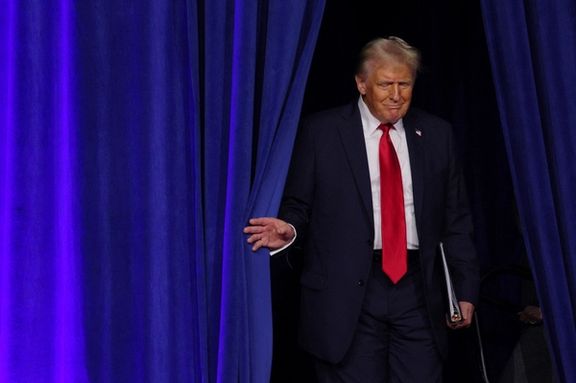
US president-elect Donald Trump rejected the idea of regime change in Iran during his campaign
Donald Trump won. Some Iranians are thrilled, seeing him as a catalyst for the collapse of the Islamic Republic. Others are gutted, thinking Kamala Harris would have meant less sanctions and some relief from unbearable economic pressure.
Then there are those, a significant number it seems, who are indifferent. They have lost hope of any change for the better.
“It makes no difference to me who’s in the White House, cause I see the problem here at home,” says Mahmoud, a well-educated pensioner who has “seen it all”.
“We are where we are, barely living, because of our rulers’ incompetence and bigotry. They don’t care if sanctions have broken our backs. They can end this if they want to. They could back down and reach an agreement with either Harris or Trump,” Mahmoud added.
US presidential elections are normally followed by many in Iran. But this time there was not so much appetite, perhaps because people are struggling more than ever, but also because many have come to believe that things go only downhill in Iran, whoever sits in the Oval Office.
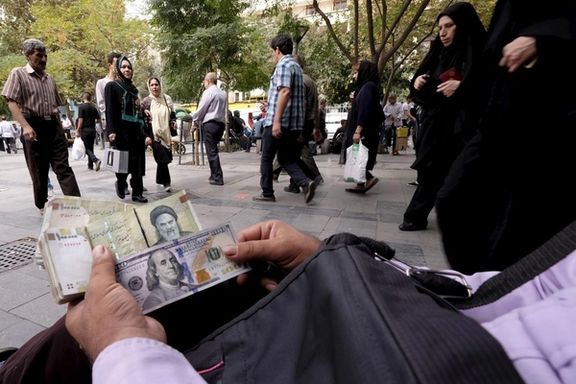
The markets were less indifferent though. Iran’s currency dropped further as soon as Trump was declared winner, breaking its record low of the week prior.
“Trump will definitely impose more sanctions on Iran and back Israel in any attack against us,” says Hossein, 45, working in advertisement. “All we had has been wiped off by skyrocketing inflation, partly due to sanctions and partly due to corruption and incompetence at home. How much more we can take, how far lower we can go, I’m not sure.”
Recent official data suggests 30 percent of Iran’s population live below the poverty line. This is double the figure from two decades ago. The impact of sanctions is impossible to deny. But on the streets and at family gatherings, most appear to blame the Islamic Republic for it, not the United States.
Thirty percent of Iranians are below the poverty line, according to official stats
Expletives are common when people talk about Iran’s foreign policy and support for armed groups across the region. The government announced last month that the military budget would be almost tripled in the upcoming Iranian calendar year. ‘Why spend so much elsewhere when so many are in need at home,’ is something you hear every day.
Hessam, a 29-year old photographer, is keen to see the back of this “wasteful policy” that he believes is at the heart of Iranians’ misery. “I hope Trump’s arrival ends the Islamic Republic’s game,” he says, “I don’t expect the regime to fall, and I fear war, but I think a Harris victory would have encouraged the regime to continue with its policies. Now they have to think twice.”
Some media reports suggest that president Masoud Pezeshkian was hoping for another Democratic administration. Hardliners have warned him against any talks with Trump, who has “blood on his hand”, that of IRGC top general, Qasem Soleimani.
The reactions to Trump’s win are not just political. Many of those who aspire to move to the US are disheartened. The memory of the 2017 travel ban is still fresh.
Samin, a computer science graduate, is one of many thousands who are at various stages of a long process to make a home in Europe or North America. “I was hoping to move to the US. I have submitted several applications and am waiting,” Samin says. “But with Trump’s return and the immigration policy that we all know well, I’m not so sure. I don’t know what future awaits me.”
It’s not clear if a Trump administration would make Samin’s move any harder. But that’s the general perception. So is the idea—rightly or wrongly—that the president-elect can play a significant role in determining the fate of the Islamic Republic one way or another.
A female teenage student in southern Iran died by suicide after facing violence and threats from her school principal, a teacher's union said, marking the second such incident in a week.
Aynaz Karimi was under intense pressure for "failing to observe decorum" for wearing nail polish and dyeing her hair, according to the Coordination Council of Iranian Educators' Trade Associations, leading to her eventual expulsion.
"Kazeroon’s Education Department and its officials, instead of defending students' rights, have remained silent, choosing to protect their own positions and status," the teacher's union said in a statement, referring to the town in Fars province.
"Ideological and repressive actions in schools not only rob students of their futures but also lead to the loss of their lives and motivation," the council wrote on their Telegram channel. "We demand an end to ideological policies, the elimination of disparaging attitudes toward students, and respect for their individual freedoms and human rights."
Just last week, a 16-year-old Afghan-Iranian girl in Tehran took her own life following a confrontation with a school principal for wearing jeans instead of the required uniform on a field trip, according to her father.
In an interview with Tehran-based Rokna News, the father in that case said he was told by the school that his daughter, Arezou, departed without permission. Later, he learned she had jumped from the sixth floor of a friend’s residential building.
The father held the school responsible for the tragedy, adding that the family has filed a formal complaint against the principal. He mentioned that this incident was not isolated, as the school had previously questioned her adherence to the hijab.
Some social media users have drawn comparisons between the experiences of Afghan and Iranian girls, noting that Arezou escaped the Taliban’s compulsory hijab and ban on girls’ education only to face similar restrictions in Iran.
The strict enforcement of hijab rules in Iran pressures Iranian women, and sparked months-long protests in 2022 after the death of a 22-year-old woman in police custody for allegedly wearing her hijab improperly.
In a recent incident, an Iranian university student’s protest in which she stripped down to her underwear drew international attention from figures like billionaire Richard Branson and Nobel Peace laureates, bringing renewed focus to the “Woman, Life, Freedom” movement which fueled the 2022 protests.
US President-elect Trump must realize that killing is in the DNA of the Islamic Republic when weighing any deal with Tehran, an outspoken Iranian dissident warned after US authorities released details of a murder-for-hire plot targeting them both.
"I have a message for President Trump now, because he said that he wants to negotiate with the regime. This is the regime. Assassinating and killing is in the DNA of the Islamic Republic," Masih Alinejad told Fox News in an interview.
"I want to fight against this regime, and I want the President of the United States to support my cause and the women of Iran who are facing the same killers every single day," she added.
Earlier on Friday the US Justice Department unsealed murder-for-hire charges against an Afghan national it said was tasked by the Islamic Revolutionary Guard Corps with assassinating both Alinejad and Trump.
Alinejad is one of the most visible critics of Iran's theocratic rulers and lives in an undisclosed location in Brooklyn since US law enforcement first uncovered the alleged Iranian plot on her life.
A champion of the Woman, Life, Freedom movement for female empowerment against Islamic headscarf enforcement in Iran, Alinejad has called for the downfall of the ruling system.
In his ultimately triumphant presidential campaign, Trump took a different tack by appearing to rule out seeking regime change despite taking a hard line on Iran as president, killing top military commander Qassem Soleimani and tightening sanctions,
Trump has said he wants to make a deal with Iran and wishes it success but that the United States would not tolerate Tehran acquiring nuclear weapons.
The US Justice Department on Friday unsealed murder-for-hire charges against an Afghan national it said was tasked by Iran’s Islamic Revolutionary Guard Corps with assassinating former President Donald Trump.
Farhad Shakeri, 51, believed to be in Iran, and two New York-based accomplices in US custody were charged with the plot against an unnamed Iranian-American journalist, likely the outspoken dissident Masih Alinejad.
Shakeri, a statement on the criminal complaint said citing an FBI interview with the suspect, was also tasked by Iran's foremost military organization with killing Trump.
"Shakeri has informed law enforcement that he was tasked (by the IRGC) on Oct. 7, 2024, with providing a plan to kill President-elect Donald J. Trump."
The text of the indictment identified Trump as "Victim-4" and alleged that an unidentified IRGC official told Shakeri that money was no object in its plan to kill him.
"In approximately mid-to-late September 2024, IRGC Official-I asked Shakeri to put aside his other efforts on behalf of the IRGC and focus on surveilling, and, ultimately, assassinating, former President of the United States, Donald J. Trump ('Victim-4' herein)."
"Shakeri indicated to IRGC Official-I that this would cost a "huge" amount of money. In response, IRGC Official-I said that 'we have already spent a lot of money ... [s]o the money's not an issue'."
Shakeri now lives in Iran, according to the indictment. He had immigrated to the United States as a child but following a 14-year stint in prison for robbery was deported in around 2008.
Tapping criminal contacts made in prison, Shakeri was able to supply the IRGC with operatives to surveil the Guards' assassination targets, it added.
Attorney General Merrick Garland underscored the danger Iran poses to prominent Americans and pledged to use his department's full resources to protect Iran's targets.
“There are few actors in the world that pose as grave a threat to the national security of the United States as does Iran,” Garland said in the statement.
“The charges announced today expose Iran's continued brazen attempts to target U.S. citizens, including President-elect Donald Trump, other government leaders and dissidents who criticize the regime in Tehran," he added.
During Trump's tenure, the US assassinated Qassem Soleimani, a top IRGC commander who had led the Islamic Republic's foreign military operations. That turned Trump and his senior officials into targets of Iranian assassination plots, US law enforcement has said.
A group of Iranian activists staged an artistic protest in London to honor a female student who recently disrobed to her underwear at a Tehran university in an apparent protest at Islamic dress code enforcement.
"In the land of prohibitions, she chose to act," Zara Agharezaei, dressed in her underwear, told Iran International TV. "This is my body, our body, the body of all women, and no one has the right to decide for us."
The female protesters, part of the Stage of Freedom group, gathered in front of the statue of London's Parliament Square. Dressed in red robes as characters from The Handmaid's Tale — a dystopian novel on the subjugation of women — they walked to Trafalgar Square and ended their march in Piccadilly Circus.
The Iranian student protester was arrested on Saturday after removing her clothing in response to an alleged assault by security forces at Tehran's Islamic Azad University over her hijab.
A video of the student sitting in the university’s Science and Research Branch courtyard quickly spread swiftly on Iranian social media, where some users identified her as Ahou Daryaei, a senior in French Literature, though her identity has not been confirmed. Authorities later said she was suffering a mental health incident.
That characterization fueled online backlash, with many viewing it as a familiar tactic by authorities to undermine female protesters by questioning their mental stability.
To raise awareness, the London activists handed leaflets to passersby that mentioned Arezou Khavari, a 16-year-old Afghan-Iranian student who took her own life this week reportedly due to school pressure over dress code issues.
A similar case emerged on Friday involving student Aynaz Karimi, who died by suicide after facing pressure over “failure to observe decorum,” including wearing nail polish and dyeing her hair which led to her expulsion, according to the Coordination Council of Iranian Educators' Trade Associations.
Since the Woman, Life, Freedom movement began—sparked by the death of young woman Mahsa Amini in police custody over hijab violations in September 2022—hardliners have increased efforts to enforce strict dress codes for women.
Despite widespread public defiance, the government has stepped up enforcement, leading to business closures and the impoundment of vehicles associated with hijab offenses.
Supreme Leader Ali Khamenei faces numerous challenges with few possible options as he struggles to digest Donald Trump’s return to the presidency, which he did not expect.
Trump’s political comeback feels like a nightmare from which Khamenei struggles to awaken. According to Iran International senior political analyst Morad Veisi, in this nightmare, Khamenei faces a leader who killed his favored commander, Qasem Soleimani, crippled Iran's oil exports, and designated his Revolutionary Guard Corps (IRGC) as a terrorist organization.
Four years ago, Khamenei was nearly certain Trump was gone for good. In his worldview, a political comeback seemed unthinkable. Yet the dynamics of US democracy have unexpectedly brought this challenge back to him.
In the three days since Trump’s victory, Khamenei has remained conspicuously silent about him, despite delivering at least one speech to the Assembly of Experts—a group of clerics responsible for selecting his successor. While he refrained from mentioning Trump or the US election directly, he labeled all US presidents as corrupt.
Khamenei appears to be weighing his options, contemplating whether to prepare for engagement with Trump's United States or to maintain a hostile stance, ignoring a development that has stunned many in the world. His choices are stark: confrontation or diplomacy.
Iranian foreign policy analyst Abdolreza Faraji-Rad, likely recognizing the difficulty of discussing the issue with Khamenei, suggested that President Masoud Pezeshkian should work to build consensus, even among his strongest opponents, on the need for someone in Iran to engage with Trump. Faraji-Rad also noted that Trump’s response to any Iranian outreach will largely depend on the tone of messages he receives from Tehran in the ten weeks leading up to his inauguration.
Faraji-Rad, however, emphasized that the purpose of approaching Trump should be lifting the US sanctions on Iran and Pezeshkian should do it by creating a balance in Iran's foreign policy. Faraji Rad is certainly not unaware of the fact that it is only Khamenei who determines and steers Iran's foreign policy.
Centrist politician Hamid Abutalebi, once a participant in the 1979 US Embassy seizure in Tehran, even suggested that Pezeshkian should congratulate Trump on his election. However, Pezeshkian is unlikely to act without Khamenei’s approval, and Khamenei is expected to reject such a move at this time. He has previously stated that Trump is unworthy of receiving any message from Iran.
Hardline commentator Abbas Salimi Namin, however, expressed absolute confidence that Iran will never negotiate with Trump. He emphasized that Iran prefers multilateral discussions on its nuclear program, engaging with a group of countries rather than negotiating solely with the United States.
Khamenei, however, faces a severe six-year economic crisis at home, driven in part by US sanctions. Iran’s currency is at an all-time low, having lost 18 times its value since 2018. He also contends with a strengthened Israel, which has significantly weakened his proxy forces in Gaza and Lebanon and has launched air strikes against targets within Iran.
Meanwhile, Davoud Heshmati, a columnist for the pro-reform Rouydad24 website, criticized Iranian officials for repeatedly claiming there’s no difference between Trump and other former US presidents. He argued that Trump adheres to a "peace through strength" philosophy, evident in his actions from the beginning of his first term until his 2018 withdrawal from the nuclear deal with a defiant Iran. Heshmati also warned that the window to negotiate with Trump may not remain open indefinitely.
International relations expert Hadi Khosrow-Shahi wrote that Trump does not support regime change in Iran, and his Middle East policies may even create opportunities for the country. He noted that Trump’s administration is likely to shift its focus from the Middle East to prioritize confronting China.
Commenting on Trump’s political comeback, Heshmatollah Falahatpisheh, a former member of Iran's parliamentary foreign relations committee, remarked, “Trump has returned with the same objectives, but with new methods to achieve them.”