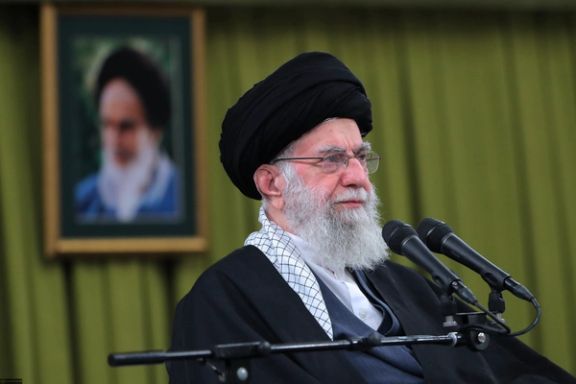
Iran's Supreme Leader Ali Khamenei, 7 November, 2024
The Islamic Republic’s Supreme Leader and other top officials, with the exception of the President, have so far refrained from commenting on the outcome of the US presidential elections and its implications for Iran.
On Thursday, Supreme Leader Ali Khamenei made no mention of the US elections in his first public speech following Donald Trump’s victory.
Instead, speaking to the members of the Experts Assembly, a council responsible for appointing his successor, he warned about the danger of “deviation” in revolutions, the current crisis in the Middle East, and promised Israel’s eventual defeat.
Khamenei repeatedly asserted in the past that the Islamic Republic would not engage in negotiations with the Trump administration. He also declined to respond to a message from Trump, delivered by the late Japanese Prime Minister Shinzo Abe in June 2019.
Some observers suggest in the media that Khamenei may now recognize the need for direct negotiations and, as a result, could adopt a more cautious tone regarding the incoming US President. This shift may stem from Iran’s severe economic challenges, a frustrated population nearing a breaking point, and escalating tensions with Israel.
“[Ruhollah] Khomeini was just as insistent on continuing the war with Iraq, but he eventually had to accept the UN Resolution that ended the war,” Mehdi, an Iranian businessman in Tehran who voted for Pezeshkian in the hope that he may succeed in lifting the Trump-imposed sanctions told Iran International.
"But for now, he will likely maintain that nothing has changed, awaiting further details on Trump’s appointments for national security adviser, secretary of state, and Iran envoy," he added. "Their significant challenge remains the vow to avenge [Qassem] Soleimani’s death."
Khomeini referred to his acceptance of Resolution 598 to end the eight-year Iran-Iraq war in 1988 as drinking a “chalice of poison”. “Khamenei has to drink the poison, too,” Mehdi said.
President Masoud Pezeshkian briefly referred to the US elections in a meeting with his campaign members Thursday. “It will never make any difference to us who wins in the US elections because our country and system rely on our internal power and our proud and great nation.”
Nevertheless, Pezeshkian emphasized that, while his government prioritizes strengthening relations with Islamic and neighboring countries, it does not hold a "closed or limited outlook" on expanding ties with other nations.
Pezeshkian’s Strategic Affairs Deputy and former foreign minister, Mohammad-Javad Zarif, who led the US negotiations resulting in the 2015 nuclear deal, expressed hope in a tweet Thursday evening that the incoming Trump and J.D. Vance administration would “stand against war as pledged” and “heed the clear lesson given by the American electorate to end wars and prevent new ones.”
In his tweet, Zarif addressed Trump and Vance directly by tagging their accounts.
“Iran, having shown its resolve and ability to stand up to any aggression, will not be swayed by threats, but will be cognizant of respect,” he wrote without mentioning Trump’s withdrawal from the nuclear deal in 2018, the draconian sanctions that he consequently imposed on Iran, or prospects for direct talks with the US.
Quoting Khamenei’s statements about Trump, ultra-hardliners have sternly warned Zarif on social media in the past two days that he must get the thought of negotiating with “Soleimani’s murderer” out of his head.
While stressing that the Islamic Republic has had “profoundly bitter experiences” with various US administrations, Foreign Ministry Spokesman Esmail Baghaei said Thursday that the US elections presented an opportunity for “revisiting and revision of misguided previous approaches”.
“What is important to Iran, and an assessment criterion, is the conduct of the US government,” he added.
Donald Trump’s victory in the 2024 US election has sent a palpable wave of desperation, masked by defiance, rippling through Iran and its regional proxies.
The President-elect has pledged to leap into action between his election on November 5 and inauguration on January 20, 2025. Traditionally, this “lame-duck” period has been one of inaction, yet the pressing military crises—one in Eastern Europe, the other in the Middle East—compel both the outgoing Biden and incoming Trump administrations to coordinate with a shared sense of urgency.
Trump’s return could signal an era of decisive US diplomacy. He has vowed to stand resolutely by Israel while assuring America’s Arab allies of their security against Iran’s regional ambitions. The ongoing conflict, ignited by Hamas’s assault on Israel on October 7, 2023, has dragged on into its thirteenth month. Trump’s pledge to “end the conflict” has left all actors, save perhaps Israel’s Netanyahu, in a state of suspense, watching keenly to see how his foreign policy could reshape the volatile dynamics of this troubled region.
Indeed, the possibility of Trump’s return to the White House has been on the minds of all factions involved in this conflict. Analysts, too, have speculated on what Trump might achieve in the Middle East. In my previous piece, What Would a Re-elected Trump Do with Iran?, I argued that his handling of the “Iran Question” would require a strategy of global engagement, one that enlists cooperation from Russia and China. Now, the key question is: How would Trump tackle Iran and its proxies in his first hundred days?
The Middle East since 2016
When Trump first took office in 2016, Iran enjoyed unmatched ascendancy in the region. Under Obama, conciliatory policies and efforts to establish the JCPOA allowed Iran to consolidate regional power, expanding influence in Iraq, Lebanon, Syria, and Yemen under the guise of fighting ISIS. By Trump’s departure in 2020, the Middle East, though not fully at peace, was on a trajectory shaped by his policies: Iran and its proxies faced sanctions and the threat of decisive strikes, such as the killing of Qasem Soleimani. The Abraham Accords, spearheaded by Trump, brought Arab states like Bahrain and the UAE into peace with Israel.
Biden’s term, by contrast, focused on attempts to negotiate with Iran and address Israeli-Palestinian tensions, with no success. Iran exploited lax sanctions enforcement to arm proxies like the Houthis, Hamas, and Hezbollah with drones and missiles. Biden’s mediation of a Saudi-Israeli accord, rooted in the Abraham Accords, showed diplomatic promise but was undermined by Hamas’s October 7 attack, backed by Iran.
A year later, Israel’s efforts to dismantle Hamas and Hezbollah have inflicted heavy damage on their resources, leaders, and infrastructure, dealing a significant blow to Iran’s regional ambitions, if more gradually than desired.
Between Biden’s lame duck period and Trump’s first 100 days
Trump’s re-emergence is an unsettling development for Iran and its proxies, while it can embolden certain leaders who, until now, were wary of Tehran’s wrath. Khamenei and his associates have responded by exhibiting a curious blend of defiance and indifference. Among Iran’s proxies, the reaction has varied: Hezbollah’s new Secretary-General, Naim Qassem, has pledged to continue the struggle against Israel while hinting at indirect ceasefire talks. Meanwhile, Iran’s IRGC deputy chief renewed Iran’s vow to retaliate recent Israeli strikes, irrespective of Trump’s victory. In the days leading up to November 5, reports emerged of Iran moving ballistic missiles to Iraq, seemingly in preparation for attacks on Israel from Iraqi soil.
Trump’s return may also inspire leaders in nations where Iran’s influence has rendered governance nearly impossible. His firm support for Israel and conservative Arab monarchies may offer vital backing to those in Iraq and Lebanon striving to throw off Iran’s yoke. Senior Shia cleric Ayatollah Ali Sistani in Iraq has issued a powerful declaration stating that only the Iraqi army has the right to bear arms, effectively rebuking Iranian-backed militias and denouncing Iran’s use of Iraqi soil to target Israel. In Lebanon, as of three weeks ago, the Lebanese Prime Minister had already rebuked Iran’s interference in Lebanese affairs, and some in the Lebanese political establishment have called for enforcing UN Security Council Resolutions 1701 and 1559, which mandate the disarmament of all militias—implicitly challenging Hezbollah’s powerful presence.
Should Trump follow through on his promise, and if the Biden administration remains committed to counter any Iranian escalation, the united resolve of both administrations may well give Iran pause. Khamenei, though far from an ideal rational actor, understands Biden’s outgoing team has little to lose by striking Iran decisively if provoked. Indeed, Iranian officials have reiterated Tehran’s ability to produce nuclear weapons at short notice.
If Khamenei were to gamble on developing and deploying nuclear weapons in the coming months, Trump would face a grave dilemma. On one hand, he has promised the American people to avoid foreign entanglements; on the other, he has vowed to prevent Iran from acquiring nuclear weapons and has assured security for Israel and Arab allies. Trump has both diplomatic and military options at his disposal, including pressuring Iran via Russia to dismantle any nuclear weapons or turn them over to Russian custody, or use advanced bombers equipped to penetrate Iran’s nuclear bunkers. However risky, such measures could likely gain Congressional support, especially from a Republican-led majority.
In conclusion, although irrational reprisals from Iran’s mullahs or their Hezbollah allies cannot be ruled out, Trump stands poised to act. With Congress behind him and the potential to broker peace between Russia and Ukraine, Trump is a formidable foe—one whom Khamenei would be wise not to underestimate. Trump’s greatest weapon remains his unpredictability, a force he wielded against Iran before and may once again deploy with lethal precision. Should Khamenei persist in his antagonism, Trump shall see him stand corrected, and in this contest, it may well be game, set, and match.
This opinion article was submitted on Nov. 6. Opinions expressed by the author are not necessarily the views of Iran International.
Satellite imagery revealed six heavy B52 bombers were moved to Qatar this week after more US forces and air defenses were already stationed in Israel ahead as Iran pledged to strike the Jewish State.
Iran has pledged retaliation for the Israeli air attacks on its missile sites on October 26, the latest direct confrontation between the regional arch-foes.
Capable of carrying large loads of munitions, the B52 deployment shown by imagery from Planet Labs indicates the United States is pushing its most powerful air assets even closer to Iran.
“All six USAF B-52 bombers at Al Udeid Air Base in Qatar. Great image from today via our friends at Planet Labs,” Hans Kristensen, Director of Nuclear Information Project, said on X.
The US has already deployed over 100 troops in addition to the THAAD missile interceptor system and dozens of fighter jets for possible interceptions.
As Iran’s Houthi militia in Yemen continues its blockade of the Red Sea region, US B52s recently bombed underground targets there.
Last month, Israel’s hours-long aerial bombardment destroyed large swathes of Iran’s air defenses, although there have been indications that the next strike could come from Iraq, suggesting a mass drone attack while the largest ballistic missiles remain in Iran. However, the Iraqi militia has missile and ballistic capabilities.
Haaretz reported that at least 12 F-15E strike fighters are bound to Jordan to build up defenses for US allies in the region following Israel's assassination of Hezbollah leader Hassan Nasrallah in an air strike in September.
The F-15Es deployment earlier “helped (Jordan) – along with the air force of Israel and other nations – to intercept the first Iranian attack on Israel on April 13, which included dozens of cruise missiles and drones, along with ballistic missiles launched at Israel,” Haaretz wrote.
After the assassination of Hezbollah leader Nasrallah in September, US Secretary of Defense, Lloyd Austin, order the USS Lincoln to stay in the region to deter Iran from an attack following Nasrallah's killing.
Additional squadrons have also since been deployed and several American missile destroyers, capable of intercepting ballistic missiles, cruise missiles, and drones, remain stationed in the Red Sea and the Mediterranean.
Israel and Iran's war of attrition broke out after a years-long shadow war in April when Iran launched an inaugural attack on the Jewish state. In retaliation for an alleged Israeli strike on the Iranian consulate in Syria, it has led to a series of direct attacks between the two archenemies.
Iranian nurses protested across Iran on Thursday leaving several facilities minimally staffed as the government fails to address the country's healthcare crisis.
Sit-ins and strikes were seen across multiple cities protesting what nurses described as a government failure to address their demands to raise salaries, pay delayed wages, and improve working conditions.
The situation reflects years of unmet promises, with wage delays now stretching up to six months. One nurse from Kermanshah, speaking to Etemad newspaper, said that many colleagues have been forced to leave public healthcare for private sector jobs or to emigrate.
Nurses in Meybod, Yazd Province, staged a protest on November 17, 2024, demanding payment of their arrears.
"There have been no improvements for us in the past three months," she said, highlighting that 18 of her 300 colleagues have left the hospital this year alone.
A video circulated on social media showed that nurses at Khomeini Hospital in Urmia held a protest on Thursday, with nurses chanting, "We've only heard promises; we've seen no action."
Mahmoud Amidi, a member of the Nurse House non-profit society, criticized security crackdowns saying some had been suspended for participating in protests or voicing concerns on social media.
"The actions taken against protesting nurses are unjust," he said, adding that such suspensions only worsen the existing nursing shortage.
Amidi said the impact of low pay and heavy workloads is having a ripple effect on the healthcare system, already at breaking point. “Who will stay in this profession for just 110 to 120 million rials ($150–$170) per month?”, he said, at least one third of Iranians already pushed below the poverty line.
The escalating protests come amid a reported shortage of 100,000 nurses across Iran’s health system, even as 50,000 trained nurses remain unemployed. Mohammad Sharifi-Moghaddam, Secretary-General of the Nursing House, warned that unless systemic issues are addressed, newly recruited nurses will likely leave the profession.
In recent months, healthcare staff have organized protests in nearly 50 cities, demanding changes to wages, workload, and working conditions. In August, a strike saw participation from nurses at 70 hospitals across Iran, a protest that lasted over a month. Since then, some 1,500 nurses have reportedly left their jobs, with 500 emigrating abroad.
As protests continue to spread across Iran’s hospitals, healthcare workers are pressing for concrete actions to address their demands. Representatives from the nursing community have warned that if conditions do not improve, strikes and other protests will likely intensify.
Donald Trump’s former special envoy for Iran is managing the president-elect's hiring for the state department, US news outlets reported, likely signaling a tough policy on Iran.
Former top State Department official Brian Hook was the target of an Iranian assassination attempt according to the FBI, leading to a beefed up security detail from the US secret service.
Hook is now expected to lead Trump’s transition team at the state department, CNN reported citing three sources familiar with the matter. Politico and the Guardian confirmed the reports.
Departing office in 2020, Hook had held out hope of diplomatic success over Iran's disputed nuclear program despite Trump’s departure from an international deal aimed at checking Tehran's progress toward a bomb.
Hook championed Trump’s heavy sanctions which hit Iran's economy and the government's finances as Trump tried to squeeze the country into submission.
“Sometimes it’s the journey and sometimes it’s the destination. In the case of our Iran strategy, it’s both. We would like a new deal with the regime. But in the meantime, our pressure has collapsed their finances,” he told the New York Times on his departure.
“By almost every metric, the regime and its terrorist proxies are weaker than three and a half years ago. Deal or no deal, we have been very successful,” he added. Iran and its armed allies across the region have been locked in conflict with US ally Israel and the administration of US President Joe Biden winds down.
Trump’s comeback has been met with caution in Iran and could mean the return of sanctions and deeper conflict.
“For Iran, it means one thing, maximum pressure,” said Jonathan Schanzer, senior vice president for research at the Foundation for the Defense of Democracies.
In addition to sanctions and withdrawing from the nuclear deal, Trump risked Iranian retaliation to assassinate Qassem Soleimani, a top Iranian military commander who had led the Islamic Republic's foreign military operations.
The drone strike which killed him in Iraq, earned Trump and his aides lasting enmity from Tehran and put Hook alongside them on an Iranian kill list, according to US law enforcement.
In March, the FBI announced it was seeking an Iranian national accused of plotting the killings of current and former US officials, including Hook.
Jason Brodsky, policy director at United Against a Nuclear Iran, told Iran International: “Personnel is policy and I think Brian heading transition efforts at the State Department is a signal that the incoming Trump administration will be reassessing US Iran policy and reviving a maximum pressure approach, which was very successful.”
Hook’s legacy leaves Iran experts such as Brodsky open to his return, while the State Department continues to put out fires from last year’s abrupt dismissal of Iran envoy Robert Malley, who accused of mishandling secret files on Iran. Details remain undisclosed amid multiple investigations, including by the FBI.
“Brian led a creative and strong Iran team when he was US special representative, and I'm pleased to see he will be involved in the transition,” Brodsky added.
Reuel Marc Gerecht, a former Iranian-targets officer in the CIA, was more cautious, however. He told Iran International: "Doing the transition isn’t doing Iran. I assume that Brian, if he is in charge of Iran policy at State [Department] would advocate what he advocated last time round. The most important questions about the nuclear program would be decided in the Oval Office."
Along with Hook, Politico reported the return of other hawks including Mark Paoletta coming in to lead transition plans for the Justice Department and former Trade Representative Robert Lighthizer dubbed to head up Trump’s economic team.
Some Iran International viewers inside the country expressed cautious optimism about Donald Trump’s re-election, hoping his return might increase US pressure on the Islamic Republic, while others remained skeptical.
All stressed that the foundation for any governmental change in Iran rests in the hands of the Iranian people, not external powers.
Their reactions were collected through anonymous direct messages to Iran International via social media platforms.
Many Iranians opposed to the Islamic Republic have expressed hope on social media that Trump will reinstate his tough stance on the Islamic government, intensifying economic and other pressures that could weaken the ruling establishment—and possibly even lead to its overthrow.
Viewers refrained from revealing their identities, citing concerns over the Islamic Republic’s recent announcement criminalizing the sharing of images, text, or audio with foreign media. Under those directives, such actions could result in prison sentences ranging from one to ten years and could be classified as "moharebeh," or “waging war against God,” a charge that could carry the death penalty.
One person said Trump’s victory is "very helpful to the people of Iran, but ultimately, we are the ones who must overthrow the Islamic Republic; no government or country in the world prioritizes our interests over its own."
Another expressed that with Democrats leaving office, the pressure on the Iranian government might increase, potentially creating "an opportunity for the Iranian people to make a move." However, they warned the system may seek compromises to safeguard power, adding: "We could see another deal with Trump, which would not benefit the Iranian people."
While Trump's previous term saw him exit the Joint Comprehensive Plan of Action (JCPOA) and pursue a maximum pressure approach, a softer approach by the Biden administration led to increased oil revenues for the government.
Some Iran International viewers questioned the faith placed in Trump’s policies, noting that American leaders act in the interests of their own citizens. "Trump, Biden, etc., all think about their own people," one viewer remarked, challenging the assumption that Trump’s policies would favor Iran’s population.
Trump’s campaign also stressed his intent to prevent Iran from advancing its nuclear program, a stance that resonated with some viewers who voiced confidence in a US leader with a firm anti-Iranian government stance.
"We are certainly happy with Trump’s election; after all, he has an anti-cleric, anti-terrorism stance," one Iranian said, referencing Trump’s past order targeting Qasem Soleimani, a high-ranking Iranian commander.
The head of Iran's Atomic Energy Organization, Mohammad Eslami, affirmed that Iran’s nuclear program would continue independently of US politics. “Our program is not affected by any comings and goings in the US,” he said.
As the dollar exchange rate climbed to over 710,000 rials in Iranian markets following Trump’s win, viewers’ opinions remained divided, with some seeing his return as a potential shift toward political upheaval in Iran, while others stressed the need for internally driven change.
The reaction among Iran International’s audience illustrates the complex spectrum of perspectives within the country, where political developments abroad intersect with deep-rooted aspirations for change — a change many believe only Iranians can ultimately achieve.