Iran threatens 'decisive' response against nuclear censure at IAEA
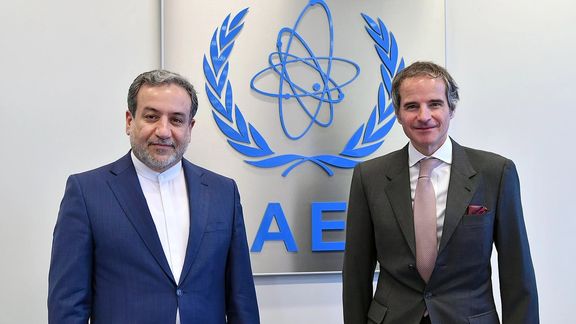
Iran's FM Abbas Araghchi and IAEA director general Rafael Grossi
Iran warned of an "immediate and decisive" retaliatory response if a widely anticipated Western-backed censure resolution is passed on Thursday and lobbied several member states of the UN's nuclear watchdog's governing body to reject it.
The foreign ministry's legal deputy was quoted by local media as saying, "We have clearly stated in advance that if the resolution is passed, we will respond decisively and immediately. The Atomic Energy Organization of Iran is prepared to implement the decision in the very hour the resolution is approved."
The United States, Germany, France and Britain are adamant to pursue a censure resolution at the quarterly meeting of the International Atomic Energy Agency for Tehran's lack of cooperation with the UN watchdog and other violations.
Foreign ministry's Kazem Gharibabadi blamed the sponsors of the resolution for disregarding Iran's recent gesture of promising to stop high-level uranium enrichment. "This move by Iran is, in fact, a response to the unconstructive approach of these few countries and their disregard for Iran's goodwill."
Gharibabadi attending a previous meeting of the IAEA in Vienna.
The Iranian foreign minister Abbas Araghchi on Wednesday called the foreign ministers of Brazil, South Africa, Bangladesh, Algeria, Burkina Faso, Pakistan - all on the Board of Governors of the International Atomic Energy Agency (IAEA) - to warn against the adoption of the resolution put forward by Western powers.
"The push by France, Britain and Germany for a resolution against Iran would only weaken and disrupt the interactional processes between Iran and the Agency," Araghchi said, according to media reports in Iran.
He called on the member states voting on the resolution to block it.
Previous voting patterns suggest that proposals backed by the main Western countries easily pass. A successful resolution could pave the way for the three European powers to trigger a "snapback mechanism" to restore UN sanctions imposed on Iran before the 2015 nuclear deal.
The planned censure is due to be approved despite Tehran offering to cap its highly-enriched uranium stock.
IAEA Director General Rafael Grossi says that Iran has agreed to freeze its uranium stockpile enriched to 60% following his request during recent talks in Tehran.
"I made a request for Iran to stop increasing the stockpile of 60%, and this was accepted," Grossi said in his report to the agency's Board of Governors in Vienna on Wednesday. The freeze would not resolve broader issues about Iran’s nuclear activities, he added.
Iran began enriching uranium up to 60% after a 2015 international deal unraveled when Donald Trump unilaterally withdrew the United States from the agreement.
“The US concerns have been all along about Iran engaging in enriching uranium to 60%. We're very concerned about it,” US alternative ambassador to the United Nations Robert Wood told Iran International on Wednesday. “I know the IAEA Board is going to be looking at this issue. We're reviewing the report of IAEA Director-General."
The IAEA’s latest confidential report confirms that Iran has made preparations to cap its stockpile at around 185 kg, according to Reuters. Iran also agreed to consider accepting the appointment of four additional experienced IAEA inspectors after having banned around one third last year.
Iran’s foreign minister has been reaching out to his counterparts and the head of the UN nuclear watchdog ahead of the agency's Board of Governors' expected passage of a censure resolution against Tehran.
In a phone call with South African counterpart Ronald Lamola on Wednesday, Abbas Araghchi warned that the resolution proposed by three European powers at the IAEA’s Board of Governors meeting would further complicate the situation.
The censure resolution against Iran was officially added to the Board's agenda on Tuesday night. France, Britain, Germany, and the United States are set to present the resolution during Wednesday’s meeting.
Araghchi also reiterated the sentiment in a phone call with the IAEA chief Rafael Grossi, saying that “if the other parties disregard Iran's goodwill and cooperative approach and pursue unconstructive actions by issuing a resolution at the IAEA Board of Governors meeting, Iran will respond in an appropriate and proportional manner."
In another phone call with French Foreign Minister Jean-Noël Barrot Tuesday night, he also said that if Iran's seek confrontation during the BoG meeting, the Islamic Republic will respond appropriately.
“This measure by the three European countries is in blatant contravention of the positive atmosphere created in the interaction between Iran and the Agency,” the Iranian foreign minister told his French counterpart. “It will only make matters more complicated.”
Previous voting patterns suggest that proposals backed by the key Western countries easily pass. A successful resolution could be a catalyst for France, Britain and Germany to trigger a so-called "snapback mechanism" to restore UN sanctions imposed on Iran before a 2015 multilateral nuclear deal.
The United States remains tightly coordinated with its European partners in advance of the IAEA Board of Governors meeting and strongly supports efforts to hold Iran accountable, State Department spokesperson Matthew Miller told Iran International, urging Tehran to cooperate with the IAEA.
A proposed censure of Iran for its lack of cooperation with the UN nuclear watchdog raises important questions at a critical time after Donald Trump’s reelection when Tehran faces regional weakness, economic pressure and Israel.
France, Britain, Germany, and the United States will introduce the resolution at Wednesday's meeting of the International Atomic Energy Agency (IAEA) Board of Governors, Iran International has learned.
Iran and nuclear experts agree on one thing: Trump’s return to the White House will have an impact on the Islamic Republic, but whether and how the incoming administration and the Islamic Republic may engage on the nuclear issue is up for debate.
The Iranian establishment has concern over the censure because of the approaching October 20, 2025 deadline for UN restrictions to be fully lifted. That’s when most restrictions against Tehran's nuclear program will be removed under the UN Security Council Resolution 2231, and the West will no longer be able to apply “snapback” sanctions.
A prior censure was made in June of this year, but it didn't seem to make any difference, however, experts point out the political climate was different a few months ago.
The Europeans could activate or trigger the mechanism, bringing back all of the previously lifted UN sanctions.
Sina Azodi, a professor and researcher at George Washington University, told Iran International that the Islamic Republic would try to avoid internationally mandated sanctions from a political standpoint because it doesn’t serve their interests.
“Iran is under sanctions, but they are US unilateral sanctions. They are not internationally mandated sanctions of the United Nations. From a political standpoint, Iran would try to avoid a snapback of UN sanctions, especially since they're less than a year away from those sanctions to be completely lifted,” said Azodi who specializes in Iran's nuclear and foreign policies.
Iran’s Foreign Minister Abbas Araghchi made comments on Iranian State TV Saturday suggesting that a diplomatic route on Iran’s nuclear ambitions still exists.
"We believe the window for diplomacy is still open, albeit for a short time, provided the other parties demonstrate genuine willingness. Without such commitment, we will pursue an alternative course, "said Araghchi.
Araghchi also said that Iran’s intentions were conveyed to the IAEA chief Rafael Mariano Grossi during his latest trip to the Islamic Republic last week. Iran offered not to expand its stockpile of uranium enriched up to 60% during his visit.
Gregory Brew, an Iran analyst with the Eurasia Group, noted that while Iran appears to signal a willingness to make concessions, it insists on doing so strictly on its own terms.
“Iran will deal, but only if they get what they want—sanctions relief—without having to make sweeping concessions on either their program or other elements of their foreign policy,” said Brew.
Despite the rhetoric, Iran’s actions are proving otherwise.
Tehran has increased its stockpile of enriched uranium to near weapons-grade levels, according to the Associated Press, which viewed a confidential report by the United Nations' nuclear watchdog Tuesday.
Uranium enriched at 60% purity is just a short step away from weapons-grade levels of 90%.
With Trump’s second term around the corner – and Iran’s deterrence proxies Hamas and Hezbollah taking a severe blow by Israel – that leaves Tehran in a predicament.
Does it double down towards nukes or try to deal with the future president, which US intelligence reports say Iran tried to assassinate?
Brew said Trumps’ return was always an element of thinking for Iran, but they are still playing it the same as with the Biden-Harris administration, wanting sanctions relief and will - as he described it - play it nice - until 2231 resolution expires. Then Iran can likely negotiate without JCPOA commitments.
Andrea Stricker, the Deputy Director and Research Fellow at FDD’s Nonproliferation & Biodefense Program, told Iran International that if Tehran makes concessions, it’s because of the incoming US president's use of peace through strength and maximum pressure.
“Tehran sees the writing on the wall that with Trump coming back into office and the E3 also prepared to increase pressure against the regime, that snapback is likely inevitable. It will seek to evade restored sanctions with the help of its patrons Russia and China, and its partner North Korea,” said Stricker.
Stricker said Trump’s maximum pressure will force Iran to tone down its nuclear ambitions and aggression in the region and that if a deal is possible, it would only be due to maximum pressure and fear of Trump.
She said Iran is fearful of Trump who ordered the assassination of General Qasem Soleimani in a targeted strike in Iraq in 2020, withdrew from the Iran nuclear deal, and re-imposed sanctions aimed at cutting Iran's oil sales to zero.
The reported enrichment of uranium stockpiles, Stricker views, as a form of blackmail to the West to prevent the censure and the snapback on UN sanctions.
“It's too little, too late,” she added.
Azodi told Iran International that Tehran has historically reacted with anger to IAEA resolutions. Based on Iran’s behavior, Azodi sees a strong possibility that Tehran would expand their nuclear program to increase the number of centrifuges and inaugurate a new centrifuge center, but he refers to it as a diplomatic play – and not a serious ploy for a bomb.
He’s doesn’t believe Iran would go for a bomb, citing that Israel and the US would do everything in their power to prevent it.
Israeli Prime Minister Benjamin Netanyahu and Trump have repeatedly said that they would not allow Iran to become a nuclear power.
With that knowledge, Azodi said a dash for the bomb would put Iran in a position of an attack - a risk he believes the Islamic Republic would not take for its own survival. Rather, some sort of a deal is more likely.
The Financial Times recently reported that Trump intends on bankrupting Iran to force Tehran to drop its nuclear program and stop funding regional proxies.
Prior to winning the US presidential election, Trump appeared on an American podcast show with host Patrick Bet-David saying he would like Iran to be successful.
“I would like to see Iran be very successful. The only thing is, they can't have a nuclear weapon,” said Trump.
Stricker believes Tehran's rulers are intimidated by Trump, seeing the potential for a deal through his strategy of maximum pressure. Azodi, on the other hand, argues that Trump's interest in striking a deal with Iran is not driven by diplomatic or ideological motives but by a desire to secure his place in history.
Iran promised to cap its stock of near weapons grade nuclear fuel on condition that no censure resolution will be issued at a Wednesday meeting of the UN nuclear watchdog, Reuters said citing reports to the body's member states.
The confidential reports by the International Atomic Energy Agency (IAEA) say Tehran has made preparations to cap the stockpile at around 185 kg (407 lbs). Iran also agreed to consider accepting the appointment of four additional experienced IAEA inspectors.
However, diplomats told Reuters that Western powers are pushing for the censure resolution at the IAEA Board of Governors meeting despite Iran's reported offer. The Wall Street Journal also quoted sources as saying that France, Britain and Germany (known as the E3) will move forward with the resolution in the Wednesday meeting.
Previous voting patterns suggest that proposals backed by the key Western countries easily pass. A successful resolution could be a catalyst for France, Britain and Germany to trigger a so-called "snapback mechanism" to restore UN sanctions imposed on Iran before a 2015 multilateral nuclear deal.
US to support efforts to hold Iran accountable
The United States is going to remain tightly coordinated with its European partners in advance of the IAEA Board of Governors meeting and strongly supports efforts to hold Iran accountable, State Department spokesperson Matthew Miller told Iran International, urging Tehran to cooperate with the IAEA.
The decision comes despite Iran's pledge to retaliate if such a resolution is adopted.
"If the IAEA Board of Governors passes a censure resolution against Iran, the Islamic Republic will undoubtedly take reciprocal action and implement new measures in its nuclear program, which they will certainly not like," Iran's Foreign Minister Abbas Araghchi told the state TV on Saturday.
Unconfirmed media reports in Tehran say Iranian authorities have threatened to "activate a significant number of advanced centrifuges and may inject gas into these centrifuges" if the resolution is passed.
This is not the first time Iran has sought to dissuade the IAEA Board of Governors from adopting censure resolutions. In March 2023, Iran told the IAEA it was committed to resolving issues around sites where inspectors have concerns about possible undeclared nuclear activity and to allow the IAEA to “implement further appropriate verification and monitoring activities.”
However, Tehran did not cooperate with the UN nuclear watchdog and even withdrew the accreditation of several inspectors assigned to conduct verification activities in Iran under the Non-Proliferation Treaty Safeguards Agreement in September 2023.
France, Britain, and Germany repeatedly attempted to rally support for a censure resolution at the Board of Governors, according to the Wall Street Journal, but their efforts were blocked by the Biden administration. In June 2024, the UN nuclear watchdog’s 35-member board of governors censured Iran for failing to cooperate with the agency.
Sharp rise in Iran's stockpile of nuclear fuel
The IAEA reports to member states cited by Reuters show that Tehran's stock of uranium enriched to up to 60% had grown by 17.6 kg since the previous report to 182.3 kg as of Oct. 26, which is enough for four nuclear weapons, according to an IAEA yardstick.
While Iran denies seeking nuclear weapons, the Islamic Republic's authorities have in multiple instances suggested that the country may change its nuclear doctrine if deemed necessary.
The IAEA Board of Governors' meeting on Wednesday will be the last quarterly Board meeting before US President-elect Donald Trump takes office in January.
Trump who withdrew the US from a nuclear deal with Iran in 2018, has vowed to restore his so-called maximum pressure against Iran and stop the country from acquiring a nuclear weapon.
Presidential aide and former foreign minister Mohammad-Javad Zarif accused Israeli Prime Minister Benjamin Netanyahu of undermining the 2015 nuclear deal and fueling regional conflicts, in a rare video message directed at Jews worldwide.
In the Monday video message, published on Zarif’s X and Instagram accounts, the Iranian vice-president for strategic affairs said the deal, officially known as the Joint Comprehensive Plan of Action (JCPOA), “could have been the foundation of a new era of peace, tranquility, regional cooperation, and freedom from threats, conflicts, and escalating tensions.”
“However, before too long, Netanyahu and his Zionist and extremist cohorts succeeded in their satanic effort to rob the region and the world of this historic opportunity, standing on the wrong side of history,” Zarif said. “The agreement would have ensured that the ‘wolf’ this habitual liar was always ‘crying’ about, would never come to town.”
In the video, Zarif appears as a peace-loving, compassionate politician, calling for peace and harmony, while he spent most of his career as a diplomat representing and defending the Islamic Republic's domestic authoritarian rule and aggressive, anti-Israel and anti-West policies.
Over the years, Zarif’s attempts to deny or explain away human rights violations in Iran have led to a lot of attacks by critics who say he has been whitewashing the Islamic Republic’s record. The same can be said about his defense of Tehran’s policies in the region, its role in the Syrian civil war, and support for militant groups in the region.
Back in 2022, Netanyahu called the JCPOA a “horrible agreement because it allowed Iran basically with international approval, to develop a nuclear and basically an atomic arsenal paved with gold, with hundreds of billions of dollars of sanction relief.”
Before Donald Trump withdrew the United States from the JCPOA in 2018, the International Atomic Energy Agency had extensive inspection powers that it used to verify Tehran’s compliance with strict enrichment limits. Since 2019, Iran has responded to US ‘maximum pressure’ sanctions by boosting the nuclear program far beyond JCPOA limits, with some estimates suggesting that the country’s nuclear weapon breakout time is “just a week”.
Zarif’s Monday message seemed to be mirroring Netanyahu's years-long series of videos addressed directly to Iranians. In his latest message released last Tuesday, Netanyahu said Iran's clerical rulers fear their own people more than anything.
"There’s one thing Khamenei's regime fears more than Israel. It’s you – the people of Iran. They spend so much time and money trying to crush your hopes and curb your dreams," he added. "Don't let your dreams die. Don't lose hope and know that Israel and others in the free world stand with you.”
Zarif, who is known as the architect of the JCPOA, is defending the nuclear deal at a time when his government is expressing its willingness to resume negotiations over its nuclear program as US President-elect Trump is expected to restore his so-called maximum pressure policy against Tehran.
France, Britain, Germany, and the United States are expected to introduce a censure resolution against Iran at the upcoming meeting of the IAEA Board of Governors despite Tehran's threats to retaliate, a German foreign ministry spokesperson confirmed to Iran International on Monday.
The decision by the US and its European allies to move forward with the censure resolutioncomes despite Iran's threat to retaliate if such a resolution is adopted.
Iran allowed Grossi and his team to tour Fordow and Natanz, two key nuclear sites, on Friday apparently in hopes that it would convince the Board of Governors not to move forward with the censure resolution. However, that strategy does not seem to have worked.
“Iran has not fulfilled its obligations under the NPT and Safeguards Agreements. The recent visit of IAEA Director General Rafael Grossi to Tehran has not changed this assessment," the German foreign ministry spokesperson told Iran International.
France, Britain, Germany, and the United States will introduce a censure resolution against Iran at the upcoming meeting of the International Atomic Energy Agency (IAEA) Board of Governors despite Tehran's threats to retaliate, Iran International has learned.
The resolution seeks to formally rebuke Tehran over its failure to cooperate with the UN nuclear watchdog and urges the Islamic Republic to take appropriate steps in this regard, a German Foreign Ministry spokesperson told Iran International on Monday.
The decision by the US and its European allies to move forward with the censure resolution comes despite Iran's threat to retaliate if such a resolution is adopted.
"If the IAEA Board of Governors passes a censure resolution against Iran, the Islamic Republic will undoubtedly take reciprocal action and implement new measures in its nuclear program, which they will certainly not like," Iran's Foreign Minister Abbas Araghchi told the state TV on Saturday.
The IAEA Board of Governors will convene its regular November meeting in Vienna at 10:30 CET on Wednesday, 20 November. Board discussions are expected to include verification and monitoring in Iran in light of United Nations Security Council resolution 2231 (2015) as well as the NPT safeguards agreement with Tehran, according to an IAEA press release.
The meeting will be held one week after the IAEA director general met Iran's President Masoud Pezeshkian in Tehran. In the meeting, Pezeshkian said Iran was prepared to cooperate with the UN nuclear watchdog to clear up "alleged ambiguities about the peaceful nuclear activity of our country".
Iran allowed Grossi and his team to tour Fordow and Natanz, two key nuclear sites, on Friday apparently in hopes that it would convince the Board of Governors not to move forward with the censure resolution. However, that strategy does not seem to have worked.
“Iran has not fulfilled its obligations under the NPT and Safeguards Agreements. The recent visit of IAEA Director General Rafael Grossi to Tehran has not changed this assessment," the German foreign ministry spokesperson told Iran International.
Algeria, Argentina, Armenia, Australia, Bangladesh, Belgium, Brazil, Burkina Faso, Canada, China, Colombia, Ecuador, Egypt, France, Georgia, Germany, Ghana, India, Indonesia, Italy, Japan, South Korea, Luxembourg, Morocco, the Netherlands, Pakistan, Paraguay, Russia, South Africa, Spain, Thailand, Ukraine, Britain, the US, and Venezuela are the 35 members of the Board of Governors for 2024-2025.
According to the Rules and Procedures of the Board of Governors, decisions on most matters require a simple majority vote of the Members present and voting. However, certain key decisions, such as those related to the Agency's budget, the appointment of the Director General, and the reconsideration of proposals or amendments, require a two-thirds majority vote.