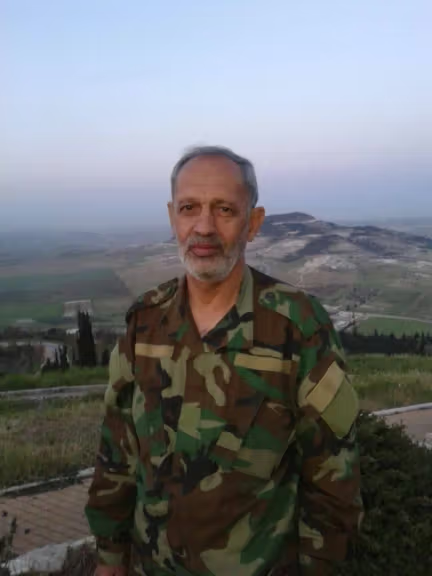
Kioumars Pourhashemi, a senior commander of Iran's Revolutionary Guards (IRGC)
A senior commander of Iran's Revolutionary Guards (IRGC) was killed in Syria's Aleppo province during an overnight attack by Islamist forces opposed to the Syrian government, Iranian media reported Thursday.
Brigadier General Kioumars Pourhashemi, also known as Haji Hashem, was a senior military advisor in Syria, the IRGC-affiliated Tasnim News reported, adding that he was killed by “Takfiri terrorists,” a term widely used in Shiite-majority Iran to refer to jihadists or supporters of radical Sunni Islam.
Islamist militants from US-designated Hayat Tahrir al-Sham (HTS) and allied rebel groups launched an offensive on Wednesday, seizing control of several towns and villages in northwest Aleppo province, a region under the control of Iran-backed supporters of the Bashar al-Assad government.
The attack marks the most significant operation since March 2020, when a ceasefire negotiated by Russia, a key ally of Assad, and Turkey, a supporter of the rebels, brought an end to years of fighting that had uprooted millions of Syrians opposed to Assad's rule.
The Syrian army reported heavy losses among the attackers, whom it described as "terrorists" operating across a broad front. The army also said it was working with Russia and unnamed "friendly forces" to regain territory and reestablish previous lines of control.
The UK-based Syrian Observatory for Human Rights reported that at least 130 people have been killed in the fighting, including 65 members of the HTS, 18 allied fighters, and 49 Syrian government soldiers.
Referring to the Wednesday attack, Iran's Foreign Minister Abbas Araghchi said the unrest in Syria was part of a US-Israeli design aimed at destabilizing the region’s security, during a phone call with his Lebanese counterpart Abdullah Bou Habib, Iran's Foreign Ministry quoted him as saying.
Russian warplanes, alongside Syrian fighter jets, have bombarded opposition positions near the Turkish border as part of efforts to repel the attack, Reuters reported on Thursday.
Syrian opposition forces are said to be operating near Aleppo within the boundaries of the Idlib de-escalation zone established in a 2019 agreement between Russia, Iran, and Turkey, the Reuters report added citing Turkish security sources.
Attorneys representing six young protesters sentenced to death for allegedly killing a Basij militia member are preparing to appeal the verdicts, according to one of the lawyers.
The defendants' attorneys are also collectively preparing to lodge a complaint with judicial authorities about the anomalies in the trial and sentencing process, lawyer Payam Derafshan announced on X on Tuesday.
The anomalies included returning the defendants to prison while on bail only a few days before the sentencing and abruptly assigning the two investigating judges who issued the arrest warrants to the case.
The six young men were among 50 residents of the Shahrak-e Ekbatan housing complex in western Tehran, arrested in connection with the severe beating of Arman Aliverdi, a pro-establishment seminary student and a Basij militia member, at the height of the Woman, Life, Freedom protests of 2022.
Aliverdi was attacked by enraged protesters who suspected him of infiltrating their ranks. He succumbed to his injuries in the hospital two days later. Authorities have labeled Aliverdi a "martyr" and have heavily leveraged his death in state propaganda against the protesters.
The Basij maintain four bases within the five square kilometer complex which has been a hotbed of protests since 2022, heavily manned by plainclothes security agents. They often fired their guns at windows, raided apartment lobbies, and destroyed property to intimidate residents.
Dissident activist Hossein Ronaghi protesting the death sentences in Shahrak-e Ekbatan with sewn lips
In the wake of the announcement of the death sentences, security forces have increased their presence in the neighborhood. A popular dissident X account, reported on Tuesday that plainclothes agents on motorbikes were patrolling the area doing random searches of residents and their phones.
Hossein Ronaghi, a dissident activist who sewed his lips in protest last week and has been holding daily protests in various areas of Tehran since then, staged a brief one-man sit-in on Friday in the area, protesting the death sentences.
The defendants, Milad Armoon, Alireza Kafa’i, Amir Mohammad Khosh Eqbal, Navid Najaran, Hossein Nemati, and Alireza Barmarzpournak, were sentenced to death on November 13 by the magistrates of Branch 13 of the Criminal Court One.
Four of the defendants sentenced to death have also been indicted for "muhariba" (waging war against God), which also bears a death sentence. All of the accused have also been charged with “propaganda against the system” and similar charges for which they will be tried separately.
Two of the three magistrates of Branch 13 of Criminal Court One voted for a death sentence. The presiding magistrate, Babak Paknia, however, opposed it.
Paknia maintains that confessions in custody, on which the death sentences were based, are not valid unless repeated in court. During the trial, the accused denied involvement in the beatings that led to Aliverdi’s death.
Iranian officials celebrated the recent ceasefire between Israel and Hezbollah as a victory, in spite of the Iran-backed group being at its weakest point since its foundation over 40 years ago.
Foreign Minister Abbas Araghchi said Thursday that Hezbollah had “shattered the myth of Israel's invincibility” during the conflict, forcing Israeli Prime Minister Benjamin Netanyahu to beg for peace despite extensive US support.
“Over the past year, Netanyahu has drained American taxpayers of tens of billions of dollars for his war crimes and enjoyed full military and political support from the US government," he said on X.
“However, after suffering heavy losses in southern Lebanon, he was forced to beg for a ceasefire. Once again, Hezbollah has shattered the myth of Israel's invincibility."
He did not mention anything about the assassination of the group's top leadership, including long-time leader Hassan Nasrallah, killed in a precision strike in Beirut in September. Around 3,000 Hezbollah operatives are also believed to have been killed in the operations, according to the Israeli military. According to Reuters, the number could be as many as 4,000.
Araghchi also framed the ceasefire as a turning point, urging Israel to recognize its defeats in both Gaza and Lebanon.
In Gaza, Israel has also dealt critical blows to Iran-backed Hamas with the group splintered into a guerrilla force after more than a year of Israeli bombardment has destroyed masses of its infrastructure. The Israeli military asserts that over 17,000 Hamas operatives have been killed since last year's offensive began.
At least 1,500 Hezbollah operatives, Iran's largest ally in the region, were also killed in a two-day operation by Israel which saw simultaneous explosions of walkie-talkies and pagers, an attack which seriously hindered the group, deemed a "terrorist" organization in countries such as the UK and US.
On Wednesday, a US- and France-brokered 60-day ceasefire between Israel and Hezbollah took effect, aiming to halt 14 months of intense conflict sparked by the Gaza war. Hezbollah has, since October 8 last year, fired over 17,000 projectiles towards Israel in support of Hamas in Gaza, which invaded Israel on October 7 last year.
The agreement mandates a 60-day cessation of hostilities, during which both Israeli and Hezbollah forces are to withdraw from southern Lebanon, with the Lebanese army and UN peacekeepers assuming control of the area.
The Commander-in-Chief of the Islamic Revolutionary Guards Corps echoed the Iranian claims of victory. "The ceasefire on the Lebanese front is a strategic and humiliating defeat for the Zionist regime which did not even come close to achieving any of its evil goals and ambitions in the war against Hezbollah," he said, according to Iran's Press TV.
Following the Israeli ground incursion last month, many Hezbollah cadres fled southern Lebanon.
Fighters had “left the area” without demonstrating “meaningful defensive operations”, according to the Institute of the Study of War (ISW), a US-based conflict think tank.
A report by the NGO said: “Hezbollah fighters do not appear to be defending against Israeli forces in these [southern] villages as the Israeli forces have consistently encountered weapons caches and infrastructure formerly used by Hezbollah fighters that left the area”.
The institute said it was “unclear why Hezbollah is not conducting meaningful defensive operations in response to Israel’s ground operations”.
Some Iranians on social media are making fun of the claims of victory, enumerating Hezbollah's losses and Tehran's own requests for a ceasefire.
New Zealand has announced new sanctions against Iranian actors supplying military support to Russia, coinciding with a week in which Moscow set a record for deploying Iranian drones to strike civilian targets in Ukraine.
The latest sanctions package is designed to address the use of chemical weapons on Ukraine's frontlines but also extends to those implicated in the transfer of arms to Russia for deployment in the conflict, according to the New Zealand Foreign Ministry.
The sanctions target seven individuals and five entities, with six of the individuals being Iranian nationals. These include Ali Jafarabadi, Head of Iran's Space Command within the Islamic Revolutionary Guard Corps Aerospace Force (IRGC-ASF), and Hamid Reza Sharifi Tehrani, a member of the Board of Directors of Qods Aviation Industries.
Others named are Mohammad Reza Mohammadi, Mohammad Sadegh Heidari Mousa, and Mohsen Asadi, all members of the Board of Paravar Pars Company. Additionally, Seyed Hamzeh Ghalandari, Director General for International Relations of Iran’s Ministry of Defence and Armed Forces Logistics (MODAFL), is also listed.
“Transfers of Iranian weaponry facilitates Russia’s illegal war of aggression against Ukraine. New Zealand condemns those who are providing support,” Foreign Minister Winston Peters said on Thursday.
These sanctions come amid intensified Russian drone offensives in Ukraine, where Iranian-made Shahed suicide drones have caused significant damage to infrastructure and residential areas.
“The enemy launched a record number of Shahed attack UAVs and unidentified drones,” Ukraine's air force said Tuesday in a statement reported by Reuters.
Known for their low cost and destructive capability, these drones have been extensively deployed to target Ukrainian energy facilities and civilian areas. Ukrainian authorities have described the latest wave of attacks as the most extensive use of Shahed drones to date.
International criticism of Iran’s role in the conflict has grown. Earlier this week, the G7 and the European Union issued a joint statement condemning Iran’s arms transfers to Russia and its missile activities in the Middle East, highlighting the broader destabilizing impact of Tehran’s actions.
Similarly, in September, the G7 condemned Iran, declaring, "Iran must immediately cease all support to Russia's illegal and unjustifiable war against Ukraine and halt such transfers of ballistic missiles, UAVs, and related technology." The statement underscored the broader implications of these actions, identifying them as a direct threat to Ukraine, European stability, and global security.
New Zealand’s sanctions align with similar moves by other nations, reinforcing global efforts to address Iran’s military collaboration with Russia and its impact on Ukraine’s sovereignty and regional stability.
Observers and commentators in Iran remain cautiously optimistic about the upcoming talks with the United Kingdom, France, and Germany regarding the country’s contentious nuclear program. However, dissenting voices persist.
The talks scheduled for November 29 were announced following a resolution by the UN nuclear watchdog, the IAEA, condemning Tehran's lack of transparency and violations of its obligations under the 2015 nuclear deal with world powers.
While the United States has stated it will not participate in the November 29 talks, some Iranian observers, including Mahmoud Abbaszadeh Meshkini, a former member of the Iranian parliament's foreign policy and national security committee, have expressed skepticism. Meshkini remarked, "Europeans do not make decisions on Iran's nuclear program independent of the United States. Their foreign policy aligns with US policies and priorities."
Former lawmaker Mahmoud Abbaszadeh Meshkini
Meshkini warned that Iran should not enter the talks without a clear objective, adding that Tehran should avoid "negotiations for the sake of negotiating."
The hardline daily Kayhan, closely aligned with the office of Supreme Leader Ali Khamenei, has emphasized that "while the talks are essential, the Pezeshkian administration should not be involved in the negotiations." Kayhan criticized the government for ignoring "the Europeans' hostile actions against Iran and the IAEA's recent resolution, which was drafted by the very countries Iran plans to negotiate with."
The paper further accused the administration of "repeated retreats" from its positions while the West continues to disregard the Pezeshkian administration's "optimistic overtures." It also noted that European nations have failed to acknowledge Pezeshkian's victory in Iran's presidential election. Kayhan warned that some might view the government's approach as "a treacherous disregard for past experiences that have harmed Iran's national interests."
The daily characterized "negotiations with Europe as a mistake" and reiterated that talks with the EU-3 are bound to fail.
The firebrand editor of Kayhan Hossein Shariatmadari
The upcoming negotiations are set to take place two years after the last round of talks between Iran and European nations. However, this is not a high-level meeting, as deputy foreign ministers are scheduled to discuss "a range of bilateral, regional, and international issues," according to the Iranian Foreign Ministry spokesperson.
The broad scope of the talks suggests that the agenda extends beyond Iran's nuclear program. Meanwhile, the moderate news outlet Khabar Online described the talks as an effort by Iran to reduce tensions with Europe.
Iranian media have also lauded the role of former Majles Speaker Ali Larijani, now a senior adviser to Supreme Leader Khamenei, in shaping diplomatic developments with Europe and the Middle East. Larijani was the first to propose negotiating with Europe and the United States in recent weeks. Observers have also noted his involvement in brokering the cease-fire between Hezbollah and Israel.
Politician Ali Mohammad Namazi told Nameh News website that Larijani went to Syria and Lebanon with an important mandate from Khamenei and conducted some successful negotiations. Namazi said that Larijani's political comeback was significant and meaningful. He added that what brought him back to the forefront of Iranian politics included the prospect of a change in relations between Iran and the United States, and the tensions in Lebanon and Gaza that brought Iran very close to an all-out war with Israel.
He highlighted Larijani's experience as a former secretary of the Supreme Council of National Security from 2005 to 2007 and suggested that Pezeshkian, who maintains good relations with Larijani, should consider asking him to assume that role once again for Iran.
Reformist figure Mohammad Ali Abtahi echoed this sentiment, describing Larijani's recent mission to Lebanon as marking "a strategic shift in Iran's foreign policy" in the region. Similarly, another reformist, Mohammad Atrianfar, argued that Larijani should be reappointed as the secretary of Iran's Supreme Council of National Security, citing his pragmatic approach and his potential to facilitate the resumption of ties between Iran and the United States.
Over nine out of every ten barrels of oil Iran exports are sold to China and often at steep discounts, a senior Iranian trade official said, adding that the dependence risks captivity in “colonial trap”.
The remarks were rare criticism by Iranian officialdom of the budding cooperation between a deeply isolated Islamic Republic and nuclear-armed economic powerhouse China.
Sanctions have left Tehran heavily dependent on China, the world's top oil importer, forcing it to navigate costly logistical hurdles to evade US-led restrictions.
“These sanctions have trapped us in a nineteenth century colonial trap, leaving the government no choice but to manage the economy at significantly higher costs than normal,” said Hojatollah Mirzaei, head of the Research Center at the Iran Chamber of Commerce.
Around 92 percent of Iranian oil goes to China, often at discounts at around 30 percent, according to Mirzaei, who bemoaned the fact that his country has little say over the transactions.
“China dictates how payments are made,” he said. “They might say, ‘use this money to buy electric buses at the price we set.’ Then Tehran’s municipality proudly announces, ‘We brought you electric buses.’”
He underlined the economic strains during a budget review session on Wednesday.
“More than half the value of each barrel is consumed in circumventing sanctions,” Mirzaei said, in apparent reference to the added expense of shipping and insuring the covert oil exports.
China has continued to purchase Iranian oil, despite US sanctions. The oil is transferred using "ghost fleets", vessels with switched off transponders and concealed ownership.