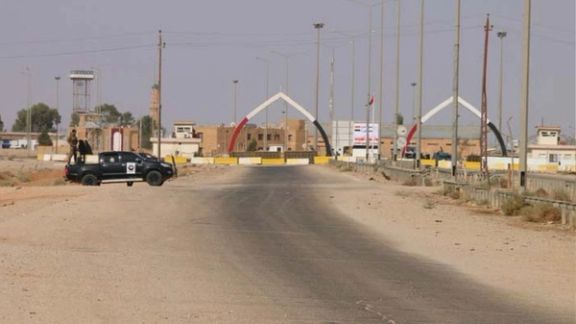
Syrian rebels seize Iraqi crossing, choking Iranian lifeline to Hezbollah
Al-Bukamal Border Crossing
US-backed Syrian Democratic Forces (SDF), an alliance of Syrian Kurdish fighters, seized the eastern city of Deir ez-Zor and a nearby Iraqi-Syrian border crossing used by Iran to arm Lebanon's Hezbollah, Reuters reported on Friday.
Syrian rebels seize Iraqi crossing, choking Iranian lifeline to Hezbollah | Iran International
The Al-Bukamal crossing fell under SDF control on Friday, Reuters said citing two Syrian army sources. The border crossing in Deir ez-Zor was a key channel used by the Quds Force of the Islamic Revolutionary Guard Corps (IRGC) to transport weapons to Lebanon through Syria.
Losing the Iraqi crossing could represent a huge blow to the regional hegemony Iran built up in the wake of the US invasion of Iraq and effectively split a so-called Shi'ite crescent spanning from the Iranian plateau to the Mediterranean.
It had united the Islamic Republic with armed co-religionists which included Iraq's Shi'ite-led government, a kaleidoscope of militias there propping it up, the Syrian government under decades of Assad family rule and Hezbollah.
The region is home to multiple military bases of Iran-backed Shi'ite militia forces from neighboring Iraq and as far afield as Afghanistan. Local activists said the Syrian army and Tehran-backed forces had pulled out of Deir el-Zor before the SDF advance.
Deir ez-Zor is the third city to slip from President Bashar al-Assad's grasp in a week. Syrian opposition forces earlier captured the cities of Aleppo and Hama and are moving closer to capturing Homs, potentially threatening the capital Damascus and Assad’s rule.
Monitoring group the Syrian Observatory for Human Rights on Friday reported clashes in the southern city of Daraa near the border with Jordan, saying local armed groups seized multiple positions belonging to the Syrian government.
Anti-government forces also captured a key Syrian army base in Daraa known as Liwa 52, Reuters reported citing two sources among opponents of Bashar al-Assad. The report said the opposition forces also seized part of the Nasib crossing on the Syria-Jordan border.
Rebels also seized the central prison of As-Suwayda Governorate in southern Syria, releasing all its inmates, according to Sky News Arabia.
Hassan Abdolghani, one of the commanders of the rebels opposing Assad, called on Syrian army forces to withdraw from Homs and Damascus in a video statement. He also urged senior Syrian military officers to defect from the army.
For over a decade, Syria's civil war saw minimal changes in frozen front lines. However, insurgents from the northwestern Idlib region, led by the former Al-Qaeda affiliate Hayat Tahrir al-Sham (HTS), have made stunning gains, marking the swiftest advances since the conflict began 13 years ago.
Russia has no plan to save Assad
Assad regained much of Syria with the help of Iran, Russia, and Hezbollah, but all three have recently been distracted by other crises. This has created an opportunity for Sunni Muslim rebels to regroup and strike back.
"The IRGC established a land connection between the Resistance, linking Iran to Iraq, Iraq to Syria, and Syria to Lebanon. Today, you can get in a car in Tehran and disembark in the southern suburbs of Beirut," former IRGC Quds Force chief Qassem Soleimani had said in a 2019 speech.
Iran plans to send weapons and personnel to Syria, a senior Iranian official said on Friday. However, Russia doesn’t have a plan to save Assad and doesn’t see one emerging as long as the Syrian president’s army continues to abandon its positions, Bloomberg reported Friday citing a person close to the Kremlin.
Russia has launched a number of airstrikes against Syrian rebels over the past week; however, it has informed the Assad government that any intervention will be limited as it has other priorities at this time, Sky News Arabia reported Friday.
The Russian embassy in Damascus has advised citizens in the country they are still able to leave on commercial flights, amid fears that the Syrian capital may be the next city to fall.
Iran plans to send weapons and personnel to Syria, a senior Iranian official said on Friday, as rebel forces advanced rapidly toward Homs, potentially threatening the capital Damascus and Bashar al-Assad’s rule.
Such a move would underscore the urgency the Islamic Republic sees in the declining fortunes of its main Arab ally after the Tehran-armed Lebanese Hezbollah militia limped to a ceasefire with arch-foe Israel last month.
“Tehran will provide military equipment, missiles, and drones, while increasing the number of advisers and deploying forces as needed,” Reuters cited an Iranian official as saying.
“Intelligence and satellite support are also being provided to Syria.”
Iran-backed Hezbollah sent an unspecified number of fighters into Homs to help Assad’s government according to Lebanese security sources and Syrian officials cited by Reuters, adding that small units crossed into Syria overnight and took up defensive positions in the city.
After capturing the northern city of Hama on Thursday, hardline Islamist-led rebels were closing in on Homs, a strategic crossroads which links Syria’s capital Damascus to the coastal regions dominated by Assad’s Alawite minority and home to Russia’s key naval and air bases.
Its capture would deal a severe blow to Assad’s remaining forces.
For over a decade, Syria's civil war saw minimal changes in frozen front lines. However, insurgents from the northwestern Idlib region, led by the former Al-Qaeda affiliate Hayat Tahrir al-Sham (HTS), have made stunning gains, marking the swiftest advances since the conflict began 13 years ago.
Assad's allies face diversions
Assad regained much of Syria with the help of Iran, Russia, and Hezbollah, but all three have recently been distracted by other crises. This has created an opportunity for Sunni Muslim rebels to regroup and strike back.
Devastating Israeli attacks since September significantly weakened Hezbollah that provided thousands of experienced fighters to defend government strongholds.
HTS leader Abu Mohammed Al-Golani (Jolani) told CNN that his group aims to “build Syria” and repatriate refugees from Lebanon and Europe. In his first interview since HTS began its offensive on November 27, Al-Golani emphasized the group's break from Al-Qaeda in 2016, claiming it poses no threat to the West and seeks to present itself as a viable alternative to Assad.
Rebels have already captured Aleppo and Hama and are pushing south toward Homs, gaining control of the towns of Talbisa and Rastan. Opposition sources report rapid disintegration of government forces and defections to rebel forces.
Civilian exodus from Homs
As rebels edge closer to Homs, thousands of residents have begun fleeing toward coastal government strongholds like Latakia and Tartus. The Syrian Observatory for Human Rights reported a mass exodus from Homs on Thursday night.
A resident of Homs noted that the offices of the city’s main security branches had been evacuated, leaving pro-government militias patrolling empty streets. "Most commercial areas are deserted," said Wasim Marouh, a local who chose to stay behind.
Islamic State resurgence
Adding to Assad’s challenges, the US-backed Syrian Democratic Forces reported increased activity by Islamic State (IS) militants in eastern Syria. Mazloum Abdi, the group's leader, said IS had regained footholds in the southern and western deserts of Deir Al-Zor and parts of Raqqa.
HTS rebels have urged Homs residents to rise up. In an online post, their operations room declared, “Your time has come.”
In response, Russian airstrikes destroyed the Rastan bridge on the M5 highway to slow the rebel advance. Syrian government forces are also deploying reinforcements around Homs.
While Assad relied heavily on Russian and Iranian military backing during the height of the civil war, Moscow’s focus on its Ukraine invasion and the recent loss of Hezbollah’s senior leadership to Israeli strikes have strained his allies’ ability to provide support.
The battle for Homs now stands as a critical test of Assad's survival in Syria’s protracted conflict.
Iran’s new chastity and hijab law has drawn criticism from journalists and activists who warn it represents a new weapon in the state's arsenal against women which could authorize extreme punishments including the death penalty and flogging.
The new Hijab and Chastity law, approved by parliament in September 2023 and finalized by the Guardian Council in September 2024, enforces compulsory hijab with harsher penalties, including hefty fines, longer prison sentences, and restrictions on employment and education.
Two particularly extreme provisions in the new law were highlighted by human rights advocate Shadi Sadr on Friday.
One grants the judiciary authority to issue death sentences to individuals accused of promoting nudity, unveiling, or improper attire in collaboration with foreign entities, classifying such acts as "corruption on earth".
As reported by Revolutionary Guards Corps-affiliated Fars News, a clause in the new Hijab and Chastity law reads: "Anyone who, in collaboration with foreign governments, networks, media outlets, groups, or organizations hostile to the state, or with individuals associated with them, or in an organized manner, engages in promoting or advertising nudity, immorality, unveiling, or improper attire shall be sentenced to fourth-degree imprisonment and third-degree fines, unless their crime falls under Article 286 of the Islamic Penal Code."
Article 286 of the Islamic Penal Code defines "spreading corruption on earth", which is punishable by death. If authorities interpret a hijab violation as falling under this article, it could lead to a death sentence.
The other provision ensures that flogging continues to be a punishment for women who fail to comply with hijab regulations.
Under Article 638 of Iran's Islamic Penal Code, any act deemed “offensive” to public decency is punishable by a prison term ranging from 10 days to two months, or by up to 74 lashes.
"The new law explicitly legalizes the violent repression of personal freedoms, escalating an already brutal system of control," Sadr said in apost on X Friday.
Masih Alinejad, journalist and women’s rights activist, called the legislation "a deliberate, calculated weapon to crush women, silence voices, and obliterate the fight for equality."
"This is not a law; it is a tool of terror," she added. Alinejad urged global solidarity, calling on women and men alike to stand united against what she described as "gender apartheid" imposed by the Islamic Republic.
Silence and control
Over 140 Iranian journalists , including veteran and well-known figures, decried the law in a joint statement, warning it will lead to widespread violations of fundamental rights, including privacy, basic freedoms, and protections for women and children.
"We warn that the 'hijab law' is a widespread violation of fundamental citizen rights," they said in their statement Friday, also criticizing the law for threatening press freedom and contradicting constitutional and international obligations.
Iran's Guardian Council approved the controversial hijab law in mid-September, typically requiring the president to formally communicate such laws to government agencies for implementation within days. However, President Masoud Pezeshkian has yet to take this step. The law is now set to be referred to him on December 13, giving him five days to sign and implement it.
If the president does not proceed, the responsibility falls to parliament speaker Mohammad Bagher Ghalibaf, who recentlysuggestedthat the announcement and enforcement of the legislation had been postponed due to “security concerns linked to the anniversary of the 2022 protests.”
With this the law's future remains uncertain, as critics both within and outside Iran continue to raise alarm over its potential consequences and call for action opposing it.
The Israeli military struck weapons transfer hubs and infrastructure near the Syrian-Lebanese border overnight, used by Iran-backed Hezbollah to transport arms, the military said Friday.
The Arida crossing, a vital link between Syria and northern Lebanon, was rendered inoperative by the strikes, according to Syrian state news agency SANA. Lebanon's transport minister, Ali Hamieh, also reported damage to the Jousieh crossing, which connects Syria to eastern Lebanon.
Both crossings are strategic entry points into Homs province, where anti-Assad rebel forces have recently gained ground.
Rebel forces, led by hardline Islamist factions, recently captured Aleppo, Syria's second-largest city, in a major blow to President Bashar al-Assad's government.
The advance builds on earlier successes in northern Syria, intensifying pressure on Assad and his allies.
In a significant development, Syrian army forces withdrew from the northern city of Hama as rebel fighters entered, citing the need to avoid urban combat and protect civilian lives, according to a military statement.
The Syrian civil war, sparked by Arab Spring protests in 2011, had largely subsided in recent years following substantial support for Assad’s forces from Iran and Hezbollah. However, a recent rebel resurgence has reignited hostilities.
Iran’s Foreign Minister Abbas Araghchi met with his Iraqi and Syrian counterparts in Baghdad on Friday to address the rapid advance of rebel forces in Syria.
In a video statement on Thursday, a Syrian rebel leader called on Iraq’s prime minister to prevent the Iran-backed Hashd al-Shaabi militia from intervening, warning that such involvement could further escalate regional tensions.
Iranian Foreign Minister Abbas Araghchi traveled to Baghdad on Friday for talks with his Iraqi and Syrian counterparts about the rapid advance of rebel forces in Syria.
In a bilateral meeting Iran and Iraq agreed to hold further discussions on Syria, aiming to coordinate support for its government and people and align political positions, Araghchi said Friday after meeting his Iraqi counterpart Fuad Hussein in Baghdad.
He added that Iran is fully prepared to assist Syria as needed.
Meanwhile, Araghchi confirmed the tripartite meeting will take place but shared no further updates.
Although the Iraqi government is not formally part of the alliance between the Islamic government in Tehran and Bashar al-Assad’s administration in Damascus, it is dominated by Shia Muslims with close relations to Tehran.
Anti-Assad forces, who launched a fierce offensive just a week earlier, captured the city of Hama on Thursday, marking a significant advance southward from their northern stronghold in Idlib and bringing them closer to threatening the Syrian capital, Damascus.
Syrian Foreign Minister Bassam Sabbagh arrived in Iraq earlier this week, ahead of Abbas Araghchi.
The visits come as Baghdad faces a critical decision: whether to intervene in Syria, allow Iran-backed militias to cross its border in significant numbers, or risk the collapse of Assad, an Alawite leader whose sect is linked to Shiism.
Iranian state media have provided limited details about the purpose of the tripartite meeting, stating only that it will focus on the crisis in Syria.
The challenges facing Assad, however, are primarily military rather than diplomatic.
For Iran, the stakes are even higher, with the potential loss of nearly all its influence in the Levant, where it has heavily invested in building armed groups and bases as part of a so-called “Shiite crescent” extending to the Mediterranean Sea.
Although Iran has framed its aim as part of a broader fight against Israel, the aftermath of the October 7 Hamas attack has significantly backfired, weakening Hezbollah in Lebanon—its main proxy force—and enabling the Syrian rebel offensive.
On Thursday, Mohammad Jolani, leader of the Syrian rebel group Hay’at Tahrir al-Sham (HTS), publicly urged the Iraqi government not to intervene. In response, a spokesperson for Iraq’s Hezbollah accused Jolani of serving Israeli interests, according to Tehran-based Tasnim News, which is affiliated with the Islamic Revolutionary Guard (IRGC).
HTS, with roots in al-Qaeda, is still regarded as an extremist Sunni movement. Iraqi Shiites fear its resurgence, drawing on memories of the Islamic State group’s (ISIS) occupation of large swaths of Iraq a decade ago.
A potential victory by anti-Assad forces in Syria would sever Iran’s land route to Hezbollah, which has faced significant losses under Israeli strikes since September, including substantial armaments supplied by Iran over the past three decades.
The United States on Thursday demanded Iran release Nobel Peace laureate Narges Mohammadi with no conditions, a day after her release for three weeks of medical leave.
"Her deteriorating health is a direct result of the abuses that she's endured at the hands of the Iranian regime," State Department spokesman Vedant Patel said in a press briefing on Thursday.
"We call again, just as we've done before, for the immediate and unconditional release of Narges and other political prisoners," he added.
Mohammadi, 52, has spent much of the last two decades in and out of prison. She is currently serving a 13-year sentence in Tehran's Evin prison.
Earlier in October, Mohammadi’s family accused Iran's security and judicial authorities of repeatedly blocking her transfer to hospital for an angiography procedure.
Her situation "continues to be deeply troubling and unfortunate, because she should have never been incarcerated in the first place," Patel said.
Mohammadi was filmed being taken off an ambulance on Wednesday, holding a picture of Mahsa Amini, the 22-year-old Iranian woman whose death in custody sparked widespread protests in 2022.
"Hello freedom! Woman Life Freedom! Freedom is our right," she shouted while seated on a stretcher.
She was awarded the Nobel peace prize in 2023 for her three-decade campaign for women's rights in Iran.