US charges two Iranians over Jordan drone strike which killed US troops
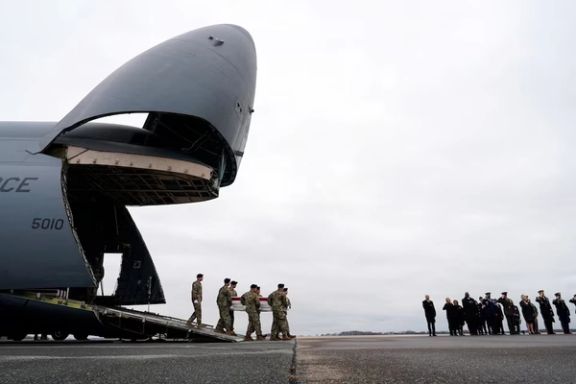
US President Joe Biden, first lady Jill Biden, Secretary of Defense Lloyd J. Austin III and Chairman of the Joint Chiefs of Staff and Air Force General Charles Q. Brown attend the dignified transfer of the remains of Army Reserve Sergeants William Rivers, Kennedy Sanders and Breonna Moffett, three US service members who were killed in Jordan during a drone attack carried out by Iran-backed militants, at Dover Air Force Base in Dover, Delaware, United States, February 2, 2024
The US Justice Department on Monday charged two Iranians with conspiring to export sensitive US technology to Iran’s Revolutionary Guards, including navigation systems used in military drones that killed three US service members.
Dual US-Iranian national Mahdi Mohammad Sadeghi, 42, a resident of Natick, Massachusetts, and Mohammad Abedininajafabadi, 38, of Tehran, were charged with violating US export control and sanctions laws.
Abedini is also accused of providing material support to a foreign terrorist organization — the Islamic Revolutionary Guard Corps (IRGC) — resulting in the deaths of three American soldiers in a January drone attack on a military base in Jordan.
The US defense department indicated at the time that an Iranian-backed Iraqi militia, Kata'ib Hezbollah, was responsible for the strike. It was the deadliest attack on US troops since the Oct. 7 Hamas attack on Israel sparked a sprawling conflict pitting Israel - long armed and supported by Washington - against groups loyal to Tehran.
Sadeghi was arrested in Massachusetts, while Abedini was detained in Italy at the request of US authorities. Both face up to 20 years in prison, with Abedini also facing charges that could result in life imprisonment.
“The Justice Department will hold accountable those who enable the Iranian regime to target and kill Americans and undermine the national security of the United States,” said US Attorney General Merrick Garland.
According to court filings, Abedini founded San’at Danesh Rahpooyan Aflak Co. (SDRA), an Iranian company that produces the Sepehr Navigation System, used in IRGC military drones, cruise, and ballistic missiles. Sadeghi, a former founder of a Massachusetts technology company, allegedly conspired to procure US-origin components through illicit channels for SDRA, violating export laws.
The investigation revealed that SDRA’s navigation systems were integral to the Shahed drones used in the January 28 attack on the Tower 22 base in Jordan, which killed three service members and injured more than 40 others.
The US government is now seeking Abedini’s extradition from Italy.
Supreme Leader Ali Khamenei urged Iranian women to resist foreign influence, warning that enemies use soft tactics to incite riots under the pretext of defending women’s rights.
“Everyone, especially women, should be vigilant about the enemy’s soft tactics and not be deceived by slogans and temptations,” Khamenei said in a meeting with a group of women on Tuesday.
"They label it as defending women, advocating for women's rights, or supporting a group of women," he added, pointing to the 'Woman, Life, Freedom' movement. "Yet, under the pretext of defending a single woman, they incite unrest in the country."
The 2022 Woman, Life, Freedom movement began after the death of 22-year-old Mahsa Amini in police custody. The ensuing crackdown, which led to the deaths of at least 550 protesters, was described as a crime against humanity by a UN fact-finding mission.
In his first public statements following the uprising in 2022, Khamenei said the protests had been engineered by Iran's enemies and their allies.
As the hijab war continues, the government has now officially postponed the implementation of the latest and most controversial hijab law, which imposes severe penalties on women and girls who defy veiling requirements, following widespread backlash from the public and international community.
Iran's Supreme National Security Council, in a letter to parliament on Saturday, requested that the implementation of the Hijab and Chastity law be halted. A member of the parliament's presiding board stated that this delay is to allow the government to submit an amended version of the bill for parliamentary review.
Last week, Amnesty International condemned the new law, stating that it intensifies the oppression of women and girls while exposing activists opposing the rules to charges that carry the death penalty.
Amnesty noted that the law, drafted in May 2023, less than a year after the Woman, Life, Freedom uprising, was introduced in response to widespread defiance of compulsory veiling by women and girls.
Iran-backed forces will endure - Khamenei
In his speech, Khamenei emphasized that Tehran's armed groups in the region, including Hamas and Hezbollah, remain strong despite significant challenges posed by external forces.
Addressing the situations in Gaza, Lebanon, and Syria, Khamenei condemned the actions of the United States and Israel, calling their assumption that resistance would end a grave miscalculation.
"They thought resistance was over," Khamenei said. "They are gravely mistaken. The spirit of Seyyed Hassan Nasrallah is alive; the spirit of Sinwar is alive. Their martyrdom has not removed them from existence. Their path continues."
Khamenei dismissed Israel's military operations in Syria, warning that its efforts to encircle and eliminate Hezbollah forces would ultimately fail. "The one who will be uprooted is Israel," he said.
While Israel maintains that it has no interest in conflict with Syria and rarely comments on specific strikes, it has carried out a series of operations targeting weapons facilities and military infrastructure. Since the fall of President Bashar al-Assad, Israel has intensified strikes against military installations across the country.
On Monday, multiple large explosions rocked Syria's coastal areas — home to Russian and pro-Assad military bases, according to the Syrian Observatory for Human Rights.
Israel also maintains troop presence inside the buffer zone and beyond, citing efforts to prevent a repeat of the October 7 attacks, in which Iran-backed Hamas infiltrated Israeli territory, killing over 1,100 people and taking more than 250 hostages.
Iran will reopen its embassy in Syria, which was stormed by militants following the fall of Damascus, but the matter is not imminent until the staff's security is ensured, Foreign Ministry spokesperson Esmaeil Baghaei said on Tuesday.
“I prefer not to use the word ‘imminent'," he said. "This is on the agenda, and as soon as the necessary conditions are met—both in terms of security and politics—we will move forward with reopening the embassy."
Video footage shared on the day President Bashar al-Assad fled to Moscow showed militants in the embassy, ransacking documents and vandalizing the facility, with shattered glass and broken furniture seen around the building. Iranian media reported that the staff had fled before it was taken over.
Addressing comments made on Monday by the EU foreign policy chief, Kaja Kallas, that Iran and Russia should have no role in Syria's future, Baghaei said: “This is an interesting joke, and I think when she made this comment, she was probably reading history books. The era when foreign powers could dictate to other regions is over.”
Explaining Iran's role in Syria, Baghaei said: “Our presence in Syria was fundamental and principled, and our withdrawal was responsible. We were not seeking expansionism, dominance, or the revival of past empires. What mattered to us in Syria was helping ensure its security in the fight against terrorism.”
Syria, under Assad, was a key component of Iran’s so-called 'Axis of Resistance,' serving as a vital land corridor for supplying weapons and materiel to Hezbollah in Lebanon. Over the years, Israel sought to disrupt this supply line through hundreds of airstrikes.
During the briefing, he also addressed remarks made by several Iranian politicians that Assad government owes approximately $30 to $50 billion to Iran.
He said the number were exaggerated, saying that the debts will be transferred to Syria's new political system based on the principle of state succession. "These figures, such as the claim of a $50 billion debt owed to Iran by Syria, are truly very exaggerated."
As Iran looks to its future after a battered Syria, Iranian President Masoud Pezeshkian will attend the D-8 summit in Egypt, the spokesman confirmed on Tuesday. The summit of the eight major Muslim developing countries, known as the D-8 Organization for Economic Cooperation, will be held on Thursday.
Iran’s nuclear chief said on Tuesday that the country’s nuclear technology will not be restricted, despite demands from the United States and European powers to halt high-level uranium enrichment.
Mohammad Eslami, head of Iran’s Atomic Energy Organization, speaking in Isfahan (Esfahan), home to the Natanz nuclear facility, said: "We must continue on the path of progress with effort and perseverance, and Iran's nuclear technology will never be restricted."
The Islamic Republic began violating the enrichment limits set by the 2015 JCPOA nuclear agreement after the United States withdrew from the accord in 2018. Following President Joe Biden’s election, Tehran announced an increase in uranium enrichment to 20% purity, later escalating to 60%, a level widely regarded as just short of the threshold needed for producing fissile material suitable for nuclear weapons.
Subsequent negotiations with the US and the European E3 countries — the UK, France, and Germany — failed to resolve key differences, revive the JCPOA, or establish a new agreement. As a result, Iran is now believed to possess enough 60% enriched uranium to produce 4 to 5 atomic bombs, should it choose to pursue nuclear weapons.
"Science and technology are considered key factors in creating power and authority," Eslami added, in spite of Iran's pursuit of nuclear power contributing to its isolation on the world stage.
"A country can maintain its independence and progress only if it pursues its development without reliance on others, especially the dominant global powers," he said.
This strategy, mainly directed against the West, has inflicted major harm on Iran’s economy, which now suffers from 50% annual inflation and a currency that has fallen 11,000-fold in the past 45 years.
Widespread energy shortages have forced the government to close offices, factories and schools in many provinces this week, while the country holds the second largest natural gas reserves in the world.
Iran’s nuclear program has cost the country hundreds of billions of dollars in lost revenue and economic growth due to 15 years of international and US-imposed sanctions.
With Donald Trump set to assume the presidency in the US, Tehran faces his “maximum pressure” policy, which includes stricter enforcement of sanctions and potentially additional restrictions.
A senior US diplomat insisted on Monday that Washington is committed to enforcing sanctions on Iranian oil sales, citing reports that Iran might be seeking to sell its oil supplies.
“We've seen unconfirmed reports regarding the potential transfer and sale of stored Iranian oil," US deputy special envoy for Iran Abram Paley's office posted on X on Monday. "Our sanctions on Iran's oil remain in place and will be enforced."
The post shared a link to a Dec. 3 US Treasury press release detailing new sanctions against 35 companies and ships over their alleged involvement in Iranian oil sales.
The entities and vessels sanctioned "play a critical role in transporting illicit Iranian petroleum to foreign markets," the Treasury statement said.
Iran International reported about Iran trying to offload unsold oil in China on Friday.
Iran's Islamic Revolutionary Guard Corps (IRGC) is seeking to sell oil stored in China before US president-elect Donald Trump can block sales with tougher sanctions, an informed source had told Iran International.
Iranian authorities instructed the IRGC to sell the sanctioned oil stored at Dalian Port in northeast China through intermediary firms, the source speaking on condition of anonymity said.
US Senate foreign relations committee ranking member Senator Jim Risch, a Republican from Idaho, cited the report in a post on X calling for harsher measures.
"For too long, #China’s purchases of illicit Iranian oil have funded #Iran’s terrorism and human rights abuses," a post on the ranking member's official page said.
"The Biden Admin has already let billions back to Tehran from elsewhere – now's the time to use #SHIPAct sanctions to freeze $1B before the #IRGC cashes out again."
Risch was referring to the Stop Harboring Iranian Petroleum (SHIP) Act which passed with broad bipartisan support and aims to impose restrictions on ports and refineries handling Iranian oil exports.
US President-elect Donald Trump declined to answer reporters who asked him on Monday whether he was considering a preemptive strike on Iran’s nuclear facilities during a press conference at his Florida residence, Mar-a-Lago.
“Is that a serious question?” asked the president-elect in his first formal press conference since winning the election last month.
“I can’t tell you that,” said Trump, “Am I going to do preemptive strikes, why would I say that? Can you imagine if I said yes or no? You would say that was strange that he answered that question”
Another reporter followed up by asking if Trump would support Israeli airstrikes on Iran’s nuclear program.
“How could I tell you a thing like that now? You don’t talk about that before something may or may not happen,” Trump responded.
A recent Wall Street Journal report, citing U.S. transition officials, said Trump is weighing the idea of preemptive strikes to stop Iran from building a nuclear bomb, and discussed concerns over Iran's nuclear program with Israeli Prime Minister Benjamin Netanyahu in a phone call.
Throughout the lengthy press conference, the soon-to-be 47th president confirmed his phone conversation but would not provide details other than to say the Middle East will be easier to resolve than the Ukraine-Russia conflict.
“We just had a very good conversation. The real conversations will start on the 20th,” said Trump. “I think we're going to be in a good place in the Middle East. I think actually more difficult is going to be the Russia Ukraine situation.”
Members of Trump’s transition team are reviewing a military option, according to the Wall Street Journal report, following the collapse of Syria’s Bashar Al-Assad and the weakening of Iran’s allies Hamas and Hezbollah.
Iran has enough highly enriched uranium to build four nuclear bombs, according to the United Nations nuclear watchdog.
Tehran has maintained that its nuclear program is for peaceful purposes.
The president-elect was similarly non-committal in an interview last week with Time magazine, which named him 2024 “Person of the Year”.
"Anything can happen. Anything can happen. It's a very volatile situation," he said.