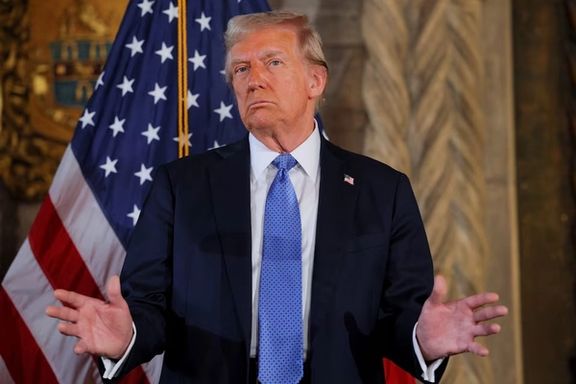
Trump proposes high-level talks with Iran through Oman - Baghdad Alyoum
Iran received a message from US President-elect Donald Trump through Oman proposing high-level talks on issues including the nuclear file, the Iraqi newspaper Baghdad Alyoum reported Sunday, citing a source close to Iranian President Masoud Pezeshkian’s administration.
“Trump’s message expressed his readiness to negotiate with Tehran and the possibility of reaching a new nuclear agreement, different from the one reached in 2015, which he withdrew from in 2018,” the source was quoted as saying.
The Iranian source added that "Trump will not wait more than a few months to receive a response from Iranian officials regarding their willingness to negotiate on a range of issues, with the nuclear file being the most prominent."
Earlier, Iranian diplomat Seyyed Hossein Mousavianin an article in Iran Newspaper, said that Trump is expected to propose direct and high-level talks with Iran shortly after taking office.
In the article, Mousavian added that while an agreement might be possible if negotiations begin, there are no guarantees that the US would adhere to it, even if successful.
New research from Iran's Ministry of Health revealed that one quarter of Iranians have experienced at least one type of mental disorder over the past year.
“In Iran, there is no law that considers and addresses issues related to psychiatric disorders,” said Vahid Shariat, the President of the Iranian Psychiatric Association in an interview with ILNA news agency.
The latest data was gathered from a nationwide study conducted over the past three years by the Ministry of Health. Shariat said Iran lacks basic provisions for mental illness.
He criticized policymakers, the Ministry of Health, and the Welfare Organization for their neglect, saying, the limited and poorly implemented mental health support package offers only a handful of medications and psychiatric services.
“There is no political will to find solutions, and there is no receptive ear to listen to the problems of individuals with severe mental illness,” he said.
Currently, the system only allows up to 54 hospitalization days per year for psychiatric care. If patients require additional care, they must bear the financial burden themselves, making long-term treatment inaccessible for many as one third of Iranians now live below the poverty line.
In November, Alireza Zali, President of Beheshti University of Medical Sciences in Tehran said that mental illness ranks second only to musculoskeletal disorders as the most common health issue in the country.
The latest research supports figures published in 2021 in the Iranian Journal of Psychology. It also cited one in four Iranians suffered with mental disorders.
"The Iranian Mental Health Survey (IranMHS) indicated that almost 1 in 4 people had one or more psychiatric disorders (23.6%); however, two-thirds of patients did not benefit from health interventions, many provided services were inadequate and imposed a high burden on Iranian families," researchers wrote, calling for intervention.
A 2019 study in The Lancet found that depressive and anxiety disorders are among the country's top 10 causes of death and disability, according to the study called 'Global burden of 369 diseases and injuries in 204 countries and territories, 1990–2019: a systematic analysis for the Global Burden of Disease Study'.
Tehran was found to have the highest incidences with almost 37.1% of residents suffering mental health problems (45.0% of women and 28.0% of men).
The research found the greatest incidence of mental health disorders was seen in the 25–34 and over 75 age groups.
The most common mental health disorders were depression (43%) and anxiety (40%), followed by somatization (30%) and social dysfunction (8.1%). Mental health disorders were more frequent in the southeast regions of the city, researchers said.
Deputy head of Iran's Revolutionary Guards (IRGC) intelligence said on Sunday that 65% to 68% of Iranians support responding to Israel's October attack on Iran, even if it leads to war.
Brigadier General Mehdi Sayyari cited a survey from a “reputable institute” for his claim but did not provide further details about its source.
Sayyari also accused Israel of using cyber, security, and military tactics to destabilize Iran instead of pursuing direct confrontation.
"Their strategy is to create instability and unrest within Iran because they know military action alone cannot achieve their goals," Sayyari said, speaking at an event in Qazvin on Sunday.
He attributed the purported Iranian public support for retaliation to a strong sense of national and religious duty, which he said Israel and its allies have been unable to weaken.
Supreme Leader Ali Khamenei denied that Iran uses proxy forces in the region, asserting that groups like Hezbollah, Hamas, and the Houthis act independently out of their own faith and beliefs, not as agents of the Islamic Republic.
In a meeting with religious eulogizers on Sunday, Khamenei addressed what he described as "absurd statements from Western and Israeli officials," dismissing the notion that Iran’s regional influence is based on the use of proxy forces.
"They constantly say that the Islamic Republic has lost its proxy forces in the region! This is another mistake! The Islamic Republic does not have proxy forces. Yemen fights because of its faith; Hezbollah fights because its faith gives it strength to fight; Hamas and Jihad fight because their beliefs compel them to do so," Khamenei said.
"They do not act as our proxies. If one day we want to take action, we will not need any proxy forces."
Khamenei's comments come amid ongoing tensions surrounding Iran’s involvement in regional conflicts, particularly in Syria, where Tehran used militias for many years to further its geopolitical interests but to no avail.
Iran has labeled the Lebanese Hezbollah, Yemen's Houthis, the Assad government and a hodgepodge of paramilitary groups in Iraq as the "Resistance Front," and began to speak more directly of a united front since the Hamas attack on Israel in 2023. In September, Iran's Foreign Minister Abbas Araghchi said, “The government’s policy is to provide unlimited support to the resistance. We will support the resistance front, which has established itself as a reality in the region. The regime [Israel] has so far failed to achieve its main goal of destroying Hamas.”
The commander of the Revolutionary Guard’s Quds Force, Esmail Qaani, said in May, that Iran has humiliated Israel by organizing the 'Islamic resistance.' “At this point, Israel has reached a level of humiliation that it has surrounded itself with barbed wire and radars to prevent infiltration,” Qaani told a gathering of young clerics.
Iran’s involvement in Syria has been one of its most significant and costly regional ventures. The Islamic Republic invested between $30 and $50 billion in financial and military support to sustain the government of Bashar al-Assad who was overthrown by the armed groups and fled to Russia this month.
Iran's aid included sending elite military units, weapons, and advisers to help counter rebel factions. This support was not only about military might but also tied to Tehran's strategic interests, particularly maintaining influence in the Levant and ensuring the continuity of the Axis of Resistance — a network of allies in Syria, Lebanon, Iraq, and Yemen.
Khamenei also warned that those within Iran who align themselves with foreign powers, particularly the United States, would face severe consequences.
"The fools smell the scent of kebab," Khamenei quipped, using a metaphor to describe what he sees as misguided ambitions from those in Iran seeking to overthrow the Islamic Republic. "Anyone inside the country who chooses to serve the Americans, the Iranian people will trample them underfoot."
Syria’s future: Khamenei’s optimism amid setbacks
Turning to Syria, Khamenei expressed confidence in the resilience of the Syrian people, despite the fall of his long-time ally Bashar al-Assad. He predicted that a group would rise to lead Syria out of its instability.
"The young Syrian has nothing to lose. His university is unsafe, his school is unsafe, his home is unsafe, his street is unsafe, his life is unsafe. What should he do? He must stand strong and determined against those who designed this insecurity and those who implemented it, and God willing, he will triumph over them," Khamenei said.
Despite the dire picture painted by Khamenei, there have been no reports of major incidents in Syria since the current leadership took control in Damascus, except tensions between Turkish-back forces and Kurds in the north.
Iran has faced significant setbacks in recent years, not only in Syria but also through its proxy networks. Groups like Hamas and Hezbollah have faced challenges, and the broader Middle East continues to see shifting alliances and power dynamics.
Despite these challenges, Khamenei expressed optimism for the future of Syria and the region, saying, "The future of the region will be better than today, by the grace of God."
Khamenei's remarks come at a pivotal moment for Iran, as the country faces mounting pressure from both regional and global powers, particularly the United States and Israel. His speech reflects Tehran's continued defiance of foreign influence, especially in Syria.
Iran's Supreme Leader said on Sunday that Iran does not need proxies if it decides to take direct military action, rejecting claims that groups like Hezbollah and Hamas operate under Tehran's command.
"They keep saying that the Islamic Republic has lost its proxies in the region. This is another falsehood. The Islamic Republic does not have proxies. Yemen is fighting because of its faith. Hezbollah fights because its faith-driven power brings it to the battlefield. Hamas and Islamic Jihad fight because their beliefs make them to do so. They do not act as our proxies. If we ever decide to act, we do not need proxies,” Khamenei said addressing a group of eulogists at Tehran's Imam Khomeini Hussainiya.
Khamenei’s remarks come on the backdrop of significant losses by Iran-backed armed groups across the region over the past year. In September, a precision Israeli strike in Beirut killed Hezbollah leader Hassan Nasrallah and several senior commanders.
Israeli military sources estimate that around 3,000 Hezbollah operatives have been killed since October 2023, while Reuters reports the figure could be as high as 4,000. Meanwhile, Hamas has also faced significant challenges in Gaza. Over a year of Israeli bombardment has caused severe damage to the group’s infrastructure, reportedly killing more than 17,000 operatives since last year’s offensive began, according to Israeli military sources.
The fall of Bashar al-Assad in Syria was the latest serious blow to Tehran’s regional influence.
Israel launched a large-scale air attack against Iran in October, devastating its air defenses and several military installations without encountering any serious defense or retaliation.
Iran has no place in Syria’s future, US Assistant Secretary of State for Near Eastern Affairs Barbara A. Leaf said in response to Iran International during a special online briefing on Friday.
“Iran will have no role whatsoever, and it shouldn’t, frankly. Iran’s had decades now of the most predatory and destructive behavior and presence in Syria, and during the war itself, of course, mustered foreign militias, its own IRGC forces, Hezbollah fighters, and really preyed upon and really viciously brutalized the Syrian people. So, it’s hard for me to imagine Iran having any role whatsoever. Why should it?”
Leaf contrasted Iran’s influence with Turkey's role as a neighboring country, stressing the US goal of fostering a stable and sovereign Syria free from external manipulation and criminal activities.
“Türkiye obviously has a very sizable role. It has sizable influence. It has, historically, and it’s a neighboring state, and it has national security interests and all sorts of other interests,” she added.
The remarks align with comments by Ahmed al-Sharaa, leader of Syria’s opposition group Hayat al-Tahrir al-Sham (HTS), who said in an interview with Asharq Al-Awsat on Friday that his faction had ended Iran’s foothold in the region.
Sharaa, whose Islamist group recently helped topple forces loyal to Bashar al-Assad, said: “Syria’s opposition has set the Iranian project in the region back by 40 years.” He added, “By removing Iranian militias and closing Syria to Iranian influence, we’ve served the region’s interests—achieving what diplomacy and external pressure could not, with minimal losses.”
Meanwhile, Iran’s Supreme National Security Council Secretary Ali Akbar Ahmadian defended Tehran’s extensive expenditures in Syria. Speaking to a state-linked publication on Friday, Ahmadian justified the financial and military support for Assad’s government, estimated to have reached $30–50 billion over the past decade.
People gather during a celebration called by Hayat Tahrir al-Sham (HTS) at the Umayyad Square, after the ousting of Syria's Bashar al-Assad, in Damascus, Syria, December 20, 2024.
“We have no regrets about the costs incurred in Syria because our presence and expenses were for our own security,” Ahmadian said. He emphasized that Iran’s involvement was not meant to replace the Syrian army but to bolster an ally vital to Iranian interests.
Iran maintained a significant military presence in Syria, primarily supporting the government of President Bashar al-Assad. Tehran provided financial aid, weapons, and military advisers, alongside the deployment of its own forces and allied militias, including the Lebanese Hezbollah and various Iraqi and Afghan groups. The Islamic Revolutionary Guard Corps (IRGC) played a central role in Iran's military operations in Syria, overseeing both direct combat and logistical support. Iran's military expenditure in Syria include funding for military operations, and the training of local forces aligned with Assad.
With Leaf’s candid critique of Iran and Sharaa’s proclamation of a major victory against Tehran’s influence, the country seems to be charting a new course.