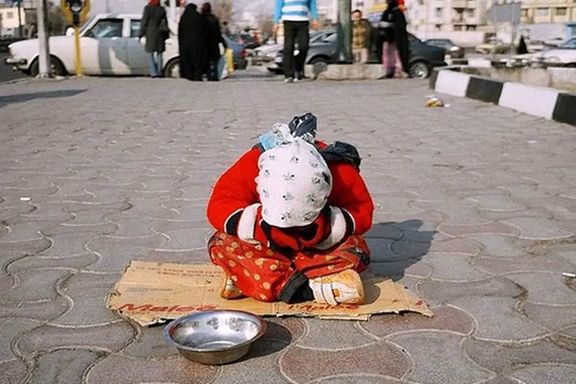
A little girl sitting on the sidewalk asking for change, Iran
As voices associated with Iran’s ruling establishment increasingly advocate for negotiations with the United States, a prominent newspaper has warned that up to 50% of the population is now living below the poverty line.
Aftab News observed that “Given Trump’s return and the persistence of a faction within the country opposing any structural reforms or negotiations to lift sanctions and expand global relations, some economists predict tougher living conditions for the majority of Iranians in 2025.”
The newspaper quoted a lawmaker specializing in budgetary issues, highlighting the stark economic challenges faced by ordinary Iranians. According to the report on Tuesday, the average monthly income for most Iranians is approximately $150, while the minimum budget required for the survival of a small family is around $450. In large cities, rent alone accounts for $250 to $300 per month, further straining household finances.
Professionals and government officials earn slightly higher salaries, but another newspaper reported that even general practitioners are now struggling to make ends meet.
The crisis deepened as Iran's currency, the rial, suffered a dramatic decline, dropping from 600,000 to the dollar to 800,000 since September—a staggering 33% depreciation. This sharp fall immediately eroded the purchasing power of citizens on fixed incomes, as prices surged in step with the weakening currency.
The newspaper estimated that, based on these figures, approximately 50% of the population now lives below the poverty line, defined as having a monthly income of less than $450.
After a hiatus of almost two years, Iran’s Central Bank recently announced the annual inflation rate, claiming that it has dropped to 36%, its lowest level in recent years. Some experts speaking to the media dismissed this figure as misleading and contrary to economic realities in the country.
In another article, Aftab News drew a comparison between Iran and African countries, particularly Morocco, highlighting that without the advantage of oil and gas resources, average monthly salaries in Morocco are around $2,000—more than ten times the average salary in Iran.
The fact that Morocco is both an Islamic country and a monarchy is unlikely to go unnoticed by Iranians reading the article. Many in Iran already reflect with nostalgia on the pre-revolution era, when the country headed by the Shah was considered the leading economic power in the Middle East.
The Islamic Republic newspaper, founded by Ali Khamenei four decades ago, warned on Tuesday that Iran is confronting a hostile regional environment due to the change of government in Syria and called on authorities to remain attuned to public sentiment.
“The only way to navigate the challenging crossroads we are currently facing is for governance to rely on popular support. This support can only be secured by prioritizing the people and respecting their rights in all material and spiritual aspects,” the newspaper said.
Families of those killed in the downing of Flight PS752 gathered at the crash site in Shahedshahr, Tehran Province, on the fifth anniversary of the tragedy under the slogan "Never Forget, Never Forgive."
The Ukrainian passenger plane was shot down by missiles from the Islamic Revolutionary Guard Corps (IRGC) on January 8, 2020, shortly after takeoff, killing all 176 people onboard, including the crew.
For three days after the incident, authorities concealed the fact that the plane had been shot down, repeatedly claiming the crash was an accident.
Masoud Ebrahim, whose daughter Niloufar was one of the victims, began his speech with the phrase “Woman, Life, Freedom” and honored “all those who have lost their lives and suffered oppression over the past 46 years.”
He said, “We didn’t know that everyone in [Khamenei’s] circle had gathered to decide to down the plane.”
Families brought items belonging to their loved ones to the site to honor their memories, videos of the gathering shared by theAssociation of Families of PS752 Victims.
Memorial ceremonies for the victims were also held in multiple countries, including Canada and Sweden, as they have been every year since the tragedy.
The families' association released a statement Tuesday on X, referring to "the great injustice that continues".
"Five years of crime, five years of lies, five years of repression, five years of longing, five years of standing firm, five years of reminding, and five years of the burning flame of anger that will not subside," the group said.
Legal battle continues
Lawyer Mahmoud Alizadeh Tabatabai, representing several victims’ families, criticized how Iranian judicial authorities handled the case. Speaking to Iran’s Didban news, he said the families were denied access to the plane’s wreckage and the full legal case file.
In April 2023, a Tehran military court sentenced the missile operator responsible for downing the plane to 13 years in prison and ordered him to pay compensation. During the investigation, Amir Ali Hajizadeh, the IRGC Aerospace Commander, was summoned as a suspect but was cleared of charges.
According to Tabatabai, Hossein Salami, the IRGC Commander-in-Chief, said in Iran’s parliament that “national interests required this missile strike.”
Tabatabai said that during the trial, a prosecutor’s representative told some families, “We did it, and it was the right thing to do.”
While 10 people were convicted in connection with the case, many families felt the process lacked transparency and withdrew their complaints. However, some, including Mohsen Asadi Lari and his wife, continued to appeal the ruling.
The Supreme Court reviewed the case and identified 12 flaws in the decision, returning it to the First Military Court for retrial. However, Tabatabai said, “Six months have passed, and no further action has been taken.”
He added, “We are following up regularly, but the court keeps delaying, saying ‘today or tomorrow,’ and we are waiting for the trial to restart in the First Military Court".
Military courts in Iran operate under the Judiciary Organization of the Armed Forces, a specialized branch of the judicial system for handling cases involving military personnel. The organization includes its own prosecutor’s office and specialized courts to oversee cases within its jurisdiction.
International actions
The four affected countries—Ukraine, Canada, Sweden, and the UK— have filed a formal complaint with the International Court of Justice and also the International Civil Aviation Organization against Iran. The complaints allege that the downing of the plane was deliberate.
"In the coming months, we envisage the response of the International Civil Aviation Organization (ICAO) and the convening of an initial session at the International Court of Justice (The Hague), and we hope the path of truth-finding will be properly followed," the families' association's statement read.
Flight PS752 was downed during a period of heightened tensions between Iran and the United States, following Iran's missile attack on US military bases in Iraq.
The missile attack was carried out in retaliation for the US killing of Iranian Quds Force commander Qassem Soleimani in Baghdad just days earlier.
As President-elect Donald Trump’s inauguration nears, more establishment figures and experts in Iran are urging authorities to engage in negotiations with the United States to alleviate the Islamic Republic’s severe economic pressures.
Former Reformist Interior Minister Abdolvahed Mousavi-Lari, one of the growing voices advocating for dialogue, told the Iranian press that "President Masoud Pezeshkian should break the taboo surrounding negotiations with the United States."
Mousavi-Lari stated that "Supreme Leader Ali Khamenei will accept the idea of negotiations with the United States if Pezeshkian explains the country's [dire economic] situation to him." This comes despite Khamenei's reputation as a staunchly anti-US political figure. In a 2019 meeting with former Japanese Prime Minister Shinzo Abe, Khamenei expressed his belief that Trump was not worthy of engaging in talks.
Mousavi-Lari emphasized the interconnected fate of Pezeshkian and Iran’s Reformist movement, stating, "Those who voted for Pezeshkian voted for change. If he refuses to negotiate with the United States, many voters may come to regret their decision."
He argued, "Pezeshkian neither wants nor is capable of pursuing negotiations with the United States without Khamenei's support. Pezeshkian must stand by his promise to the people to address the country's economic problems." Mousavi-Lari reiterated that Pezeshkian should seek the leader's backing, adding, "Khamenei certainly wants the government to succeed and will support efforts to ensure its success."
However, the politician’s optimism about Khamenei’s intentions is not necessarily aligned with recent history. The Supreme Leader has consistently voiced staunch anti-US and anti-West sentiments, advocating for defiance and a strategy centered on regional dominance.
The prospect of further economic turmoil and unpredictable popular protests looms heavily over all levels of Iran's ruling establishment.
A senior expert on the United States told local media that Trump is eager to capitalize on potential unrest in Iran to pressure Tehran into entering negotiations with Washington. Meanwhile, a former Interior Minister has called on Pezeshkian to seek Khamenei's backing for talks with the United States.
In an interview with the Tehran-based Khabar Online website, Hadi Alami Fariman also cautioned that "any shift in Iran's nuclear doctrine will bring hardship for Iranians and provoke extensive military attacks on the country."
Fariman added that "Iran's nuclear dossier is likely to be the most significant issue Trump will address in dealing with Iran. His plans are expected to include maximum pressure tactics, intensifying sanctions, and pressuring China to halt oil purchases from Iran," he said.
He also suggested that "the Trump administration will aim to incite protests in Iran as a means to pressure the government into negotiations. Simultaneously, Trump is likely to leave a narrow window for diplomacy open to Tehran."
Meanwhile, Fariman proposed that "Iran should launch an extensive lobbying effort in the United States to establish connections with those close to the Trump administration and members of Congress." He also recommended the establishment of a direct hotline between Tehran and Washington to facilitate communication.
Fariman warned that "Trump's initial challenge for the Islamic Republic is likely to be the creation of major economic crises." He further emphasized that "Iran must adapt to the world's new order and pursue a fresh agenda."
Summing up Iran’s potential path forward, Fariman stated, "We should embrace a strategy of competition rooted in negotiations rather than threats. It is time to decide whether we want to align ourselves with this new global order or resist it."
He also suggested that Iran should consider cooperation with emerging states, including Syria, based on their de facto recognition. "We must acknowledge that Syria has shifted from a pro-Russian and pro-China orientation to one that supports the United States. At least for now, it harbors no hostility toward Israel and has established good relations with Arab states," he explained.
Iraq’s prime minister is set to visit Tehran on Wednesday to discuss regional issues following the tumultuous events of 2024, including the overthrow of Syria’s Bashar al-Assad and the decline of Iran’s regional influence.
On Monday, Iran’s Foreign Ministry spokesperson, Esmail Baghaei, told reporters that Prime Minister Mohammed Shia al-Sudani will focus on discussing the situation with Syria’s new government. Both Iraq and Iran are navigating cautiously amid the radically changed dynamics in the region.
Arab media reported on Sunday that the commander of the Quds Force of Iran's Islamic Revolutionary Guard Corps (IRGC) was visiting Baghdad to meet the leaders of Tehran-backed Shia groups as well as the Iraqi prime minister, Arab media reported Sunday.
Esmail Ghaani (Qaani) and several of his advisers in the Quds Force arrived in Baghdad on Sunday morning to meet with the leaders of the Shia factions and the head of the Popular Mobilization Units (PMU), Falih al-Fayyadh, Erem News reported citing an Iranian source.
There have been recurrent reports and analysis about Iraqi government plans to restrict the Iran-backed Shia militia groups. In fact, as opposition forces were moving toward Damascus last month to depose Assad, the Iraqi militia did not cross the border to defend him.
A pro-Hezbollah newspaper in Lebanon reported last month that the Iraqi militias reached a deal with the government not to attack Israel. The move reflected concerns about escalating conflicts in the region and fears of Iraqi security being endangered after insurgents took control in neighboring Syria.
Some regional and Iranian media outlets speculate that al-Sudani’s visit to Tehran may aim to persuade the Islamic Republic to halt its support for Shiite militias. While it remains unclear whether the prime minister’s agenda is that bold, the role of these militias in Iraqi politics is likely to be a key topic of discussion.
The Iranian Rouydad24 website, citing Arab media, said that al-Sudani’s agenda is securing guarantees from Tehran to cease its support for militias and Iran-aligned groups in Iraq, urging Iran to respect the decisions of the Iraqi government, and ensuring Iraq's immunity from any military operations by the US or Israel launched from Iraqi territory are expected to be key demands.
It is believed that Israeli, and possibly US, warplanes could launch missiles at Iran using Iraqi airspace. Reportedly, Israel employed this tactic during its October airstrike on Iran.
Alaeddin Boroujerdi, an influential Iranian lawmaker, told local media last week that the Iraqi Prime Minister might be delivering a message to Iran, though he did not specify its source. The Tehran-based Etemad Online suggested that the message likely originates from Washington, urging Baghdad to curb Iranian-backed militias and Shiite groups.
An Iraqi journalist in Baghdad, speaking on condition of anonymity, told Iran International that significant developments are expected in January and February as President-elect Donald Trump takes office.
While Iran's Supreme Leader continues calls for Syrian youth to reject the new leadership, Iran’s foreign ministry has reaffirmed its commitment to Syria’s sovereignty.
“Syria must not become a safe haven for terrorists, and its people should decide their future without foreign, regional, or extra-regional interventions,” Foreign Ministry spokesperson Esmaeil Baghaei said during a press briefing on Monday.
In contrast, Khamenei accused the United States and Israel of orchestrating the removal of former President Bashar al Assad, urging resistance against what he described as a foreign-imposed government.
The fall of Assad in December and the rise of Hay’at Tahrir al-Sham (HTS) has upended Iran’s influence in Syria, challenging its long-standing strategic foothold in the country.
“We respect the choice and decisions of the Syrian people,” Baghaei said. The foreign ministry is advocating for diplomacy and cooperation with Syria while Khamenei’s rhetoric signals Tehran’s unwillingness to relinquish its influence in the country, which turned from being a key ally to a potential adversary as the Sunni HTS aligns with Iran's rivals in the region and garners international support.
Iran's Foreign Ministry Spokesman Esmail Baghaei during a weekly briefing on January 6, 2024.
US pressures and nuclear negotiations
Simultaneously, Iran faces mounting pressure from the United States over its nuclear program.
National Security Advisor Jake Sullivan recently presented President Joe Biden with potential military options against Iranian nuclear facilities as reported by Axios. Baghaei condemned these threats as violations of the United Nations Charter, calling on the Security Council to address what he described as provocations undermining international peace and security.
“The threat of force against a country’s peaceful nuclear facilities constitutes a double violation of international obligations,” Baghaei said. He accused Washington of attempting to dictate policies in preparation for the next US administration.
Iran’s strained relations with Western powers extend to stalled nuclear negotiations. Baghaei said talks with European countries are set to resume in Geneva on January 12 and insisted that Iran remains committed to dialogue, saying, “We have never avoided the negotiation table and have always believed in honorable negotiations.”
The talks come at a critical time, as the IAEA reports Iran’s progress in enriching uranium to near-weapons-grade levels. Tehran insists its nuclear program remains peaceful, but international concerns persist over its potential for weaponization.
The "chain murders" of the 1990s—a series of assassinations targeting Iranian dissidents and intellectuals—claimed at least 80 lives and stand as a dark chapter in the Islamic Republic's history of extrajudicial killings.
Carried out by the Ministry of Intelligence under President Akbar Hashemi Rafsanjani, these killings sought to silence critics deemed threats to the state, continuing into the presidency of Mohammad Khatami.
In 1999, the Ministry of Intelligence officially—but only partially—admitted responsibility for four of the murders.
Q: Who were the dissidents killed by intelligence ministry agents?
Five individuals whose murders in November and December 1998 drew national and international attention were:
Majid Sharif: A translator and journalist.
Dariush Forouhar: Leader of the Pan-Iranist Nation Party of Iran.
Parvaneh Forouhar (Eskandari): Activist and wife of Dariush Forouhar.
Mohammad-Jafar Pouyandeh: Member of the banned Iranian Writers Association.
Mohammad Mokhtari: Member of the banned Iranian Writers Association.
The Ministry officially acknowledged responsibility for the killings of Dariush and Parvaneh Forouhar, Mohammad Mokhtari, and Mohammad-Ja’far Pouyandeh, but denied involvement in other cases, including Pirouz Davani’s death.
Q. How were the victims killed and where were their bodies found?
Majid Sharif’s body was found on the side of a road in Tehran on November 19, 1998, six days after he disappeared. Authorities claimed heart failure as the official cause of his death.
Dariush and Parvaneh Forouhar were stabbed to death in their Tehran home on November 22. Both sustained multiple stab wounds, suggesting the attack was both deliberate and exceptionally violent.
Mokhtari’s body was discovered on December 3 near a cement factory on a road south of Tehran, several days after he went missing.
Pouyandeh’s body was found in a field in Shahriyar, also south of Tehran, on December 8, a day after he left his office in the capital to return home.
Both bodies showed signs of strangulation, though the authorities never officially confirmed the cause of death.
Q: Were the killings limited to those in November and December 1998?
No. At the time, political groups and media outlets suspected the intelligence ministry of involvement in numerous other assassinations, often disguised as overdoses, car accidents, or unexplained stabbings.
The suspected victims of these systematic assassinations were primarily opponents of the Islamic Republic, including dissident politicians, literary figures, and translators. Others reportedly targeted included an Armenian, three Protestant priests, followers of the banned Bahá'í faith, a prominent university professor with no known political affiliations, and civilians allegedly linked to the intelligence ministry’s covert operations.
Q: When did government-linked murders begin and end?
Many believe the "Chain Murders" began with the killing of Dr. Kazem Sami, who served as minister of health in the first post-revolution cabinet in 1979.
Dr. Kazem Sami was stabbed to death in his medical practice in 1988. The individual accused of his murder reportedly died by suicide in prison. Years later, former President Akbar Rafsanjani, in his memoirs, referenced the alleged killer’s death, fueling further questions about the case.
Some activists and advocates argue that the "Chain Murders" never truly ceased, with allegations of systematic killings resurfacing in recent years.
Prominent filmmaker Kioumars Pourahmad, whose body was found without a suicide note in April 2023, andDariush Mehrjui and his wife, who were fatally stabbed in their Karaj home in October 2023, have been cited as possible victims of a renewed wave of targeted killings.
Q: Who did the authorities blame for the murders?
Supreme Leader Ali Khamenei and his supporters initially blamed “foreign enemies,” including Israel, for the murders of the Forouhars and the two writers.
Public outcry over these particular killings, however, put pressure on the so-called reformist government of President Mohammad Khatami.
At Khatami's insistence, a three-member independent team was established to investigate the killings. The committee ultimately confirmed suspicions of the intelligence ministry’s direct involvement.
On January 4, 1999, the ministry issued an unprecedented statement partially acknowledging responsibility by blaming “rogue” agents for four of the murders and describing the killings as “despicable and abhorrent.”
This limited admission prompted further scrutiny, as the intelligence ministry operates under the authority of Khamenei, raising questions about how such "rogue" actions could occur without his knowledge.
Q: What happened to the “rogue agents”?
Three top officials of the ministry—Saeed Emami, Mostafa Kazemi, and Mehrdad Alikhani—along with several agents, were charged with ordering and carrying out the assassinations.
Emami, widely regarded as the mastermind behind the killings, allegedly died by suicide in prison before his trial.
The remaining defendants were tried in Tehran's military court. Sentences ranged from qisas (death penalty) to life imprisonment, with some receiving as little as two and a half years.
Q: Were the death sentences carried out?
No. Judiciary authorities stated that the victims’ families had waived their Sharia-based right to qisas for the killers. This act of pardon spared the defendants from execution.
Q: Did the revelation of the ministry’s role in the killings affect the minister?
Ghorban-Ali Dorri-Najafabadi, a minister favored by Khamenei, who at the time had not yet fully consolidated his power as Supreme Leader, was forced to resign. He was replaced by the relatively moderate Ali Younesi.
Najafabadi has consistently denied any knowledge of the assassinations. However, some defendants in the case rejected this claim, stating that the "physical elimination" of targets identified by higher authorities was part of their job description.
In his 1999 trial, prominent reformist cleric and politician Abdollah Nouri accused Najafabadi of being aware of the killings.