Frenchman detained on Iran spying charges reveals identity
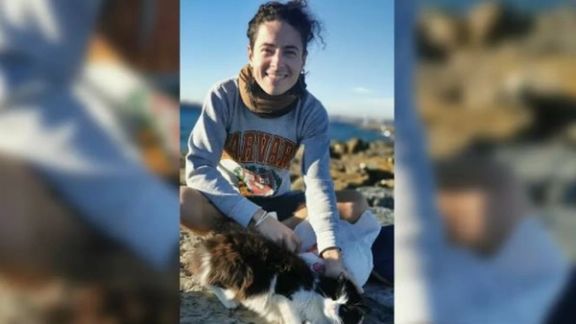
A French citizen detained in Iran for over two years on espionage charges revealed his identity and described his ordeal in a phone call aired on French radio on Monday, as Paris steps up efforts to gain his release.
In the conversation recorded in prison and aired by radio network France Inter, Olivier Grondeau, who had previously only been identified only by his first name, described his detention as arbitrary and unbearable.
The 34-year-old tourist who was arrested in Shiraz on October 12, 2022 during a world tour added that he is a victim of what he called political blackmail as France and Iran grapple over his case.
Grondeau was sentenced last February to five years in prison for "espionage and conspiracy against the Islamic Republic" and is currently held in Tehran’s Evin Prison in a wing designated for foreign and dual-national detainees.
He called on French authorities to secure his release and expressed hope that his request for parole would be granted.
The French foreign ministry, which summoned Iran’s ambassador on January 10, has demanded the immediate release of Grondeau and two other French detainees, teachers Cécile Kohler and Jacques Paris, who have been held since May 2022.
"Their situation is intolerable, with inhumane detention conditions that, in some cases, constitute torture under international law," the ministry said in a statement.
Grondeau shares a cell with 18 other detainees and has limited access to a library and books sent by the French embassy. He also highlighted the harsher conditions faced by Kohler and Paris in the same message.
"You, who have the power to influence this matter, hear this truth," Grondeau said, apparently addressing French authorities.
"Cecile's strength, Jacques' strength, Olivier's strength, it is all running out," he added.
"Your responsibility is called upon to ensure the survival of three human beings."
Grondeau is one of an unknown number of foreign or dual-nationals held by Iran in what rights groups and some foreign governments decry as hostage diplomacy.
Most recently, an Italian journalist was released in an arrest which is understood to have been leverage to force Italy to release an Iranian imprisoned on terrorism charges.
Iran’s pharmaceutical industry is grappling with sharp price increases born out of the weakness of Iran's currency, causing some drug costs to more than quadriple.
The increases are likely to gain pace as the government reduces foreign currency allocations for essential goods.
Newly released data from Zahravi Pharmaceutical Company illustrates the extent of the price surge.
The price of 20 milligrams of basic antibiotic Gentamicin rose from 460,000 rials to 2,366,700 rials—a 415% increase. Vitamin B12 prices climbiedby 156% from 526,000 rials to 1,355,980 rials.
Health Minister Mohammadreza Zafarghandi recently linked rising medication prices to currency fluctuations.
“Medication prices are influenced by exchange rate fluctuations and will undergo changes,” Zafarghandi said, while emphasizing the government’s commitment to supporting consumers.
“The government intends to pay the difference caused by exchange rate changes to insurance companies. This amount will be provided to them so that the price changes for medications are not paid out of people's pockets,” he added.
Despite these assurances, the impact on the healthcare system remains a growing concern. The rial has nearly a third of its value since September, making it increasingly expensive for pharmaceutical companies to import raw materials.
The 2025 budget outlined by President Masoud Pezeshkian’s administration includes a 20% reduction in foreign currency allocations for essential goods and a 35% increase in the subsidized exchange rate, further straining the sector.
Economic observers caution that government policies may place additional burdens on patients. The head of the Tehran Chamber of Commerce previously warned that securing foreign currency and local rials for production remains a challenge, particularly in sectors reliant on imports like pharmaceuticals.
Zahravi Pharmaceutical Company’s price hikes may be the first in a wave of similar adjustments across the industry, as other manufacturers are expected to follow suit. While government intervention aims to cushion the blow, the overall trajectory suggests an increasingly precarious healthcare system.
With further cuts in subsidies and rising exchange rates on the horizon, patients and providers alike face a difficult year ahead.
Iran summoned the French ambassador to Tehran on Monday, cautioning him over recent meetings with an exiled opposition organization which the government has proscribed a 'terrorist' group, the Iranian Foreign Ministry spokesman said.
"The ambassador was given a caution regarding hosting terrorism and supporting terrorist groups," spokesman Esmail Baghaei said during a regular briefing, referring to an event held by the Mujahedeen-e-Khalq (MEK).
The event, held in Paris on Saturday, was attended by Keith Kellogg, who is set to serve as President-elect Donald Trump’s special envoy for Ukraine.
It follows a meeting in Paris last Thursday when the group, known as the National Council of Resistance of Iran, the political arm of the Mojahedin-e Khalq group, hosted former US Secretary of State Mike Pompeo.
Pompeo had been part of the Trump administration which had levied crippling sanctions on Tehran for its nuclear program.
The MEK has long been a source of contention between Tehran and Western governments.
Iran views the group as a terrorist organization responsible for attacks within the country in the 1980s, while the MEK describes itself as an opposition movement seeking regime change in Iran. The group was a leftist-Islamist underground network during the monarchy, opposed to Western influence in Iran. After the revolution, which it supported, a rift developed between the newly established clerics and the MEK.
Iran will not beg the United States for nuclear negotiations, the country’s foreign ministry spokesman said on Monday as the incoming Trump administration promises a maximum pressure stance on Tehran.
"Regarding the United States, we will make decisions at the appropriate time based on actions and approaches," Esmail Baghaei said at a press conference in Tehran. "Naturally, negotiation is not something we would beg for."
The remarks come amid continued tensions between Tehran and Washington over issues including Iran’s nuclear program and ongoing military action across the region.
Last week, Iran's Supreme Leader Ali Khamenei rebuked proponents of renewed nuclear talks with the United States under President Donald Trump, warning of intractable American hostility.
Trump has said Iran cannot be allowed to develop a nuclear weapon. The country is already under significant sanctions imposed during his first administration.
A thousand new drones were delivered to Iran's army on Monday as the country is holding two-month-long military air defense drills around its strategic sites throughout Iran.
The drones were delivered to various locations throughout Iran and state media say they have high stealth and anti-fortification abilities.
"The drones' unique features, including a range of over 2,000 kilometers, high destructive power, the ability to pass through defense layers with low Radar Cross Section, and autonomous flight, not only increase the depth of reconnaissance and border monitoring but also boost the combat capability of the army's drone fleet in confronting distant targets," IRGC media Tasnim news agency added.
Earlier this month, Iran started two-months-long military exercises which have already included war games in which the Revolutionary Guards and the Army defended key infrastructure, including Natanz, Fordow and Khondab installations, against mock attacks by missiles and drones.
Saudi Arabia plans to monetize all its mineral resources, including uranium, by enriching and selling it, while Iran begins nuclear talks with the E3 in Geneva.
Speaking at a conference in Dhahran, Saudi energy minister Prince Abdulaziz bin Salman said on Monday, "We will enrich it and we will sell it and we will do a 'yellowcake,'" referring to the powdered concentrate used to prepare uranium fuel for nuclear reactors.
According to Iranian media, Iran's two-day discussions with the E3 (Britain, France, and Germany), along with a European Union representative, will focus on negotiations for a nuclear deal and regional issues.
The talks follow November meetings amid tensions following the UN nuclear watchdog's Board of Governors' resolution censuring Iran, demanding that Tehran resolve outstanding issues with the IAEA over its advancing nuclear program.