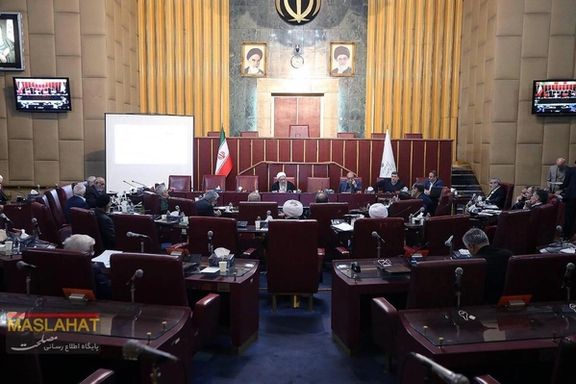
A meeting of Iran's Expediency Discernment Council
When a key advisory body in Iran started revisiting the contentious issue of acceding to international monetary conventions, it not only faced opposition from hardliners but also raised questions about whether the Supreme Leader has moderated his stance.
The Expediency Discernment Council (EDC), reportedly authorized by Ali Khamenei to undertake this review, was created to resolve disputes between the parliament and the Guardian Council, the body responsible for granting final approval to all legislation.
Economy Minister Naser Hemmati recently announced on social media that the Supreme Leader has approved a revisiting of Iran's accession to anti-money laundering and terrorism financing conventions.
Khamenei has not made any public statements on the matter so far.
The Financial Action Task Force (FATF) is an intergovernmental organization established to combat money laundering, terrorist financing, and other threats to the international financial system. Iran was first placed on its blacklist primarily due to its failure to meet international standards for combating money laundering and terrorist financing.
Many observers believe that the rapid deterioration of the Iranian economy, coupled with demands by the presidential administration and many politicians in Tehran, may have led Khamenei to give the green light for resolving the matter.
In an interview published by Euro News on Tuesday and widely covered by Iranian media, Asghar Fakhrieh-Kashan, former deputy of Iran's Central Bank, expressed that he had "the feeling" President Masoud Pezeshkian had reached an agreement with Khamenei to resolve the issue.
What role does the Expediency Discernment Council play in the debate?
One of the Council’s main mandates is to arbitrate between the Parliament and the constitutional watchdog, the Guardian Council, when a law is approved by the former but rejected by the latter and they cannot resolve the dispute.
The Council’s chair and members are appointed by Khamenei.
The current controversy centers on two pieces of legislation required by the FATF to remove Iran from its blacklist: the Palermo Convention on combating transnational organized crime and the CFT Act on combating the financing of terrorism.
Although Parliament approved these laws in 2018, the Guardian Council rejected them, citing conflicts with "resistance economy guidelines," national security policies, and "contradiction with the Sharia".
In November 2018, the matter was referred to the EDC, where it has remained stalled. This prolonged inaction could not have occurred without Khamenei's directive or consent.
Approval by two-thirds of the EDC's 43 current members is needed to finalize the two long-delayed pieces of legislation.
Who supports and opposes FATF-required accession?
Accession to the conventions has been a contentious issue in the Iranian political scene since 2016, largely due to the significant restrictions Iran faces on its relations with international banks and foreign trade as a result of being on the FATF blacklist.
The former nuclear negotiator, hardliner Saeed Jalili, who ran against Pezeshkian in the July snap presidential elections, is currently a member of the Expediency Discernment Council (EDC). He has the support of EDC members and some lawmakers in Parliament.
In a fiery anti-American speech recently, ultra-hardliner lawmaker Mehdi Koochakzadeh slammed the efforts to accede to anti-money laundering conventions under the Financial Action Task Force (FATF) as tantamount to “approving servitude to America.”
In a letter earlier this week to the Chairman of the Expediency Discernment Council (EDC), Sadegh Amoli-Larijani, 120 lawmakers argued that accession to the Palermo and CFT conventions would not benefit the Iranian nation. They contended that such a move would only “escalate the problems resulting from sanctions” and enable the US to uncover Iran's methods of circumventing them.
Reports suggest that at least half the members of EDC have a history of opposing not only these laws but Iran's accession to all conventions demanded by FATF.
However, as in many other cases, a subtle indication through unofficial channels from Khamenei may turn some of them.
Why is a decision on FATF legislation important?
The FATF recommends "enhanced due diligence" for transactions involving blacklisted countries. This makes financial dealings with Iran costly, risky, and time-consuming for international institutions. Countries may also apply countermeasures, such as terminating banking relationships, prohibiting transactions, or imposing additional audit requirements.
Resolving FATF-related issues would reduce these barriers, potentially facilitating greater access to international financial markets and alleviating economic pressure on Iran.
What steps has Iran taken to meet FATF’s requirements?
In 2016, under President Hassan Rouhani, Iran agreed to an FATF action plan to move from the blacklist to the gray list.
By 2020, however, the FATF reinstated Iran on its blacklist due to its failure to complete the action plan.
The global anti-money laundering task force, therefore, urged its members to continue to advise their financial institutions to apply enhanced due diligence to business relationships and transactions with natural and legal persons from Iran.
37 of the 41 recommendations to the Iranian government that the FATF made in 2016, including a cash declaration regime, were accepted by Iran and relevant legislation was introduced in these areas. But the counter-terrorism financing remains the toughest hurdle in Iran as hardliners argue that it would restrict Iran’s ability to assist their proxy groups abroad.
A widespread network of brokers online are working to facilitate a trade in eggs, sperm, embryos and surrogate wombs, Iranian newspaper Ham-Mihan reported in an investigation.
The report on Wednesday details how the transactions are advertised using coded language such as "work from home" on platforms like Divar - a popular Iranian online classifieds site - Instagram and Telegram.
Iran's lack of a clear legal framework governing the donation of reproductive cells and embryos has allowed the brokers to flourish, with some even collaborating directly with doctors.
The advertisements primarily target young adults aged 18 to 31, with varying prices, Ham-Mihan added. Surrogacy typically costs between 3 and 4 billion rials (approximately $3,750 to $5,000), plus an additional 90 million rials (less than $110) paid monthly to the surrogate until delivery.
In May, Tejarat News, another Iranian news outlet, reported a wider range for surrogacy costs, from 4 to 9 billion rials (roughly $5,000 to $11,000). Citing a gynecologist and a maternity ward nurse, it reported that individuals born in the 1990s are the most common surrogates.
Ham-Mihan reported that sellers are required to provide a physician-certified ultrasound confirming the size and reserve of each ovary, along with a certified copy of their national identity card obtained through a designated notary public.
For married donors written spousal consent is mandatory, while unmarried donors must provide a divorce or death certificate. A psychiatric evaluation is also required for all donors.
Zahra Ahmadi, director of social work at the Royan Infertility Treatment Center, a leading facility in Iran, told Ham-Mihan that brokers and intermediaries profit from the unregulated market.
She emphasized that donors can bypass these intermediaries by contacting the Royan Center directly for anonymous donations, dealing directly with the center rather than individual recipients. Ahmadi added that direct egg donors at Royan receive 160 million rials (about $200) per donation under a formal contract.
The report by Ham-Mihan also connects this trade to a broader trend of organ selling in Iran, which has sharply increased in recent years, even involving buyers in neighboring countries.
In June 2023, Hossein Biglari, head of the Kermanshah Kidney Patients Support Association, reported that kidneys were being sold in the province for negotiated prices between 2.5 billion rials (approximately $3,000 at current exchange rates).
Iranian media reports over the past two years have documented the growing prevalence of advertisements for liver, bone marrow, and cornea transplants, as well as sperm and egg donations appearing publicly alongside the sale of kidneys. Some advertisements even offer hearts for sale.
In May 2023, the Jahan-e-Sanat daily reported that some brokers facilitate the sale of organs in neighboring countries like the United Arab Emirates, Turkey and Iraq, fetching prices between of up to $15,000 for sellers.
While many analysts agree that Iran finds itself in a weakened position, a conservative commentator inside Iran claims that the unstable situation might shift in Tehran's favour.
Former politician Abolfazl Hassanbeigi, who is permitted to express his views in Iran's domestic media, also cautioned the country's officials that Iran is likely to face two challenging years ahead.
In the interview with the conservative Nameh News site, Hassanbeigi suggested that with proper management, the situation could improve -- ultimately bringing the region in line with Iran’s interests.
In its analysis, Nameh News noted that recent developments in the region have led many to believe that Tehran's influence has been weakened.
The diminishing influence of Hamas and Hezbollah, coupled with the fall of Assad in Syria, and the rise of Joseph Aoun—viewed as a candidate favored by both the US and Saudi Arabia—as Lebanon's president, has led many analysts to conclude that the dominance of Iranian-backed forces in the region might be drawing to a close.
Several Iranian observers, including imprisoned government critic Mostafa Tajzadeh, have argued that the fall of Assad, along with Israeli strikes on Hezbollah and Hamas, signals the collapse of what Iran refers to as the "axis of resistance," a term Tehran uses to describe its network of allies and proxies in the region. These observers view this as a strategic defeat for the Islamic Republic, attributing Iran’s growing isolation and economic difficulties to Supreme Leader Khamenei’s commitment to the "axis."
Meanwhile, Iran's ambassador to Lebanon, Mojtaba Amani, said last week that the election of Aoun, who has not been Hezbollah's candidate, does not represent a defeat for Iran.
Nameh News dismissed the idea of the "axis of resistance" ending as a delusional, suggesting that over time, the prevailing perception might shift towards viewing the region as increasingly aligned with the US.
However, the outlet also noted that some analysts believe the "axis" has experienced similar fluctuations in the past but has ultimately been revitalized, continuing to influence regional developments.
The website also pointed out that "none of the two views reflect the whole truth. In fact, both of them reflect what the analysts like to happen. West Asia has always been giving birth to new developments that disrupted previous equilibriums. However, the main question is that where will Iran be standing and what role Tehran is likely to play in the region."
Hassanbeigi told Nameh News that Iran's regional strength depends on resolving its internal disputes, asserting that the country is powerful enough to deter opposition if united.
He criticized radicals in Iran's political landscape, particularly in the parliament, for undermining the presidential administration through psychological warfare and efforts to tarnish its image.
"The radicals think of themselves as a new political force and that they can do anything they want even if their behavior harms the country's national interests," Hassanbeigi argued.
Addressing tensions with the US, Hassanbeigi remarked that despite Netanyahu's efforts, Washington does not appear to view a war with Iran as being in its best interest.
He acknowledged the challenges ahead, stating, "We face a couple of difficult years, but if we navigate this period effectively, the regional dynamics will shift."
He claimed that American policies often create adversaries wherever they intervene, as their excessive demands alienate others in the region.
Iranian President Masoud Pezeshkian has arrived in Tajikistan for his first foreign visit of 2025.
Announcing the visit, the Foreign Ministry spokesman, Esmail Baghaei, wrote on X, that the visit is a "symbol of the two nations' leaders’ commitment to further strengthening relations."
During the visit, approximately 20 cooperation agreements are expected to be signed between the two countries, according to Iran's Foreign Minister Abbas Araghchi.
Speaking to Iranian media, Araghchi said Tuesday that the agreements will span various sectors, including trade, investment, water and electricity industries, technical engineering services, transportation, tourism, university research, and more.
Ahmadreza Jalali, an Iranian-Swedish scientist currently sentenced to death in Iran, accused the Swedish government of neglecting his case in an audio message from Evin Prison.
In the message, which was sent to his wife, Vida Mehrannia, and received by Iran International, Jalali said: "I have been abandoned under these horrific conditions, with the imminent threat of execution looming. It appears that because of my dual nationality, I am regarded as a second-class citizen."
As part of a prisoner exchange agreement in June, Sweden repatriated a former Iranian official convicted of war crimes, Hamid Nouri, in exchange for the release of two Swedish citizens, Johan Floderus, an EU representative, and Saeed Azizi, who had been detained in Iran on charges of "spying for Israel."
However, Jalali, who was sentenced to death in October 2017 on charges of “corruption on earth”, was left behind in Iran.
“Swedish authorities are aware of my situation, yet no actions have been taken to improve it," he added.
"It seems that what might happen to me as a Swedish citizen is not a priority for Swedish officials. I face the risk of death, either by execution or due to my deteriorating health condition."
Since last year's prisoner exchange, Jalali has criticized the decision, describing the Swedish government’s exclusion of him as discriminatory.
In June, he publicly challenged the Swedish Prime Minister to meet with his son and family to explain why he was left behind and what actions would be taken to support them in the event of his execution.
Jalali's trial in Tehran’s Revolutionary Court, Branch 15, was criticized by Amnesty International for relying on confessions obtained under torture.
The latest US sanctions targeting Russian and Iranian oil could significantly disrupt Russia's oil supply chains, the International Energy Agency (IEA) said in its monthly report on Wednesday.
The new US sanctions on Iran and Russia announced last Friday, target entities responsible for over one-third of Russian and Iranian crude exports in 2024.
"We maintain our supply forecasts for both countries until the full impact of sanctions becomes more apparent, but the new measures could result in a tightening of crude and product balances," the IEA said.
Washington's latest sanctions package includes over 160 tankers, which the IEA estimates transported about 22% of Russia's seaborne oil exports in 2024.
The agency highlighted the effectiveness of earlier vessel designations, saying they had "reduced the activity of designated tankers by 90%."
The US Treasury on Friday imposed sanctions on several vessels involved in transporting Iranian oil, as part of a broader effort to disrupt Russia's network of ships evading US-led energy sanctions.
Of the 183 blacklisted vessels, eight were identified as having transported both Russian and Iranian oil, the Treasury reported.
"Several of the vessels sanctioned today have shipped not only Russian oil but also sanctioned Iranian oil," the Treasury said.
The vessels are part of a "shadow fleet," described by the Treasury as a network using "high-risk shipping practices" to avoid detection.
Many of these ships have been involved in transporting Russian oil at prices exceeding the $60-per-barrel cap imposed by G7 countries, the Treasury added.
Early January saw crude oil prices rise above $80 a barrel, what the IAE described as a result of tighter sanctions and a cold snap in the northern hemisphere.
However, the IEA anticipates that strong supply growth outside OPEC+ and the potential for OPEC+ to ease production cuts could moderate further price increases.
The IEA forecasts global oil supply growth of 1.8 million barrels per day (bpd) in 2025, with non-OPEC+ production contributing 1.5 million bpd.
While IEA's latest report did not provide an estimate for market surplus in 2025, its December forecast projected at least 950,000 bpd, indicating comfortably supplied market.