Britain denies funding Iran's influence operation in West
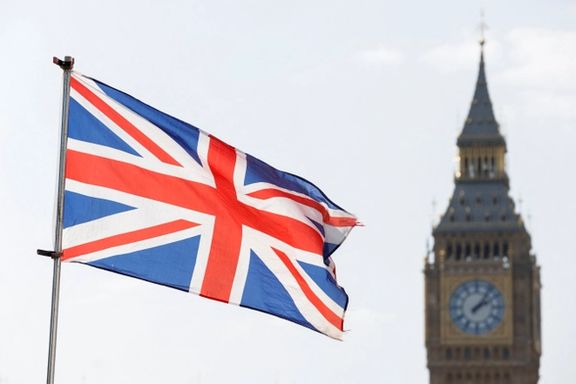
The UK flag
The British government has not funded Iran's influence network in Western countries, the UK Foreign Office told Iran International, rejecting remarks by a Swedish-Iranian scholar who said his involvement in the scheme was backed by the UK government.
"We have no record of funding for the IEI or any departmental work with them," the UK Foreign Office said in response to an inquiry about funding for the Iran Experts Initiative (IEI), a network linked to Iran’s Ministry of Foreign Affairs.
In late January, a report by Sweden’s TV4 revealed Roozbeh Parsi, the director of the Swedish Institute for International Affairs’ Middle East program, was involved in the IEI, a network formed by Tehran to expand its influence in the West.
Parsi denied any cooperation with the Iranian government, saying his participation in the Iran-led initiative was backed up by the UK government.
"I was doing this on behalf of the British Foreign Office," he wrote in a response published by Expressen, one of Sweden's most prominent dailies, on January 31. "For the British Foreign Office, which financed our participation, and other governments in the West, it was about strengthening their positions ahead of the negotiations on [Iran's] nuclear program."
The Swedish media's investigation, which cited emails provided by Iran International, followed a 2023 joint exposé by Iran International and Semafor that detailed Tehran’s efforts to cultivate relationships with academics and analysts abroad to expand its soft power.
Inquiry into allegations
In 2023, a spokesman for the European Council of Foreign Relations (ECFR) also told Iran International that "the Iran Expert Initiative was a European-government backed initiative that ECFR staff sometimes took part in but did not lead on."
The ECFR spokesman declined to name the European government.
Sweden's Foreign minister Maria Malmer Stenergard saidon Thursday the country had launched an inquiry into allegations that Parsi was involved in the Tehran-led influence network aimed at shaping Western policy.
The top diplomat said the government had contacted the Swedish Institute of International Affairs for more information, calling the allegations “very serious.”
She warned that Iran, along with Russia and China, is conducting extensive intelligence operations in Sweden.
Iran's president was among the country's top leaders voicing opposition to dialogue with the United States during events marking the 46th anniversary of the 1979 Islamic Revolution.
Amid celebratory gatherings attended by state officials, President Masoud Pezeshkian said on Monday: “If the US were sincere about negotiations, why did they sanction us?”
Reflecting Tehran's concerns about returning to the negotiating table with President Donald Trump who, during his first term, pulled out of the 2015 nuclear accord and imposed crippling sanctions on Iran, Pezeshkian said: “He says, ‘Let’s have a dialogue,’ and at the same moment, he signs memos for all possible conspiracies against Iran.”
Iranian President Masoud Pezeshkian during rallies marking the anniversary of the 1979 Islamic Revolution in Iran, February 10, 2024
Further casting doubt on recent hopes for rapprochement amid a mood of mistrust, Pezeshkian accused Washington of orchestrating conspiracies against Iran while proposing talks and claimed it was Tehran's archenemy Israel, not Iran, that destabilized the Middle East.
The comments followed Supreme Leader Ayatollah Ali Khamenei’s recent statement that negotiations with the US are “unwise and dishonorable.”
Foreign Minister Abbas Araghchi echoed similar sentiments, saying, “What they mean by negotiation is surrender. Iran negotiated in good faith, but the other side failed to fulfill its commitments and withdrew from the [2015 nuclear] agreement. Why should we trust them?”
Donkeys draped with US, Israeli, and UK flags are displayed at a state-sponsored rally marking the anniversary of the 1979 Islamic Revolution in Iran, February 10, 2024
Defense Minister Aziz Nasirzadeh also rejected talks under current conditions, saying, “We will not negotiate under sanctions and threats, and we do not recognize the new US administration.”
IRGC Aerospace Commander Amir Ali Hajizadeh mocked Trump’s threats, saying, “He does not have such courage. A powerful Iran does not submit to coercion.”
Like previous years, a statement was released by the government after the ceremony stressing that as the Supreme Leader said it is not wise or honorable to hold negotiations with the US.
“The government must strengthen security and intelligence structures to prevent the infiltration of enemy agents and divisive movements within the country’s institutions,” added the statement
The document also called for a stronger military. "We expect national officials to take decisive action against those disrupting the nation’s psychological security," it continued, "who, by aligning with the enemy, attempt to distort the truth.”
As officials rallied in support of the Islamic Republic, protests erupted in Tehran and other cities on Sunday night, where citizens chanted slogans such as “Death to the dictator” and showed anger at Supreme Leader Khamenei during state-organized fireworks displays.
The ongoing public unrest underscores the tensions within Iran as it faces mounting international and domestic challenges in the midst of its crushing economic crisis.
People carrying banners mocking (from left) Turkish President Recep Tayyip Erdoğan, Israeli Prime Minister Benjamin Netanyahu, Saudi Prime Minister Mohammed bin Salman Al Saud and Syria's interim leader Ahmed al-Sharaa during rallies to mark the anniversary of the 1979 Islamic Revolution in Iran, February 10, 2024
Nasser Seraj, a senior Iranian judiciary official accused of abuses by rights groups, has been appointed as the secretary of Iran's High Council for Human Rights and the judiciary's deputy for international affairs.
According to US-based Human Right Activists In Iran (HRAI)'s Spreading Justice website which documents rights abuses in Iran, Seraj "was directly involved in the issuance of death sentences for corruption and consequently is responsible for the violation of the right to life."
Mizan News Agency, the judiciary’s official outlet, reported Saturday that judiciary chief Gholamhossein Mohseni-Ejei appointed Seraj to replace Kazem Gharibabadi, who had held the position since 2021.
Seraj, formerly the judiciary chief’s political deputy, has held key judicial roles, including Tehran’s military prosecutor, judiciary advisor, head of the General Inspection Organization, Supreme Court deputy, and deputy justice minister.
As a judge, Seraj presided over the trial of the 2011 $3 billion embezzlement case, sentencing four men to death. One of those convicted, businessman Mahafarid Amir Khosravi, was executed in 2014 without prior notice to his family or defense attorney.
HRAI's Spreading Justice website says that the rushed execution was intended to prevent Amir Khosravi from exposing the names of government officials involved in the corruption scandal.
The rights group also says Seraj played a key role in restricting press freedom by overseeing the selection of the Press Supervisory Jury, which has been involved in shutting down newspapers and censoring media.
Iranian people marked the 46th anniversary of the 1979 Islamic Revolution with cries of "Death to the Islamic Republic" and "Death to the Dictator" ringing through several cities across the country on Sunday night.
Videos obtained by Iran International show people chanting against the clerical establishment during official fireworks to commemorate 22 Bahman (11 February), the day the Pahlavi dynasty was overthrown, giving way to what is now known as the Islamic Republic.
People in Tehran, Karaj, Arak, Mashhad and Kermanshah, among other cities, chanted "Death to Khamenei the Murderer", "Death to the Islamic Republic" and "Death to Dictator", videos recorded on mobile phones show.
Mashhad is Iran’s second-most populous city in the northeast; Karaj, the third-most populous city, located west of Tehran; Arak, an industrial hub and the fourth-most populous city in central Iran; and Kermanshah, the country’s ninth-most populous city.
The cries were heard in Tehran's Ekbatan, Tehranpars, Jannatabad, Ekhtiarieh and Enghelab (Revolution) neighborhoods, each with different demographic and social characteristics - from middle class to poor districts.
"Death to Execution Republic" was heard in a video from Jannatabad, referring to the Islamic Republic's hanging spree over the past few years.
"No one is chanting Allahu Akbar in this big city," one Tehran resident is heard saying in a video sent to Iran International, referring to the slogan that the Islamic Republic's supporters used to chant during the revolution anniversaries in the past.
In Kermanshah, people chanted slogans like "This year is year of blood, Khamenei falls with a thud."
Iran's threat to assassinate US President Donald Trump during the 2024 election campaign was more severe than publicly known, according to a new book.
Extraordinary precautions, including the use of a decoy plane, were implemented by Trump’s team to counter the threat, according to a forthcoming book, Revenge: The Inside Story of Trump’s Return to Power written by Alex Isenstadt.
“Law enforcement officials warned Trump last year that Tehran had placed operatives in the US with access to surface-to-air missiles,” the author said in an interview with Axios.
“The concern intensified after a foiled assassination attempt of Trump at his golf course in West Palm Beach, Fla., on Sept. 15.”
Isenstadt said he was given extensive access to Trump's inner circle during his campaign.
On one occasion, Trump traveled aboard a plane owned by real estate executive Steve Witkoff while his staff flew on Trump Force One. Many aides only learned of the switch just before takeoff, leading to what campaign insiders dubbed the Ghost Flight.
According to the book, set for release on March 18, the Secret Service also organized decoy motorcades and took steps like disabling a drone suspected of following Trump’s motorcade in Pennsylvania.
Campaign insiders noted that Trump grew more cautious about public events and spoke less frequently about ordering the 2020 airstrike that killed Iranian general Qassem Soleimani in Iraq.
Soleimani led the Islamic Revolutionary Guard Corps’ Quds Force and Iran's influence and military allies in the Middle East.
Since then, US authorities have tracked several threats against Trump and former officials linked to Soleimani's assassination.
"If they did that, they would be obliterated," Trump said recently. "That would be the end. I've left instructions - if they do it, they get obliterated. There won't be anything left."
Iranian foreign ministry spokesperson Esmail Baghaei reacted to Trump's remarks saying, “Tehran reserves its right to pursue a legal process for achieving justice regarding the killing of national champions and senior officials to achieve results in domestic and international courts.”
Iran’s Atomic Energy Organization announced plans to construct a yellowcake production facility capable of producing 20 tons annually.
The announcement follows the commencement of radioactive materials extraction at a complex in Yazd province.
“Today, the extraction and operation of radioactive materials and accompanying elements in the Anomaly 10 area began,” said Javad Ahmadi, the deputy head of the Atomic Energy Organization.
“Last September, we carried out the exploration of this area, and now we have reached the stage of extracting radioactive materials and accompanying elements from this mine.”
Yellowcake, a processed uranium ore, is a key material for nuclear power plants, which Iran claims is its focus, though concerns remain over its potential use in atomic weapons. The West has expressed fears that Iran’s ultimate aim may involve weapons-grade enrichment.
Ahmadi also mentioned the project’s scope, saying that it involves approximately 40 million tons of radioactive materials, iron ore, and other elements.
“We have also planned to establish a yellowcake production plant with an annual capacity of 20 tons.”
Last year, the head of the UN's nuclear watchdog said that Iran is "weeks not months" away from a nuclear weapon.
In spite of a November resolution by the International Atomic Energy Agency's Board of Governors censuring Iran for its lack of cooperation, Iran has continued to forge ahead with its enrichment towards weapons level uranium.
The deputy head of Iran’s Atomic Energy Organization, Behrouz Kamalvandi, said at the time: "We will significantly increase enrichment capacity ... The Westerners are trying to push our nuclear industry backward through pressure tactics."
The latest developments come as President Donald Trump looks to bring Iran back to the negotiating table. During his first term, the US withdrew from the 2015 nuclear accord, a deal that restricted Iran’s uranium enrichment to 3.67 percent—well below the 90 percent required for weapons—while capping its stockpile at 300 kilograms.
Further expanding its nuclear initiatives, Iran on Saturday launched production of Iridium Hexafluoride (IR46) at the Shahid Raeisi Nuclear Site in Isfahan. State media claims the material has medical and industrial uses and opens new export opportunities for Iran.
While President Donald Trump’s new administration has indicated openness to renegotiations, Supreme Leader Ayatollah Ali Khamenei has dismissed the prospect, calling dialogue with the US dishonorable.
Trump has clearly announced that the Islamic Republic must not have nuclear weapons while countries such as the United Kingdom, Germany and France (the E3) continue to push for measures to prevent Iran's nuclear progress.
Iran insists its nuclear program is strictly for peaceful purposes, though its growing capabilities are likely to draw increased international scrutiny.