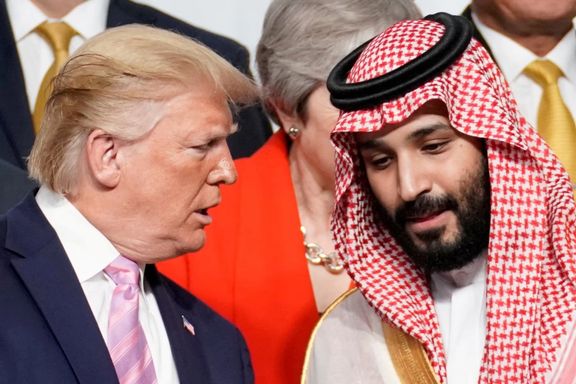
US President Donald Trump and Saudi Crown Prince Mohammed bin Salman
Tehran has reacted with suspicion to a report suggesting regional rival Saudi Arabia may mediate between Iran and US President Donald Trump, in the latest twist to a drama over whether Iran would accept Trump's overtures for a nuclear deal.
CNN reported on Sunday that Riyadh is open to brokering discussions between the US and Iran to curb Tehran’s nuclear program.
The kingdom is concerned, the US network reported, that Iran might pursue nuclear weapons more aggressively after Israel battered regional allies which had acted as Iran's deterrent to a direct Israeli attack for decades.
Asked about the CNN report at his weekly press briefing Monday, Iran's foreign ministry spokesman Esmaeil Baghaei denied any knowledge and said these were only “media speculations.”
An article titled "Will Saudi Arabia Mediate Iran-US Negotiations?" published by Nour News on Monday outlined key obstacles to Saudi mediation. It highlighted Iran's deep mistrust of the US, shaped by the policies of former President Donald Trump, who withdrew from the 2015 nuclear deal. The article also pointed to conflicting Iranian and Saudi interests in regional matters, including Lebanon, Iraq, and Syria, as additional challenges to mediation efforts.
Iranian authorities are “seeking strong guarantees of reduction of sanctions before entering new talks,” the media outlet close to former Iranian national security chief Ali Shamkhani, wrote.
Despite these challenges, Nour News acknowledged the potential for reduced tensions and even a new agreement if Saudi Arabia facilitates balanced, pressure-free negotiations.
Foreign affairs expert Ali Bigdeli, speaking to Nameh News on Sunday, noted that Saudi Arabia’s diplomatic influence had grown, citing an upcoming US-Russia meeting in Riyadh as evidence. He suggested Iran might view Saudi mediation positively. “Mr. Araghchi’s visit to Oman may not be unrelated to this matter,” he added.
Bigdeli also argued that Saudi mediation would differ significantly from that of Qatar, given Saudi Arabia’s dominant role in the Persian Gulf.
Iran's Supreme Leader Ali Khamenei repeatedly asserted in the past that the Islamic Republic would never engage in negotiations with the Trump administration. He also notably declined to respond to a message from Trump, delivered by former Japanese Prime Minister Shinzo Abe in June 2019.
In a speech on February 7, after Trump issued an executive order to reinstate his “maximum pressure” sanctions on Iran, Khamenei emphatically rejected talks with the United States.
Meanwhile, US Secretary of State Marco Rubio arrived in Riyadh on Monday ahead of planned talks between Trump and Russian President Vladimir Putin, to be hosted by Saudi Crown Prince Mohammed bin Salman. While Iran’s nuclear program may be discussed, no official announcements have been made.
On Sunday, US National Security Advisor Mike Waltz said President Donald Trump is willing to engage in talks with Iran only on condition that Tehran fully abandon its nuclear program.
"The President has also expressed a willingness to take whatever action is necessary. All options are on the table," Waltz told Fox News on Sunday, leaving the option of diplomatic channels open.
Oman acted as a mediator between Iran and the United States before the talks that led to the 2015 nuclear deal, and Qatar has recently offered to mediate new talks.
Speculation has risen that this topic may feature in the upcoming visit of Qatari Emir Tamim bin Hamad Al Thani to Tehran. However, Iranian Foreign Ministry spokesman Esmaeil Baghaei denied these claims during his weekly briefing on Monday.
Iran and Saudi Arabia restored diplomatic ties in 2023, facilitated by Iraq and China. The Saudi Embassy in Tehran reopened in August of that year, seven years after vigilantes attacked and torched the building in protest to the execution of dissident Shia cleric Nimr Baqir al-Nimr in Saudi Arabia.
The Iranian government has licensed 205 matchmaking websites in a bid to boost declining marriage rates among young Iranians, according to ILNA news agency.
"The government will be accountable for any problems these centers may cause," said Alireza Rahimi, Deputy Minister of Sports and Youth Affairs. He added that an expert group has been formed to evaluate the effectiveness of these websites in increasing marriage rates.
While Rahimi acknowledged what he called “some abuses" at these centers, he did not elaborate on the details of possible problems and oversight mechanisms. He added that the police are responsible for dealing with unlicensed matchmaking services.
The move comes as Iran faces a declining marriage rate and rising divorce rate. Government efforts to encourage higher birth rates have failed to produce results, according to data from the National Organization for Civil Registration.
According to the latest data from Iran's Civil Registration Organization, nearly 39% of marriages in the first seven months of the Iranian year 1403 (March to September 2024) ended in divorce. Data from the Statistical Center of Iran also reveals a 46% decrease in marriages between 2010 and 2023.
Economic hardship, rising awareness of individual and family rights, and access to legal and counseling services are among the factors contributing to young people's reluctance to marry.
In January, Iran's Science Ministry announced it is removing educational content discouraging childbearing and offering new incentives to boost declining fertility rates. These include more married student dorms, on-campus kindergartens, and increased financial aid for housing, loans, and other benefits for married students with children.
Supreme Leader Ali Khamenei said on Monday that Iran could fend off an attack by its enemies, days after US newspapers reported Israel was considering strikes this year on Iran’s nuclear sites.
“Today, in terms of strong defense and confronting hard threats from the enemy, we have no worries or problems. Our capability to counter hard threats is at an excellent level, and for that reason, the people feel secure,” he said.
The Wall Street Journal and The Washington Post reported last week citing US intelligence assessments from last month that Israel saw an opening for an attack on Iranian nuclear sites as early as the first of this year.
Israel is basing its assessment, the papers reported, on Iran's weakness after an Oct. 26 Israeli attack knocked out much of its air defenses and a greater perceived receptiveness to military action from US President Donald Trump.
Khamenei did not directly address the idea of an Israeli attack or potential talks between Iran and the US following the restoration of President Donald Trump's "maximum pressure" campaign.
Earlier this month, while announcing a hasher sanctions policy on Tehran, Trump also signaled a willingness to negotiate a deal with Iran—a proposal that Khamenei has publicly rejected.
His speech in the city of Tabriz, delivered during the month-long commemoration of the Islamic Republic’s 46th anniversary, was claimed by state-run broadcasters to have drawn thousands, although this figure could not be independently verified.
“The Islamic Revolution has managed to preserve itself as an independent identity and as a vast, hopeful base for the peoples of the region and even beyond. The reason for the anger of arrogant and colonialist forces around the world towards the Islamic Republic is the steadfastness and resistance of the Iranian nation in confronting them,” Khamenei told the gathering.
Relative moderate President Masoud Pezeshkian, who was also in attendance, recently backed Khamenei’s opposition to dialogue with the US. Iran’s Supreme Leader is the ultimate decision-maker on foreign and domestic policy.
Since Trump’s announcement, Iranian hardliners have steadfastly resisted any talks, while a few voices have pushed for easing the stance to relieve economic pressure by lifting sanctions.
Over the past year, Israel’s repeated military operations targeting Iranian-backed militant proxies in Gaza, Lebanon, and Syria have significantly eroded Tehran’s regional influence. With the fall of Assad’s government—once a critical ally—these external pressures have left Iran in what analysts describe as its most fragile state.
Talks with Washington now appear distant as US-led sanctions deepen hardship and discontent for Iranians grappling with a worsening economy.
Iranian President Masoud Pezeshkian says the Islamic Republic does not seek conflict but faces external pressures from countries he accuses of fueling instability.
“We are not seeking war… We seek peace and tranquility,” Pezeshkian said Monday, according to semi-official ISNA news agency.
He criticized Western nations for what he called hypocrisy in their human rights advocacy, referencing the civilian death toll in Gaza.
“They massacred more than 18,000 young people and buried 20,000 women under the rubble, yet they claim to champion human rights,” he said.
Elsewhere in his remarks Pezeshkian hailed the role of science in addressing Iran’s challenges, urging reliance on scholars and elites. “There are many paths, but our solution lies in science,” he noted.
He also warned that domestic divisions fuel external hostility, saying, “Unnecessary conflicts encourage the greed of our enemies.”
The president’s remarks come amid international sanctions on Iran over its nuclear program, its support for Russia’s war in Ukraine, and its backing of armed groups across the Middle East.
It also comes after a statement from the G7 at the Munich Security Conference blamed Tehran for being the cause for regional instability.
“The G7 members unequivocally condemned Iran’s destabilizing actions, including its rapid advancement of uranium enrichment without credible civil justification, its facilitation of terrorism organizations and armed groups across the Middle East and Red Sea, its proliferation of ballistic missiles and drones, and its transnational repression and violation of fundamental human rights,” read the statement issued on Saturday.
Pezeshkian previously echoed similar calls for peace during a visit to Tajikistan last month, but has rejected nuclear negotiations with the United States in accordance with a directive by Supreme Leader Ali Khamenei.
Iran rejected the latest G7 statement that criticized Tehran's ongoing nuclear activities and support of regional militant groups.
“The G7 members unequivocally condemned Iran’s destabilizing actions, including its rapid advancement of uranium enrichment without credible civil justification, its facilitation of terrorism organizations and armed groups across the Middle East and Red Sea, its proliferation of ballistic missiles and drones, and its transnational repression and violation of fundamental human rights,” read the statement issued on Saturday.
The G7 ministers held a meeting on the sideline of the Munich Security Conference.
Foreign Ministry Spokesman Esmail Baghaei on Monday and during his weekly briefing rejected the statement as politically motivated, arguing that Western powers themselves were responsible for fueling instability.
“The return of stability and security to West Asia requires these countries to stop their interventionist policies in regional affairs,” he said, referring to the United States, Canada, and three European members of the G7.
Iran pushes back on military, nuclear criticism
In response to criticism concerning the military capabilities of Iran, Baghaei said that Iran’s defense facilities follow all prevailing international laws.
“Iran’s military and defense advancements are necessary for national security and contribute to stability in West Asia,” he added.
Over the nuclear issue he dismissed concerns raised over enrichment of uranium as being politically driven.
“Our peaceful nuclear activities are fully in line with the Non-Proliferation Treaty and international safeguards,” he said, adding that Iran would continue its program based on its technical and industrial needs.
Baghaei accused the G7 of ignoring Israel’s nuclear capabilities. “The biggest obstacle to a nuclear-free Middle East is the Zionist regime, which has stockpiled weapons of mass destruction while enjoying full support from the same G7 countries,” he said.
Diplomatic outreach continues despite tensions
Despite Western pressure, Baghaei highlighted Iran’s ongoing diplomatic efforts, pointing to high-level meetings in Oman by Foreign Minister Abbas Araghchi. “These engagements are part of a broader strategy to enhance economic and political cooperation,” he noted.
On restrictions faced by Iranian flights to Beirut, he said discussions are underway with Lebanese officials. “We will not allow external forces to disrupt the strong historical ties between Iran and Lebanon,” he said.
Last week two flights from Tehran were banned from landing in Lebanon's only international airport.
On Friday, the second flight banned from taking off from Iran triggered protests in Lebanon from supporters of the Iran-backed group who blocked the road to the airport. The Lebanese army fired tear gas at protesters.
Responding to Israeli threats, Hezbollah funeral plans
Baghaei also addressed Israeli Prime Minister Benjamin Netanyahu's recent comments on a possible attack on Iran.
“Such statements are a blatant violation of international law, and those who issue these threats should be held accountable,” he said.
Israel's Prime Minister Benjamin Netanyahu expressed his intention on Sunday "to finish the job against Iran" with the support of US President Donald Trump.
Regarding Iran’s involvement in the funeral of the assassinated Hezbollah Secretary-General Hassan Nasrallah, killed by Israel last year, Baghaei said Tehran will be participating at a high level.
The Iranian government faces a delicate challenge in handling current university protests amid broader public frustration over rising prices and stalled diplomacy with the West.
The protests began Friday evening at Tehran University’s campus after Amir-Mohammad Khaleghi, an undergraduate business management student, was fatally stabbed by two men who stole his laptop just outside the campus.
On Saturday and Sunday, hundreds of students gathered again at Tehran University and Tarbiat Modares University to protest. They submitted a list of demands to authorities, warning of further demonstrations if their concerns—including the removal of “plainclothes forces” from university campuses—were not addressed.
Students accuse authorities of neglecting their safety amid a rise in robberies near campus in recent years. Meanwhile, they criticize officials for prioritizing the surveillance of student activists and suppressing dissent instead of addressing security concerns.
During Friday’s peaceful protest, four students were arrested, and a female student was injured by one of the unidentified agents who stormed the campus. The detained students were later released.
The presidential administration took an unusually conciliatory approach, a departure from the Iranian government’s typical response. Rather than escalating force against the students, officials appeared willing to defuse tensions. This tactic can be related to current public anger at the deteriorating economic situation and the danger of widespread protests.
University official Hossein Hosseini met with the protesters and blamed the violence on vigilantes and plainclothes security agents who entered the campus without authorization.
Higher Education Minister Hossein Simaei Sarraf cut short an official visit to Saudi Arabia and returned to Iran after Friday’s protests. He later apologized to the students and pledged decisive action against unauthorized interference in university affairs.
“Certain individuals and groups are more focused on creating turmoil rather than resolving crises. These irresponsible actions, whose instigators and masterminds remain unknown, have placed a significant burden on the country,” Deputy Higher Education Minister Gholamreza Zarifian told the reformist Etemad Online, referring to the unrest triggered by Friday’s violence against students.
A law passed by Parliament in 2000, during the presidency of reformist Mohammad Khatami, prohibits police and other security forces from entering higher education institutions except under “extraordinary circumstances” and only with the university dean’s request and the Higher Education Minister’s approval.
One of the dormitory rooms destroyed by vigilantes and security forces during the 1999 student protests
This legislation followed the 1999 student protests, which began on July 7 at Tehran University. Students had initially gathered peacefully outside their dormitories to protest the closure of Salam, a reformist newspaper. Some later moved their protest outside the campus before returning to their dormitories without any incidents.
That night, riot police, the Revolutionary Guards’ Basij militia, and vigilante groups raided the student dormitories, attacking sleeping students indiscriminately. They destroyed rooms and personal belongings, and in a tragic incident, one student was thrown to his death from an upper floor. A similarly violent raid occurred at Tabriz University dormitories two days later.
Known as the Kuy-e Daneshgah Disaster, these events sparked days of protests and unrest in Tehran and other major cities. Demonstrators marched toward Supreme Leader Ali Khamenei’s office in Tehran, chanting slogans against him.
Security forces responded with a brutal crackdown, killing at least three people, injuring over 200, and arresting hundreds more. Many detainees spent years in prison as a result of the protests.
The 1999 university unrest set a precedent for future anti-government protests in 2009, 2017, 2018, 2019, and 2022. This history may partly explain the Iranian authorities' apparent reluctance to use force against university students.