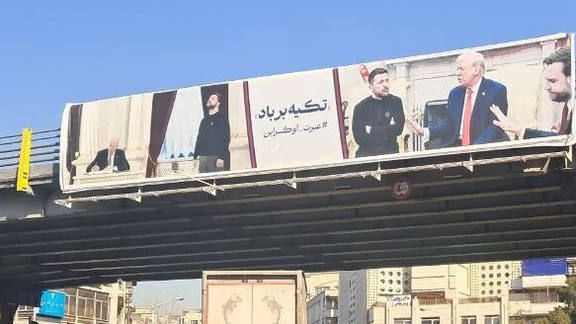
Tehran banners echo Khamenei’s stance on US after Trump-Zelensky blowout
Banners featuring the heated Oval Office exchange between US president and his Ukrainian counterpart have appeared across Tehran, echoing Iran's Supreme Leader’s criticism of Ukraine’s reliance on the United States.
The banners display phrases such as "End of the mirage" and "Leaning on the wind," referencing Ukraine’s ties with Washington.
The campaign underscore Iran's hardliners’ argument that the Trump-Zelensky clash validates Supreme Leader Ali Khamenei’s ban on negotiations with the United States.
Donald Trump and Volodymyr Zelensky's confrontation occurred during their meeting on Friday which intended to finalize a minerals agreement granting the US access to Ukraine's rare earth elements—a deal seen as a step toward a potential ceasefire with Russia - a long time Tehran ally.
The discussion escalated when Trump accused Zelensky of risking global conflict by refusing to make concessions to Russia, leading to an abrupt end to the meeting and the cancellation of the agreement.
Shortly after the Oval Office clash, Khamenei’s office reposted his 2022 remarks warning that Ukraine’s trust in the US was a mistake, saying that Washington cannot be trusted.
The Israeli ambassador to the US, Yechiel Leiter, warned that Iran is rapidly advancing its nuclear program while refusing to cooperate with the nuclear watchdog, arguing that diplomatic efforts to contain Tehran have failed.
“Right now we’re at a pivotal moment because Iran is racing forward in the nuclear program,” Leiter said in an interview with Fox News, pointing to the upcoming March 3 meeting of the International Atomic Energy Agency (IAEA).
“They’re supposed to produce a report on Iranian progress, but they won’t be able to because Iran doesn’t really cooperate with the IAEA.”
In 2023, Iran banned around one third of the IAEA's inspectors and the IAEA's chief, Rafael Grossi, said last month, “Iran is not still cooperating as we would like them to do.”
Leiter accused Iran’s leadership of lying about its nuclear ambitions and dismissed diplomatic efforts. “These people are liars. They’re charming liars. But they lie,” he said.
He added that Iran has openly declared its intention to destroy Israel and warned that its missile attacks on Israeli cities were part of a broader campaign against the West.
“They call us the little Satan. The United States is the big Satan. And they’re coming for Western civilization as a whole," he said.
He dismissed efforts to negotiate with Iran, saying, “You can’t talk Iran out of this.” He contrasted the Trump administration’s approach with prior US policies, praising former President Donald Trump for withdrawing from the 2015 nuclear deal.
“There’s real clarity on the Iranian situation within the Trump administration,” he said, emphasizing strong coordination between Trump and Israeli Prime Minister Benjamin Netanyahu.
Leiter's remarks come amid growing concerns over Iran’s uranium enrichment program.
Last Wednesday, the IAEA found that Iran's stock of near-bomb-grade uranium has risen to levels which in principle could be refined further into the equivalent of six nuclear bombs, according to a Reuters report citing confidential IAEA files.
Citizens across Iran told Iran International that they are struggling to afford even the most basic necessities as Nowruz (Norouz), the new Iranian year, approaches on March 20.
Many described empty markets, fading Norouz shopping traditions, and the daily struggle to cope with soaring prices and dwindling purchasing power.
A hypermarket owner in Tehran remarked, "This is nothing like the Norouz seasons we used to see. People barely buy anything beyond absolute necessities. Our bestsellers now are cigarettes and large bottles of soda, while even basic cleaning products for Norouz housecleaning sit untouched on the shelves."
Iran’s economic crisis has worsened across all sectors. The rial has hit a historic low, with US dollar being exchanged at 940,000 rials. Inflation continues to climb, making everyday goods unaffordable amid misgovernance and Donald Trump’s “maximum pressure” policy to intensify sanctions.
A government employee told Iran International, "A decent women’s suit costs at least 150 to 180 million rials ($159–$191). My salary is 102 million rials ($109), and 70 million ($74) of that goes to rent. How can I buy new clothes when I can barely afford food?"
Over the past five years, tens of millions of Iranians have seen their living standards erode as wages fail to keep pace with soaring inflation. Today, the average worker earns roughly $120 per month, while official estimates suggest that a minimum of $500 is needed for the basic survival of a family of three.
An employee at a clothing store in Tehran’s northern Mirdamad district said, "Customers used to rush in to buy new clothes for Norouz. Now, people walk in, check the prices, and leave empty-handed. It’s an economic catastrophe."
The Hamshahri newspaper, affiliated with Tehran Municipality, reported that vendors who once relied on strong year-end sales to compensate for slow months are now struggling, as even slightly higher-quality items exceed ten million rials ($10.60)—far beyond what most families can afford.
A pensioner said, "I receive 90 million rials ($96) a month, and everything is expensive. A kilo of beef costs 990,000 rials ($10.50), cooking oil is 5,700,000 rials ($6.10), and even a simple loaf of bread is 200,000 rials (21 cents). Fruits are a luxury now—kiwis are 1,500,000 rials ($1.60) per kilo, low quality oranges are 350,000 rials (37 cents), and the cheapest apples are 460,000 rials (49 cents). I even have to buy rice on an installment plan."
Furniture has also become unaffordable. Hamshahri wrote in its report, "If someone wants a decent-quality sofa set, they need at least 700 million to one billion rials ($745–$1,060). Even the low-quality sets, which barely last a year or two, cost between 200 to 300 million rials ($213–$319)."
A shopkeeper added, "People are collapsing under poverty, yet the Islamic Republic does nothing to ease their suffering. The streets are full of window-shoppers who can’t afford anything, and business owners are struggling with rising utility bills."
Iran International, in a recent report analyzing data from Iran’s Statistics Center warned that official figures—26.6% for food inflation and 32% overall—significantly understate the true rate. An analysis revealed that prices for 15 key household items surged by an average of 12% in just one month.
A survey of grocery prices in major cities, including Tehran, Mashhad, Isfahan, and Tabriz, found that household consumption costs had risen between 22% and 360% in the past week, with an average increase of 150%.
Iran's deputy foreign minister called for unity among Muslim nations in response to what he called Israeli destabilizing actions and provocations in the region, Iranian state media reported.
Majid Takht-Ravanchi made the remarks in a Saturday meeting in Abu Dhabi with the UAE president's diplomatic advisor Anwar Gargash.
The two sides also discussed bilateral relations as well as pressing regional and international issues, according to Iran's official news agency IRNA.
Takht-Ravanchi underlined Iran’s commitment to forging closer ties with neighboring countries, expressing Tehran's preparedness to enhance relations with the UAE based on mutual interests.
The UAE and Iran repaired their diplomatic ties in 2022, about six years after Abu Dhabi cut diplomatic relations in allegiance with Saudi Arabia after the 2016 looting of the Saudi embassy in Tehran.
Two members of the IRGC's Basij paramilitary forces were assassinated on Saturday in Iran's restive Sistan-Baluchestan province, the Quds Base of the IRGC Ground Forces announced.
According to the statement, "Hojatoleslam Sadegh Mahmoudi and Milad Damankesh were targeted by terrorists while traveling home from work in a private vehicle and were martyred in the attack." The two were part of the Shahid Sajjad Security Plan.
Sunni militant group Jaish al-Adl in a statement on Saturday claimed responsibility for the attack.
Iran's Sistan-Baluchestanprovince has long been a flashpoint for violence, frequently targeted by Jaish al-Adl, which is known for ambushes, bombings, and armed attacks that have claimed the lives of both civilians and security forces.
The incident follows a surge in violence in the province. In February, the group took responsibility for a bombing in Chabahar that destroyed a government coordination office, as well as an armed assault on a Housing Foundation building.
Jaish al-Adl said those attacks were in retaliation for policies displacing local Baluch communities. The Baluch are one of the poorest ethnic groups in Iran, suffering from lack of decent public services and infrastructure.
Both Iran and the United States have designated Jaish al-Adl as a terrorist organization. The group has carried out multiple attacks on Iranian military and IRGC positions in recent years.
In November, four members of the Islamic Revolutionary Guard Corps were killed in clashes during a military drill in Rask County. In October, Jaish al-Adl claimed responsibility for an attack that killed ten Iranian military personnel.
Shortly after the Oval Office blowout between the presidents of Ukraine and the United States, the office of Iran's Supreme Leader reposted his 2022 criticism of Ukrainians' reliance on Washington.
"The first lesson from the situation in Ukraine is that Western support for countries and governments that are their puppets is a mirage," the post on Ali Khamenei's X account quotes him as saying in Ukrainian.
"All governments must understand this. Those governments relying on the US and Europe should look at the current situation in Ukraine," the post reads, citing his remarks from March 1, 2022.
Khamenei's office reposted his old comments in reaction to Friday’s controversial meeting between US President Donald Trump and his Ukrainian counterpart Volodymyr Zelensky, in an apparent effort to vindicate his longtime opposition to the West, and the US in particular.
Citing Khamenei’s early February speech, in which he declared negotiations with the Trump administration would not be “wise, expedient, or dignified,” they argue that Trump's confrontational exchange with Ukrainian President Volodymyr Zelensky in the Oval Office should serve as a warning to those who question Khamenei’s stance.
On social media, hardliners have also extensively highlighted Khamenei’s warnings in the past about direct talks with the United States and his criticism of Trump for not abiding by the commitments the US had made in the 2015 JCPOA nuclear deal and re-imposition of sanctions on Iran in 2018.
Following the Oval Office incident, some reformist politicians and commentators—who have generally supported direct talks with the United States—also voiced skepticism about the viability of negotiations with the Trump administration.