Leniency for ex-ministers charged with corruption in Iran sparks backlash
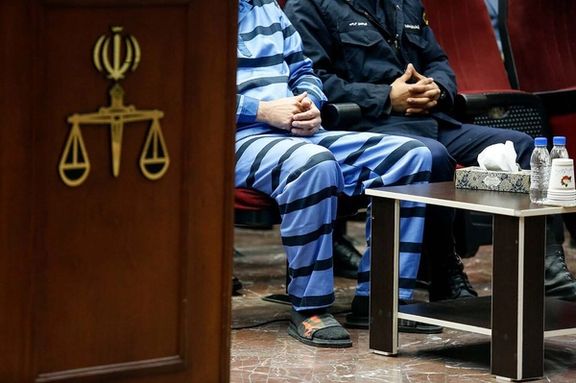
A court session of the Debsh Tea corruption case
Iran's judiciary has been criticized for its leniency when sentencing two former ministers convicted in a multi-billion dollar corruption case with allegations of nepotism influencing their jail terms.
Former trade minister Reza Fatemi-Amin received a one-year sentence and former agriculture minister Javad Sadatinejad was handed two years after both were found guilty of “complicity in disrupting the country’s economic system”.
The charges related to an alleged multi-billion-dollar corruption case dubbed the Debsh Tea scandal.
Many in the media and on social media argued that ordinary Iranians and political prisoners receive much harsher sentences, criticizing the ruling as unjust.
Ham Mihan newspaper in Tehran wrote that, “As former ministers, the convicted individuals should have faced stricter, not more lenient, sentences.”
It has been one of the largest financial corruption cases in Iran’s history, involving financial misconduct amounting to approximately $3.4 billion.
Investigations uncovered widespread fraud, including large-scale tea smuggling, currency manipulation and illegal acquisition of foreign exchange.
Gholamali Imanabadi, a well-known former lawmaker, went so far as to accuse some ruling figures of orchestrating the ouster of the economy minister and former foreign minister Javad Zarif from the government on Sunday to create chaos and divert attention from the light sentences issued in the Debsh scandal.
Supporters of the Reformist faction within the Islamic Republic pointed out that the two convicted ministers served in the previous government of former President Ebrahim Raisi—a government that had presented itself as “revolutionary” and committed to higher ideals.
The sentencing of former government officials is a rare instance of high-profile figures being prosecuted in Iran. However, similar cases have often resulted in appeals or commutations that prevent full enforcement.
Now, the unusually light sentences for the two ministers are widely seen as another example of leniency for insiders loyal to the system.
At the center of the scandal was the industrial group’s CEO Akbar Rahimi Darabad, who on Monday was sentenced to 66 years in prison for multiple economic crimes according to his spokesman, including organized smuggling and bank fraud.
Rahimi Darabad has also been required to return over €2 billion in received foreign currency facilities and pay fines for various smuggled tea shipments.
The two ex-ministers were among 44 individuals found guilty in the case, which allegedly involved Iran’s Central Bank, customs and a string of other ministries, raising public concerns over the extent of economic misconduct in the country.
The investigation alleged that Debsh Tea had exploited government policies to acquire vast amounts of foreign currency at official exchange rates, later selling it at significantly higher prices on the open market.
President Masoud Pezeshkian said on Wednesday he cannot implement a law that Iranians oppose, after hardliners largely thwarted his agenda by pushing out top aides and rejecting his overtures to Washington.
The remarks, quoted by the head of his office in a post on X, were the strongest yet against a dormant law to tighten Islamic morality restrictions on women.
"I cannot enforce the chastity and hijab law because it creates problems for people and I will not stand against the people," Pezeshkian said.
The soft-spoken, relatively moderate president had seldom spoken so directly against a key plank of rival hardliners' domestic agenda.
It was due to impose harsh penalties on women and girls who defy veiling requirements, including fines, prison terms, flogging and even the death penalty.
Last week, Pezeshkian's Economy Minister Abdolnaser Hemmati was impeached by Parliament while Vice President for Strategic Affairs Javad Zarif resigned under pressure.
The moves follow a decisive rejection by hardliners, led by Supreme Leader Ali Khamenei, of talks with the US the president hope could ease pressure on Iran's moribund economy - a key challenge to his administration.
Popular opposition to hijab enforcement exploded in September 2022 when a young woman named Mahsa Jina Amini died in morality police custody, sparking nationwide protests dubbed the Woman Life Freedom movement.
The unrest was quashed with deadly force and opposition to the theocracy festered, but hardliners still drafted the new hijab law in May 2023.
Iran's embattled President Masoud Pezeshkian is feeling shaken but determined to carry on in office after hardliners forced out two of his key aids, a source close to his office told Iran International.
The source, who spoke on condition of anonymity, said the President is no quitter but has been "a bit fragile since Sunday evening".
Economy Minister Abdolnaser Hemmati was impeached by parliament while Vice President for Strategic Affairs Javad Zarif resigned under pressure last week.
The latter was the country's most prominent reformist and an articulate exponent of the Islamic Republic's foreign policy on the world stage. Zarif would likely have been Pezeshkian's key player in nuclear talks the administration hopes could have rolled back US-led sanctions crippling Iran's economy.
Hardliners, most importantly Supreme Leader Ali Khamenei, have rejected those talks.
But now that Pezeshkian's agenda appears decisively thwarted, Tehran newspapers which had long alluded to the possibility of his resignation have gone largely mute on such an unprecedented move which would lay bare political infighting.
Unlike a few weeks ago, when newspapers and websites openly debated Pezeshkian's possible resignation from various political perspectives, the topic now appears off-limits.
Journalists and commentators have largely avoided mentioning resignation directly, possibly engaging in self-censorship as they grasp the gravity of the situation and fearing reactions by authorities.
Nearly all outlets treated the word as taboo, instead voicing concerns over the collapse of Pezeshkian’s “national reconciliation” project—an effort to bridge the divide between rival factions, including Reformists and hardliners, to curb political infighting.
Only one prominent reformist, former lawmaker Ali Nazari—now editor-in-chief of the reformist daily Mostaghel—openly addressed the issue. He advised Pezeshkian to "honorably resign" following the removal of two top aides: Economy Minister Abdolnaser Hemmati and Vice President Mohammad Javad Zarif.
Although government spokesperson Fatemeh Mohajerani officially dismissed rumors of Pezeshkian's possible resignation, a viral video on social media fueled further speculation. The footage showed Pezeshkian reciting a verse from the Quran: "If you live in poverty and misery, weakness is not an excuse to stay where you are. Leave!"
Many interpreted this as a sign of his frustration and sense of powerlessness, possibly hinting at a decision to step down. Others suggested he was simply encouraging Iranians struggling under economic pressure to consider emigration.
Meanwhile, some users circulated another video from Pezeshkian's election campaign, in which he said, "If I find it impossible to stand by my promises, I will discontinue my political activities."
Many newspapers and websites in Iran have highlighted the impact of Zarif's absence in the Pezeshkian administration.
They noted that Zarif would be sorely missed, as the president had relied on him in the unlikely event of a shift in Khamenei's firm stance against negotiations with the United States.
One newspaper pointed out on Wednesday that with Zarif and Hemmati gone, 75% of Pezeshkian’s cabinet is now made up of hardliners—figures he had attempted to co-opt but who remain fundamentally opposed to him.
Only two days after the impeachment of Hemmati and the removal of Zarif from his post, most of the press have almost forgotten the former while Zarif's pictures were all over both conservative and proreform media.
Although the word "resignation" was largely avoided, newspapers and websites widely discussed the deadlock created by Sunday's events. Ham Mihan wrote, "Those who brought about the deadlock are expected to explain it and show a way out of it."
Former diplomat Kourosh Ahmadi wrote in Shargh, "It was clear long ago that there was no room for Zarif in the government." On the conservative front, political commentator Mehdi Arab Sadeq wrote on the Nameh News website, "Zarif was Pezeshkian's last line of defense. With his departure, Pezeshkian lost at least half of his social backing."
On the same website, centrist politician Mansoor Haqiqatpour advised that Pezeshkian should remove all the conservatives he brought into his government. Like many other commentators across the political spectrum, he argued that Pezeshkian's national reconciliation project has failed and should be abandoned.
The pro-reform outlet Rouydad24 described Sunday's events as a symbolic defeat for the Iranian president and warned that even greater pressure is yet to come.
Iran’s military security is fundamentally different from nations that depend on foreign powers, Foreign Minister Abbas Araghchi wrote in Ettela’at daily on Wednesday, pointing to the Trump-Zelensky flare-up this week.
“Iran does not purchase its security; it builds it,” he said, arguing that its independence comes at a cost Tehran has long been willing to pay. "Iran has demonstrated that dependence on others is not only a risk but also a strategic mistake."
He said the country has chosen a path of self-reliance, avoiding the risks that come with dependence on shifting geopolitical alliances, highlighted last week in the very public spat at the Oval Office between Ukrainian President Volodymyr Zelensky and US President Donald Trump over Russia's invasion of Ukraine.
"Maintaining independence comes at a cost, and Iran has always paid that price. Since the early days of the Islamic Revolution, economic pressures, sanctions, military threats, and proxy wars have all been designed to turn Iran into a submissive player in the international system," he wrote.
"The recent dispute at the White House between Donald Trump, J.D. Vance, and Volodymyr Zelensky was not just an ordinary disagreement; it revealed deepening fractures at the core of the international system."
Following the heated exchange, Supreme Leader Ali Khamenei’s office reposted his 2022 remarks warning against reliance on the West.
Banners reflecting this message have also appeared across Tehran, featuring phrases such as “End of the mirage” and “Leaning on the wind.”
The column pointed to shifting dynamics in Ukraine, where Zelensky—once reliant on Western aid—now challenges US leadership directly.
“Even small allies are realizing that their dignity comes at a cost,” he added.
Although Iran produces many types of weapons, its arsenal is technologically inferior to Western and many Russian weapons. Iran does not have an effective air force, and despite Araghchi's claim of independence buys many weapons systems from others, such as Russia.
Since Friday's clash, many Iranian hardliners have said that the Trump-Zelensky blowout validates Khamenei’s opposition to negotiations with the United States.
Citing Khamenei’s early February speech, in which he declared negotiations with the Trump administration would not be “wise, expedient, or dignified,” they argue that Trump's confrontational exchange with Ukrainian President Volodymyr Zelensky in the Oval Office should serve as a warning to those who question Khamenei’s stance.
Araghchi’s comments about self-reliance contrast with the reality that the general population in Iran is experiencing.
With over 40 percent inflation, skyrocketing prices, and the devaluation of the national currency, one-third of the population has fallen below the poverty line—something that, according to many, the officials of the Islamic Republic never experience in their own lives.
Iran will not tolerate statements from Turkish officials that threaten historical and regional ties, Ali Akbar Velayati, senior advisor to Supreme Leader Ali Khamenei, warned.
“Iran will never remain silent in the face of baseless remarks,” he told Jam-e Jam daily, responding to Turkish Foreign Minister Hakan Fidan’s recent comments to Al Jazeera in which he accused Iran of risking regional disorder.
Iran was a key backer of Syrian President Bashar al-Assad, who was ousted in December by a Turkish-supported Islamist-led rebel alliance. “If this policy continues, I don’t think it will be good,” Fidan said.
Iran has also backed groups including Lebanese Hezbollah, Hamas in Gaza and the Houthis in Yemen for decades with financial aid and weapons.
"If you are trying to cause anxiety in a third country, other countries can also disturb you by supporting groups in your own country," Turkey's foreign minister added.
Velayati rejected that Iran was destabilizing the Middle East, saying, “Iran is a powerful country with an ancient civilization that has always worked for regional security and cooperation.”
He cautioned Turkish officials against repeating “unrealistic and interventionist claims” and stressed that engagement and dialogue define Iran’s approach, but added that Tehran will respond to any criticism.
Iran's foreign ministry summoned Turkey's ambassador, state TV reported on Tuesday, following Fidan’s comments.
Without using the term ‘summoning’, the Iranian foreign ministry confirmed that Ambassador Hicabi Kırlangıç met with Mahmoud Heydari, the ministry's Director General for the Mediterranean and Eastern Europe, on Monday.
"The common interests of the two countries and the sensitivity of regional conditions require avoiding wrongful comments and unreal analyses that could lead to differences and tensions in our bilateral relations," Heydari said.
Elsewhere in his remarks, Velayati warned against Israel for what he alleged as attempts to divide Syria, saying that “the groundwork for disintegration has already been laid,” citing rival factions including Kurdish groups, Alawites, and militant groups.
Iran's Shiite clerical government became deeply involved in Syria's civil war early in the conflict, sending regular and proxy forces to defend Bashar al-Assad's rule.
Iran, which invested heavily in Assad’s survival—spending at least $30-$50 billion—now faces the challenge of recalibrating its strategy. Supreme Leader Ali Khamenei has vowed on multiple occasions to reclaim Iran’s influence in Syria, adding further tension to an already complex situation.
Turning to Europe, Velayati predicted the European Union’s eventual collapse, citing deepening divisions over Ukraine.
“This is one of the worst periods for Europe since NATO’s founding,” he said. He argued that Europe’s dependence on the US had left it politically vulnerable, saying that “in the end, Europe will submit to America.”
On Trump’s stance in the Ukraine war, Velayati said Washington was pursuing an “empire in the Western Hemisphere” while seeking cooperation with Russia to avoid disruption to its plans.
“However, in the Eastern Hemisphere, countries like China, Iran, and even Saudi Arabia will not easily bow to such dominance,” he added.
After Iranian hardliners ousted two key aides and rejected his hopes for talks with the United States, the young presidency of relative moderate Masoud Pezeshkian appears to be at a low ebb.
Economy Minister Abdolnaser Hemmati was impeached by Parliament while Vice President for Strategic Affairs Javad Zarif resigned under pressure last week.
Hardliners accused Hemmati of failing to curb rising prices, inflation, and the devastating devaluation of Iran’s rial, while Zarif faced criticism over his family members' US citizenship. Pezeshkian had strongly defended both men.
The key question in Iranian newspapers on Monday was, "Will hardliners stop here?" Some outlets predicted that attacks on Pezeshkian and his government would continue.
Political commentators speaking to Persian-language media outside Iran said that anyone in Pezeshkian's position would have resigned almost immediately.
Inside Iran, however, commentators remained silent or were too intimidated to voice opinions that could be seen as undermining the government's integrity or sowing discord among officials.
What media, commentators, and politicians in Iran did not say was that Hemmati was impeached for economic problems rooted in Supreme Leader Ali Khamenei’s refusal to negotiate with the United States to address Iran’s chronic economic crisis. While many have acknowledged in recent months that US sanctions are the primary driver of Iran’s economic hardships, they have consistently avoided blaming Khamenei for the situation.
Even Pezeshkian and Hemmati, who detailed Iran’s deep economic problems in their speeches at the Majles, avoided explicitly naming Khamenei as the culprit. However, Pezeshkian made it clear: "I wanted to negotiate with the United States, but Khamenei forbade negotiations, and therefore, I said we won't negotiate."
That statement alone was damning. Pezeshkian was desperately trying to convey to the nation that the suffering was not his fault. From Khamenei’s perspective, shifting the blame to the economy minister helped absolve the Supreme Leader of responsibility for prolonging the country’s financial hardships.
With Khamenei dominating the country's political and media landscape, Pezeshkian has little room to further defend himself. He is likely to be left isolated, facing intensified attacks from hardliners who oppose his presidency and have never hidden their desire to unseat him.
The pro-reform website Fararu quoted former government spokesman Ali Rabiei as saying, "Pezeshkian has more difficult days ahead of him."
Other reformists, including cleric Mohammad Ali Abtahi, a former aide to President Mohammad Khatami, criticized Pezeshkian for his attempts to unify with hardliners. Abtahi argued that Pezeshkian appointed ultraconservatives to key positions in his government without securing their support for his administration.
Tehran's former mayor Gholam Hossein Karbaschi, who is currently the proprietor of centrist Ham Miham daily, wrote: "The hardliners will be further emboldened if Pezeshkian does not object and keeps giving concessions to ultraconservatives."
Karbaschi advised Pezeshkian that "There should be a limit to the idea of national reconciliation." He added that Hemmati's impeachment was a factional move and is not likely to bring about any improvement in the country's economic situation." He explained that the "ultraconservatives always held a grudge against Hemmati since June 2021 when he was competing with ultraconservative figureheads Saeed Jalili and Ebrahim Raisi as presidential candidate and questioned their understanding of the country's economy."
Referring to "the failure of national reconciliation as Pezeshkian's main project," proreform Rouydad24 warned the Iranian President: "Reconciliations with others in power has failed. Think of reconciling with the people."