Iran’s costs outweigh its gains in the region, Turkish FM says
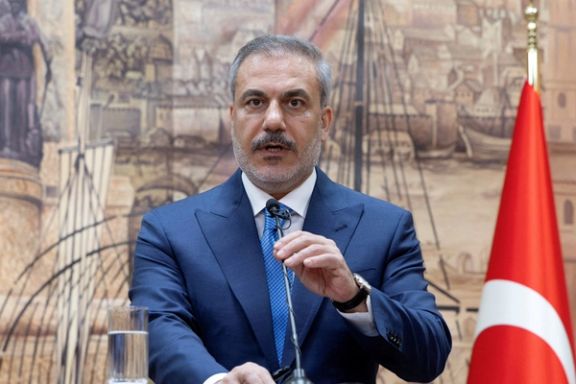
Turkey's Foreign Minister Hakan Fidan
Iran has paid a heavy price to maintain its influence in Iraq and Syria, yet its gains have been minimal compared to the costs, Turkey’s Foreign Minister said in an interview with Al Jazeera on Wednesday.
Hakan Fidan, who served as Turkey’s intelligence chief for nearly eight years, said he had shared this assessment with Quds Force commander Qasem Soleimani, who was killed in a US drone strike near Baghdad International Airport in January 2020. Iran’s regional strategy has fallen short of its goals, and shifting geopolitical dynamics have forced Tehran to reassess its role, according to Fidan.
His latest remarks echo his December interview, in which he criticized Iran’s involvement in Syria, arguing that despite its extensive presence, it failed to prevent the devastation in Gaza caused by Israel’s offensive. That interview highlighted Turkey’s evolving stance, as Ankara has gained leverage following the ousting of Bashar al-Assad, Iran's key ally in the region.
Ankara is widely regarded as the primary backer of the Syrian rebels who toppled Assad, led by Ahmed al-Sharaa.
Iran’s Supreme Leader Ali Khamenei, however, insists that Tehran's armed groups, including Hamas and Hezbollah, remain strong despite external pressures. Addressing developments in Gaza, Lebanon, and Syria, he accused the United States and Israel of misjudging the strength of Iran-backed groups, an assessment that appears increasingly disconnected from the shifting realities on the ground.
In a separate interview with the Saudi-affiliated Al-Hadath, Fidan noted that Iran must reflect on its actions post-Assad. He stressed the need for a regional order built on cooperation, sovereignty, and mutual interests, one that moves beyond the dominance of any single power, whether Iranian, Turkish, or Arab.
The Iranian government will raise diesel prices starting next month, Iran International has learned, in a move which could stoke unrest as economic malaise mounts.
Diesel will be sold at market rates, and a significant portion of government subsidies will be eliminated.
An executive directive outlining the changes has already been drafted and awaits official approval.
The change is likely to deepen the economic burden on citizens, adding to the existing strain caused by a weak currency and high inflation.
A gasoline price hike in November 2019 triggered days of nationwide protests, during which authorities deployed paramilitary forces who used overwhelming force to suppress the unrest.
At least 1,500 people were killed, according to a Reuters investigation.
Economic conditions have since worsened, with persistent high inflation pushing tens of millions of Iranians into deeper poverty.
Iran International reported in December that Iran was preparing to ease fuel subsidies in a move likely approved at the highest levels of government.
At the time, documents indicated that the monthly distribution of subsidized gasoline would be drastically cut from 87 million liters to 42.5 million liters.
Iranians had already begun noticing changes as fuel stations started installing eight-digit price displays—signaling a potential shift in pricing policies.
The diesel price increase comes as Iran’s top officials continue to discuss also a possible gasoline price hike this spring.
Sources told Iran International that security agencies are increasingly worried about the country’s growing dependence on fuel imports and its shrinking capacity to meet demand under escalating US sanctions.
Washington this week imposed a new round of sanctions targeting Iran’s oil industry, including key brokers, shipping firms, and the head of the National Iranian Oil Company.
These measures, part of the renewed "maximum pressure" campaign by the Trump administration, aim to cut Iran’s oil revenue, which remains the backbone of its economy and regional military operations.
With Iran pumping 3.2 million barrels per day as of January, the latest restrictions are expected to further strain the country’s financial and energy sectors.
A former US Navy sailor has pleaded guilty in a Chicago federal court to plotting an attack on Naval Station Great Lakes in Illinois purportedly on behalf of Iran’s Revolutionary Guards (IRGC), the Justice Department said on Thursday.
Xuanyu Harry Pang, 38, of North Chicago, pleaded guilty on Nov. 5, 2024, to conspiracy and attempted destruction of national defense facilities, but his case was unsealed on Thursday.
"In the summer of 2021, Pang communicated with an individual in Colombia about potentially assisting with a plan involving Iranian actors to conduct an attack against the United States to avenge the death of Qasem Soleimani ," the US Justice Department said in a press release.
Soleimani, a commander of IRGC's Quds Force was killed in a US drone strike near Baghdad International Airport in January 2020, a move ordered by US President Donald Trump.
An undercover FBI employee, posing as an affiliate of the IRGC's foreign operations arm the Quds Force, later engaged with the Colombian contact, who connected the agent to Pang.
While stationed at Naval Station Great Lakes, Pang discussed possible attack targets, including the base and other locations in the Chicago area.
Pang met with an undercover FBI operative three times in late 2022, including in downtown Chicago and Lake Bluff, Illinois. During these meetings, he provided images and videos of the naval base, US military uniforms, and a cell phone that could serve as a test detonator.
Pang remains in custody and faces up to 20 years in prison. His sentencing date has not been set.
The Islamic Republic cannot be reformed and cannot offer democracy or freedom, Iranian Nobel Peace Prize laureate Narges Mohammadi told the French weekly magazine Nouvel Obs.
"People in Iran, based on historical experiences and decades of efforts now demand a transition from tyranny to democracy, meaning a shift away from the Islamic Republic," she said.
Mohammadi, who won the Nobel Prize in 2023, is currently on temporary leave from prison.
In her interview featured on the cover of a Nouvel Obs special edition on Iran, she described the government in Tehran as unaccountable and inefficient, asserting that its downfall is inescapable and what Iranians want.
"The transition from the Islamic Republic is aimed at creating a democratic and secular structure where human rights and women's rights are guaranteed, and civil society is realized and strengthened," she said.
Mohammadi, 52, has spent much of the past 20 years in and out of prison. She has been arrested, tried, and sentenced to prison multiple times because of her human rights work.
Last December Mohammadi was released from Tehran's Evin prison to receive medical care where she was serving a 13-year sentence.
She was awarded the Nobel peace prize for her three-decade campaign for women's rights in Iran.
Two US lawmakers introduced a bipartisan bill urging the European Union to list Iran's Islamic Revolutionary Guard Corps a terrorist organization to present a united Western front against Tehran's military operations in the Middle East.
The Revolutionary Guards are a paramilitary and intelligence organization which helps arms and trains Shi'ite armed groups in the region.
US President Donald Trump designated the IRGC a terrorist organization in 2019 and ordered the assassination of its commander Qassem Soleimani in a drone strike in Baghdad the next year.
The European Union has so far held off on such a designation for the IRGC as a whole though it has designated individuals in the organization. None of the EU member states list it as a terrorist organization.
"To defeat the IRGC, which is responsible for sponsoring terrorist attacks against innocent civilians across the globe, the United States cannot act alone," congresswoman Claudia Tenney, a co-sponsor of the so-called Encouraging the EU to DESIGNATE Resolution, said in a statement.
"It's time for our EU allies to step up and follow suit .. this will send a strong message that the West is united against the IRGC's malicious actions and that we will hold them accountable for their vile acts of terrorism," the New York Republican added.
The EU has designated the Palestinian armed movement Hamas and the military wing of Lebanese Hezbollah terrorist organizations. Both groups, along with the Houthi group in Yemen and various militias in Iraq are backed by IRGC.
A full terrorism designation imposed on the IRGC would enable European law enforcement greater police and investigatory powers to prosecute Iranian officials and organizations.
The classification could also have profound dent European-Iran trade relations, as the IRGC controls a large portion of the Islamic Republic's economy.
“With Tehran more isolated than ever, now is the time to tighten the screws— we must not ease up or give the IRGC room to regroup," congressman Brad Schneider said.
"The US and Canada have already acted, and I urge our European allies to join us," the Illinois democrat said.
Fifteen key household items had increased in price by an average of 12% in just one month, a recent analysis by Iran International found, exposing a stark gap between official inflation figures and the reality faced by consumers.
Despite government statistics indicating a food inflation rate of 26.6% and an overall inflation rate of 32%, supermarket prices have risen far beyond these numbers, leaving many Iranians struggling to afford basic goods.
Supermarket prices have surged beyond what official reports indicate, leaving many citizens once considered middle class struggling to maintain their previous standard of living.
“We have stopped buying many things we used to consider normal, like nuts or even good quality rice,” said Mansour, 52, a resident of Tehran, who used to work in the banking sector but now finds his salary insufficient. “My children don’t understand why we’ve cut back so much.”
The economic crisis, which was once felt primarily by low-income families, has now engulfed middle-class households as well.
The Iranian rial has depreciated by more than 50% since September, falling to approximately 940,000 rials per US dollar. The collapse, combined with persistently high inflation—averaging around 40% annually over the past five years—has left many struggling to afford basic needs.
Official numbers versus market reality
Iran’s Ministry of Labor bases annual salary increases on official inflation figures, but market prices have consistently outpaced these statistics. A recent analysis by Iran International found that 15 key household items had increased in price by an average of 12% in just one month.
After cooking oil prices soared in December and potatoes became significantly more expensive in January, February has seen a sharp rise in the cost of legumes—some doubling in price within two weeks.
A survey of grocery prices in major cities, including Tehran, Mashhad, Isfahan, and Tabriz, found that household consumption costs had risen between 22% and 360% in the past week, with an average increase of 150%.
A 500-gram pack of tea, which cost 2 million rials ($2.13) last year, is now 4.6 million rials ($4.89).
Dairy products have also seen sharp increases. While official statistics report a 24% year-on-year inflation rate, market prices suggest much higher hikes.
A bucket of yogurt, which was 500,000 rials ($0.53) last year, now costs 760,000 rials ($0.81)—a 52% increase.
A 24-pack of toilet paper, once priced at 1.78 million rials ($1.89), now costs 3.93 million rials ($4.18), marking a 121% surge.
Families' statements about the price of various types of powdered milk also show that in February this year, the price of this essential product for infants has increased by 150 to 200 percent compared to the same time last year.
Rent and housing costs keep soaring
Inflation has also made housing less affordable. The Statistical Center of Iran reported a 37.6% increase in rent prices last month, but a nationwide survey by Iran International suggests that rents have risen by an average of nearly 78% over the past year. Many tenants have been forced to downsize or move to less expensive areas.
A resident of Tehran’s Yousef Abad neighborhood, who previously paid 240 million rials ($260) per month in rent, had to move to a smaller apartment due to rising costs. “I now pay 400 million rials ($430) a month for a place that is 10 square meters smaller,” he said.
While low-income citizens have long struggled with inflation, the economic crisis has now eroded the financial security of middle-class families. Many have reduced their spending on non-essential goods, and in some cases, even food quality has suffered.
With average monthly incomes now at just $120, while basic living costs exceed $500, over 30% of the population has fallen below the poverty line.