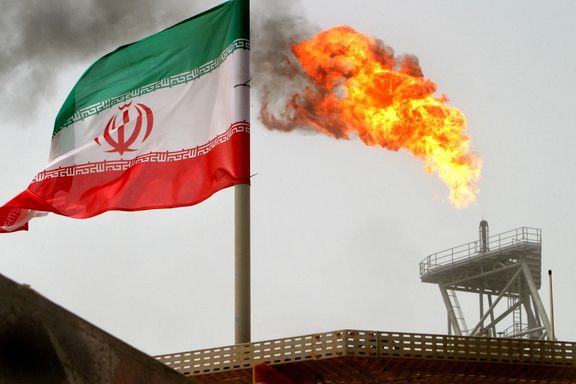
Oil prices rise as US sanctions on Iran fuel supply concerns
Oil prices rose for a second consecutive day on Tuesday as fresh US sanctions on Iran raised concerns over tighter supply, while strong global refining margins signaled steady demand for crude, Reuters reported.
Brent crude futures rose 15 cents to $74.93 a barrel by 0724 GMT. US West Texas Intermediate crude futures climbed 23 cents to $70.93 a barrel.
"In the short term, I continue to think crude oil is looking for a base. The fresh US sanctions announced on Iran overnight will likely assist with this as will the Iraqi oil minister's commitment to rein in its oversupply," Reuters quoted IG market analyst Tony Sycamore as saying.
The United States rolled out new Iran-related sanctions, the Treasury and State Departments announced on Monday, targeting companies and individuals including the head of Iran's national oil company.
The measures target over 30 brokers, tanker operators and shipping firms the treasury department accuses of facilitating the trade from which Iran derives most of its state revenue, including for regional military operations Washington opposes.
They come after President Donald Trump this month reinstated the "maximum pressure" campaign on Iran from his first term, with the stated aim of driving its oil sales to zero.
Iran, the third-largest producer in the Organization of the Petroleum Exporting Countries (OPEC), pumped 3.2 million barrels per day in January, according to a Reuters survey.
The United States rolled out new Iran-related sanctions, the Treasury and State Departments announced on Monday, targeting companies and individuals including the head of Iran's national oil company.
The measures target over 30 brokers, tanker operators and shipping firms the treasury department accuses of facilitating the trade from which Iran derives most of its state revenue, including for regional military operations Washington opposes.
They come after President Donald Trump this month reinstated the "maximum pressure" campaign on Iran from his first term, with the stated aim of driving its oil sales to zero.
“Iran continues to rely on a shadowy network of vessels, shippers, and brokers to facilitate its oil sales and fund its destabilizing activities,” Secretary of the Treasury Scott Bessent said in a statement on Monday.
“The United States will use all our available tools to target all aspects of Iran’s oil supply chain, and anyone who deals in Iranian oil exposes themselves to significant sanctions risk.”
Among those sanctioned is Hamid Bovard, Iran’s deputy oil minister and chief of the National Iranian Oil Company (NIOC) as well as Abbass Asadrouz, who leads the NIOC subsidiary that oversees Iran’s oil terminals.
The Iranian Oil Terminals Company oversees Iran’s oil terminals including the Kharg Island Oil Terminal through which most Iranian oil flows and the South Pars Condensate Terminal making up all of Iran’s gas condensate exports, the treasury statement added.
Also in the crosshairs were oil brokers in Hong Kong and the United Arab Emirates as well as tanker operators in China and India.
"We will continue to disrupt such illicit funding streams for Iran’s malign activities," the State Department said in a separate statement.
"As long as Iran devotes its energy revenues to financing attacks on our allies, supporting terrorism around the world, or pursuing other destabilizing actions, we will use all the tools at our disposal to hold the regime accountable."
Despite US-led sanctions, Iranian oil sales netted $53 billion in 2023 and $54 billion a year earlier, according to official US estimates, and output last year hit its highest since Trump imposed his original maximum pressure sanctions in 2018.
Still, Bloomberg reported last week citing data from energy consultancy Kpler that Iranian daily oil export flows to top customer China had strongly rebounded this month, Trump's first full month in office.
The unexpected rise comes after traders worked around logistical hurdles thrown up by previous US-led sanctions on the exports, the news agency reported.
China does not recognize US sanctions and private companies in the world's number one importer of oil account for almost all of Iran's sales.
Private ports in China are receiving oil from US-sanctioned tankers, Bloomberg reported this month, allowing major buyers of Iranian and Russian crude to avoid restrictions at larger ports.
"China and other countries have supported Iran in order for it to circumvent US sanctions for too long," US Senate foreign relations chairman Jim Risch said after the treasury's announcement.
"After years of President Biden’s refusal to act, I applaud President Trump’s return to maximum pressure," the Idaho Republican said on X.
Iran defended its human rights record and condemned Western sanctions at a United Nations Human Rights Council meeting in Geneva.
“For decades, the Iranian people have faced grave challenges, including unjust economic sanctions and terrorism, which have had many devastating impacts on their social and economic rights,” Foreign Minister Abbas Araghchi said in a speech on Monday.
Araghchi, however, did not acknowledge that sanctions against Iran include those for human rights violations, which have targeted both individuals and entities across government sectors from the IRGC to the prison services. Other sanctions have been for Iran's support of Russia's war on Ukraine and its ongoing nuclear program.
The number of people executed in Iran rose from 834 to 901 in 2024, including 31 women, the UN Human Rights Office said in January. The figures have reached record highs since 2022.
While Araghchi said Tehran is committed to improving human rights and cited achievements in education, healthcare, and women's rights, Iran has restricted women's freedoms, including the violent enforcement of hijab laws.
Iran has frequently used violence to suppress demonstrations, including the 2022 protests following the death of Mahsa Amini in morality police custody. Iranian forces killed hundreds of protesters, and arrested thousands more.
Iran's top diplomat also warned against the “politicized use of human rights” as a tool for pressure saying, “Human rights may not be used as a leverage of political and economic pressure or interference in the internal affairs of countries.”
The Islamic Republic has been accused of detaining foreign nationals and dual nationals on vague charges as a means of gaining leverage in diplomatic negotiations—a practice rights groups describe as 'hostage diplomacy'.
An Iranian economist has warned that hyperinflation could take hold unless effective negotiations with the United States lead to the lifting of sanctions.
“Without easing sanctions through productive negotiations, reducing inflation seems unlikely,” Ghodratollah Emamverdi told Etemad newspaper on Monday. He cautioned that if monthly inflation reaches 50%, Iran could face hyperinflation. Currently, monthly inflation is at four percent, while annual inflation is estimated to be over 40%.
On Sunday, the only government agency reporting inflation figures announced an annual rate of 35%. However, labor groups and analysts contend that the government downplays negative economic news, suggesting the real inflation rate is much higher.
Emamverdi noted that although Iran’s inflation rate has not yet reached the critical 50% threshold, continued sanctions and internal political tensions could push the economy into hyperinflation.
Majid-Reza Hariri, former head of Iran’s chamber of commerce, criticized the presidential administration’s inability to address the current crisis, saying the government is effectively paralyzed.
“We either have a government or we don’t, and I personally believe we are facing a state of no government. If the government cannot solve economic problems, no one is forced to be president or minister,” Hariri said. He added that everyone in the current administration was aware of the situation by mid-2024 but still chose to run for office or accept ministerial positions.
President Masoud Pezeshkian has argued that Iran’s complex and deep-seated economic problems are too vast for his administration to resolve, implicitly pointing to the impact of sanctions. Following Supreme Leader Ali Khamenei’s ban on negotiations with the United States in early February, Pezeshkian expressed his support for the decision, aligning himself with Iran’s ultimate political authority. As the new Iranian year approaches on March 20, the government faces the challenge of setting pay raises for millions of workers, including those in government and quasi-public enterprises. Workers are demanding wage increases of up to 70% to keep pace with soaring inflation.
The Iranian rial has lost more than 50% of its value in the past six months, driving expectations of even higher inflation. Currently, the minimum wage stands at about $120 per month, while semi-official estimates indicate that at least $400 per month is needed to support a family of three.
The government is considering a wage increase of less than 50%, which would still leave workers struggling to afford basic necessities. However, even a smaller pay hike could further fuel inflation.
Dr. Kylie Moore-Gilbert, a researcher and former prisoner in Iran, has criticized Australian Senator Fatima Payman for defending Iran’s treatment of women in an interview with the state-run Press TV.
In a post on X, Moore-Gilbert called Payman’s remarks “nonsense,” rejecting the senator’s claim that Iran allows women to participate in democracy.
She pointed out that Payman had previously attended a Senate inquiry into Iran’s human rights abuses and questioned why she would agree to speak with Press TV.
“The English-language propaganda arm of the Islamic Republic [is] known for broadcasting false confession videos and forced interviews with prisoners before they are executed," she said.
“The irony of a strong and powerful woman originally from Afghanistan… denying that her Iranian sisters face similar challenges just next door,” Moore-Gilbert wrote, adding that Payman’s stance contradicts her past expressions of solidarity with Iranian protesters.
Payman’s interview, in which she accused Western media of biased coverage on Iran, has sparked backlash, with critics arguing that her comments downplay the Islamic Republic’s record on women’s rights.
Iran’s foreign minister and parliament speaker traveled to Beirut to attend the funeral of Hassan Nasrallah, the slain Secretary General of Hezbollah, and his deputy.
Abbas Araghchi and Mohammad Bagher Ghalibaf, along with several Lebanese politicians and leaders of Iran-backed groups, will attend the ceremony.
Lebanese media said Iran’s President Masoud Pezeshkian expressed a desire to attend but did not receive an invitation.
Iranian state media said that family members of the late President Ebrahim Raisi and former Foreign Minister Hossein Amir-Abdollahian, who were killed in a helicopter crash last year along with several government officials, also traveled to Lebanon as part of an official delegation of around 40 representatives.
Araghchi said: “Many people in Iran wanted to participate today to bid farewell to these two heroes of the resistance. The funeral will show that Hezbollah remains strong, loyal to its ideals, and that the struggle will continue.”
Iran’s Supreme Leader Ali Khamenei issued a message for Nasrallah’s funeral, honoring him as a pioneering leader of the resistance whose legacy will endure. He also praised Safieddine as a vital figure in Lebanon’s resistance, offering prayers for them and all fallen fighters.
Khamenei added that “the resistance against usurpation and oppression will continue until its goals are achieved.”
Hezbollah, designated a terrorist organization by countries such as the US and UK, is currently in a fragile US-French brokered ceasefire with Israel, while both sides allege continued violations.
Last year, while thousands of projectiles being fired by Hezbollah to Israel in allegiance with Iran-backed Hamas in Gaza, hundreds of Hezbollah operatives were killed by Israel, including the assassination of its decades-long leader, Nasrallah.
He was killed in a targeted airstrike targeting Hezbollah’s command center in Beirut’s southern suburbs.
Hundreds more operatives were also seriously injured in a two-day operation in which Israel targeted pagers and walkie-talkies belonging to the group's members.
Ahead of Nasrallah’s burial, the Lebanese government extended the suspension of flights to and from Iran indefinitely.
The Washington Post reported that with the cancellation of Iranian passenger flights, Hezbollah supporters are traveling through Iraq to reach Beirut.
The funeral procession for Nasrallah and Safi al-Din is set to begin Sunday at a sports stadium in southern Beirut. Naim Qassem, Hezbollah’s current Secretary General, is expected to deliver a speech.
The US Embassy in Beirut has advised its citizens to avoid areas surrounding the funeral, including the airport.
Once Iran’s most powerful regional proxy armed militia, Hezbollah was founded with the support of the Revolutionary Guards in 1982 but suffered heavy losses in last year’s war, with Israel significantly weakening its military and political power.
While Tehran remains its key backer, the group’s diminished strength has raised questions about its ability to project power as it once did.