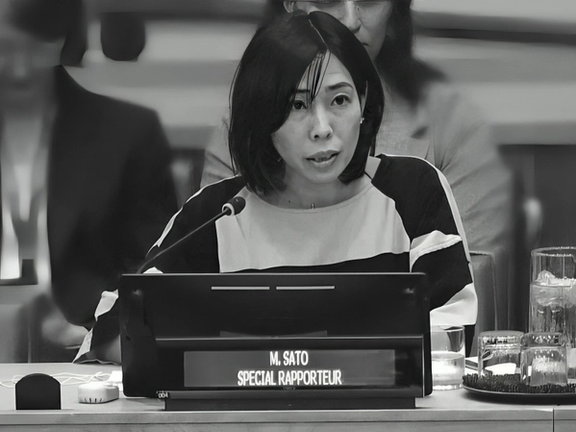
Iran’s planned amputations amount to torture, UN special rapporteur says
The planned amputation of three men’s fingers in Iran amounts to torture and must be halted immediately, the UN Special Rapporteur on Human Rights in Iran told Iran International in an interview.
"Today, I’m very concerned about the possibility of amputation of fingers that may be implemented to three men who have been convicted of theft,” said Mai Sato.
"Corporal punishment, including amputation, is absolutely prohibited under international law. And if executed, will amount to torture or ill-treatment," she said.
Earlier, rights group Amnesty International said the three men — Hadi Rostami, Mehdi Sharfian, and Mehdi Shahivand — held in Urumieh Central Prison in northwestern Iran, were informed by prosecution authorities last month that their sentences would be implemented as early as 11 April.
Amnesty said the same prison carried out amputations on two brothers last October using a guillotine device, raising alarm that authorities are prepared to enforce further amputation sentences.
Despite violating Article 7 of the International Covenant on Civil and Political Rights (ICCPR), to which Iran is a party, Amnesty said the court had sentenced the three men to “have four fingers on their right hands completely cut off so only the palm of their hands and thumbs are left”.
Sato urged the Iranian authorities to halt the amputation sentence on the men.
Amnesty said the three men have consistently maintained their innocence and said that their confessions were forced under torture, including beatings, flogging and suspension by their limbs.
At least 223 amputations have been carried out by Iranian authorities out of 384 known sentences since 1979, according to the US-based rights group the Abdorrahman Boroumand Center.
Iranian authorities had removed several organs from dual national Jamshid Sharmahd before transferring his body to Berlin after his sudden death in an Iranian prison while awaiting execution, the family's lawyers said Friday.
The lawyers said autopsy results revealed that several organs, including his tongue, larynx, thyroid, and heart had been removed before his body was transferred to Germany, hindering a full investigation into the cause of his death.
The possibility that Sharmahd may have been poisoned cannot be dismissed, according to lawyer Patrick Kroker.
His body was in poor condition Kroker said, adding that the corpse had only two teeth remaining.
Sharmahd was abducted by Iranian agents during a visit to the United Arab Emirates in 2020 and forcibly taken to Iran. According to Sharmahd family's lawyers, he was taken to Iran via Oman.
In February 2023, the Iranian judiciary sentenced him to death on charges of endangering national security.
He was convicted of heading a pro-monarchist group called Tondar accused of a deadly 2008 bombing at a religious center in Shiraz, killing 14 and injuring 215 more. The accusation, which Sharmahd repeatedly denied, was never substantiated by any public evidence.
'Mutilation'
At the memorial ceremony on Friday co-organized by the Berlin-based rights group Hawar Help, Sharmahd's daughter, Ghazaleh, told Iran International that the removal of his organs served two purposes: to traumatize the family and conceal evidence of his fate.
"They took out his tongue, the one with which he spoke about what they didn't want him to and they removed his heart, the one that beat for Iran," Ghazaleh said.
She added that in death by hanging, examiners might look for external evidence such as marks from a tight noose. However, after a few months these marks fade and internal organs must be investigated.
“The organs they removed are the very things that could show he was executed,” she said.
On October 28 last year, Iran's judiciary website Mizan announced that Sharmahd was executed. However, a week later on Nov 5, the judiciary spokesperson Asghar Jahangir said that Sharmahd died of a stroke before his scheduled execution.
The conflicting accounts of the Iranian authorities at the time raised questions about the truth behind his death.
Nearly four months after his demise was announced by Iranian authorities, German authorities informed Ghazaleh that her father’s body would be transferred to Berlin.
"We had to try really hard to bring him here, and German authorities didn’t want to help," Ghazaleh told Iran International.
Activist Mina Khani said that rights group Hawar Help, led by founder Düzen Tekkal and co-initiator of the group’s German political sponsorship program for Iranians detained in Iran, Mariam Claren, were deeply involved in pushing the German government to pressure Iran to repatriate Sharmahd's body.
“The most shocking part was the Islamic Republic’s mutilation of Jamshid Sharmahd's body, where parts of his body including his tongue, larynx, thyroid, and heart were removed before being sent,” Khani added.
In a statement following the ceremony, Julia Duchrow, Secretary General of Amnesty International said: "The shocking finding of the autopsy is that the cause of Jamshid Sharmahd's death cannot be determined due to the condition of the body."
Duchrow called on the German Federal Prosecutor's Office to immediately launch criminal investigations against Iranian officials suspected of being responsible for Sharmahd's death.
Iran plans to amputate the fingers of three men convicted of theft on Friday just days after executing five political prisoners, prompting alarm from UN human rights experts and international rights groups.
"Three men in Iran face imminent finger amputations that may be carried out as early as tomorrow (11 April 2025). The prohibition of torture and ill-treatment is absolute and allows no exceptions," Mai Sato, Special Rapporteur on the situation of human rights in the Islamic Republic of Iran, said in a post on X.
UN experts, which include Sato, expressed deep concern over the planned amputations, saying it violates international law and called for the immediate halt of such punishments.
In their statement, the UN experts said the three men were convicted of theft in 2019 and sentenced to amputation, with the Supreme Court upholding the verdict in 2020 despite allegations of torture.
Iran executes five political prisoners
The planned amputations come just days after Iran executed five political prisoners on Tuesday in Mashhad Central Prison, in northeastern Iran.
Left to right- Farhad Shakeri, Abdolhakim Azim Gorgij and Abdolrahman Gorgij.
The five prisoners, identified as Farhad Shakeri, Abdolhakim Azim Gorgij, Abdolrahman Gorgij, Taj Mohammad Khormali, and Malek Ali Fadayi Nasab, were convicted of “armed rebellion” for their affiliation with banned political groups, according to Norway-based rights group Iran Human Rights (IHR).
In a statement on Wednesday, IHR said the five men were executed without the opportunity for a final visit with their families. Their executions came after years of detention, including long periods in solitary confinement and allegations of torture during their trials.
“These prisoners were subjected to torture and sentenced to death following an unfair trial in the Revolutionary Court,” said Mahmood Amiry-Moghaddam, Director of Iran Human Rights (IHR). "The international community and the people of Iran must respond seriously to these executions."
The executions of the five men came on the same day as Amnesty International warned that the vast majority of the executions in Iran last year were linked to political repression.
The rights group reported that Iran accounted for 64% of all known global executions in 2024, with at least 972 people executed, in what Amnesty said is the government's ongoing campaign of mass suppression of dissent.
Iran’s top commanders sharpened their rhetoric against the United States and Israel ahead of expected diplomatic contacts in Oman, boasting of technical superiority and strategic endurance in the face of Western pressure.
“Despite all their claims, the United States and the Zionist regime are ineffective in practice,” said Revolutionary Guard Quds Force Commander Esmail Qaani at an event in Tehran on Thursday.
“They cannot even understand how our missiles strike their targets with such precision. This is our power.”
Qaani said Western-backed forces, though well-equipped, remained “helpless before the will of determined nations.”
At the same time, Navy Commander Shahram Irani said Iran’s maritime strength had reached unprecedented levels, saying international actors now viewed his forces as a superpower.
"Today, the enemies view the Armed Forces of the Islamic Republic of Iran and the Strategic Naval Force of the Army as a superpower, and the devil is seeking direct confrontation at sea. By the grace and power of God, we will defeat and drown the devil in the sea, just like Pharaoh’s people."
The comments follow recent threats by US officials, including president Donald Trump over Iran’s nuclear activities and regional support for proxies.
After Trump’s threats of a military strike, Tehran has agreed to indirect talks, despite a previous refusal by Khamenei.
An Argentine prosecutor has requested the arrest of Iran’s Supreme Leader Ali Khamenei in connection with the 1994 bombing of a Jewish community center in Buenos Aires that killed 85 people.
Prosecutor Sebastián Basso, who replaced the late Alberto Nisman, asked federal judge Daniel Rafecas to issue national and international arrest warrants for Khamenei, according to Argentine paper Clarin.
Basso also requested the application of trial in absentia for the remaining Iranian and Lebanese suspects named in the case.
Some of the high-level officials accused in the bombing case include former Iranian President Akbar Hashemi Rafsanjani, who has since died, then-Foreign Minister Ali Akbar Velayati, and former Intelligence Minister Ali Fallahian.
Others include former IRGC commander Mohsen Rezaee, former Quds Force commander Ahmad Vahidi, former Iranian diplomat Ahmad Reza Asghari, former cultural attaché Mohsen Rabbani, and Imad Mughniyeh, the late Hezbollah operations chief.
The move follows the passage of a law promoted by President Javier Milei last year, allowing trials in absentia in cases involving grave crimes.
The bombing remains Argentina’s deadliest terrorist attack. On July 18, 1994, a truck loaded with explosives detonated outside the Argentine Israeli Mutual Association (AMIA) building in Buenos Aires, killing 85 people and injuring hundreds.
In April 2024, Argentina’s top criminal court found that the bombing was carried out by Hezbollah militants under “a political and strategic design” by Iran. Iranian officials have denied any role in the attack, and no suspects have stood trial to date.
In 2015, Alberto Nisman, the Argentine prosecutor who was later succeeded by Basso, was found dead days after accusing then-President Cristina Fernández of covering up Iran’s role in the AMIA bombing. A federal judge later ruled that Nisman had been murdered.
Last year, President Javier Milei announced the new legislation aimed at allowing the prosecution of those responsible. “Today we chose to speak out, not stay silent,” Milei said.
“We choose life, because anything else is making a game out of death ... While they may never be able to serve a sentence, they will not be able to escape the eternal condemnation of a free court proving their guilt to the entire world.”
Milei has blamed the “fanatical government of Iran” for the bombing and linked the 1994 attack to the October 7, 2023, assault by Hamas on Israel. “The terrorism of that tragic Oct. 7 is exactly the same terrorism that attacked us 30 years ago,” he said.
Speaking at a commemorative event last year organized by the World Jewish Congress and the Latin American Jewish Congress, Milei also criticized previous Argentine governments and the judiciary for “negligence, cover-up, and manipulation of evidence” in the case.
In the same week as his speech, Milei’s government declared Hamas a terrorist organization, a move which irked Tehran, and said that “in recent years, a link with the Islamic Republic of Iran has been revealed.”
A report last year by the INSS said the government of President Javier Milei is "an ardent ally of both the United States and Israel", and said the Argentine government still holds Iran accountable for the attacks in 1992 on the Israeli embassy in Buenos Aires, in addition to the AMIA bombing.
"In total contrast to previous governments, the current [Argentinian] regime is willing to stand up to Iran and its axis of resistance. Argentina is no longer willing to sweep the problem under the rug," the report said.
Argentina is also trying to secure the extradition of Iranian Interior Minister Ahmad Vahidi, last year issuing a request to Interpol for his part in the AMIA bombing.
The United States on Wednesday imposed sanctions on five Iranian companies and one individual for their alleged support of Iran’s nuclear program, the Treasury Department said.
The action targets entities linked to the Atomic Energy Organization of Iran (AEOI) and its subsidiary, the Iran Centrifuge Technology Company (TESA), both of which play key roles in Iran’s uranium enrichment and nuclear development efforts.
The Treasury’s Office of Foreign Assets Control (OFAC) designated the firms under Executive Order 13382, which aims to curb the proliferation of weapons of mass destruction.
"The Iranian regime’s reckless pursuit of nuclear weapons remains a grave threat to the United States and a menace to regional stability and global security," said Treasury Secretary Scott Bessent. “Treasury will continue to disrupt Iran’s nuclear advances and broader destabilizing agenda.”
Among those sanctioned is Atbin Ista Technical and Engineering Company (AIT), accused of aiding TESA’s acquisition of foreign components. AIT's managing director, Majid Mosallat, was also designated for acting on behalf of the company.
Also blacklisted are Pegah Aluminum Arak Company, which supplies aluminum products to TESA, and Thorium Power Company (TPC), established in 2023 to develop thorium-fueled reactor technologies under the guidance of AEOI.
The designations further include Pars Reactors Construction and Development Company (Satra Pars) and Azarab Industries Co., both of which are involved in AEOI-led nuclear projects, including reactor construction and equipment production.
As a result of the sanctions, all US-linked assets of the designated individuals and entities are frozen, and US persons are generally prohibited from conducting transactions with them. Secondary sanctions may apply to non-US persons engaging in certain activities with the listed entities.
The sanctions come amid heightened nuclear tensions and just days before talks between the United States and Iran are set to take place in Oman on Saturday.
The upcoming negotiations, to be led by Iranian Foreign Minister Abbas Araghchi and US envoy Steve Witkoff, were announced on Monday by President Donald Trump, who has repeatedly threatened Iran with military action if it does not agree to a deal since returning to the White House in January.