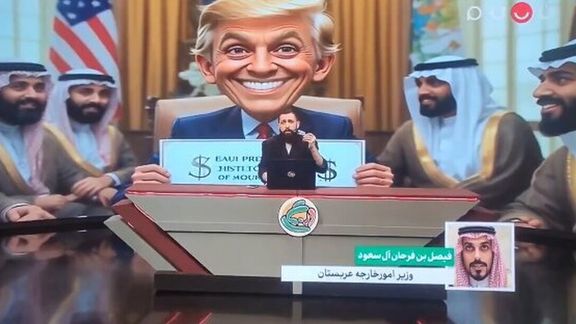
Iranian state TV apologizes after satirical show mocked Saudi minister
A screengrab from a program on Iran's state TV
One of Iran's state television channels, Nasim TV, has apologized for a satirical program that mocked a Saudi Arabian official, saying the incident was a negligent mistake and that disciplinary action has been taken against those responsible.
The Tasnim news agency reported that a video circulating online showed actor Mohsen Afshani seemingly making fun of the Saudi foreign minister through what appeared to be digitally altered content.
The timing of the broadcast, just a week after the Saudi defense minister's trip to Iran, drew widespread criticism online and in some media outlets, raising questions about potential efforts to undermine the improving bilateral relations and the government's foreign policy objectives, including ongoing talks with the United States.
While Nasim TV did not name the program in its statement, it acknowledged that "some political policy lines regarding neighboring countries were inadvertently disregarded" in a recorded satirical show.
The network assured the public that those responsible for the lapse would face disciplinary measures.
The Financial Times, citing analysts close to the Saudi leadership, reported last week that Saudi Arabia’s defense minister used a high-level visit to Tehran to signal Riyadh’s opposition to military confrontation with Iran.
“Saudi is clearly sending a message to Tehran that it will not be a conduit in any fashion towards an attack on Iran,” said Ali Shihabi, a Saudi commentator close to the royal court. “The kingdom supports President [Donald] Trump’s efforts to find a diplomatic solution to the nuclear crisis, and doesn’t want a war.”
Prince Khalid bin Salman’s visit took place just days before Iran resumed nuclear talks with the United States. Bin Salman is the highest-ranking Saudi royal to visit Iran in decades and includes the kingdom’s ambassador to Yemen.
Saudi and Iran only resumed diplomatic ties in 2023 after a seven-year hiatus following an attack on the Saudi embassy in Tehran which drove a wedge between the two powers.
Local authorities are deploying advanced surveillance technologies in Isfahan to identify and threaten women who defy the country’s strict hijab regulations, according to research by internet watchdog Filterwatch.
The NGO, which specializes in internet freedoms in Iran and the Middle East, released a report last week detailing new technologies and tools allegedly used by authorities in Isfahan, Iran's third most populous city, for hijab enforcement.
These include International Mobile Subscriber Identity-Catchers (IMSI-Catchers), data from contactless card readers, and urban surveillance cameras.
IMSI-Catchers—also known as fake cell towers—can intercept and track mobile phone communications by impersonating legitimate towers. A portable fake cell tower carried by a hijab enforcer, for instance, can connect to the cell phone of a woman not wearing the hijab on the street and identify her number.
“The combined use of IMSI-Catchers, contactless card readers, and surveillance cameras—along with access to government databases and the cooperation of telecom operators—has created a powerful, multilayered tool to systematically violate women’s rights through identification, tracking, and intimidation,” Filterwatch said in its report.
Stricter hijab enforcement in Isfahan
So far, this surveillance-driven enforcement strategy appears limited to Isfahan, a conservative bastion where hardliners have pushed for stricter hijab enforcement—even after the Supreme National Security Council (SNSC) temporarily shelved a controversial new 'hijab and chastity law' in September to avoid sparking unrest if it was brought into effect.
The law has been slammed globally by rights groups and the UN which said it amounted to gender apartheid.
In December, Iranian media unveiled the details of the new law which had been kept secret. Stricter measures against women who unveil in public would include travel bans, social media bans, prison sentences, and lashes. It also criminalizes anyone promoting the encouragement of hijab defiance.
“The Isfahan case is a serious alarm bell about the escalation of digital authoritarianism and the use of technology as a weapon against the rights of citizens, especially women, in Iran,” Nima Akbarpour, a tech expert and filmmaker, warned in a post on X.
Warning text messages reveal extent of data access
In recent weeks, dozens of women reported on social media that they received threatening text messages after visiting public places in Isfahan during the Nowruz (Iranian New Year) holidays in late March as the crackdown escalates.
Screenshots shared online show messages from various state entities, including the provincial branch of the Office for the Promotion of Virtue and Prevention of Vice, the Department of Justice, and the police.
The first two agencies warned recipients of potential legal prosecution should the violation of hijab rules be repeated. The third message, from the police, informed recipients that “evidence of the crime” had been submitted to the judiciary.
The messages included the women’s full names and specified the exact locations where the alleged violations occurred—indicating the authorities had access to their personal and location data.
In some cases, the same messages were reportedly sent to the recipient’s husband or father, demonstrating the extent of data collected.
While reports of such warnings first emerged in June 2023, local authorities only recently confirmed the practice after it appears to have become more widespread.
Last week, Amir-Hossein Bankipour, an ultra-hardline lawmaker from the province, said, "[Sending text messages] began some time ago, and its impact has already been observed, with approximately 80–90 percent of recipients complying after receiving the text message. This method has proven effective without causing social tension".
Public defiance continues
Public acts of defiance against the hijab have grown to new heights in the past year despite authorities' threats of severe legal crackdowns, occasional violence against women on the streets, and measures such as impounding vehicles if unveiled women are spotted in them.
A nationwide movement against compulsory hijab intensified following the death of Mahsa Amini in the custody of the morality police in September 2022. Her death sparked protests across Iran under the slogan "Woman, Life, Freedom," shifting public sentiment decisively against compulsory hijab.
Many women now refuse to wear the compulsory head covering, long tunics, and trousers as dictated by the country's Shariah law. They are also now often seen singing and dancing in public in defiance of the religious establishment.
Pope Francis, who died on Monday at age 88, maintained a balance in his dealings with the Islamic Republic over his 12-year papacy—engaging Iran’s leaders diplomatically while voicing criticism over executions and crackdowns on dissent.
Elected in 2013, the Argentine-born pontiff entered the Vatican just as Hassan Rouhani, a relative moderate within Iran’s ruling establishment, rose to power. Their political overlap raised hopes of better ties.
Rouhani visited the Vatican in January 2016, meeting Pope Francis behind closed doors. According to Vatican readouts, the Pope welcomed Iran’s nuclear deal with world powers and urged its leaders to help defeat terrorism and extremism in the region.
Despite maintaining diplomatic relations, Francis never visited Iran, even as he made rare and symbolic trips to nearby Muslim-majority states. In 2021, he traveled to Iraq, where he held an unprecedented meeting with Grand Ayatollah Ali al-Sistani in Najaf, which Iran’s state broadcaster ignored entirely.
Tensions between the progress ideals of the Vatican under Francis and Tehran’s actions sharpened after the death of Mahsa Jina Amini in morality police custody in 2022 sparked the nationwide "Woman, Life, Freedom" protests.
Francis condemned the use of the death penalty on demonstrators during his annual address to the Vatican diplomatic corps in January 2022.
"The death penalty cannot be employed for a purported state justice, since it does not constitute a deterrent nor render justice to victims but only fuels the thirst for vengeance."
Weeks earlier, during his Christmas Day address, he called for reconciliation in Iran, grouping it with other regions experiencing conflict. He prayed for a lasting truce in Yemen and for reconciliation in Myanmar and Iran, highlighting the need for peace and dialogue there.
Francis also responded to escalating regional tensions. After the US killing of Qassem Soleimani in 2020 and Iran’s retaliatory strikes in Iraq, he called for restraint and dialogue, warning against war’s destructive toll.
“I call on all sides to keep the flame of dialogue and self-restraint alight and ward off the shadow of hostility,” he said in his annual State of the World address to diplomats in January 2020.
Even as he criticized Iran’s human rights record, Francis remained a point of contact for Iranian leaders. In November 2023, late President Ebrahim Raisi spoke with the Pope by phone, expressing appreciation for his call for an immediate ceasefire in Gaza following Hamas’s October 7 attack on Israel.
Francis repeated that plea during his final Easter address, delivered weeks before his death.
Iran said the lifting of US sanctions remains the decisive issue in nuclear negotiations, as technical-level meetings prepare to resume in Muscat following a round of talks in Rome.
“The essential demand of Iran is the removal of unjust sanctions,” Foreign Ministry spokesman Esmail Baghaei said on Monday during a weekly briefing. “These restrictions, imposed under the pretext of the nuclear file, have no legal foundation.”
In November, Foreign Ministry spokesman Esmail Baghaei said, “The official stance of Iran in rejecting weapons of mass destruction and regarding the peaceful nature of the Islamic Republic of Iran’s nuclear program is clear".
Earlier this year, the UN nuclear watchdog, the International Atomic Energy Agency (IAEA), said Iran had enriched uranium to near weapons grade. Last week, the Wall Street Journal reported major gapsin the agency's understanding of Tehran's nuclear inventory since 2023 when Tehran banned dozens of inspectors and removed cameras in key sites.
Muscat to host next round of expert talks
Baghaei confirmed that the next expert-level meeting between Iran and the United States would be held in Oman, a key mediator in the talks, along with Italy.
Tehran says the negotiations are taking place without direct contact between Iranian and American negotiators. Efforts to restore the Joint Comprehensive Plan of Action (JCPOA) have faltered since the collapse of the 2015 deal following the US withdrawal in 2018 under the first administration of President Donald Trump.
According to Baghaei, the forthcoming technical talks will focus on the details of the framework that might underpin any future agreement.
“We are serious and swift, but a deal depends on the will of the counterpart. Constant references to the snapback mechanism are not constructive,” he said, referring to threats from European states to reimpose UN sanctions under the nuclear accord’s dispute resolution clause.
Beijing and Moscow remain ‘key interlocutors’
Iran's foreign minister is set to travel to China for consultations, Baghaei said, adding that Beijing and Moscow remain crucial interlocutors due to their roles in the UN Security Council and the 2015 nuclear deal.
“We have always been in contact with the European troika as well,” he said, referring to Britain, France, and Germany. These countries, alongside Russia and China, were original signatories of the JCPOA and remain engaged in efforts to salvage the deal.
Baghaei added that all such talks remain rooted in the framework of the nuclear agreement and UN Security Council Resolution 2231, which endorsed the JCPOA in 2015.
Tehran rejects pressure, denies Rome meeting with IAEA
Baghaei also rejected the idea that Iran would yield under pressure. “We do not change our positions under threats. We respond to goodwill with goodwill and know how to counter intimidation,” he said.
Iran has repeatedly warned it will not bow to coercive diplomacy, including military threats or economic isolation, a stance hardened by years of Western sanctions and regional conflict.
US President Donald Trump has warned of bombing Iran if Tehran fails to reach a deal over its nuclear program.
"If they don't make a deal, there will be bombing — and it will be bombing the likes of which they have never seen before," Trump said.
“There were no meetings or discussions with Mr. Grossi in Rome,” he said. “He traveled there on his own initiative. We had already spoken with him in Tehran before the Rome talks, and saw no need for further discussions.”
A sharp rise in the price of opium in Iran has driven long-time users of the traditional narcotic toward cheaper and more dangerous synthetic alternatives, according to a field report published by Tehran-based daily.
The Haft-e Sobh paper cited market data showing a 32 percent year-on-year increase in opium prices in April, bringing the average cost to around 1.64 million rials per gram—equivalent to roughly $2.
The rial fell sharply after the start of Iran-US nuclear negotiations, trading at 820,000 to the dollar. Based on this rate, the current opium price range of 1.3 to 2 million rials per gram translates to $1.58 to $2.44.
“The price hikes in the past two years have been astronomical,” one user told Haft-e Sobh. “People can’t afford opium or its derivatives like opium extract anymore. Many have switched to industrial drugs instead.”
Over the past five years, the average price of opium has more than doubled. In 2020, it stood at around 750,000 rials per gram ($0.91), rising to 1.2 million rials ($1.46) in 2023 and now averaging 1.64 million rials ($2).
For much of the last decade, black-market opium prices had risen more slowly than Iran’s official inflation rate. But that gap has now narrowed considerably. Official inflation in the past year was 33.4 percent, nearly mirroring the 32 percent jump in opium prices.
The shift in affordability has triggered a broader change in consumption. A February 2025 field report by the Etemad newspaper found that the use of traditional narcotics like opium has declined sharply in the past seven years, with heroin and methamphetamine becoming more prevalent.
Unlike opium, meth is often easier to manufacture domestically and does not rely on cross-border supply chains.
Much of the current scarcity is linked to the Taliban’s ban on poppy cultivation in Afghanistan, enacted in early 2022. Taliban forces destroyed large swathes of opium poppy fields, disrupting regional supply and pushing up prices.
In July 2022, Iran’s Tejarat News website reported that prices had spiked nearly sixfold before partially stabilizing.
Meanwhile, as demand remains high, reports of poppy cultivation inside Iran have surfaced despite official crackdowns. Government-linked media recently aired footage of poppy fields being destroyed in southern provinces.
In one case from March, footage released by the Baloch Activists Campaign showed armed raids by Iranian forces on the village of Esfand in Sistan and Baluchistan province, aimed at destroying local poppy farms.
In 2022, the UN office on drugs and crime (UNODC) reported that an estimated 2.8 million people suffer from a drug use problem in Iran. The country also has one of the world’s highest prevalence of opiate use among its population.
A day after the second round of nuclear talks between Iran and the United States concluded in Rome, Tehran’s major newspapers revealed the ongoing divide between reformists and hardline factions.
While reformist outlets welcomed what they described as swift progress and a move toward technical-level discussions, conservative dailies backed the negotiation team but renewed warnings against what they called US hostility and external opposition from diaspora critics.
On Sunday, Ham-Mihan, a reformist paper aligned with technocratic factions, described the shift to expert-level talks as evidence of agreement on core principles, such as Iran’s continued uranium enrichment.
It called this “a sign of rapid progress” but warned that it did not guarantee a final deal. “The stage reached suggests a framework is in place, but final terms will be decided in detail-oriented discussions,” the editorial said.
The paper also predicted the alleged indirect format of talks may soon shift to direct engagement, arguing that detailed negotiations are impractical through intermediaries.
Shargh, another reformist paper, featured interviews with four former officials and political figures. All welcomed the apparent momentum.
“If external spoilers are kept at bay, this can lead to tangible gains for the Islamic Republic,” said reformist activist Mohammad-Sadegh Javadi-Hessar, adding that European threats to trigger the snapback mechanism appear to have receded.
In contrast, the conservative Farhikhtegan focused on perceived foreign interference. Its lead story, titled “Lobbyists of Tension,” accused a range of organizations—including American Israel Public Affairs Committee (AIPAC), United Against Nuclear Iran (UANI), and the Foundation for Defense of Democracies—of undermining the talks.
It said, without evidence, that these groups, through “financial backing and intelligence ties,” aim to maintain pressure on Iran and shape US foreign policy against Tehran.
The paper also said that "Iranian dissidents abroad were spreading misleading information to derail the negotiations,” framing the process as vulnerable to outside manipulation.
The hardline Kayhan, viewed as reflecting the Supreme Leader’s position, struck a defiant tone. In a lengthy commentary, it warned that negotiations were historically a tool of colonial pressure and argued that only military and nuclear strength had forced the US to the table.
In another piece, Kayhan wrote that excluding Europe and regional states in the talks had allowed Iran to slow the pace and avoid compromise. The writer said “indirect talks humiliated the US, reinforcing Tehran’s standing.”
Saying that US enmity toward the Islamic Republic would persist regardless of the outcome, it added, “The world is watching a diplomatic clash between satanic and divine powers,” as resistance to diplomatic means continued.