With dueling statements, US and Iran approach standoff over enrichment
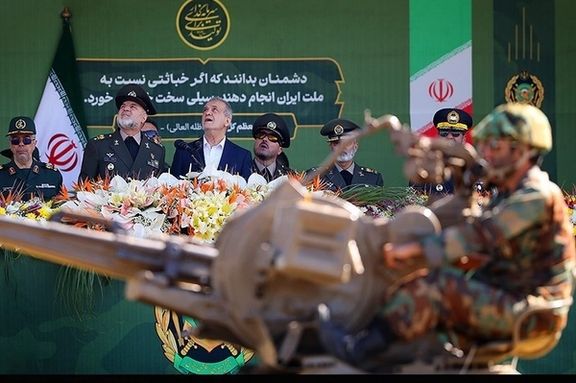
Iranian President Masoud Pezeshkian and the chief of staff of Iran's armed forces Major General Mohammad Bagheri observe the annual Army Day parade in Tehran, April 18 2025.
The United States and Iran appear to be on a collision course over whether Tehran should be allowed to enrich uranium in any nuclear deal between the two arch-foes, potentially endangering talks headed for a third round on Saturday.
US secretary of state Marco Rubio ruled out allowing any Iranian uranium enrichment, while Iranian foreign minister Abbas Araghchi said the talks would stumble if US demands stray from a sole focus on nuclear weapons.
"If Iran wants a civil nuclear program, they can have one just like many other countries in the world have one, and that is they import enriched material," US secretary of state Marco Rubio said in an interview with The Free Press podcast.
"There’s a pathway to a civil, peaceful nuclear program if they want one. But if they insist on enriching, then they will be the only country in the world that doesn’t have a 'weapons program,' quote-unquote, but is enriching. And so I think that’s problematic."
The UN nuclear watchdog said last month that Iran is only non-nuclear armed state enriching uranium to 60%. Several countries which do not possess nuclear weapons, including Japan, Brazil, Germany and the Netherlands, enrich uranium at lower levels.
Iran denies seeking a nuclear weapon and has said its nuclear program is peaceful and marks a national scientific accomplishment. Israel, the United States and other Western countries question Tehran's intentions.
The United Nations permits uranium enrichment as part of peaceful nuclear technology and Iran is a member of the Non-Proliferation Treaty aimed at preventing the spread of nuclear weapons.
Iranian officialdom has repeatedly said Iran's enrichment is not up for discussion.
"If America’s only demand is that Iran not possess nuclear weapons, that demand is attainable and we can meet it," Iran's Foreign Minister Abbas Araghchi told reporters in Beijing on Wednesday.
"But if (Washington) makes impractical and unreasonable demands, it’s natural that we will run into problems."
Araghchi's hosts, nuclear-armed US rival China, appeared to confirm its alignment with Iran's position while blessing the talks with Washington.
"China appreciates Iran's commitment not to develop nuclear weapons, respects Iran's right to peacefully use nuclear energy and supports Iran in conducting dialogue with all parties including the United States to safeguard its legitimate rights and interests through consultation and negotiation, "Chinese Foreign Minister Wang Yi said.
'Out of compliance'
Calling Iran "nuclear-ambitious", Rubio criticized a 2015 international nuclear deal from which US President Donald Trump withdrew in his first term and vowed to seek more permanent curbs on Iran's nuclear activity.
"The previous deal was bad for a number of reasons. It gave Iran immediate and full sanctions relief in exchange for enrichment capabilities that at any point could be weaponized in the future," Rubio said.
"They got to keep that permanently, they got to keep the sanctions relief permanently, and they only had to live by the enrichment limitations for a defined period of time."
Iran and the United States are due to hold a third round of indirect nuclear talks on Saturday in Rome after both sides described the previous two rounds as constructive.
Last week, Rubio warned that Iran is nearing a nuclear weapons capability and urged European allies to consider reimposing UN sanctions on Iran under the JCPOA’s snapback mechanism.
Iran has accumulated nearly 300 kilograms of uranium enriched up to 60% purity, in violation of the 2015 nuclear deal.
Fellow signatories Germany, France and the United Kingdom can use their authority under the agreement to reimpose UN sanctions.
The deal’s final sunset clause is set to expire in October.
Former Iranian President Hassan Rouhani said that a near-final agreement with the United States was within reach in the spring of 2021, but was ultimately derailed by hardliners’ opposition seeking to undermine his administration.
During a meeting on Monday, Rouhani urged the current government to make the best use of the present opportunity for negotiations with the US, emphasizing the importance of preventing war.
"We must make the most of this window for negotiations. Our fundamental duty is to prevent war, not because we are afraid of it, but because war benefits no one – not the United States, not Iran, and not the region... We must not give Trump any excuse, nor let Netanyahu take advantage of the current regional situation,” he said.
Rouhani said that his former negotiating team, led by Abbas Araghchi -- now foreign minister, had secured a favorable agreement that would have lifted not only pre-existing sanctions but also those imposed by the Trump administration.
He alleged that the US had "almost agreed" to remove the Islamic Revolutionary Guard Corps (IRGC) from its list of terrorist organizations.
"At that time, I said in the government that if they allow us, we will finish it today. Only one signature remained for Mr. Araghchi to complete," Rouhani said, accusing domestic opponents of blocking the deal to ensure his administration's failure.
He said while no agreement has been reached in the ongoing round, the talks have already offered hope to Iran's currency and gold markets, as well as public morale.
Rouhani also addressed the internal debate surrounding negotiations with the West, criticizing those who advocate for confrontation and disengagement from international organizations. He argued that while international bodies are not always fair, dialogue and diplomacy are essential for reducing tensions.
French authorities have arrested a dual Iranian-French national in Paris for expressing support for Palestine, Iranian state media reported on Wednesday.
Mizan News Agency, affiliated with Iran’s judiciary, reported that Shahin Hazamy was detained by French security forces on Tuesday. The outlet described him as an independent journalist and said the arrest stemmed from his support for Palestine, without citing French legal charges.
French magazine Le Point confirmed through Hazamy’s lawyer that the arrest was based on accusations of “apologie du terrorisme,” a criminal charge under French law covering praise of terrorist acts. Hazamy remains in temporary detention while the case is under review by investigating judges.
Posts on Hazamy’s Instagram account show support for Hezbollah and Palestinian factions backed by Tehran, as well as images taken during recent visits to Lebanon. He also voiced solidarity with Mahdieh Esfandiari, a 39-year-old Iranian translator living in Lyon who has been held since early March under similar charges.
According to Le Point, Esfandiari is accused of publishing Telegram posts in support of the October 7 Hamas attack on Israel, which Israeli officials say killed over 1,200 mostly civilians.
Iran’s foreign ministry has criticized both arrests, demanding explanations and consular access. Spokesman Esmail Baghaei said earlier in April that the detentions raised serious concerns over the rights of Iranian nationals in France.
France, meanwhile, says Iran detains French citizens as leverage in diplomatic disputes. Foreign Minister Jean-Noël Barrot urged French nationals not to travel to Iran, citing the risk of arbitrary arrest.
Iran’s ambassador to Lebanon, Mojtaba Amani, said the decision on whether Hezbollah should disarm rests with the Lebanese government, days after he publicly criticized international disarmament efforts.
“We are committed to what the Lebanese agree upon,” Amani said in an interview with Lebanon’s Al Jadeed TV on Wednesday in a reversal of remarks made last week which caused him to be summoned by Lebanon's Foreign Ministry.
Last week Amani warned against what he called a disarmament “conspiracy,” saying on X: “We in the Islamic Republic of Iran understand the danger of this conspiracy and its threat to the security of the region’s peoples.
"We warn others against falling into the enemy's trap. Preserving deterrent capability is the first line of defense for sovereignty and independence and must not be compromised.”
Amani also confirmed he had not attended the ministry's summons. “I was informed of the Foreign Ministry’s request regarding my posts about weapons, but I apologized for not attending,” he said in Al Jadeed TV interview. “No new date has been set.”
His comments come after Lebanese President Joseph Aoun said last week that he hopes Hezbollah, designated as a terrorist organization by countries including the US, UK and EU, can be disarmed or brought under state control this year, following what he described as a significant weakening of the group during Israel’s recent military campaign.
The Iran-backed group is currently in the midst of a fragile US and France-brokered ceasefire with Israel which began in November. Both sides report dozens of breaches.
Iran briefed China on Tehran’s negotiations with Washington and called for accelerated implementation of the 25-year strategic cooperation pact, Iranian media reported Wednesday.
“The Islamic Republic is proceeding with diplomacy seriously and in good faith, despite bitter past experiences,” Foreign Minister Abbas Araghchi said during a meeting with China's First Vice Premier Ding Xuexiang on Wednesday, held at the Great Hall of the People in Beijing.
Araghchi is to hold a third round of talks with US envoy Steve Witkoff on Saturday.
The Iranian foreign minister and his Chinese hosts also discussed accelerating the implementation of the 25-year agreement, first signed in 2021, which envisions Chinese investment in Iran’s energy and infrastructure sectors in exchange for long-term energy supply commitments.
However, its implementation has lagged amid sanctions, Chinese investments in Iran so far meager, and the exact details of which remain top secret. Projects like the South Pars gas field development and the Gohardasht Steel project have encountered hurdles, with Chinese firms retracting or terminating their investments.
The comprehensive strategic partnership announced in 2016 saw the two countries plan to increase trade to $600 billion by 2026 while in 2023, according to the International Monetary Fund’s Direction of Trade Statistics dataset, the volume of trade reached just $12.5 billion.
During the Wednesday meeting in Beijing, the Chinese vice premier called the relationship with Iran “a product of mutual trust and shared interests,” and said China would work to expand coordination across regional and international platforms.
Foreign Ministry spokesman Esmaeil Baghaei said on X on Tuesday, "With a shared outlook on many international issues, and by relying on mutual trust and respect, Iran and China are resolutely advancing their efforts to safeguard the mutual interests of their nations."
Upon his arrival in China, Araghchi described China and Russia as “strategic partners and close friends who have supported Tehran in difficult times.”
He said Iran would maintain close consultation with China moving forward.
“We will definitely continue our consultations with China as a member of the Security Council, a member of the IAEA Board of Governors, and a country with experience in the nuclear issue,” Araghchi added.
Earlier, a source familiar with the matter told Iran International that Iran’s Supreme Leader delivered a message through Araghchi to Chinese President Xi Jinping, reaffirming Iran’s long-term commitment to the strategic partnership regardless of the outcome of the nuclear negotiations.
The man who shot dead two Iranian Supreme Court judges in a rare assassination of top officials in January has been identified as Farshid Asadi, a 31-year-old court service aide, a source familiar with the matter told Iran International.
Asadi, originally from Razan in Iran's Western Hamedan Province, worked at the Supreme Court in Tehran providing refreshments to judges and staff, said the source who spoke on condition of anonymity due to the sensitivity of the matter.
The assailant was initially assigned to the court’s fifth floor but was later relocated to the first floor after Judge Mohammad Moghiseh moved his office there.
On January 18, veteran judges Moghiseh and Ali Razini were shot and killed inside the Supreme Court building in central Tehran. The incident shocked the judiciary and remains largely unexplained by authorities.
The two clerics were central figures in Iran's theocratic establishment who had handed down death sentences and other harsh punishments on dissidents for decades. Supreme Leader Ali Khamenei led their funerals.
Their deaths marked a rare attack on senior officials as discontent over political repression and economic malaise festers in Iran.
The source told Iran International that Asadi first entered the room of a security guard and injured him before proceeding to the judges’ office. There, he shot Razini once, killing him instantly. As Moghiseh attempted to flee, Asadi fired again, striking him in the hand and then fatally in the back, piercing his heart.
Asadi, the source added, also intended to target another senior judicial figure, Mahmoud Toliyat, a former Revolutionary Court judge, but changed his mind for unknown reasons. He then turned the weapon on himself and died at the scene.
The full name, age and intended third target of the attacker was not previously reported.
Initial reporting by state-affiliated media suggested the attacker may have been an outsider or “armed infiltrator.” However, conflicting accounts followed, with judiciary-linked outlets later confirming the assailant was employed inside the court complex.
Following the shooting, several of Asadi’s relatives—including his father, uncle, maternal uncle, and two female cousins—were detained at different times by Iran’s Ministry of Intelligence, the source told Iran International.
It remains unclear how many are still in custody.
Separately, former political prisoner Bijan Kazemi has been held incommunicado for over 100 days in connection with the case. Authorities are reportedly attempting to extract a confession linking Kazemi to the firearm used in the attack. Asadi’s father is under pressure to admit involvement, the source added.
Judges Razini and Moghiseh, both clerics, were widely known for their roles in high-profile security cases and for issuing harsh sentences against political dissidents.
They were also involved in the mass execution of political prisoners in 1988, a chapter heavily criticized by human rights organizations.