Iran is only non-nuclear armed state enriching uranium to 60%, IAEA says
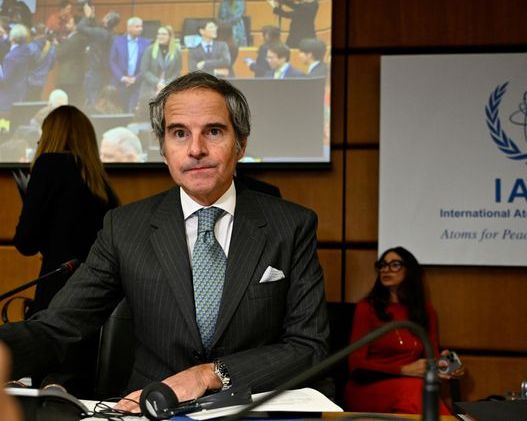
IAEA Director General Rafael Mariano Grossi looks on before the start of the agency’s quarterly Board of Governors meeting in Vienna, Austria, March 3, 2025
Iran has significantly increased its supply of near-weapons-grade uranium in just three months, the head of the International Atomic Energy Agency (IAEA) said on Monday, highlighting Iran's unique position as the only non-nuclear weapon state enriching to such levels.
"Iran’s stockpile of uranium enriched up to 60% U‑235 has increased to 275 kg, up from 182 kg in the past quarter," IAEA Director General Rafael Mariano Grossi in his statement to the agency’s Board of Governors on Monday.
"Iran is the only non-nuclear weapon State enriching to this level, causing me serious concern," Grossi added.
The IAEA has argued in the past that there is no credible civilian use for uranium enriched to 60%, which is a short step from weapons-grade 90% enriched fissile material.
US President Donald Trump has demanded Iran end all programs that can enable it to produce nuclear weapons as a pre-condition for an agreement that would lift economic sanctions.
"It is also four years since the Agency was able to conduct complementary access in Iran," Grossi added in his statement.
He said Iran claims it has declared all of its nuclear material and activities, but "this statement is inconsistent with the Agency’s findings of uranium particles of anthropogenic origin at undeclared locations in Iran."
The IAEA still does not know "the current location(s) of the nuclear material and/or of contaminated equipment involved," said the head of the UN nuclear watchdog.
Grossi also pointed to an unexplained issue with Iran’s past uranium metal production. "There is also a discrepancy in the material balance of uranium involved in uranium metal production experiments conducted at Jaber Ibn Hayan Multipurpose Laboratory, for which Iran has not accounted," he said.
He said Iran is not following "modified Code 3.1, which is a legal obligation," and warned that the "outstanding safeguards issues remain unresolved." He added, "They stem from Iran’s obligations under its Comprehensive Safeguards Agreement and need to be resolved for the Agency to be in a position to provide assurance that Iran’s nuclear programme is exclusively peaceful."
Grossi said Iran had indicated it would consider accepting four additional IAEA inspectors but ultimately did not approve them. "I deeply regret that Iran did not accept their designation," he said.
"There has been no significant progress towards implementing the Joint Statement of 4 March 2023," Grossi said, urging Iran to engage with the IAEA. He said he will submit a "comprehensive and updated assessment on the presence and use of undeclared nuclear material" as requested by the IAEA Board in November 2024.
Grossi said his talks with Iranian officials, including President Masoud Pezeshkian and Foreign Minister Abbas Araghchi, showed that "there may be room for constructive compromises." He added, "I hope to see them again soon and pursue effective dialogue and tangible results."
At a press conference in Vienna on Monday after the IAEA Board of Governors meeting Grossi stressed the need for Iran to provide answers. "What we need is real answers (from Iran). What we need is an engagement that is moving forward. We need to stop talking about process and start getting some answers as soon as possible," he said when asked what the agency expects from Iran.
Addressing broader diplomatic efforts, Grossi said, "An important statement by President Trump was when he said that he wants to have some form of a deal, some form of an agreement (with Iran)," Grossi said. "We need to engage as soon as possible, because time is passing."
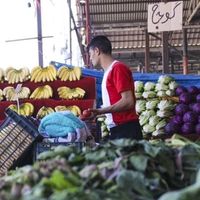
Potato prices in Iran have surged by a staggering 217% in the past year, according to the Statistical Center of Iran, highlighting a sharp increase in the cost of essential food items.
The sharp rise in the price of a staple food, now a lifeline for an increasingly impoverished population, has become a major public concern in recent weeks, a trend now confirmed by official data.
The average price of potatoes reached over 500,000 rials (about 54 US cents) per kilogram in February, up from approximately 150,000 rials a year earlier. Today, the average Iranian worker earns roughly $120-170 per month, while official estimates suggest that a minimum of $500 is needed for the basic survival of a family of three.
The surge positions potatoes as the food item with the highest price increase in the past 12 months, significantly exceeding the country's general inflation rate, which according to official figures hovers around 35%.
Attributing the sharp rise in potato prices to increased exports and smuggling, Agriculture Minister Gholamreza Nouri Ghezeljeh said on Sunday that exports have been halted. "More potatoes were exported this year compared to last year, and some were also smuggled," he said.
Due to fuel and other government subsidies, it is cheaper to produce food staples in Iran than in some neighboring countries. Also, as Iran's currency has lost 50% of its value since September, exporting any homegrown product for foreign currency has become more rewarding.
Paradoxically, Deputy Agricultural Minister Akbar Fat'hi announced in January that Iran was importing 50,000 tons of potatoes to combat soaring prices.
The imported potatoes, aimed at stabilizing the market, were to be sold at approximately 30 US cents per kilogram, significantly below current prices. He warned further imports may be necessary if the market remains volatile.
Eggplant also saw a substantial price increase of 123%, ranking second among food items with the highest annual inflation.
The Statistical Center's report revealed that a broad range of essential goods, including legumes, rice, and dairy products, have experienced significant price hikes in recent weeks. Pinto beans, for instance, saw a 30% increase in just one month, while Iranian rice rose by an average of 13.5%.
While many food categories experienced significant inflation, chicken and beef prices remained relatively stable, with increases of 4% and 8%, respectively. This stability is likely due to decreased demand as rising costs force many Iranians to reduce meat consumption.
The directors and lead actors of My Favorite Cake, an Iranian film that premiered at the Berlin International Film Festival, went on trial in a court in Tehran on Saturday, alongside other members of the production team.
Directors Behtash Sanaeeha and Maryam Moghaddam, actors Esmail Mehrabi and Lily Farhadpour, producer Gholamreza Mousavi, and one of the film’s cinematographers faced charges of propaganda against the state, promoting immoral content, and screening the film without a permit, according to US-based rights group, Human Rights Activist News Agency (HRANA).
Lily Farhadpour in a scene from My Favorite Cake.
A day after the hearing, Farhadpour wrote a post on her Telegram channel recounting details of the session.
Describing the trial as an inquisition rather than a judicial process, she wrote that the courtroom featured a “Prosecutor’s Desk” where no one sat. “The judge is both the judge and the prosecutor—but mostly the prosecutor,” she added. “You do not feel like you are being judged; you feel like you are only being prosecuted.”
She later deleted the post, writing, “They told me to delete the previous post. I said: ‘Of course.’” She did not specify who instructed her, but Iranian authorities have increasingly restricted artists' social media activities and pressured them to self-censor.
Esmaeil Mehrabi and Lily Farhadpour dancing together in a scene from the movie My Favorite Cake.
My Favorite Cake tells the story of an elderly woman living alone in Tehran, navigating the loneliness of old age while seeking new experiences. The film explores themes of personal freedom, love, and human connection.
Authorities have taken issue with the film’s portrayal of life outside state-imposed social restrictions, particularly its depiction of women without mandatory hijabs and scenes that hint at relationships outside conservative norms of unmarried couples.
The film also features scenes where the characters consume alcohol—an act that, while common in private homes, is illegal under Iran’s strict laws. In Iran, the production, sale, and consumption of alcohol have been prohibited since the 1979 Islamic Revolution. Despite the ban, alcohol consumption persists through underground networks, with many Iranians producing homemade wine and spirits in private settings.
The film was awarded the FIPRESCI Jury Prize at Berlinale and the Silver Hugo at the Chicago Film Festival.
My Favorite Cake filmmakers Behtash Sanaeeha and Maryam Moghadam in an undated photo.
Moghadam and Sanaeeha, known for their previous festival appearances, were unable to attend their film’s premiere last year due to a travel ban imposed on them by Iranian authorities.
The film crew's trial comes amid an intensified crackdown on independent filmmakers and artists in Iran, particularly those who challenge state-imposed restrictions.
Iranian foreign ministry on Monday described US President Donald Trump’s Oval Office blowout with Ukrainian President Volodymyr Zelensky as heralding the return of 19th century style colonialism.
"From a legal and diplomatic perspective, this serves as a wake-up call to consider whether international relations are reverting to the 19th century, where power, intimidation, and pressure dictated interactions between countries," Esmail Baghaei said during his weekly briefing.
He also spoke about a number of other issues, including the ouster of former foreign minister Mohammad Javad Zarif as a top presidential aide and Russia's possible role in mediating between Tehran and the Trump administration.
The spokesman also contended that Iran has long rejected reliance on outside powers. “What matters for us and our region is that security must be self-sustained, with regional countries taking the lead in ensuring stability and security in West Asia and the Persian Gulf through their own efforts and cooperation.”
Following the Trump-Zelensky exchange, Supreme Leader Ali Khamenei’s office reposted his 2022 remarks warning against reliance on the West.
Banners reflecting this message have also appeared across Tehran, featuring phrases such as “End of the mirage” and “Leaning on the wind.”
Tensions with Turkey addressed
Baghaei also addressed Turkish Foreign Minister Hakan Fidan’s recent remarks on Iran’s role in the region.
“We highly value our bilateral relations with Turkey,” he said, but added, “The remarks we have heard were unconstructive. Perhaps our Turkish friends should reflect more on the impact of their policies.”
Fidan recently told Al Jazeera that Iran’s costly efforts in Iraq and Syria have yielded little. He said he had conveyed this view to Quds Force commander Qasem Soleimani before Soleimani’s 2020 killing in a US drone strike.
Zarif resignation
Responding to a question on whether Vice President Mohammad Javad Zarif’s resignation could be interpreted as a message to foreign parties, Baghaei said, "Surely, you do not expect me to comment on how others interpret the country’s internal developments?"
"Mr. Zarif has clearly expressed his own views in the message he issued."
Baghaei also confirmed that President Masoud Pezeshkian had received Zarif’s resignation letter.
Zarif, the architect of 2015 nuclear deal, said he stepped down after a meeting with Iran’s judiciary chief. “He advised me to return to the university to prevent further pressure on the government,” Zarif wrote on X.
Mediation efforts over US ties
In response to a question about whether Russia has offered to mediate between Iran and the United States, he said: "It is natural for countries to express their willingness to mediate Iran-US negotiations as an act of goodwill and assistance."
Russian Foreign Minister Sergei Lavrov’s visit to Tehran last month sparked speculation in Iranian media about whether he is carrying a message from Washington or pushing Moscow’s own agenda at Iran’s expense.
About the possibility of the UAE mediating between Iran and the US, Baghaei said: "Given the significance of this matter, many parties may express their willingness to facilitate discussions. From this perspective, it is natural for countries to consider offering assistance if needed."
Iranian filmmakers Shirin Sohani and Hossein Malayemi won the Academy Award for Best Animated Short for their film In the Shadow of the Cypress at the 97th Oscars in Hollywood, dedicating the award to their fellow Iranians.
"Just the fact that we managed to make this film under the extraordinary circumstances of our country is a miracle," Malayemi said in his acceptance speech, in what appeared to be a reference to the censorship challenges faced by Iranian filmmakers and artists.
"We are going to dedicate our film and this precious award to all those who are still fighting in their inner and outer battles heroically -- especially to our fellow Iranians who are still suffering," Malayemi added.
The duo's Oscar journey nearly ended before it began. Their film, a self-funded passion project six years in the making, almost missed Hollywood’s biggest stage as their US visas were approved only a day before the ceremony.
"Three hours ago our plane landed in LA. We hadn't obtained our visa until yesterday And we were totally disappointed, and now we are here. It's a miracle," Sohani said.
The film -- which beat competitors including Beautiful Men, Magic Candies, Wander to Wonder, and Yuck! -- was praised for its unique visual storytelling. It had previously screened at Venice Tribeca and the Los Angeles Short Film Festival and was nominated for Annie Awards and the Annecy International Animated Film Festival.
While Iranian cinema has global reputation for its exploration of social themes, independent filmmakers operate under a system of stringent censorship.
The government requires script approval and screening permits by the Ministry of Culture and Islamic Guidance, punishing those who challenge political or social taboos with bans, imprisonment, or exile.
Award-winning director Mohammad Rasoulof had been jailed for his films before leaving Iran, while Jafar Panahi has worked under house arrest, and Asghar Farhadi, despite his global acclaim, said he will not make films in Iran anymore.
Mohammad Javad Zarif, the architect of Tehran's 2015 nuclear deal with world powers, resigned as Iran's vice-president, state media reported Sunday, a few days after the country's Supreme Leader voiced his opposition to holding talks with Washington.
"President Masoud Pezeshkian has received Javad Zarif's resignation letter but has not yet responded," the Iranian government's official news agency IRNA confirmed.
Zarif's resignation came after the Parliament ousted the Pezeshkian administration’s finance minister in a vote of no confidence, the IRGC-affiliated Fars News reported, citing two unnamed sources.
However, the semi-official ISNA news agency reported that the resignation was unrelated to the Parliament's impeachment of the finance minister and was submitted before the vote of no confidence.
"In his letter to the president, Zarif said that he prefers to serve Iran by teaching at a university," ISNA added.
Many observers believed that Zarif joined the Pezeshkian administration to help negotiate another nuclear deal with world powers similar to the Joint Comprehensive Plan of Action (JCPOA), which was scrapped by Donald Trump during his first term in office.
However, Supreme Leader Ali Khamenei, the country's ultimate decision-maker, rejected the idea of talks with Trump last month, calling them "neither wise, nor intelligent, nor honorable."
The Iranian president told parliament on Sunday that he initially supported negotiations with the United States but deferred to Khamenei’s position against engaging in talks.
“I believed it was better to engage in dialogue, but when the Leader said we would not negotiate with the US, I said, ‘We will not negotiate with the US, period,’” Masoud Pezeshkian said.
Zarif is no stranger to resignations, treating them almost like brief intermissions—having submitted five during his tenure under former President Hassan Rouhani.
Last August, he resigned as Pezeshkian's aide, but his departure was short-lived, as he returned as vice president for strategic affairs within a couple of weeks.
In November, Parliament Speaker Mohammad-Bagher Ghalibaf joined hardliners in the parliament who had long been calling for Zarif's dismissal over his son's US citizenship.
Ghalibaf called on Zarif to resign voluntarily as he, too, believed that Zarif’s appointment to the post was illegal.
Led by the Paydari (Steadfastness) Party faction, ultra-hardliners in Parliament have refused to amend a 2020 law that prohibits appointing dual nationals or individuals whose spouses or children hold dual nationality to "sensitive positions" in the government. Hardliners argue the restriction applies to Zarif.