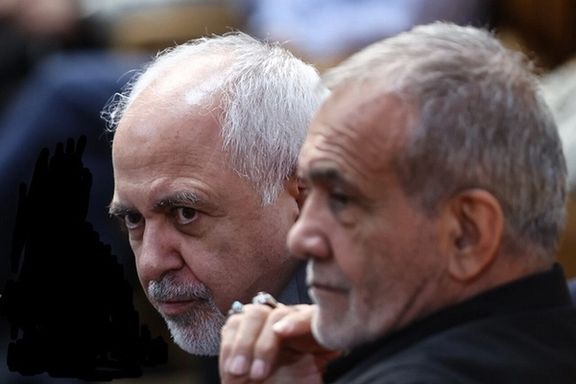
Iran's vice-president Javad Zarif resigns, yet again
President Masoud Pezeshkian (right) and his deputy Mohammad Javad Zarif
Mohammad Javad Zarif, the architect of Tehran's 2015 nuclear deal with world powers, resigned as Iran's vice-president, state media reported Sunday, a few days after the country's Supreme Leader voiced his opposition to holding talks with Washington.
"President Masoud Pezeshkian has received Javad Zarif's resignation letter but has not yet responded," the Iranian government's official news agency IRNA confirmed.
Zarif's resignation came after the Parliament ousted the Pezeshkian administration’s finance minister in a vote of no confidence, the IRGC-affiliated Fars News reported, citing two unnamed sources.
However, the semi-official ISNA news agency reported that the resignation was unrelated to the Parliament's impeachment of the finance minister and was submitted before the vote of no confidence.
"In his letter to the president, Zarif said that he prefers to serve Iran by teaching at a university," ISNA added.
Many observers believed that Zarif joined the Pezeshkian administration to help negotiate another nuclear deal with world powers similar to the Joint Comprehensive Plan of Action (JCPOA), which was scrapped by Donald Trump during his first term in office.
However, Supreme Leader Ali Khamenei, the country's ultimate decision-maker, rejected the idea of talks with Trump last month, calling them "neither wise, nor intelligent, nor honorable."
The Iranian president told parliament on Sunday that he initially supported negotiations with the United States but deferred to Khamenei’s position against engaging in talks.
“I believed it was better to engage in dialogue, but when the Leader said we would not negotiate with the US, I said, ‘We will not negotiate with the US, period,’” Masoud Pezeshkian said.
Zarif is no stranger to resignations, treating them almost like brief intermissions—having submitted five during his tenure under former President Hassan Rouhani.
Last August, he resigned as Pezeshkian's aide, but his departure was short-lived, as he returned as vice president for strategic affairs within a couple of weeks.
In November, Parliament Speaker Mohammad-Bagher Ghalibaf joined hardliners in the parliament who had long been calling for Zarif's dismissal over his son's US citizenship.
Ghalibaf called on Zarif to resign voluntarily as he, too, believed that Zarif’s appointment to the post was illegal.
Led by the Paydari (Steadfastness) Party faction, ultra-hardliners in Parliament have refused to amend a 2020 law that prohibits appointing dual nationals or individuals whose spouses or children hold dual nationality to "sensitive positions" in the government. Hardliners argue the restriction applies to Zarif.
Israel's prime minister praised the US President for providing the weapons the Jewish state needs to fight against Iran and its armed allies in the region.
On Saturday, the Trump administration approved a nearly $3 billion arms deal for Israel, bypassing the usual congressional review. The deal includes additional 2,000-pound bombs for use in its conflict with Iran-backed militants in the Middle East.
Prime Minister Benjamin Netanyahu on Sunday praised Trump's role in ensuring the supply of what he called critical military equipment, saying, "He has shown it by sending us all the munitions that were being held up."
"This way he is giving Israel the tools we need to finish the job against Iran’s terror axis," Netanyahu said, according to Israeli media reports.
He did not make clear whether he has received any green light from the White House for taking any action against Iran and its armed allies using the weapons provided by the Trump administration.
Since mid-2024, Israel has inflicted heavy blows against Iran's proxies in the region, especially weakening the Lebanese Hezbollah by eliminating hundreds of its fighters and most of its leadership.
Israel has also been considering attacks on Iran's nuclear sites and views its adversary as vulnerable, the Wall Street Journal reported last month citing US intelligence agencies' assessment in the waning days of the Joe Biden administration.
Israel is considering significant strikes on Iran in 2025 and views President Donald Trump as more amenable to their plans, the paper cited officials familiar with the assessment as saying.
US intelligence cited the risk of further conflict in the Middle East and characterized Iran as weakened following an Oct. 26 Israeli attack on Iran, adding that Israel views the window for denying Iran a nuclear weapons capability as fast closing.
Iran denies seeking a nuclear weapon but Israel says its Mideast nemesis wants an atomic bomb and must be denied the power to destroy the Jewish state.
The German embassy in Tehran is investigating reports of the detention of a German national and has raised the matter with Iranian authorities, a source from the German Federal Foreign Office told Iran International on Sunday.
“The Foreign Office takes reports about detentions of German nationals very seriously. Our embassy in Tehran is investigating the report intensely and has confronted the Iranian side at a high level with the reports,” the source said.
No further details were immediately available on the identity of the detainee or the circumstances of their arrest.
On Saturday, Iranian Finland-based journalist Kambiz Ghafouri reported the alleged arrest of a male German citizen in Iran, saying he is currently in quarantine at Tehran's notorious Evin Prison.
In January, the European Parliament adopted a motion for a resolution condemning Iran’s detention of European Union citizens, labelling the practice as “hostage diplomacy.”
The resolution called for the immediate release of detained EU nationals and for a stronger coordinated diplomatic efforts by EU member states.
In its resolution, the European Parliament “strongly condemns Iran’s use of hostage diplomacy” and calls for the immediate and safe release of all EU citizens held in the country, including Olivier Grondeau, Cécile Kohler, Jacques Paris, and Ahmadreza Djalali.
Last month, the body of German-Iranian national Jamshid Sharmahd was returned to Germany after his death in an Iranian prison while awaiting execution.
Sharmahd was abducted by Iranian agents during a visit to the United Arab Emirates in 2020 and forcibly taken to Iran. In February 2023, the Iranian judiciary sentenced him to death on charges of endangering national security, but he died of a stroke before his scheduled execution, according to Iran's judiciary.
Sharmahd was convicted of heading a pro-monarchist group named Tondar accused of a deadly bombing incident that occurred in 2008 at a religious center in Shiraz, killing 14 and injuring 215 more. The accusation, which Sharmahd repeatedly denied, was never substantiated by documented evidence.
A sudden and unexplained reduction in Iranian electricity supply plunged Iraq's eastern province of Diyala into a partial blackout on Saturday, highlighting Iraq's ongoing dependence on Iranian power.
The cut, which slashed about half of the electricity Iran provides to Diyala, severely disrupted power in the province's eastern, northern, and northeastern regions, according to Aws al-Mahdawi, a Diyala Provincial Council member.
"It could be a technical issue or related to re-programming codes," al-Mahdawi told Rudaw, a media outlet in the Iraq’s Kurdistan region.
This latest incident follows a history of disruptions to the Mirsad power line, alongside Iran's own energy shortages which have seen extensive blackouts, most recently forcing working weeks down to two or three days in large swathes of the country.
During Iraqi Prime Minister Mohammed Shia' al-Sudani's visit to Tehran in January, officials announced plans to restore 625 megawatts through the Mirsad, Karkha, and Siril lines.
Iraq depends on Iranian electricity and gas imports to bolster its own power generation. To mitigate the impact of US sanctions on Iranian exports, Washington has repeatedly granted Iraq four-month waivers, allowing continued energy purchases.
These waivers, recently extended in the summer for 120 days and nearing expiration, are intended as a temporary measure until Iraq can achieve energy independence.
In early February, US President Donald Trump issued a directive to reinstate the 'maximum pressure' policy on Tehran. The directive signaled a potential end to sanctions waivers, saying, “The Secretary of State will also modify or rescind existing sanctions waivers.”
The Central Bank of Iran (CBI) has demanded new measures to force transparency from banks and financial institutions, citing widespread failure to comply with existing freedom of information laws.
The directive, reported by Tasnim News Agency on Sunday, mandates dedicated online portals for immediate publication of non-confidential financial data including information on financial policies, loan facilities, and regulatory directives.
It also ordered banks and non-bank credit institutions to establish units to handle public inquiries within a strict 10-day deadline.
Aimed at bolstering public trust and accountability, the move comes in response to repeated violations of the Law on Publication and Free Access to Information, according to the CBI.
The CBI said that inspections reveal banks are consistently failing to comply with transparency laws, adding that this undermines public trust and hinders access to crucial financial information.
The measure comes as Iran slides to 151st out of 180 countries in Transparency International's 2024 Corruption Perceptions Index (CPI).
The CPI, which assesses perceived public sector corruption, shows Iran's continued decline, with a score of just 23 out of 100. The index highlights concerns over bribery, misuse of public funds, and limited access to information.
In October 2023, a report by the World Bank placed Iran among the worst countries in the world in terms of Worldwide Governance Indicators, with a Voice and Accountability Index score of -1.45, placing it among the lowest for political participation, free expression, and media freedom."
Iran’s parliament impeached Economy Minister Abdolnaser Hemmati, bringing his tenure to an end after lawmakers blamed him for the country’s worsening economic crisis.
The vote followed a heated session in which Hemmati defended his record while critics pointed to the surging exchange rate and rising inflation.
Parliament voted 182 to 89 in favor of impeachment, with one abstention and one void ballot out of 273 total votes. Under Article 135 of Iran’s Constitution, ministers remain in office unless dismissed by the president or voted out by parliament.
The impeachment was initiated by 119 members of parliament, citing currency instability, the devaluation of the rial, and increasing food prices. Following speeches from both supporters and opponents of Hemmati, lawmakers cast their votes in favor of removing him from office.
“The country is in a state of war. Even Qatar, Turkey, and Iraq are not returning our dollars,” he said. Hemmati, for his part, sought to reassure lawmakers by arguing that “the exchange rate will decrease.”
The value of the Iranian rial has sharply declined, with the US dollar now trading at 940,000 rials, further straining households and businesses. Inflation has remained persistently high, with the price of essential goods continuing to rise.
Hemmati acknowledged the hardship, saying: “We understand the devastation that seven consecutive years of over 40% inflation have inflicted on the people. We know that people are suffering under the economic situation.”
During his defense, Hemmati highlighted efforts to increase government revenue through taxation since coming to office last year under Pezeshkian.
“Seventy percent of the government’s expenses are covered through tax revenues. The tax organization generated 1700 trillion rials ($1.8 billion) in revenue over the past month. If the tax organization neglects its duties even for a single day, we won’t be able to pay salaries,” he said.
Some lawmakers accused the government of deliberately allowing the exchange rate to climb. Hemmati rejected the statement, adding: “The dollar rate is not real, and we will certainly bring it down.” He also linked Iran’s economic struggles to US policies, warning that “Trump has officially declared economic war against us.”
Some commentators in Iran have argued that without a deal with the US and the removal of sanctions, the economy cannot improve. Others contend that removing Hemmati alone will do little to address the country’s deeper economic challenges.
The president can appoint an interim minister for up to three months in the absence of a permanent replacement.