Iran’s president backs US talks but aligns with Khamenei’s ban
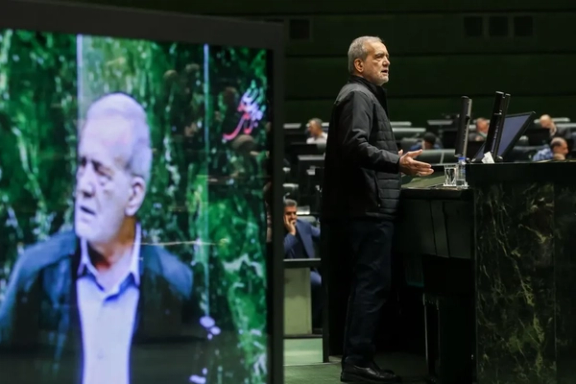
Iran's President Masoud Pezeshkian speaks during economy minister's impeachment in parliament on March 2, 2025.
The Iranian president told parliament on Sunday that he initially supported negotiations with the United States but deferred to Supreme Leader Ali Khamenei’s position against engaging in talks.
“I believed it was better to engage in dialogue, but when the Leader said we would not negotiate with the US, I said, ‘We will not negotiate with the US, period,’” Masoud Pezeshkian said.
Khamenei, the country's ultimate decision-maker, rejected the idea of talks with Trump last month, calling them "neither wise, nor intelligent, nor honorable."
Speaking during the impeachment session of Minister of Economy Abdolnaser Hemmati, Pezeshkian described the challenges his administration faced upon taking office.
“When we took over the government, there was an imbalance in water, gas, electricity, and money,” he said, referring to the country's shortages.
Critics of Hemmati’s economic policies attribute the skyrocketing dollar exchange rate, rising food prices, and overall inflation to his leadership. The US dollar has surged to 940,000 rials, placing severe strain on households and businesses.
Addressing broader geopolitical issues, Pezeshkian likened the current situation to wartime conditions, citing incidents such as the killing of former Hamas leader Ismail Haniyeh on the first working days of his government and developments in Syria and Lebanon.
“We are in a full-scale war and must adopt a wartime posture... Today’s war is worse and more difficult than the war with Iraq,” he said.
He also referenced US sanctions on Iranian shipping, adding, “Trump imposed extensive sanctions on our ships, and now they are stuck, unable to unload their cargo... Qatar, Iraq, Turkey, and many other countries are not returning our dollars.”
During the impeachment hearing, lawmakers in favor of Hemmati’s removal argued that his policies had worsened the economic crisis.
One of these critics, MP Jabar Kouchaki-Nejad, criticized the government’s economic team, saying their performance had affected all social classes.
“Hemmati explicitly told us that the issues of currency depreciation and inflation have nothing to do with him,” Kouchaki-Nejad said.
MP Rouhollah Izadkhah also pointed out that the national currency had lost 62% of its value in a few months, while Rasoul Bakhshi Kouhpayeh pointed out that the exchange rate of the US dollar in Iran had increased 13,000 times over the past 50 years.
Hemmati defended his record, arguing that inflation had fallen by 10% under his tenure. “Seventy percent of the government’s expenses are covered through taxes. In the past month alone, the tax organization has collected 1700 trillion rials ($1.8 billion) in revenue,” he said.
He dismissed accusations that the government deliberately increased the exchange rate, saying, “The dollar rate is not real, and we will certainly bring it down.”
Some commentators, analysts and media outlets in Iran have pointed out in recent months that without a deal with the US and removal of sanctions the economy cannot improve. Some have also argued that impeaching a minister would not help to improve the situation.
Citizens across Iran told Iran International that they are struggling to afford even the most basic necessities as Nowruz (Norouz), the new Iranian year, approaches on March 20.
Many described empty markets, fading Norouz shopping traditions, and the daily struggle to cope with soaring prices and dwindling purchasing power.
A hypermarket owner in Tehran remarked, "This is nothing like the Norouz seasons we used to see. People barely buy anything beyond absolute necessities. Our bestsellers now are cigarettes and large bottles of soda, while even basic cleaning products for Norouz housecleaning sit untouched on the shelves."
Iran’s economic crisis has worsened across all sectors. The rial has hit a historic low, with US dollar being exchanged at 940,000 rials. Inflation continues to climb, making everyday goods unaffordable amid misgovernance and Donald Trump’s “maximum pressure” policy to intensify sanctions.
A government employee told Iran International, "A decent women’s suit costs at least 150 to 180 million rials ($159–$191). My salary is 102 million rials ($109), and 70 million ($74) of that goes to rent. How can I buy new clothes when I can barely afford food?"
Over the past five years, tens of millions of Iranians have seen their living standards erode as wages fail to keep pace with soaring inflation. Today, the average worker earns roughly $120 per month, while official estimates suggest that a minimum of $500 is needed for the basic survival of a family of three.
An employee at a clothing store in Tehran’s northern Mirdamad district said, "Customers used to rush in to buy new clothes for Norouz. Now, people walk in, check the prices, and leave empty-handed. It’s an economic catastrophe."
The Hamshahri newspaper, affiliated with Tehran Municipality, reported that vendors who once relied on strong year-end sales to compensate for slow months are now struggling, as even slightly higher-quality items exceed ten million rials ($10.60)—far beyond what most families can afford.
A pensioner said, "I receive 90 million rials ($96) a month, and everything is expensive. A kilo of beef costs 990,000 rials ($10.50), cooking oil is 5,700,000 rials ($6.10), and even a simple loaf of bread is 200,000 rials (21 cents). Fruits are a luxury now—kiwis are 1,500,000 rials ($1.60) per kilo, low quality oranges are 350,000 rials (37 cents), and the cheapest apples are 460,000 rials (49 cents). I even have to buy rice on an installment plan."
Furniture has also become unaffordable. Hamshahri wrote in its report, "If someone wants a decent-quality sofa set, they need at least 700 million to one billion rials ($745–$1,060). Even the low-quality sets, which barely last a year or two, cost between 200 to 300 million rials ($213–$319)."
A shopkeeper added, "People are collapsing under poverty, yet the Islamic Republic does nothing to ease their suffering. The streets are full of window-shoppers who can’t afford anything, and business owners are struggling with rising utility bills."
Iran International, in a recent report analyzing data from Iran’s Statistics Center warned that official figures—26.6% for food inflation and 32% overall—significantly understate the true rate. An analysis revealed that prices for 15 key household items surged by an average of 12% in just one month.
A survey of grocery prices in major cities, including Tehran, Mashhad, Isfahan, and Tabriz, found that household consumption costs had risen between 22% and 360% in the past week, with an average increase of 150%.
Iranian hardliners claim that Friday’s controversial meeting between the US and Ukrainian presidents validates Supreme Leader Ali Khamenei’s opposition to negotiations with the United States.
Referring to Khamenei’s early February speech, where he said negotiations with the Trump administration would not be “wise, expedient, or dignified,” they argue that Trump's confrontational exchange with Ukrainian President Volodymyr Zelensky in the Oval Office should serve as a warning to those who question Khamenei’s stance.
“Can an Iranian even imagine our president in Zelensky’s position?” Abdollah Ganji, a former editor of the IRGC-linked Javan newspaper, wrote in an X post, referencing Trump’s remark during the meeting that Zelensky was in no position to dictate terms because he didn’t have the right cards in hand.
Khamenei’s political adviser and former secretary of Iran's Supreme National Security Council, Ali Shamkhani, shared photos of Khamenei’s June 2019 meeting with the late Japanese Prime Minister Shinzo Abe, during which Khamenei refused to accept a message Abe was delivering from Trump.
On social media, hardliners and ultra-hardliners have also extensively highlighted Khamenei’s warnings in the past about direct talks with the United States and his criticism of Trump for not abiding by the commitments the US had made in the 2015 JCPOA nuclear deal and re-imposition of sanctions on Iran in 2018.
Incident disappoints advocates of talks with US
Iranian President Masoud Pezeshkian said in a speech on Thursday that Tehran was open to talks with Washington but would not “bow to bullies.” However, he also stressed that without the lifting of US sanctions, there could be no economic improvement.
Following Friday’s Oval Office incident, some reformist politicians and commentators—who have generally supported direct talks with the United States—also voiced skepticism about the viability of negotiations with the Trump administration.
Mohammad-Ali Abtahi, a former vice president under reformist President Mohammad Khatami, dismissed negotiations with Trump as futile. “Trump and the America of Trump are not parties we can negotiate with,” he tweeted. “Imagine Pezeshkian sitting across from him—talking to this man won’t help the Iranian people.”
Reformist commentator Fayyaz Zahed condemned Trump’s public rebuke of Zelensky, likening it to “a return to the era of imperialism.” He remarked, “The real America is what we are witnessing.”
Former political prisoner Hossein Ronaghi's tweeted:
Calls for strategic decision-making
Despite the backlash, some Iranian analysts argue that the incident underscores the urgency of determining when and how to engage in negotiations with the US before Iran loses all bargaining power.
“The humiliating exchange between Zelensky and Trump proved that negotiations must happen while there are still cards left to play,” argued Diako Hosseini, a political commentator and deputy chairman of the Tehran Chamber of Commerce, in an X post. “One should never enter talks under any other circumstances.”
In a lengthy thread, Mohammad Rahbari, another political commentator in Tehran, argued that the lesson Iran should take from the standoff between Trump and Zelensky for Iran is to look at international relations from a different perspective in the current circumstances. Warning against “obstinacy,” he argued that Iran should remain cautiously open to negotiations to avoid “falling victim to bigger powers.”
"Trump has not, and will not, pursue abstract goals... He knows how to calculate and knows numbers. Smart behavior towards him means proposals that are of mutual benefit, precise and clear!" Ali Asghar Sahfieian, managing director of the reformist news website Ensaf News, argued in a tweet.
A Tehran-based pro-reform newspaper called on president to take concrete steps toward negotiations with the United States, arguing that rhetoric alone will not resolve Iran’s economic crisis.
Responding to Masoud Pezeshkian’s remarks on Thursday saing,"We will not bow to bullies. We should not fear what they plan to do with sanctions. Some say we have no choice but to negotiate"—the reformist daily Ham Mihan questioned his approach.
"You say you don't shy away from dialogue—so why not put the ball in the opponent’s court?" the editorial argued. It urged the president to work toward halting the Trump administration's escalating sanctions, establish a negotiation agenda, and set a clear timeframe for talks.
The newspaper dismissed the notion that negotiating with the US equates to surrender, writing, "If they [the US] act like bullies and demand more than they offer, then inform the people and reject their terms. Otherwise, negotiations will yield results. Those who argue that we have no choice but to negotiate are not advocating surrender—because surrender requires no negotiation."
The debate over talks with the United States comes as Iran faces increasing economic pressure. In February, US President Donald Trump reinstated sanctions under his “maximum pressure” policy, calling for a deal that would permanently prevent Iran from acquiring nuclear weapons.
More recently, Trump signed a directive aiming to reduce Iran’s oil exports to zero, arguing that Tehran cannot be allowed to have a nuclear weapon and must make a deal.
"I would prefer a deal with Tehran to an Israeli attack on their nuclear sites," he said after signing the memorandum that reinstated the sanctions.
Iran’s Supreme Leader Ali Khamenei has dismissed engagement with Trump, calling negotiations "not wise, expedient, or dignified."
Beyond foreign policy, Ham Mihan also examined Pezeshkian’s economic promises, particularly his statement that "If shares are to be allocated, they should go to those truly in need, not to the wealthy."
These are good words, wrote Ham-Mihan. “So why hasn’t it been implemented? You have repeated it several times already. Moreover, your proposed national budget contradicts this notion of justice. You have increased salaries at half the rate of inflation.”
On Pezeshkian’s comments that "we are not afraid; we will stay and build the country with strength," Ham Mihan argued that fear is sometimes necessary.
"People are afraid. Officials should also be afraid. We should fear the people becoming angry. We should fear that some are unable to secure a dignified life... We should fear being unable to provide water and electricity for the people, leading to factory closures and even government shutdowns."
Iran continues to struggle with mounting economic and social crises, exacerbated by years of sanctions, government mismanagement, and public unrest. The 2022 protests, sparked by the death of Mahsa Amini in police custody, evolved into broader demonstrations against political repression and economic hardship. The government’s crackdown further eroded trust in state institutions.
The national currency has suffered a dramatic collapse, with the rial recently surpassing 940,000 per US dollar. Inflation remains persistently high, driving up the cost of food, housing, and healthcare. Energy shortages have worsened the crisis, with rolling blackouts disrupting industries and daily life.
The editorial concluded by warning Pezeshkian that rhetoric alone will not satisfy public expectations: " Let us fear that people pin their hopes on us, only for us to disappoint them and make them turn away. In fact, more than anything, we are in need of fear."
The lawyer for the son of a key figure in Iran’s ruling elite says they have filed a lawsuit against Bloomberg over a report alleging his involvement in Iranian oil trade linked to Russia and global energy markets.
However, the lawyer, as quoted by Iranian media, did not specify where or when the lawsuit was filed. Iran International has not independently verified whether the lawsuit has actually been filed.
Hossein Shamkhani, the son of former security chief Ali Shamkhani, is at the center of the controversy. In December 2024, Ali Shamkhani, who served as secretary of the Supreme National Security Council (SNSC) from 2013 to 2023, declared himself a key decision-maker on Iran's global strategy and nuclear diplomacy.
ILNA published the interview on Saturday, in which the lawyer rejected Bloomberg’s reporting on Milavous Group Ltd., a company that Bloomberg reported had a financial turnover of $15 billion in 2022 and was part of Shamkhani’s business network.
The lawyer, who was not named, dismissed Bloomberg’s reporting as "completely fabricated", saying: "Mr. Shamkhani is neither the owner nor a shareholder of Milavous Group, and the numbers Bloomberg published are pure fiction. If they had any proof, they would have published it by now."
"We have taken legal action against Bloomberg for publishing false and baseless accusations against Mr. Shamkhani. They have provided no evidence to support their reporting, despite repeated requests," the lawyer told ILNA.
Bloomberg’s investigation described Milavous Group as a major player in the global oil market, allegedly engaged in blending and rebranding crude oil from Iran and Russia to obscure its origins. According to the report, sources familiar with the matter said that Shamkhani oversaw a sprawling web of interconnected businesses facilitating illicit Iranian oil sales. The report also noted that Milavous and other companies in Shamkhani’s network supply oil to major buyers, including China’s Sinopec, Chevron in the US, and BP in the UK.
However, Shamkhani’s unnamed lawyer said the financial claims about Milavous were inaccurate.
"We obtained financial records for Milavous Group, audited by an American firm, and they show that the company's turnover was just $9.2 million in 2022 and around $9.9 million in 2023. These figures are nowhere near what Bloomberg published," the lawyer said.
The Bloomberg report also noted that while Hossein Shamkhani has not been sanctioned, some of the vessels believed to be under his control had been blacklisted by the US Treasury. The investigation cited multiple unnamed sources alleging that Shamkhani’s network had deep ties to both Iranian and Russian oil markets, benefiting from the lack of direct sanctions against him.
Additionally, in December, Bloomberg reported that Hossein Shamkhani plays a key role in the supply of Iranian arms to Russia, citing more than a dozen unnamed US, UK, and European officials, as well as individuals with direct knowledge of his activities.
Despite these allegations, both Shamkhani and Milavous have denied any wrongdoing. A separate lawyer representing Shamkhani previously told Bloomberg that the allegations were "baseless and lacking supporting evidence." Similarly, Milavous Group's managing director, Mohamed Al Hashmi, dismissed any connection to Shamkhani or involvement in Iranian or Russian oil trading.
Shamkhani’s legal team now insists that the lawsuit will hold Bloomberg accountable for what they describe as "irresponsible and false reporting."
Tehran is open to talks with Washington but will not be bullied into them, Iranian President Masoud Pezeshkian has said, sounding a positive note on negotiations even after the country's Supreme Leader rejected the idea this month.
"We never said we won’t talk, but we shouldn’t bow to bullies," Pezeshkian said Thursday.
"Why should someone on the other side of the world make a statement, and we react with fear?" he added, in an apparent reference to US President Donald Trump.
"We are not afraid; we will stay, we will build, and we will build with strength. This is what we believe in."
Iran's ultimate decision-maker Supreme Leader Ali Khamenei this month rejected talkswith Trump, calling them "not wise, intelligent or honorable."
In recent weeks, several Iranian officials, including the foreign minister and the government spokesperson, have echoed the position that Iran sees no point in talks while US sanctions remain in full force.
"Iran's position in the nuclear talks is completely clear, and we will not negotiate under pressure and sanctions," Abbas Araghchi said earlier this week. "There is no possibility of direct negotiations between us and the United States as long as maximum pressure is applied in this manner."
However, perspectives within Iran’s establishment vary. Ahmad Bakhshayesh, a member of the Iranian Parliament’s National Security and Foreign Policy Committee, indicated that negotiations were no longer on the table.
Bakhshayeh said Iran’s increased military budget submitted by Pezeshkian to parliament in October reflects a shift away from diplomatic engagement.
The renewed debate follows US President Donald Trump’s decision earlier this month to restore the "maximum pressure" campaign of sanctions on Iran from his first term.
His move revived a hardline strategy aimed at crippling Iran’s economy, particularly its oil exports, which had been severely restricted following Washington’s 2018 withdrawal from the Joint Comprehensive Plan of Action (JCPOA).
Trump’s latest directive aims to further reduce Iran’s oil exports, a key source of revenue, to zero.
Tehran cannot be allowed to have a nuclear weapon and must make a deal, Trump has argued. "I would prefer a deal with Tehran to an Israeli attack on their nuclear sites," he said after signing the memorandum that reinstated the sanctions.
Meanwhile, Russian Foreign Minister Sergey Lavrov recently visited Tehran following high-level discussions between Moscow and Washington in Saudi Arabia.
While the exact details of the discussions remain unclear, some Iranian media outlets have cautioned that Russia may not be a reliable partner and could adjust its stance based on shifting geopolitical priorities, speculating that Lavrov may have made concessions regarding Iran’s position.
While the Trump administration has engaged in talks with Moscow to end the war in Ukraine, it has maintained a hardline approach toward Iran, demanding a reversal of Tehran's nuclear, military and regional policies.
At the same time, Washington has hinted at a shared strategic interest with Moscow in preventing Iran from acquiring nuclear weapons.
Speaking to independent journalist Catherine Herridge, Senator Marco Rubio said last week, “There are things we could cooperate on geopolitically,” adding, “I’m not sure the Russians are fans of the Iranian regime having nuclear weapons.”