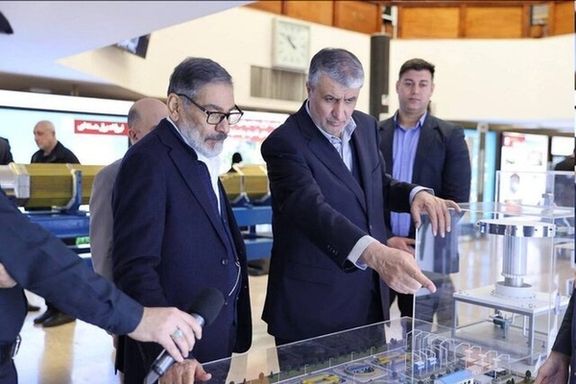
Ali Shamkhani, the former secretary of the Supreme National Security Council, and Mohammad Eslami, the director of the Atomic Energy Organization of Iran, during an expo on the country’s nuclear program in Tehran (February 2025)
Within the span of 24 hours, confusion has emerged in Iran over who is leading any potential nuclear negotiations, even as the president and senior officials press for talks with Washington.
In what appears to be a brewing turf war, former security chief Ali Shamkhani and President Masoud Pezeshkian’s administration are publicly asserting their control over the nuclear file and potential negotiations with Washington.
First, the state-run IRNA news agency and the government’s information office on Monday, both controlled by the presidential administration, referred to Shamkhani, the former head of the Supreme National Security Council, as overseeing the nuclear file while reporting on his visit to a nuclear exhibition.
The following day, the Rouydad24 news website, not under direct state control, quoted the foreign ministry’s information office in an article stating that the ministry remains in charge of all negotiations related to Iran’s nuclear issue.
"The responsibility for conducting talks and negotiations on the nuclear issue remains with the Ministry of Foreign Affairs, as before. This process is managed by the honorable minister and carried out by the political and international legal departments. Naturally, the formulation of negotiation strategies and coordination between relevant institutions continues to be handled by the Supreme National Security Council," Rouydad24's report quoted the foreign ministry.
Some experts would interpret this statement as reflecting the foreign ministry’s view that it should lead the nuclear negotiations, while the national security council should set broader policies and potentially determine the key issues and parameters of the talks.
The Supreme National Security Council (SNSC) is Iran's principal decision-making body on national security issues, which includes defense, foreign policy, and intelligence matters.
In December 2024, Ali Shamkhani, who served as secretary of the SNSC from 2013 to 2023, declared himself a key decision-maker on Iran's global strategy and nuclear diplomacy.
"I have been entrusted with the project of determining Iran's position in the global order," he said at the time, after having left the SNSC.
Shamkhani's statement, many experts would ascertain, likely came with the Supreme Leader's approval.
The Foreign Ministry, meanwhile, insists that there has been no change in the leadership of nuclear negotiations. While the SNSC sets overall policy, the ministry remains responsible for conducting nuclear diplomacy.
Previously, government's spokesperson Fatemeh Mohajerani had seemingly rejected the notion that Shamkhani would be at the helm of nuclear negotiations, saying, "Ask the Atomic Energy Organization who is responsible for the nuclear file."
In the face of such contradiction, Iran experts may view Shamkhani as a representative of Supreme Leader Ali Khamenei on major foreign policy matters—given that Khamenei is the ultimate authority in the country.
It is unlikely, however, that the presidential administration or Shamkhani himself would publicly acknowledge this.
The United States is convinced that a secret team of scientists in Iran is exploring a faster way to develop a nuclear weapon - within months - should Tehran decide to build one, The New York Times reported on Monday.
Iranian engineers and scientists are seeking to be able to turn nuclear fuel into a weapon within months rather than a year or more, the report said citing intelligence collected in the last months of the Biden administration.
The report cited US officials as saying Washington still believes that Iran and its Supreme Leader Ali Khamenei had not made a decision to develop a weapon.
In December, White House National Security Adviser Jake Sullivan said the Biden administration was concerned that a weakened Iran could build a nuclear weapon and that he was briefing President-elect Donald Trump's team on the risk.
The Biden administration's intelligence assessment has been relayed to Trump’s national security team during the transition of power, the New York Times added.
The report was released as the relatively moderate president of Iran, Masoud Pezeshkian, has publicly expressed willingness to re-engage with the United States in talks over its nuclear program, which it says is for peaceful purposes.
Setbacks dealt to Iran and its regional allies in a 15-month conflict with Israel and the inability of Iranian missiles to pierce US and Israeli air defenses, the New York Times reported, galvanized Iran to to seek new ways to deter its adversaries.
On January 10, then-CIA Director William Burns suggested that Iran’s weakened strategic position marked by regional setbacks could open the door to renewed nuclear negotiations.
"That sense of weakness could also theoretically create a possibility for serious negotiations," Burns said in an interview with NPR, referencing his experience with secret talks involving Tehran more than a decade ago.
Last month, Trump, Biden and Israeli Prime Minister Benjamin Netanyahu all described Iran as weakened, citing Tehran's reduced influence following the fall of its ally Bashar al-Assad in Syria, Israeli attacks on its air defenses and the killing of leaders of its armed Palestinian and Lebanese allies.
However, Iran's Supreme Leader denied his country's power has been undermined. "That delusional fantasist claimed that Iran has been weakened. The future will reveal who has truly been weakened."
The Islamic Republic has long ruled out developing nuclear weapons, a top political advisor to Iran's Supreme Leader Ali Khamenei said, in dovish remarks pointing to a potential openness to reviving talks with the United States.
"Iran has never sought nuclear weapons and never will," said Ali Shamkhani during a visit to the Atomic Energy Organization in Tehran on Monday.
"However, we will fully defend our legal rights in political and technical aspects with all our strength," the former security chief added.
Western powers say Tehran's expansion of its nuclear program lacks any credible peaceful purpose.
As economic malaise in Iran has deepened, renewed talks with the United States over the disputed nuclear program are widely viewed as the best avenue to ease sanctions.
Iran maintains that it will not pursue nuclear weapons, citing a long-standing fatwa or religious edict by Khamenei banning all weapons of mass destruction, including nuclear arms.
In an October 2019 speech, Khamenei said that building and maintaining nuclear weapons is "absolutely haram," meaning strictly forbidden under Islamic law.
However, analysts argue that the fatwa is merely an advisory opinion rather than a binding legal decree. They say it was intended to mislead the international community about the true intentions of a nuclear program that Tehran insists is peaceful.
Kamal Kharrazi, a senior foreign policy advisor to Khamenei, said last year that Iran has the capacity to produce nuclear weapons and an existential threat could prompt a reconsideration of the Supreme Leader’s injunction.
Iranian authorities have consistently asserted that the country's nuclear program is intended for peaceful purposes.
However, Western powers and independent nuclear experts argue that the levels and quantities of enrichment undertaken by Iran since 2021 go far beyond those needed for energy or scientific research purposes.
"Iran continues to develop its nuclear program to levels that lack any credible civilian justification," France, Britain and Germany said in a joint statement to the United Nations in December.
The costs of Iran’s nuclear program are negligible compared to the achievement of gaining nuclear technology despite sanctions, the country’s atomic energy chief said on Sunday.
"We shouldn’t focus on weighing costs against benefits. While we are paying a heavy price due to sanctions, the emphasis is not on the costs," said Mohammad Eslami, an Iranian vice president and head of the Atomic Energy Organization.
When asked by a state TV interviewer to explain how the expenses are justified, he underscored the importance of acquiring advanced technology that so-called arrogant global powers seek to deny other nations, particularly Iran.
Eslami argued that evaluating the program’s costs and benefits should occur only after what he described as the required technological capabilities were achieved.
“We are now on this path. We’ve reached a stage where we can apply nuclear technology in various fields,” he added.
He maintained that Iran’s nuclear program is transparent and peaceful, accusing critics of using it to fuel what he called Iranophobia internationally.
Eslami's remarks came after Ali Larijani, an advisor to the Supreme Leader, signaled a softer stance on Iran’s nuclear program, calling it vital but stressing that it should not overshadow broader progress as “people must live their lives.”
The nuclear program is a pillar of our development, but not its entirety, he said on Saturday, stressing that despite his direct role in past negotiations, its scope must remain within defined limits.
"The nuclear issue is part of our national strength, but it is not all of it. People must live their lives, and progress must be achieved in various fields. The nuclear agreement [JCPOA] preserved nuclear knowledge, ensuring its continuation, but reduced the number of centrifuges from 9,000 to 5,000," Larijani, who is considered a moderate conservative in the Islamic Republic's political spectrum, argued.
Iran has faced ongoing electricity and gas shortages due to underinvestment and the impact of US-led sanctions which have hindered modernization efforts in its power, oil and gas sectors.
Iran’s leadership has been wrestling with the idea of re-engaging with Washington over the nuclear program in order to reduce US economic sanctions.
Iran's nuclear program: costs vs benefits
On January 23, Eslami highlighted the economic benefits of the Bushehr Nuclear Power Plant, saying it cost $1.8 billion but has supplied 70 billion kilowatt hours of electricity to the grid in more than a decade. He estimated that producing the same amount of energy from fossil fuels would have cost $8 billion. However, government data shows that the reactor produces just 2% of Iran's annual electricity needs.
Critics argue the program’s costs outweigh its benefits.
Outspoken reformist commentator Sadegh Zibakalam criticized the nuclear program in a post on X on January 23, questioning its value.
“Mr. Zarif says we had no intention of producing nuclear weapons and could have built them if we wanted. So why incur such enormous costs for over 20 years?” he wrote. Zibakalam also cited unfulfilled promises to build five nuclear plants comparable to Bushehr.
In a letter to hardline lawmaker Hamid Rasaei in February 2023, Zibakalam argued that Iran could procure fuel for its Bushehr power plant through the International Atomic Energy Agency (IAEA).
“Not only does our insistence on producing nuclear fuel domestically have no economic justification due to its high cost, but also other things like speaking of 'our proud nuclear achievements' are one-sided and exaggerated.”
Since US President Donald Trump imposed what he called maximum pressure sanctions in his first term starting in 2018, Iran’s national currency has depreciated nearly 20-fold, and inflation has surged to 40%.
The sanctions severely disrupted the economy, particularly in the banking, trade, transportation and insurance sectors.
Sanctions have severely disrupted multiple sectors of Iran’s economy, particularly international trade, which has been hit hard by rising costs in banking, transportation, shipping, and insurance.
In a recent state-run television program, Saeed-Reza Ameli, former secretary of Iran's Supreme Cultural Revolution Council, said sanctions have cost the Iranian economy $1.2 trillion over the past 12 years.
Economist Vahid Shaghaghi-Shahri echoed similar concerns in an interview with the Etemad newspaper last week, saying Iran’s gross domestic product has shrunk from $640 billion to $400 billion over the same period.
Without sanctions, he estimated, the economy could have grown to $1 trillion.
Ali Larijani, an advisor to the Supreme Leader, signaled a softer stance on Iran’s nuclear program, calling it vital but stressing that it should not overshadow broader progress, as “people must live their lives.”
The nuclear program is a pillar of our development, but not its entirety, he said on Saturday, stressing that despite his direct role in past negotiations, its scope must remain within defined limits.
"The nuclear issue is part of our national strength, but it is not all of it. People must live their lives, and progress must be achieved in various fields. The nuclear agreement [JCPOA] preserved nuclear knowledge, ensuring its continuation, but reduced the number of centrifuges from 9,000 to 5,000," Larijani, who is considered a moderate conservative in the Islamic Republic's political spectrum, argued.
His comments come as Iran’s leadership wrestles with the idea of re-engaging with Washington over the nuclear program in order to reduce US economic sanctions.
Mahmoud Vaezi, the former chief of staff to ex-President Hassan Rouhani, suggested that Tehran should talk to President Donald Trump through key figures inside the US rather than third countries.
"Trump today is different from before—he’s got four years of experience under his belt," Vaezi said on Saturday. "It’s better to talk to him through certain people in the US rather than countries with their agendas." It was unclear whether Vaezi was referring to those who have long advocated for accommodation with Tehran or other intermediaries.
Vaezi also warned against letting Israel dictate Iran’s place on America’s foreign policy agenda. His stance echoes that of Foreign Minister Abbas Araghchi, who recently said that while Tehran is open to discussions, any new deal will be much harder to achieve than in 2018.
"The situation is different and much more difficult than the previous time," Araghchi said. "Lots of things should be done by the other side to buy our confidence … All we have heard is just nice words, and this is obviously not enough."
After Trump said earlier this month that it would be "nice" to resolve the nuclear crisis without escalation or military action from Israel, reactions in Iran have been anything but uniform.
While some officials hint at a willingness to explore diplomacy, hardline clerics are having none of it. Mohammad-Mehdi Hosseini Hamedani, the Friday prayer Imam of Karaj and the Supreme Leader’s representative in Alborz province lashed out at those pushing for talks, accusing them of misleading the public.
"The enemy threatens us daily, yet some still talk about negotiations," he warned. Another cleric, Abdolnabi Mousavi-Fard, called any broad discussions with Washington a "surrender to illegitimate American demands."
Their pushback comes after Supreme Leader Ali Khamenei made an ambiguous statement earlier this week, telling officials to “know their enemy” before entering any talks. Some see this as a quiet nod to negotiations, while others insist it’s just another reminder to stay wary of the US.
The debate over whether to engage with Trump is exposing deep divisions in Iran’s leadership. While some see an opportunity, hardliners are digging in, warning that diplomacy could mean dangerous compromises. Reformists argue that isolation is not a sustainable strategy and that engagement with global powers, including the US, could help lift sanctions and improve Iran’s economy.
A Senate resolution introduced on Friday urges Washington and its allies to maintain a firm stance, ensuring that all possible options remain available against the threat of a nuclear-armed Iran.
Led by Senator Lindsey Graham (R-SC), the bipartisan resolution was co-sponsored by Senators John Fetterman (D-PA) and Katie Britt (R-AL), alongside Representatives Jared Moskowitz (D-FL) and Mike Lawler (R-NY).
“If the Iranian Ayatollah and his henchman obtain a nuclear weapon, it would be one of the most destabilizing and dangerous events in world history,” Graham said in a statement. “They are trying to acquire a nuclear weapon as part of their religious agenda to purify their faith, destroy the Jewish State, and drive Westerners out of the Middle East.”
During his first term in 2018, President Donald Trump withdrew from the Obama-era JCPOA nuclear deal, demanding greater concessions from Tehran. The Biden administration later spent 18 months in indirect talks with Iran to negotiate a new agreement, but the effort failed. Now, Iran has enough enriched uranium to produce four to five nuclear warheads in a relatively short time.
The resolution does not explicitly authorize the use of military force, but it affirms that Iran’s nuclear ambitions must be met with strong opposition. It also calls on Iran to immediately cease uranium enrichment, the development of nuclear warheads, and the possession of delivery systems capable of carrying such weapons.
Although Trump and his aides have taken a tough stance on Iran's nuclear threat, they have not outlined their plans for the coming months. It remains to be seen whether he will tighten economic sanctions or pursue negotiations.
Fetterman stressed the urgency of the issue, saying that “Iran’s pursuit of nuclear weapons is a threat we cannot ignore.” He added, “The United States, Israel, and our allies cannot afford to sit back while the Iranian regime continues down this dangerous path. This resolution sends an unmistakable message: all options are on the table to prevent a nuclear-armed Iran.”
Britt doubled down, insisting that a firm foreign policy is the key to keeping Iran in check. “Peace is achieved through strength, and our resolution sends an important bipartisan message to Iran that the US will not tolerate Tehran’s aggression,” she said.
Moskowitz described Iran’s nuclear ambitions as an unacceptable escalation that poses a direct threat to the security of the US and its allies. “Iran must dismantle its nuclear program now. This resolution makes clear the United States won’t stand for anything less and will consider all options to protect our national security,” he said.
Lawler also warned of the consequences of a nuclear-armed Iran, calling it a danger “not only to our closest ally, Israel but also to the whole world.” He added, “We must keep all options on the table when it comes to dealing with this unprecedented situation.”
At a press conference in Washington, DC, the National Council of Resistance of Iran (NCRI) pointed to the Shahroud missile site in northeastern Iran, where it said the Islamic Republic is working on nuclear warheads for solid-fuel missiles with a range of over 3,000 kilometers (1,864 miles).
The NCRI attributed the information to its network of sources inside Iran but did not provide further details on the evidence.