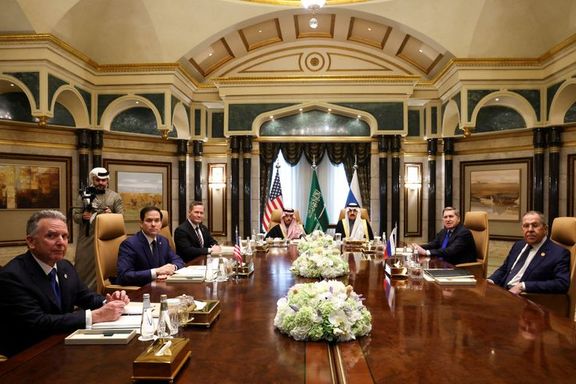
Russian and US delegations meet in Saudi Arabia. February 18, 2025
The conservative Tehran newspaper Jomhouri Eslami has warned Iranian authorities that Moscow may sacrifice Iranian interests in exchange for concessions from Washington over the Ukraine conflict.
Referring to US-Russia negotiations over Ukraine that began earlier this week in Riyadh—talks that notably excluded Kyiv—the newspaper speculated on Wednesday that these discussions could lead to a Moscow-Washington agreement. Such a deal, it argued, might see Russia securing territorial gains in Ukraine in return for granting Washington more leverage to protect Israel’s interests in the Middle East.
“Iran will be drawn into this equation alongside Lebanon, Syria, Iraq, and Palestine… and Russia will turn a blind eye to any actions the United States may take against Iran,” the newspaper wrote in an editorial titled “Us and the Great Moscow-Washington Deal.” This editorial has been widely covered by other media outlets in Iran.
The article accused Russia of failing to support Iranian forces in Syria in the past when Israeli jets targeted their positions and of collaborating with the US and Israel against Iran’s ally, Bashar al-Assad, when Tahrir al-Sham militia forces made advances against his troops.
Jomhouri Eslami warned that Moscow could betray Iran again if Washington helps Russia emerge victorious in Ukraine. The paper urged Iranian authorities to remain vigilant and strategize ways to mitigate the consequences of such a deal.
A similar concern was raised by the reformist Shargh daily in an article titled “Will Tehran Be Sacrificed in a Trump-Putin Deal?” The publication urged Iranian authorities to swiftly decide whether to pursue direct negotiations with the United States over its nuclear program.
Foreign relations expert Rahman Ghahramanpour, interviewed by Shargh, suggested that any deal between Donald Trump and Vladimir Putin would first impact European nations that have supported Ukraine. However, he acknowledged that Iran’s position could become a bargaining chip in future discussions, given Moscow’s role in Iran’s 2015 nuclear agreement, the Joint Comprehensive Plan of Action (JCPOA).
Meanwhile, Russian Presidential Press Secretary Dmitry Peskov attempted to reassure Iran, stating in an exclusive interview with Iran’s official news agency (IRNA) on Wednesday that Moscow’s talks with the United States would not impact its relations with Tehran. Peskov confirmed that Iran’s nuclear program was mentioned in a February 12 phone call between Trump and Putin but insisted it was not a primary topic of discussion.
Peskov told IRNA that the cooperation between Iran and Russia was independent of the relations between the Kremlin and the White House. Peskov confirmed that Iran's nuclear program had been “mentioned” in the Trump and Putin’s phone call on February 12, but said it had not been a primary topic in the two presidents’ talk.
Iran faces a limited timeframe, as the European signatories of the 2015 nuclear deal could invoke the “snapback” mechanism in October, reinstating UN sanctions lifted under the agreement. In an interview with RIA Novostiast last week, Russia’s envoy in Tehran, Alexey Dedov, emphasized the importance of Russia and China in any nuclear negotiations, stating, “Without Russia and China, such discussions will not reach their goals and will remain unproductive.”
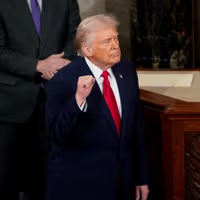
Trump has signaled a preference for striking a deal with Tehran but has also made clear that, failing diplomatic progress, he would not hesitate to consider military options to prevent Iran from acquiring nuclear weapons.
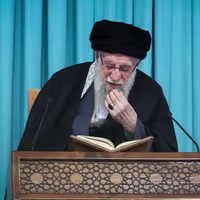
Iran has sought to deepen ties with Russia and China in line with Supreme Leader Ali Khamenei’s “Look East” policy in the past few years. This approach, which hardliners have actively promoted, posits that closer relations with non-Western powers will bolster Iran’s development and resilience against US pressure and sanctions. However, economic sanctions imposed by Trump in 2018 have led to a deep economic crisis in Iran, without any decisive assistance by Russia and China.
Trump’s stance on the Ukraine war and the concessions he appears willing to make to Putin have been widely criticized by US politicians and media, including by some conservatives who fear that bypassing Kyiv in negotiations could have serious security implications for Ukraine and its European allies.
Iran has repaired damage to its air defenses from an Oct. 26 Israeli attack, a senior military official said on Wednesday, adding that Tehran would punish Israel and any power helping it strike Iran.
The remarks were the first official confirmation that the Israeli air attacks had damaged Iran's air defense systems but emphasized a hawkish stance which appeared to allude to US assistance to a future Israeli raid.
"The air defense of Islamic Iran is at the height of readiness, and the minor damage inflicted on it has been completely repaired," Mohammad Bagheri, chief of staff of Iran's armed forces was quoted by state media as saying.
His remarks were the third time in as many days that a top Iranian military official rebutted US and Israeli assertions that Iran was weakened by the bombardment and come after US media reported that Israel is mulling striking Iranian nuclear sites.
"The air defense of the Armed Forces of the Islamic Republic is at peak readiness for offensive operations, and missile production is continuously being carried out with very high quantity and quality," Bagheri added.
The Wall Street Journal and The Washington Post reported last week citing US intelligence findings from last month that Israel saw an opening for an attack on Iranian nuclear sites as early as the first half of this year.
Visiting the White House this month, Israeli Prime Minister Benjamin Netanyahu said the Israeli strikes had "crippled Iran's air defenses." Trump the next day said any reports of a devastating US-Israeli attack on Iran were "greatly exaggerated".
Israel is basing its assessment, the papers reported, on Iran's weakness after an Oct. 26 Israeli attack knocked out much of its air defenses and a greater perceived receptiveness to military action from US President Donald Trump.
"If the enemy makes any mistake, Israel’s security—and that of those involved in equipping and planning its operations—will be at risk, and the region will not see peace," Bagheri added.
Supreme Leader Ali Khamenei said on Monday that Iran could fend off an attack by its enemies, after rejecting an overture from Trump for a deal over Iran's nuclear program, which Tehran says is peaceful but Israel insists aims at building a bomb.
Iran’s healthcare system is facing mounting challenges, with medicine shortages and soaring costs reaching alarming levels.
In February, Iran’s Pharmaceutical Association sent a letter to Ali Ahmadian, Secretary of the Supreme National Security Council, highlighting the government’s failure to pay its debts to pharmacies—estimated in the hundreds of millions of dollars, according to media reports.
The financial strain has severely disrupted pharmacies’ cash flow, hindering medicine procurement and availability. The letter warned that the crisis poses a serious threat to public health.
The head of Iran’s Medical Council (IRIMC), the non-governmental body responsible for medical licensing and regulation, also recently wrote to President Masoud Pezeshkian, raising concerns over delayed government payments to pharmacies.
The issue stems from government agencies such as the State Welfare Organization failing to pay their share of the cost of medicines dispensed to patients.
To keep essential medicines affordable, the Iranian government tightly regulates pharmaceutical prices and provides subsidies.
In 2022, President Ebrahim Raisi’s administration increased the official foreign currency exchange rate for medicine and medical equipment imports from 42,000 to 285,000 rials per dollar—nearly a seven-fold rise. Current free market exchange rate is more than 900,000 rials per dollar.
Authorities defended the move as an effort to curb the smuggling of subsidized medicine to neighboring countries. Another price increase of at least 20% is expected in the next Iranian calendar year, starting March 20, when new government exchange rates take effect.
In January, Iran’s Central Bank reported that it had allocated $3.4 billion for medicine, medical equipment, and pharmaceutical ingredients since late March 2024. Of this amount, $2.4 billion was provided to importers at the preferential rate of 285,000 rials per dollar.
Since March, the rial has depreciated sharply, plummeting from approximately 600,000 to over 900,000 per dollar in the open market.
Pharmaceutical companies report that currency shortages and the depreciation of the rial have significantly increased the cost of both imported medicines and domestically produced drugs that rely on imported ingredients.
The shortage of foreign currency allocated for medicine imports has fueled a thriving black market, where vital medications—especially those for cancer and rare diseases—are sold at exorbitant prices.
Despite these rising costs, strict government price controls have rendered the production of certain medicines unprofitable, leading some companies to discontinue manufacturing essential drugs.
Annual inflation has risen by around 40 percent, each year in the past five years, and the rial has lost 95% of its value since 2018 when Donald Trump withdrew from the 2015 nuclear deal and re-imposed draconian sanctions on the country.
The economic strain has taken a heavy toll on Iranian households. The massive depreciation of the rial and high inflation have drastically increased the cost of living, including expenses for food, housing, and healthcare and driven over 30 percent of the population below the poverty line.
According to Iran’s Statistical Center, healthcare accounts for approximately 10% of urban household expenditures.
Health Minister Mohammad-Reza Zafarghandi recently acknowledged that high medical costs are pushing many families into poverty, with lower-income groups often forgoing necessary treatments due to financial constraints.
Further compounding the crisis, Iran’s healthcare system has been hit by a mass exodus of doctors and nurses in recent years. Many medical professionals have emigrated to countries like Oman in search of better wages and improved living conditions, exacerbating the strain on Iran’s healthcare sector.
With Iran maintaining its stance against talks with the United States, it is pressing ahead with plans to triple its military budget for the new Iranian year in March, signaling preparations for potential military scenarios.
While officials deny that war is imminent, they acknowledge that diplomacy is no longer on the table.
Ahmad Bakhshayesh, a member of the Iranian Parliament’s National Security and Foreign Policy Committee, addressed the military budget increase which was announced in October when President Masoud Pezeshkian submitted the budget plan to the parliament for approval.
“It cannot be interpreted exactly in that way, but a significant increase in the military budget means that we are not negotiating and negotiations are not on our agenda,” Bakhshayesh told Ruydad 24 website.
Fatemeh Mohajerani, the government spokesperson, had announced a 200% increase in the military budget during a press conference in October saying that the purpose of the is move was to "strengthen the country's defense capabilities."
The budget for Iran’s armed forces was 7,220 trillion rials in last year’s budget bill. Given the exchange rate defined in that budget (330,000 rials per dollar), Iran’s military budget the last year could be estimated at $15.7 billion.
Based on this, the allocated budget for Iran’s armed forces in the coming year will likely be around 21,660 trillion rials. Given the exchange rate defined in the new year budget (570,000 rials per dollar) Iran’s military budget could be estimated at $46 billion.
The announcement follows increasingly aggressive rhetoric from Supreme Leader Ali Khamenei and senior commanders of the Islamic Revolutionary Guard Corps (IRGC), who have repeatedly signaled readiness for military confrontation.
On Tuesday, IRGC Aerospace Force Commander Amir Ali Hajizadeh said another attack on Israel, dubbed True Promise III, is in the cards.
“Iran’s third attack on Israel, True Promise 3, will definitely take place, but officials have planned for it and will use it strategically—we will not waste it,” Hajizadeh said.
He also warned that an assault on Iran’s nuclear facilities would trigger widespread conflict in the region.
Hajizadeh’s comments came after US President Donald Trump threatened Iran with an Israeli military strike if it refused to halt its nuclear program.
Meanwhile, officials the Pezeshkian administration, who previously advocated diplomacy, have shifted their stance, aligning with Khamenei’s hardline position against negotiations with the US—a stance he emphasized in a speech earlier this month.
“Today, in terms of hard defense and military threats from enemies, we have no concerns or problems,” Khamenei also said in one of his recent speeches.
The new year’s budget bill projects 1.75 million barrels of oil exports per day, with 420,000 barrels allocated to the military—equivalent to 24% of total exports. In monetary terms, the armed forces will receive €11 billion worth of oil, up from €4 billion in the previous year.
This nearly threefold increase means the military’s oil revenue will exceed the government’s by 520 trillion rials ($565 million).
Hajizadeh acknowledged that the military buildup is a response to growing tensions. “War conditions don’t always mean attacking—we must also prepare for being attacked,” he said, adding that heightened tensions have secured increased government funding.
Iran’s two previous attacks on Israel cost an estimated 1,380 trillion rials ($1.5 billion)—or 16 million rials ($17) per citizen. Meanwhile, over 60 million Iranians—70% of the population—rely on government food coupons for essential goods, yet the budget for these subsidies has been cut by 33%, dropping from €16 billion to €12 billion for the next year.
At the same time, the government lacks the funds to finance the food coupons and has resorted to withdrawing from the National Development Fund with the Supreme Leader’s approval.
With military spending surging, funds for vital imports—including medicines, infant formula, and livestock feed—have been slashed, driving up prices. Even before the next fiscal year begins, over 400 Social Security-covered medicines have already seen price hikes.
At least one third of Iranians are already living below the poverty line while workers strikes continue demanding unpaid wages.
A radical vigilante group leader in Tehran has suggested that Iran should carry out an operation against the United States similar to its missile attacks on Israel last year.
The conservative Tehran-based website Tabnak quoted Hossein Allah-Karam, leader of the vigilante group Ansar Hezballah, as saying that US President Donald Trump and Israeli Prime Minister Benjamin Netanyahu cannot follow through on their threats against Iran.
Tabnak described Allah-Karam as a political science professor at the University of Tehran and quoted him as asserting that Trump has failed to back his threats against Hamas. He concluded, “His other threat about bombing Iran if we do not sign a paper for him also cannot materialize.”
The hardline figure further claimed, “Trump’s performance has forced the United States and Israel to kneel before Gaza.”
He added, "We have achieved this with the capabilities we already have, so why should we challenge ourselves by opting to upgrade our capabilities?" This was perhaps a veiled reference to producing nuclear weapons and more potent ballistic missiles.
Allah-Karam’s remarks align with recent statements from Supreme Leader Ali Khamenei and some IRGC commanders suggesting Iran is prepared for conflict with Israel.
In a recent speech, Khamenei called for upgrading Iran's ballistic missiles. Meanwhile, IRGC deputy commander Ali Fadavi said on Monday that a third direct attack on Israel will happen in due course. "Operation True Promise 3 will occur at the right time," Fadavi said.
Fadavi made these remarks in response to statements by Israeli and US officials regarding Iran’s perceived weakness, as well as Trump’s threat that Israel would bomb Iran if Tehran refused to negotiate with the United States over its controversial nuclear program.
He stated, “Not a single day has passed without the world's evildoers—the Great Satan, America, and its allies—waging war against us.”
Reformist political commentator Ahmad Zeidabadi warned on Telegram that "Netanyahu has already made preparations for attacking Iran in the coming months." He appeared to be referring to Trump's backing of the plan, possibly alluding to the shipment of US-made bunker buster bombs to Israel and stationing of US B-52 bombers somewhere in the region.
Zeidabadi added that "all official statements and both direct and indirect remarks from Israeli and US officials suggest that such an attack is imminent." He cautioned that "while it might be a limited strike, its consequences could be extremely destructive and uncontrollable."
On Monday, Canadian-based military analyst Houshang Hassanyari and German-based political analyst Ali Sadrzadeh, both Iranian-born, stated on Iran International TV that the Islamic Republic appears to be preparing for war against Israel. Both analysts agreed that Iranian officials and military commanders' claims about the country's military capabilities are based on illusion rather than reality.
Hassanyari warned that "the Islamic Republic is under a dangerous illusion. Khamenei believes his forces can defend Iran and deliver heavy blows to Israeli and US forces. Even if he is not actively planning a war against Israel, his rhetoric is pushing Iran toward one."
He added that Iran lacks strong military capabilities and is destined for a major defeat in any war. If a conflict with Israel breaks out, the United States will undoubtedly intervene to support Israel.
Sadrzadeh, however, expressed skepticism about the likelihood of war. "I do not believe Iran is preparing for a war with Israel, as its commanders and top officials must have at least a basic understanding of their forces' limitations. US officials say Iran has no effective air defense, and as far as I know, Tehran no longer has allies or strategic depth in the Middle East."
He also noted that the situation has changed since the Iran-Iraq war of the 1980s. Given the protests in Iran in recent years, it is inconceivable that Iranians would rally behind Khamenei’s idea of war against Israel.
Ozempic and other weight-loss injections have become the latest luxury craze among affluent Iranians, as the nation struggles with a chronic shortage and soaring cost of essential medications.
Anti-obesity drugs like Ozempic, Wegovy and Mounjaro are not approved by Iran’s health regulators but that does not seem to bother those who seek and afford this newfound status symbol.
“Have a quick scroll through Instagram and you’ll see scores of Ozempic posts,” says Fatemeh, a psychotherapist in Tehran over a call on an encrypted messaging app. “You may see the medical pen flaunted alongside a Givenchy or a Louis Vuitton.”
For many, Ozempic is as much about status as it is about fitness, she says, adding that it’s not all too rare to happen upon someone live streaming their injection of Mounjaro to showcase their apparent weight-loss journeys.
The longing for a slimmer physique is nothing new. But the anti-obesity injections, often called a Fitness Wand, are also highly coveted in Iran not in spite of but because of their high cost.
On Instagram and Telegram, platforms with the most users in Iran, instructional videos are mushrooming on Ozempic and other weight-loss medications, with more physicians and clinics offering tips on how to use those, how to get the best results, and of course, how to tell apart the original and the fake ones.
“For many of our clients, these weight-loss pens are seen as tools to regain self-confidence,” says Maryam Majd, a 42-year-old fitness trainer at a high-end gym in Tehran’s affluent Zaferaniyeh district.
“Our gym staff is trained to assist with using these products, and we’ve even set up a dedicated room next to the solarium for this purpose,” she adds.
The urge to follow western trends may be explained, partly at least, by Iran’s official isolation from the world. But there’s little doubt that Iranians tend to be trigger happy when it comes to invasive methods of uplifting their appearance.
A user on Instagram showcases their wight-loss drug and their Mercedes in one frame
Take the wave of rhinoplasty (or nose jobs) that came to Iran’s shores a couple of decades ago and has left very few nostrils intact. Then it was liposuction, then Botox.
Every time it starts with the well-off and spreads to others, first as a luxury then a necessity, an obsession almost, which compels people with not enough disposable income to cut their expenses elsewhere, give up their basic needs even, to afford it.
Ozempic and other pens appear to be following a similar trajectory.
All this comes as many Iranians have to visit multiple pharmacies and queue up for hours to get life-saving medication for their loved ones.
Iran’s ongoing economic troubles—driven by sanctions, corruption and government mismanagement—has led to chronic shortages of essential drugs. Three in ten Iranians are now unable to afford their medication due to the soaring prices.
It does not help that some black market dealers, drawn by the substantial profit margins, have shifted their focus from rare disease medications to high-demand weight-loss drugs.
As the global trend of weight-loss medications continues to gain traction, Ozempic and similar drugs have become yet another example of Iran’s widening gap—between those constantly chasing the latest status symbol and those struggling to meet their basic needs.