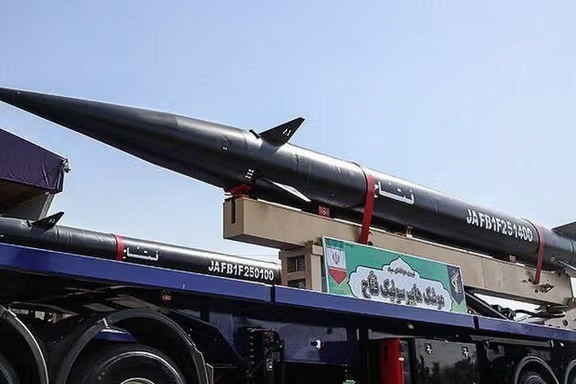
Iran's ballistic missile Fattah on display in a military parade, Tehran, September 2024
A senior Islamic Revolutionary Guard Corps (IRGC) commander said on Monday that a third direct attack on Israel will happen in due course, in a potential rebuttal to repeated US and Israeli assertions that Iran is weak.
"Operation True Promise 3 will occur at the right time," IRGC deputy commander Ali Fadavi said. Iran previously hit Israel with missile salvos in April and October.
15-months of warfare has seen Israel gain the upper hand in a region-wide confrontation with Iran and its regional armed allies. An Oct. 26 Israeli attack on Iran has been hailed by US and Israeli leaders for allegedly weakening Iran's defenses.
Fadavi added that the Islamic Republic had successfully weathered threats from adversaries since its inception.
"Not a single day has passed without the world's evil-doers waging war against us. Though the form of their actions may have changed, there has not been a day without it. Who stands on the other side, confronting us? The Great Satan, America, and those who fought with it against us."
The phrase Great Satan, used to describe the United States, originates from the rhetoric of Ayatollah Ruhollah Khomeini, the founder of the Islamic Republic.
Khomeini famously declared the US "the Great Satan, a wounded snake" on November 5, 1979. The trope is commonly used by Iranian officials to frame the conflict in cosmic religious terms.
Fadavi offered no specifics on the threatened attack against Israel, which Iran has codenamed True Promise. His comments followed by only one day after the US Secretary of State Marco Rubio stood alongside Israeli Prime Minister Benjamin Netanyahu in Jerusalem and spoke about containing Iran and limiting its nuclear development.
Netanyahu said Israel had dealt a significant blow to Iran since the start of the war in Gaza and that with the support of US President Donald Trump "I have no doubt we can and will finish the job".
Earlier on Monday, Iran's Foreign Ministry spokesman Esmaeil Baghaei denounced their remarks, saying: "When it comes to a country like Iran, they cannot do a damn thing."
"You cannot threaten Iran on one hand and claim to support dialogue on the other."
Trump has expressed openness to a deal with Tehran but also reinstated the "maximum pressure" campaign that was applied during his first term to stop Tehran from obtaining a nuclear weapon.
Iran's first direct attack on Israel, Operation True Promise 1 on Apr. 13 involved 300+ missiles and drones targeting military installations with minimal damage, retaliating for the killing of two Iranian generals in Damascus.
Operation True Promise 2 on Oct. 1, 2024 followed, with around 200 missiles targeting Israeli military facilities after the assassination of Iran-aligned militant leaders, including former Hezbollah leader Hassan Nasrallah.
The emir of Qatar Tamim bin Hamad Al-Thani will visit Tehran in coming days, the Hezbollah-affilaited Al-Mayadeen News reported, a couple of weeks after Doha expressed preparedness to mediate talks between Iran and the United States.
Iran's former ambassador to Doha Hamid Dehghani on Sunday described the emir's visit as "very important".
"The visit of Sheikh Tamim bin Hamad Al Thani to Tehran at this stage, and his discussions with our country's officials regarding bilateral relations, regional and global developments, especially consultations on the issue of Palestine, are considered highly significant," Dehghani said in a post on his X account.
On February 5, the Qatari foreign ministry spokesman told Fox News the Arab country was prepared to serve as a mediator between Tehran and Washington in settling the crisis over Iran's disputed nuclear program, as it did in the past.
“It is through mediation and through the negotiations that we have done this in the past,” Majed Al-Ansari said. “And we had been even during the first Trump administration working with the administration over getting an arrangement with Iran."
“We are hopeful that we can be instrumental for the United States with this,” the diplomat added.
On Sunday, US National Security Advisor Mike Waltz said President Donald Trump is willing to engage in talks with Iran only on condition that Tehran fully abandon its nuclear program.
"The President has also expressed a willingness to take whatever action is necessary. All options are on the table," Waltz told Fox News on Sunday, leaving the option of diplomatic channels open.
Trump's state secretary Marco Rubio told CBS later in the day that the US administration does not "have any outreach from Iran."
"Ideally, yeah, I would love to wake up one day and hear the news that Iran has decided not to pursue a nuclear weapon, not to sponsor terrorism, and re-engage in the world as a normal government. We've had no indication of any of that, not just now, but for 30 years," he said.
Hardline Iranian newspaper Farhikhtegan has criticized the country's foreign policy establishment for being left behind in Syria as regional rivals gain power in Tehran's former outpost.
The paper argued in an article on Sunday that Iran's "clichéd diplomacy" has left it weak as Turkey and Saudi Arabia gain ground.
"If our country doesn't take immediate action to disrupt Turkey's plan in Syria, Iran's name will be removed from the list of influential actors in Syria's developments, and Saudi Arabia will turn itself into another Turkey in this arena," the newspaper wrote.
The paper lambasted the Foreign Ministry's approach, describing it as disappointing and lacking any urgent action plan to secure Iran's national interests.
"In the midst of this heavy diplomatic battle...the approach that the Iranian diplomatic apparatus has taken seems disappointing," the article stated.
Farhikhtegan pointed to what it sees as a key miscalculation. "Iran is waiting to see how the new Syrian side will behave," the paper said, referring to an earlier statement from a government official.
The article further highlighted Turkey's proactive engagement with the new Syrian government, contrasting it with what it called Iran's passivity. It also highlighted the growing influence of Saudi Arabia and the UAE in the region, suggesting they are capitalizing on Iran's inaction.
The paper concluded with a stark warning: "It seems that the procrastination of Iranian diplomacy...is closing this window [of opportunity]."
It urged a strategic shift, including engagement with Saudi Arabia and the UAE, to counter Turkish influence and reclaim Iran's stake in Syria's future after years of building itself in the country alongside ousted President Bashar Al Assad.
On Saturday, a foreign ministry official said Tehran was in indirect talks with Syria’s new government. “We are monitoring the developments in Syria with deliberation and patience and will make our specific decision when the time is right,” Mohammadreza Raouf Sheibani, Iran’s special representative for West Asia, said in an interview.
He confirmed recent remarks of Syrian Foreign Minister Asaad Hassan al-Shibani about an exchange of positive messages between Tehran and Damascus following the overthrow of Assad’s government in December.
Iran and Russia, Assad’s main backers during the brutal conflict that began in 2011, played key roles in maintaining his grip on power until a rapid rebel offensive last December forced him into exile in Moscow. Since then, both countries have sought to maintain influence in Syria while navigating the new political landscape.
Iran, which invested heavily in Assad’s survival—reportedly spending at least $30-$50 billion—now faces the challenge of recalibrating its strategy. Supreme Leader Ali Khamenei has vowed on multiple occasions to reclaim Iran’s influence in Syria.
US Secretary of State Marco Rubio said that Iran is the single greatest threat to the Middle East in a joint press conference with Israeli Prime Minister Benjamin Netanyahu in Jerusalem.
Rubio said: "Behind every terrorist group, behind every act of violence, behind every destabilizing activity, behind everything that threatens peace and stability for the millions of people that call this region home is Iran.
"And by Iran I mean the ayatollahs, by Iran I mean its regime, a regime who by the way, its people don’t support. The people of Iran are victims of that regime."
Netanyahu, who has long campaigned for harsher policies on Iran from global powers, warning of the threat the country's nuclear program poses to the region, welcomed the comments which echo his own years-long campaign against Tehran.
“Israel and America stand shoulder to shoulder in countering the threat of Iran," he said. "We agree that the ayatollahs must not be allowed to have nuclear weapons. We also agreed that Iran’s aggression in the region has to be rolled back.”
Addressing the Gaza war against Iran-backed militants, Hamas, Netanyahu said Israel had dealt a significant blow to Tehran over the past 16 months, adding that with the support of Trump, "I have no doubt we can and will finish the job".
He also said Israel had weakened the Iranian-backed Hezbollah movement in southern Lebanon and had hit hundreds of targets in Syria to prevent a new Iranian-backed front opening up against Israel.
"Now, if any other force believes that Israel will permit other hostile forces to use Syria as a base of operations against us, they are gravely mistaken," Netanyahu said.
US Secretary of State Marco Rubio meets with Israeli president Isaac Herzog at the president's residence in Jerusalem, Israel February 16, 2025.
The Lebanese government has banned Iranian flights landing in Beirut twice in the last week for fears that Israel may shoot them down, according to AFP.
The US gave warnings to Lebanon that Israel may take military action as Iran-backed Hezbollah continues to use the airport to bring in weapons and money from Iran amid a US-France brokered ceasefire, the report said. Hezbollah and Iran deny the allegations.
A statement on Hezbollah media Al Mayadeen, responded to contest the closure: “Hezbollah demands that the Lebanese government reverse its decision of preventing the Iranian plane from landing at Beirut airport and take serious measures to prevent the Israeli enemy from imposing its dictates and violating sovereignty.”
Hezbollah, designated a terrorist organization by countries such as the US and UK, has been under greater scrutiny since the November ceasefire with Israel has seen the country’s army take greater control under the watch of the US and France which mediated the truce.
Last Thursday, Lebanese authorities sent word to Iran that a Beirut-bound flight should not take off.
On Friday, another flight was banned from taking off from Iran, triggering protests in Lebanon from supporters of the Iran-backed group who blocked the road to the country’s only international airport. The Lebanese army fired tear gas at protesters.
Speaking to AFP, a source said: “Through the Americans, Israel informed the Lebanese state that it would target the airport if the Iranian plane landed in Lebanon.
“The American side told the Lebanese side that Israel was serious about its threat.”
Last year, The Telegraph reported that Beirut International Airport was being used by Hezbollah as a smuggling route for Iran to arm and fund Hezbollah, quoting airport whistleblowers.
The latest incidents would be classed as breaches of the fragile ceasefire, which both sides claim the other has breached dozens of times.
Last week, Lebanese media also reported that flights into Beirut from Iraq were undergoing extra scrutiny to ensure they were not being used by Iran to send cash to Hezbollah.
Iran's foreign minister said Saturday the country was prepared for constructive talks with Lebanon on restoring Tehran-Beirut flights.
In a phone call on Saturday, the two countries’ foreign ministers discussed “how to resolve the problem of civil flights” and “confirmed their readiness to hold constructive talks in good faith”, after a decision to bar two flights from landing triggered violent protests in Beirut.
Iran reciprocated by barring two Middle East Airlines flights from landing in Tehran to evacuate Lebanese citizens, Lebanon's An-Nahar reported.
Iran's ambassador to Beirut Mojtaba Amani told state media that the Islamic Republic will allow Lebanese flights to land in Tehran only if Iranian flights are permitted to land in Beirut.
Tensions between the two countries started when Lebanon halted flights by Iranian carriers, including Mahan Air and Iran Air.
Saeed Chalondari, CEO of Imam Khomeini Airport City, said Lebanon had announced a suspension of Iranian flights until February 18, directing passengers to use Lebanese carriers instead.
The dispute follows accusations from Israel that Iran’s IRGC Quds Force has been using civilian flights to smuggle funds to Hezbollah via Beirut International Airport. Israeli military spokesperson Avichay Adraee said on X that Iran and Hezbollah were exploiting commercial flights to transfer money for attacks on Israel.
The flight ban has sparked tensions in Lebanon. Images circulating on social media showed Hezbollah supporters blocking roads to Beirut Airport in protest against the refusal to allow Mahan Air to land.