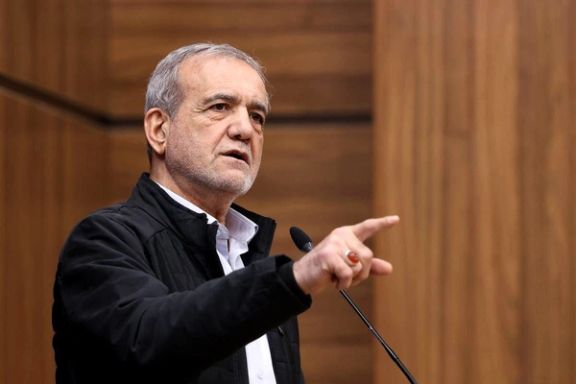
Tehran won’t bow to bullies but is open to talks, president says
President Masoud Pezeshkian
Tehran is open to talks with Washington but will not be bullied into them, Iranian President Masoud Pezeshkian has said, sounding a positive note on negotiations even after the country's Supreme Leader rejected the idea this month.
"We never said we won’t talk, but we shouldn’t bow to bullies," Pezeshkian said Thursday.
"Why should someone on the other side of the world make a statement, and we react with fear?" he added, in an apparent reference to US President Donald Trump.
"We are not afraid; we will stay, we will build, and we will build with strength. This is what we believe in."
Iran's ultimate decision-maker Supreme Leader Ali Khamenei this month rejected talkswith Trump, calling them "not wise, intelligent or honorable."
In recent weeks, several Iranian officials, including the foreign minister and the government spokesperson, have echoed the position that Iran sees no point in talks while US sanctions remain in full force.
"Iran's position in the nuclear talks is completely clear, and we will not negotiate under pressure and sanctions," Abbas Araghchi said earlier this week. "There is no possibility of direct negotiations between us and the United States as long as maximum pressure is applied in this manner."
However, perspectives within Iran’s establishment vary. Ahmad Bakhshayesh, a member of the Iranian Parliament’s National Security and Foreign Policy Committee, indicated that negotiations were no longer on the table.
Bakhshayeh said Iran’s increased military budget submitted by Pezeshkian to parliament in October reflects a shift away from diplomatic engagement.
The renewed debate follows US President Donald Trump’s decision earlier this month to restore the "maximum pressure" campaign of sanctions on Iran from his first term.
His move revived a hardline strategy aimed at crippling Iran’s economy, particularly its oil exports, which had been severely restricted following Washington’s 2018 withdrawal from the Joint Comprehensive Plan of Action (JCPOA).
Trump’s latest directive aims to further reduce Iran’s oil exports, a key source of revenue, to zero.
Tehran cannot be allowed to have a nuclear weapon and must make a deal, Trump has argued. "I would prefer a deal with Tehran to an Israeli attack on their nuclear sites," he said after signing the memorandum that reinstated the sanctions.
Meanwhile, Russian Foreign Minister Sergey Lavrov recently visited Tehran following high-level discussions between Moscow and Washington in Saudi Arabia.
While the exact details of the discussions remain unclear, some Iranian media outlets have cautioned that Russia may not be a reliable partner and could adjust its stance based on shifting geopolitical priorities, speculating that Lavrov may have made concessions regarding Iran’s position.
While the Trump administration has engaged in talks with Moscow to end the war in Ukraine, it has maintained a hardline approach toward Iran, demanding a reversal of Tehran's nuclear, military and regional policies.
At the same time, Washington has hinted at a shared strategic interest with Moscow in preventing Iran from acquiring nuclear weapons.
Speaking to independent journalist Catherine Herridge, Senator Marco Rubio said last week, “There are things we could cooperate on geopolitically,” adding, “I’m not sure the Russians are fans of the Iranian regime having nuclear weapons.”
While a senior adviser to Iran's Supreme Leader rejected talks with the United States and urged Iranians to exercise "maximum patience" in response to US "maximum pressure," others called for restraint and diplomacy.
The diversity of views suggests the ruling establishment has yet to either decisively welcome or reject US President Donald Trump's overture for diplomacy.
Iranian media quoted Kamal Kharrazi, chairman of the Strategic Council of Foreign Relations that advises Ayatollah Khamenei, as saying to Iraq's al-Yum newspaper that "US and Israel's pressure will not stop Iran's nuclear program" and ruled out negotiations with Washington "as long as America's unilateralism" continues.
At the congress of the Reformist Mardom Salari Party on the same day, Jalil Rahimi Jahanabadi criticized the government's and parliament’s decision-making, saying it has not solved any problem. He urged Tehran to "avoid challenging regional and global powers, as this can be costly for Iran."
He explained that "Trump has questioned all the democratic standards of the West and we need to run the country's affairs in this situation."
Meanwhile, he warned Iran's hardliners against challenging President Masoud Pezeshkian, cautioning that "if he is undermined, there will be no one left to address the country's problems."
In a separate development on the same day, prominent Reformist Behzad Nabavi cautioned the government that "Iran's economic situation is dire, and the country cannot afford to delay negotiations with the United States for another four years" until Trump leaves the White House.
However, according to the Iranian Labor News Agency (ILNA), Nabavi acknowledged that while Iran's economic crisis requires urgent action, Tehran cannot rush into negotiations with Trump.
He proposed that Iran should first engage in talks with Europe to gradually ease the sanctions that have devastated the economy. "At the same time, we need to reach a cease-fire with the United States," ILNA quoted him as saying. However, he did not specify what Europe could offer Iran or how Tehran could persuade Trump to wait until it is ready for negotiations.
President Donald Trump reinstated his “maximum pressure” sanctions on Iran in February, demanding a deal that would permanently prevent Tehran from acquiring nuclear weapons.
However, Nabavi noted that a short-term solution for Iran's problems requires lifting the sanctions, but if that is not possible Tehran should resort to rationing foodstuff and essential commodities to limit the impact of sanctions.
As Iran’s currency has fallen by around 50% since September, prices of essential necessities have skyrocketed in recent weeks and more inflation is expected in the coming months. The overall consensus in the Iranian media is that the country faces harsh challenges and the government seems unable to find more money to finance imports.
In a related development, conservative daily Jomhouri Eslami cautioned Iranian officials against trusting Russia.
Following Russian Foreign Minister Sergey Lavrov's visit to Tehran, the newspaper warned, "We cannot make yet another mistake. Do not trust Russia!"
The daily argued that it would be a mistake for Iran's foreign ministry to trust a foreign power that "has proven unreliable" in past experiences, including during nuclear negotiations, the Ukraine war, Syria before Assad's fall, and disputes over Iran's ownership of three Persian Gulf islands.
Jomhouri Eslami suggested that contrary to official statements, Lavrov's visit was linked to a major deal between the United States and Russia and could impact the future of Iran-US relations.
The editorial also criticized Iran's state-run news agencies for their "misleading reporting practices," accusing them of focusing on irrelevant details rather than the substantive outcomes of talks with foreign officials. It warned that this approach "erodes public trust in Iranian media" and drives audiences to seek news about Iran from foreign outlets, calling this shift "a significant loss."
Iranian female singer Hiva Seyfizadeh was arrested during a live performance in Tehran on Thursday night after security forces raided the venue, whose audience included both men and women in defiance of the theocracy's gender-mixing laws.
Iranian law prohibits women from singing solo before mixed audiences that include men and mandates adherence to strict hijab regulations.
Although the restrictions are longstanding, a surge of recent such performances have challenged legal and cultural boundaries.
According to music journalist Bahman Babazadeh, the concert had received official authorization. However, during the performance, security forces—accompanied by four female officers—entered the venue and took Seyfizadeh into custody.
Authorities have not given an official reason for the arrest, but an eyewitness, speaking to Iran International on condition of anonymity, confirmed that men were present at the event.
The eyewitness also noted that organizers had prohibited the audience from recording the concert.
Shortly after the incident, Emarat Rooberoo, the venue where the concert was held, announced via Instagram that it would remain closed until further notice.
It is unclear whether authorities or a preemptive decision by the organizers imposed the closure.
Seyfizadeh has previously drawn attention for performing without the mandatory hijab in solidarity with anti-government protesters during Iran’s recent wave of civil unrest.
Her arrest follows a broader crackdown on female performers defying Iran’s strict regulations on women’s public appearances and artistic expression.
In December, security forces arrested and later released singer Parastoo Ahmadi after she livestreamed a concert without the mandatory hijab. Ahmadi’s performance, in which she appeared with bare shoulders, directly challenged Iran’s enforced dress code.
Later that month, the Iranian Judiciary issued a statement condemning the event, stating that the concert had been held "without legal authorization and adherence to Sharia principles" and that it would take unspecified action against the singer and the production team.
Despite internet restrictions, Ahmadi’s Caravanserai Concert quickly became one of the most discussed topics on Iranian social media. Though YouTube is officially restricted in Iran, the performance garnered over 1.5 million views within three days, with clips widely shared online.
Iran has welcomed the call for the Kurdistan Workers' Party (PKK) to lay down its arms, viewing it as a significant step toward ending violence and promoting regional security.
Esmaeil Baghaei, spokesperson for Iran's Foreign Ministry, praised the announcement made by jailed PKK leader Abdullah Ocalan, who urged the group to dissolve itself in a letter read by Turkey’s pro-Kurdish DEM Party.
“The Islamic Republic of Iran supports any process that leads to the cessation of terrorism and strengthens security in neighboring Turkey,” Baghaei said Friday, expressing hope that this development would have positive effects throughout the region.
Ocalan’s statement comes amid shifting dynamics in the Middle East following the collapse of the Assad government in Syria. The new Syrian administration, backed by Ankara, is seeking to consolidate control over Kurdish-held areas in the north, while Turkey has intensified its push to dismantle Kurdish militant groups in both Syria and Iraq.
Last month, Turkish Foreign Minister Hakan Fidan called on Iran to align its stance with Ankara’s efforts against the PKK, saying, “There are some who think differently about the PKK in Iran, but we urge all countries, including Iran, to cease support for the group.” His remarks followed reports of an alleged meeting between Iran’s IRGC Quds Force Chief Esmail Qaani and leaders of the PKK-linked YPG in Syria.
Ankara, which classifies the YPG as a terrorist organization, has repeatedly warned that it will take military action if Kurdish militants do not disarm and withdraw. The disbandment of the PKK could reshape security dynamics in the region, particularly in oil-rich northern Iraq, where the group has maintained a base for decades.
Iran has paid a heavy price to maintain its influence in Iraq and Syria, yet its gains have been minimal compared to the costs, Turkey’s Foreign Minister said in an interview with Al Jazeera on Wednesday.
Hakan Fidan, who served as Turkey’s intelligence chief for nearly eight years, said he had shared this assessment with Quds Force commander Qasem Soleimani, who was killed in a US drone strike near Baghdad International Airport in January 2020. Iran’s regional strategy has fallen short of its goals, and shifting geopolitical dynamics have forced Tehran to reassess its role, according to Fidan.
His latest remarks echo his December interview, in which he criticized Iran’s involvement in Syria, arguing that despite its extensive presence, it failed to prevent the devastation in Gaza caused by Israel’s offensive. That interview highlighted Turkey’s evolving stance, as Ankara has gained leverage following the ousting of Bashar al-Assad, Iran's key ally in the region.
Ankara is widely regarded as the primary backer of the Syrian rebels who toppled Assad, led by Ahmed al-Sharaa.
Iran’s Supreme Leader Ali Khamenei, however, insists that Tehran's armed groups, including Hamas and Hezbollah, remain strong despite external pressures. Addressing developments in Gaza, Lebanon, and Syria, he accused the United States and Israel of misjudging the strength of Iran-backed groups, an assessment that appears increasingly disconnected from the shifting realities on the ground.
In a separate interview with the Saudi-affiliated Al-Hadath, Fidan noted that Iran must reflect on its actions post-Assad. He stressed the need for a regional order built on cooperation, sovereignty, and mutual interests, one that moves beyond the dominance of any single power, whether Iranian, Turkish, or Arab.
The Iranian government will raise diesel prices starting next month, Iran International has learned, in a move which could stoke unrest as economic malaise mounts.
Diesel will be sold at market rates, and a significant portion of government subsidies will be eliminated.
An executive directive outlining the changes has already been drafted and awaits official approval.
The change is likely to deepen the economic burden on citizens, adding to the existing strain caused by a weak currency and high inflation.
A gasoline price hike in November 2019 triggered days of nationwide protests, during which authorities deployed paramilitary forces who used overwhelming force to suppress the unrest.
At least 1,500 people were killed, according to a Reuters investigation.
Economic conditions have since worsened, with persistent high inflation pushing tens of millions of Iranians into deeper poverty.
Iran International reported in December that Iran was preparing to ease fuel subsidies in a move likely approved at the highest levels of government.
At the time, documents indicated that the monthly distribution of subsidized gasoline would be drastically cut from 87 million liters to 42.5 million liters.
Iranians had already begun noticing changes as fuel stations started installing eight-digit price displays—signaling a potential shift in pricing policies.
The diesel price increase comes as Iran’s top officials continue to discuss also a possible gasoline price hike this spring.
Sources told Iran International that security agencies are increasingly worried about the country’s growing dependence on fuel imports and its shrinking capacity to meet demand under escalating US sanctions.
Washington this week imposed a new round of sanctions targeting Iran’s oil industry, including key brokers, shipping firms, and the head of the National Iranian Oil Company.
These measures, part of the renewed "maximum pressure" campaign by the Trump administration, aim to cut Iran’s oil revenue, which remains the backbone of its economy and regional military operations.
With Iran pumping 3.2 million barrels per day as of January, the latest restrictions are expected to further strain the country’s financial and energy sectors.