Energy shortages force Iran to cut workweek to two, three days
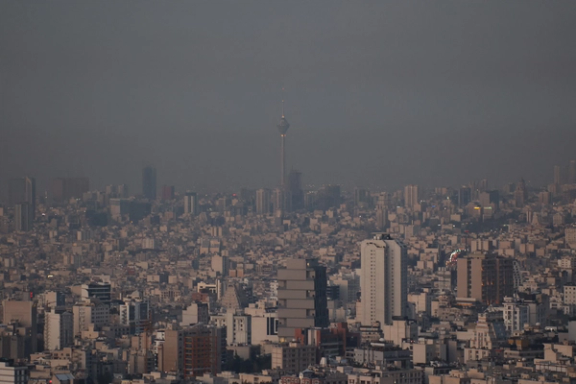
A general view of Tehran, October 26, 2024
Government offices, banks, and schools across most of Iran remained closed on Monday as a worsening energy crisis forced authorities to shut down public services in at least 22 of Iran's 31 provinces.
The closures, driven by severe gas shortages and electricity cuts, have left Iranians accustomed to working weeks of just two or three days.
With snow, rain, and plunging temperatures further straining the country’s already fragile energy infrastructure, provincial officials announced the shutdowns late Sunday, impacting regions including Tehran, Mazandaran, Gilan, Golestan, Isfahan, Markazi, Kerman, Hamedan, etc.
In Tehran, schools, courts, and government offices suspended operations entirely, with authorities mandating that all heating systems be turned off to conserve fuel.
“This isn’t about bad weather,” said Nima, a wholesaler of car spare parts in the capital. “The government announces these closures to cover up its energy failures. They know if they don’t shut things down, people will protest over the lack of heating and electricity,” he told Iran International.
A large number of Iranians said on social media that in some provinces, schools were declared closed without arrangements for online classes. However, many said that virtual education is unreliable anyway, as power outages also disrupt internet access.
The country’s aging telecommunications infrastructure lacks backup battery systems, further limiting connectivity.
The frequent shutdowns have hit businesses hard, particularly as Iran nears Nowruz, the Persian New Year, when many retailers rely on a seasonal surge in consumer spending. Hamid, 38, who runs a clothing boutique in Tehran’s Gisha neighborhood, said sales have plummeted.
“We wait 11 months for this last stretch before Nowruz to make a profit, but every week, we lose two or three working days,” he told Iran International. “This morning, I sold just two pairs of pants and a shirt, which were already discounted. Meanwhile, my bounced checks are piling up.”
Iran’s work week has long been out of sync with the global economy, with weekends falling on Thursday and Friday instead of Saturday and Sunday. Nima said the latest wave of shutdowns has made the situation even worse.
“Iranian businesses already struggle because we only overlap with the international market for three days a week,” he said. “Now, with these extra closures, we’re essentially shut down half the month. How can there be an economy in a country that’s closed for business?”
Compounding the crisis, the Iranian rial continues to weaken against the US dollar amid economic pressures from US sanctions. The falling currency has further eroded purchasing power, leaving many consumers unable to afford even discounted goods.
Public sector closures have become a frequent occurrence in Iran, with schools and offices repeatedly shut in recent months due to pollution, dust storms, cold weather, and fuel shortages.
While officials cite weather conditions for the latest round of shutdowns, weather tracking services have not predicted subzero temperatures or heavy snowfall for many of the affected provinces.
For business owners like Hamid and Nima, the pattern is clear. “It’s not about the cold,” Nima said. “It’s about the country running on empty.”
An Iranian economist has warned that hyperinflation could take hold unless effective negotiations with the United States lead to the lifting of sanctions.
“Without easing sanctions through productive negotiations, reducing inflation seems unlikely,” Ghodratollah Emamverdi told Etemad newspaper on Monday. He cautioned that if monthly inflation reaches 50%, Iran could face hyperinflation. Currently, monthly inflation is at four percent, while annual inflation is estimated to be over 40%.
On Sunday, the only government agency reporting inflation figures announced an annual rate of 35%. However, labor groups and analysts contend that the government downplays negative economic news, suggesting the real inflation rate is much higher.
Emamverdi noted that although Iran’s inflation rate has not yet reached the critical 50% threshold, continued sanctions and internal political tensions could push the economy into hyperinflation.
Majid-Reza Hariri, former head of Iran’s chamber of commerce, criticized the presidential administration’s inability to address the current crisis, saying the government is effectively paralyzed.
“We either have a government or we don’t, and I personally believe we are facing a state of no government. If the government cannot solve economic problems, no one is forced to be president or minister,” Hariri said. He added that everyone in the current administration was aware of the situation by mid-2024 but still chose to run for office or accept ministerial positions.
President Masoud Pezeshkian has argued that Iran’s complex and deep-seated economic problems are too vast for his administration to resolve, implicitly pointing to the impact of sanctions. Following Supreme Leader Ali Khamenei’s ban on negotiations with the United States in early February, Pezeshkian expressed his support for the decision, aligning himself with Iran’s ultimate political authority. As the new Iranian year approaches on March 20, the government faces the challenge of setting pay raises for millions of workers, including those in government and quasi-public enterprises. Workers are demanding wage increases of up to 70% to keep pace with soaring inflation.
The Iranian rial has lost more than 50% of its value in the past six months, driving expectations of even higher inflation. Currently, the minimum wage stands at about $120 per month, while semi-official estimates indicate that at least $400 per month is needed to support a family of three.
The government is considering a wage increase of less than 50%, which would still leave workers struggling to afford basic necessities. However, even a smaller pay hike could further fuel inflation.
Iran’s Foreign Minister Abbas Araghchi met with UN Secretary-General António Guterres on the sidelines of the Conference on Disarmament in Geneva on Monday, Iran’s official news agency IRNA reported.
The Conference on Disarmament (CD), established in 1979, is a UN-affiliated multilateral forum for arms control and disarmament negotiations.
It focuses on nuclear disarmament, preventing an arms race in space, and curbing weapons proliferation. Held annually in Geneva, it includes 65 member states.
According to IRNA's report, Araghchi and Guterres discussed global security challenges and the need for international cooperation to promote stability.
Iran’s foreign ministry on Monday said it has summoned Poland’s chargé d'affaires in Tehran following comments made by Polish Foreign Minister Radek Sikorski, who last week criticized Iran and Russia's military cooperation.
"In response to the biased and baseless remarks made by the Polish foreign minister against our country, Marcin Wilczek, Poland’s chief envoy in Tehran, was summoned by Mahmoud Heidari, the assistant foreign minister," the statement read.
While the ministry did not elaborate on the specifics of the comments they rebuffed, semi-official IMNA news agency reported that the summons followed Sikorski’s role in facilitating the transfer of an Iranian-made drone from Ukraine to the US for display at the Conservative Political Action Conference (CPAC).
Speaking about his involvement, Sikorski told The Wall Street Journal last week, “There is an axis of aggression between Iran and Russia. The Islamic Republic is sending death and destruction into all directions, and we need to jointly, directly, face the threat and remove it.”
On taking credit for the trophy drone, Sikorski said, “We have to remember that the first credit needs to go to the Ukrainians, who shot the thing down.”
According to WSJ, Sikorski helped to facilitate the drone’s procurement for the US-based nonprofit organization, United Against Nuclear Iran (UANI).
The Iranian government says that domestic tax revenue is not being spent on supporting its regional military allies amid a deepening economic crisis plunging millions of Iranians into poverty.
Mohammad Hadi Sobhanian, head of Iranian National Tax Administration (INTA), told ILNA: “There is absolutely no discussion regarding the payment of taxes for overseas projects, and it is not the case that people pay taxes and the taxes are spent outside the country.”
He instead pointed to the government’s tax earmarking plan, which he said provides greater transparency in how revenue is allocated.
But leaked reports of Iran’s financial assistance to regional groups such as Hezbollah in Lebanon are fueling anger while at home, Iranians are suffering with mass unemployment and poverty.
Meanwhile, Hezbollah has been expanding its network of interest-free loan funds, using Iranian support to provide financial relief to its followers.
Tehran recently allocated over $10,000 per family to Lebanese households affected by the most recent conflict with Israel, according to sources familiar with the matter. The funds were distributed among Shiite families aligned with Hezbollah.
Naim Qassem, Hezbollah’s newly appointed secretary-general, described the payments as a “gift from the Islamic Republic.”
Some Iranian politicians maintain that Tehran’s military strength is deterring the United States as tensions fester between President Donald Trump and the Islamic Republic.
Former parliament member Ezzatollah Yousefian said on Friday that “Trump does not want to go to war with Iran because he knows Iran’s missile power can obliterate an entire country.”
Yousefian also reiterated that Iran will not accept to take part in any negotiation in a situation marked by arrogance.
Another former lawmaker, Mohammad Hassan Asafari, told a local conservative website, “Trump has realized that Iran is now speaking with one voice and that no one in Iran will accept negotiations under threats and arrogance.” He added that Trump’s decisions on Iran are influenced by the latest developments in Iran’s domestic political climate.
Despite Asafari’s claim of unity, many political figures in Tehran have been asking for a change in foreign policy and negotiations with the United States.
Asafari also urged Tehran to stand firm against Trump, saying, “Trump is accustomed to using fear and intimidation in negotiations, but Iran is aware of his tactics and will not bow to arrogance or threats.”
Addressing Trump’s statement about allowing Israel to attack Iran if Tehran refuses to negotiate over its nuclear program, Asafari said, “If we stand firm, Trump will back down, but if we show division, he will exploit it.” He also echoed Yousefian’s statement that Iran’s missile power is substantial, adding, “If Israel makes a miscalculation, confronting Iran will not be easy.”
Iran launched hundreds of ballistic missiles against Israel twice in 2024, causing minimal damage as most were intercepted by Israeli, US and other allied air defenses and warplanes.
Yousefian also noted that “Trump constantly contradicts himself to confuse his opponents, which reflects a businessman’s mentality.” He added, “He is committed to protecting Israel, but no one can predict the tactics he will use to achieve that.”
Trump’s objective goes beyond preventing Iran from obtaining nuclear weapons; he aims to disarm the country entirely, Yousefian argued. He explained that Trump is increasing pressure on Tehran to force it to the negotiating table, adding, “Unlike Biden, Trump is not a patient man and will not spend two years on negotiations. He wants quick results; otherwise, he will exert more pressure.”
In another development, Iran's Deputy Foreign Minister Majid Takht Ravanchi emphasized that the Foreign Ministry “will act within the frameworks set by Supreme Leader Ali Khamenei for interaction with America.” He deliberately used the term “interaction” instead of “negotiation,” reflecting Khamenei’s firm opposition to talks with the United States.
During an interview with an Iraqi network on a recent visit to Baghdad, Ravanchi criticized the US for failing to uphold its commitments under the 2015 nuclear deal with Iran. He noted that Trump withdrew from the agreement in 2018 after Iran declined to engage in new talks on its nuclear program and regional military ambitions. Ravanchi added that Iran is now focused on pursuing discussions with Europe.
In another development, prominent Iranian lawmaker Ali Keshvari criticized the United States, saying, “The US has a poor track record in its previous negotiations with Iran,” and accused it of “easily undermining its obligations.”
Keshvari also accused the US of “unilateralism when dealing with independent countries,” arguing that “the US seeks only to serve its own interests and secure concessions without offering any in return.” He added, “The US has employed this approach in its negotiations with many other countries,” although he did not specify which ones.