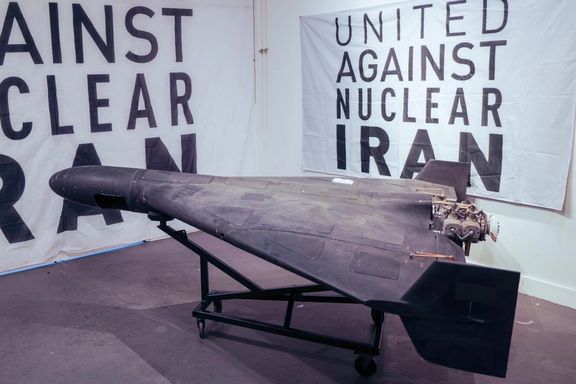
Downed Iranian drone captured in Ukraine displayed in US
A photo of the Iranian-designed Shahed-136 military drone that has arrived in the US.
A disassembled Iranian-designed Shahed 136 military drone seized in Ukraine arrived at Joint Base Andrews in Maryland this week and was displayed as part of a political conference addressing the ongoing threat of Iran.
The drone, brought down by Ukrainian forces, was transported with cooperation from Ukrainian and Polish special forces and United Against Nuclear Iran (UANI), a US-based nonprofit, Wall Street Journal reported.
“The Iranians have tried to conceal the role of this terror WMD weapon for years,” said UANI’s head Mark Wallace, who served as a US ambassador at the United Nations.
Wallace and Thomas Kaplan, a funder of UANI, were the ones who persuaded Polish Foreign Minister Radoslaw Sikorski at a meeting in Warsaw to procure an Iranian drone for Wallace to import into the United States.
The drone was displayed at the Conservative Political Action Conference this weekend and Donald Trump, the President of the United States, spoke at the conference.
According to the report, the Shahed-136 drone is considered the most widely used military drone in the world and is manufactured in Iran's military industries under the supervision of the IRGC. The IRGC is designated as a terrorist organization in the United States.
Russian forces have used thousands of these drones—rebranded as Geran-2—in Ukraine, with one striking Chernobyl’s radiation containment shelter on February 14.
Iranian-backed militants also launched a Shahed that killed three US service members in Jordan on January 28.
Former US intelligence official Norman Roule describes Iran as a “serial arsonist that openly nurtures other arsonists who operate in regional countries.” and supports proxies like Hezbollah, Hamas, and the Houthis.
“Russia also serves as a proxy because it’s extending Iran’s power projection and allows Iran to perform on the world stage,” he said.
The United States first warned in July 2022 that Iran was preparing to supply Russia with battlefield drones, and September 13 marked the anniversary of the first Shahed drone being shot down by Ukraine.
Russia soon began large scale use of the Iranian drones in attacks on Ukraine’s infrastructure and civilian targets. The Shahed 136 drones have been used alongside cruise and ballistic missile attacks to overwhelm Ukrainian air defenses.
Iran has repaired damage to its air defenses from an Oct. 26 Israeli attack, a senior military official said on Wednesday, adding that Tehran would punish Israel and any power helping it strike Iran.
The remarks were the first official confirmation that the Israeli air attacks had damaged Iran's air defense systems but emphasized a hawkish stance which appeared to allude to US assistance to a future Israeli raid.
"The air defense of Islamic Iran is at the height of readiness, and the minor damage inflicted on it has been completely repaired," Mohammad Bagheri, chief of staff of Iran's armed forces was quoted by state media as saying.
His remarks were the third time in as many days that a top Iranian military official rebutted US and Israeli assertions that Iran was weakened by the bombardment and come after US media reported that Israel is mulling striking Iranian nuclear sites.
"The air defense of the Armed Forces of the Islamic Republic is at peak readiness for offensive operations, and missile production is continuously being carried out with very high quantity and quality," Bagheri added.
The Wall Street Journal and The Washington Post reported last week citing US intelligence findings from last month that Israel saw an opening for an attack on Iranian nuclear sites as early as the first half of this year.
Visiting the White House this month, Israeli Prime Minister Benjamin Netanyahu said the Israeli strikes had "crippled Iran's air defenses." Trump the next day said any reports of a devastating US-Israeli attack on Iran were "greatly exaggerated".
Israel is basing its assessment, the papers reported, on Iran's weakness after an Oct. 26 Israeli attack knocked out much of its air defenses and a greater perceived receptiveness to military action from US President Donald Trump.
"If the enemy makes any mistake, Israel’s security—and that of those involved in equipping and planning its operations—will be at risk, and the region will not see peace," Bagheri added.
Supreme Leader Ali Khamenei said on Monday that Iran could fend off an attack by its enemies, after rejecting an overture from Trump for a deal over Iran's nuclear program, which Tehran says is peaceful but Israel insists aims at building a bomb.
Nobel Peace Prize laureate Narges Mohammadi criticized the Iranian government's rights records and called for a global efforts to undermine what she called Tehran's gender apartheid.
In a virtual address to Italy’s parliament on Wednesday, Mohammadi said the current leadership in Iran is “fundamentally an unaccountable regime, incapable of upholding democracy, freedom, and equality.”
"This struggle is difficult, exhausting, and costly for women and for Iranian society. We need global will and determination to put an end to gender apartheid," she added.
Mohammadi is the most outspoken and prominent dissident inside the country and has spent over a decade in Iranian prisons. Currently on medical leave from Tehran's Evin Prison, she has resumed her public criticism of Iran's theocratic rulers.
"The Iranian people seek a transition from tyranny to democracy," she said, calling for an end to the systemic violence and discrimination that she said has marked the Islamic Republic's rule for over four decades.
She also addressed the case of three Iranian activists—Varisheh Moradi, Pakhshan Azizi, and Sharifeh Mohammadi—currently facing execution, urging global action to prevent their deaths.
Mohammadi rejected remarks by the Iranian government that sexual violence against women does not exist.
“I have witnessed numerous instances of such violence and have many accounts from women that I can testify about,” she added.
Mohammadi has helped spearhead a weekly protest campaign against Iran's high rate of executions which often targets political prisoners, dubbed No to Execution Tuesdays.
With Iran maintaining its stance against talks with the United States, it is pressing ahead with plans to triple its military budget for the new Iranian year in March, signaling preparations for potential military scenarios.
While officials deny that war is imminent, they acknowledge that diplomacy is no longer on the table.
Ahmad Bakhshayesh, a member of the Iranian Parliament’s National Security and Foreign Policy Committee, addressed the military budget increase which was announced in October when President Masoud Pezeshkian submitted the budget plan to the parliament for approval.
“It cannot be interpreted exactly in that way, but a significant increase in the military budget means that we are not negotiating and negotiations are not on our agenda,” Bakhshayesh told Ruydad 24 website.
Fatemeh Mohajerani, the government spokesperson, had announced a 200% increase in the military budget during a press conference in October saying that the purpose of the is move was to "strengthen the country's defense capabilities."
The budget for Iran’s armed forces was 7,220 trillion rials in last year’s budget bill. Given the exchange rate defined in that budget (330,000 rials per dollar), Iran’s military budget the last year could be estimated at $15.7 billion.
Based on this, the allocated budget for Iran’s armed forces in the coming year will likely be around 21,660 trillion rials. Given the exchange rate defined in the new year budget (570,000 rials per dollar) Iran’s military budget could be estimated at $46 billion.
The announcement follows increasingly aggressive rhetoric from Supreme Leader Ali Khamenei and senior commanders of the Islamic Revolutionary Guard Corps (IRGC), who have repeatedly signaled readiness for military confrontation.
On Tuesday, IRGC Aerospace Force Commander Amir Ali Hajizadeh said another attack on Israel, dubbed True Promise III, is in the cards.
“Iran’s third attack on Israel, True Promise 3, will definitely take place, but officials have planned for it and will use it strategically—we will not waste it,” Hajizadeh said.
He also warned that an assault on Iran’s nuclear facilities would trigger widespread conflict in the region.
Hajizadeh’s comments came after US President Donald Trump threatened Iran with an Israeli military strike if it refused to halt its nuclear program.
Meanwhile, officials the Pezeshkian administration, who previously advocated diplomacy, have shifted their stance, aligning with Khamenei’s hardline position against negotiations with the US—a stance he emphasized in a speech earlier this month.
“Today, in terms of hard defense and military threats from enemies, we have no concerns or problems,” Khamenei also said in one of his recent speeches.
The new year’s budget bill projects 1.75 million barrels of oil exports per day, with 420,000 barrels allocated to the military—equivalent to 24% of total exports. In monetary terms, the armed forces will receive €11 billion worth of oil, up from €4 billion in the previous year.
This nearly threefold increase means the military’s oil revenue will exceed the government’s by 520 trillion rials ($565 million).
Hajizadeh acknowledged that the military buildup is a response to growing tensions. “War conditions don’t always mean attacking—we must also prepare for being attacked,” he said, adding that heightened tensions have secured increased government funding.
Iran’s two previous attacks on Israel cost an estimated 1,380 trillion rials ($1.5 billion)—or 16 million rials ($17) per citizen. Meanwhile, over 60 million Iranians—70% of the population—rely on government food coupons for essential goods, yet the budget for these subsidies has been cut by 33%, dropping from €16 billion to €12 billion for the next year.
At the same time, the government lacks the funds to finance the food coupons and has resorted to withdrawing from the National Development Fund with the Supreme Leader’s approval.
With military spending surging, funds for vital imports—including medicines, infant formula, and livestock feed—have been slashed, driving up prices. Even before the next fiscal year begins, over 400 Social Security-covered medicines have already seen price hikes.
At least one third of Iranians are already living below the poverty line while workers strikes continue demanding unpaid wages.
The Governor of Iran's Central Bank traveled to Yekaterinburg, Russia, to meet with his Russian counterpart and continue talks on advancing financial and banking cooperation between the two countries.
According to the Central Bank of Iran’s public relations office, Mohammad-Reza Farzin's trip, made at the invitation of Elvira Nabiullina, Governor of the Central Bank of Russia, focuses on furthering the bilateral banking agreements between Iran and Russia.
In January, Iran and Russia implemented a bilateral currency agreement to settle trade using their national currencies, according to Iran's Central Bank.
According to Farzin,Tehran and Moscow are also working to integrate the Russian Mir and Iranian Shetab card payment networks.
It is unclear if the measure was related to an Iranian-Russian comprehensive strategic partnership agreement signed in January by Russian President Vladimir Putin and his Iranian counterpart Masoud Pezeshkian.
A radical vigilante group leader in Tehran has suggested that Iran should carry out an operation against the United States similar to its missile attacks on Israel last year.
The conservative Tehran-based website Tabnak quoted Hossein Allah-Karam, leader of the vigilante group Ansar Hezballah, as saying that US President Donald Trump and Israeli Prime Minister Benjamin Netanyahu cannot follow through on their threats against Iran.
Tabnak described Allah-Karam as a political science professor at the University of Tehran and quoted him as asserting that Trump has failed to back his threats against Hamas. He concluded, “His other threat about bombing Iran if we do not sign a paper for him also cannot materialize.”
The hardline figure further claimed, “Trump’s performance has forced the United States and Israel to kneel before Gaza.”
He added, "We have achieved this with the capabilities we already have, so why should we challenge ourselves by opting to upgrade our capabilities?" This was perhaps a veiled reference to producing nuclear weapons and more potent ballistic missiles.
Allah-Karam’s remarks align with recent statements from Supreme Leader Ali Khamenei and some IRGC commanders suggesting Iran is prepared for conflict with Israel.
In a recent speech, Khamenei called for upgrading Iran's ballistic missiles. Meanwhile, IRGC deputy commander Ali Fadavi said on Monday that a third direct attack on Israel will happen in due course. "Operation True Promise 3 will occur at the right time," Fadavi said.
Fadavi made these remarks in response to statements by Israeli and US officials regarding Iran’s perceived weakness, as well as Trump’s threat that Israel would bomb Iran if Tehran refused to negotiate with the United States over its controversial nuclear program.
He stated, “Not a single day has passed without the world's evildoers—the Great Satan, America, and its allies—waging war against us.”
Reformist political commentator Ahmad Zeidabadi warned on Telegram that "Netanyahu has already made preparations for attacking Iran in the coming months." He appeared to be referring to Trump's backing of the plan, possibly alluding to the shipment of US-made bunker buster bombs to Israel and stationing of US B-52 bombers somewhere in the region.
Zeidabadi added that "all official statements and both direct and indirect remarks from Israeli and US officials suggest that such an attack is imminent." He cautioned that "while it might be a limited strike, its consequences could be extremely destructive and uncontrollable."
On Monday, Canadian-based military analyst Houshang Hassanyari and German-based political analyst Ali Sadrzadeh, both Iranian-born, stated on Iran International TV that the Islamic Republic appears to be preparing for war against Israel. Both analysts agreed that Iranian officials and military commanders' claims about the country's military capabilities are based on illusion rather than reality.
Hassanyari warned that "the Islamic Republic is under a dangerous illusion. Khamenei believes his forces can defend Iran and deliver heavy blows to Israeli and US forces. Even if he is not actively planning a war against Israel, his rhetoric is pushing Iran toward one."
He added that Iran lacks strong military capabilities and is destined for a major defeat in any war. If a conflict with Israel breaks out, the United States will undoubtedly intervene to support Israel.
Sadrzadeh, however, expressed skepticism about the likelihood of war. "I do not believe Iran is preparing for a war with Israel, as its commanders and top officials must have at least a basic understanding of their forces' limitations. US officials say Iran has no effective air defense, and as far as I know, Tehran no longer has allies or strategic depth in the Middle East."
He also noted that the situation has changed since the Iran-Iraq war of the 1980s. Given the protests in Iran in recent years, it is inconceivable that Iranians would rally behind Khamenei’s idea of war against Israel.