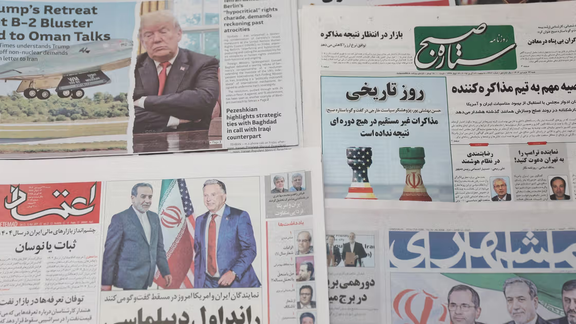
The three Iranian newspapers closest to the heart of power have adopted a maverick stance against talks with Washington, signaling that the theocracy's most powerful institutions remain deeply skeptical of diplomacy with their arch-nemesis.
While the Culture Ministry, the Supreme Council of National Security and the Press Supervisory Board issue ad hoc directives to newspaper editors about what to publish, three newspapers consistently defy those and often escape with a gentle caution.
They are Kayhan, Javan and Vatan-e Emrooz, linked respectively to the Supreme Leader’s office, the Islamic Revolutionary Guard Corps (IRGC) and the ultraconservative Paydari Party, all of which continue to criticize the negotiations with the United States – in apparent disregard of the highest office of the realm.
Earlier this week, Kayhan, known for its staunch anti-Americanism, attacked those who back talks with Washington, accusing them of turning a blind eye on the harm done to Iran by US sanctions.
"Why should we trust Trump, a man even his allies do not trust," the paper asked, using some unusually provocative language to describe Israel’s prime minister Benjamin Netanyahu.
Ultraconservative daily Vatan-e Emrooz also cautioned in its editorial against advancing the talks in a way that would make withdrawal or retreat from any agreement impossible.
The negotiating team should be wary of leaving Iran vulnerable to exploitation, the editorial warned.
The admonitions and the critiques may not be as harsh as they were a couple of weeks ago – prior to Khamenei’s cryptic backing of negotiations. But the very fact that they keep flowing after the leader’s blessing of diplomacy is significant.
"Speaking without restraint at times ... our unnecessary objections, our lack of patience, and our flawed analyses of situations can have historical consequences,” Khamenei cautioned last week with no direct reference to the ongoing negotiations.
“Therefore, we must be very careful," he said. But the trio appear to have not received the memo. Or maybe they have.
The three dailies not only represent powerful factions within the Islamic Republic’s polity, but they also enjoy direct access–with varying degrees–to Khamenei’s office.
It may be easier, therefore, to explain their editorials as necessary objections, contingencies for a potential policy shift should the interests of the leadership require one.
No surprise, perhaps, that IRGC-linked Javan, the daily closest to and representing actual power, has shown the most balanced approach to the negotiations in recent weeks.
"Iran may wish to maintain its image as an anti-imperialist warrior. But who says an agreement limited to eliminating sanctions against reducing enrichment levels will tarnish that image,” Javan asked in an editorial this week.
"We have done this before. Why shouldn't we do it again...? No country in the world will characterize this as Iran relinquishing its ideals."
Unlike other outlets in Iran, which face severe consequences for minor errors, these three dailies roam carefree on the theocracy’s political plane. Whether or not their tone is part of a grand strategy by the topmost officialdom remains unknown.
"Some say that Trump is unpredictable,” Javan concluded its editorial. “Well, we are not that predictable either!"
Dozens of women in Tehran and Shiraz have reported receiving personalized text messages in recent days from Iran's Headquarters for the Promotion of Virtue and Prevention of Vice warning them about hijab violations.
What began as a pilot surveillance project in the conservative city of Isfahan is now quietly extending its reach to the Iranian capital.
The emergence of these messages in Tehran and Shiraz has triggered widespread concern that Iran’s hardline factions are laying the groundwork for a high-tech nationwide surveillance system to enforce mandatory hijab laws.
“I was visiting my father’s grave in the early hours of the morning when I received the warning,” wrote one woman posting under the handle @jesuisminaaa on X. “I sat there, crying and crushed. Someone there had reported me. How can a person think only about my headscarf in a place filled with grief?”
The message she and others received is stark: remove your hijab in public, and you may face legal action.
From cars to the streets
Since 2023, Iran’s police have used traffic cameras to detect unveiled women in cars. Registered vehicle owners receive automated warnings. If three warnings are logged, the car is impounded for up to four weeks. Tens of thousands of cars have been seized under the measure.
Many male owners report that no women—veiled or unveiled—were in their cars on the dates cited in the warning messages. Some female drivers also say they were not using their vehicles at the time the alleged violations occurred.
According to multiple experts and reports on social media, the institution is now identifying individuals by cross-referencing surveillance footage with mobile phone geolocation data, smart card usage including subway and bank cards as well as government identity databases.
The result: personalized messages delivered to women’s phones within hours of their appearances in public spaces.
Legal and ethical questions
The scale and precision of the operation have provoked an outcry from legal experts, activists and ordinary citizens.
“Law experts, please answer this: does the Headquarters for the Promotion of Virtue and Prevention of Vice even have legal access to people’s personal data?” wrote Abdollah Ramezanzadeh, a reformist former government spokesman and law professor on X. “Let the country be in peace!”
The head of the powerful, hardline institution is appointed by Supreme Leader Ali Khamenei and appears to operate independently of the government.
Both the Minister of Telecommunications, Sattar Hashemi, and government spokesperson Fatemeh Mohajerani have denied the administration’s involvement or authorization for the expanded surveillance.
“It has been proven that the use of force in the realms of culture and society leads to counterproductive results. In the field of education, police and judicial measures have not been effective and will not be,” the president’s deputy chief of staff for communications said in a post on X.
“Blaming the administration and the president for the costs of repeating failed experiences is both inaccurate and unethical,” Mehdi Tabatabai added.
But critics argue that even if the government, parliament and the judiciary have no direct control and are not formally endorsing the measures, they are doing little to intervene.
Labor Day in Iran was marked by demonstrations by teachers and heightened security in several cities across the country with allegations of violent suppression of protesters by security forces.
A group of active and retired teachers gathered outside the Ministry of Education headquarters in Tehran on Thursday to mark International Workers’ Day.
The protest, organized by the Coordinating Council of Iranian Teachers' Trade Associations, was met with a heavy security response.
According to a statement from the council, “Security forces violently dispersed demonstrators,” preventing any photography and arresting an unspecified number of participants.
“The security atmosphere was so heavy that even the right to take pictures was denied,” the group said. “Teachers were beaten and forced to leave.”
Similar gatherings were reported in other cities under tight security. Authorities did not immediately comment on the reported arrests or use of force.
Meanwhile, Iranian government officials sought to reassure workers facing mounting economic hardship in a bid to calm tensions.
Iranian government spokeswoman Fatemeh Mohajerani
Government spokeswoman Fatemeh Mohajerani acknowledged the ongoing economic challenges, citing recent inflation estimates and the impact on workers’ purchasing power as two thirds of the country now live below the poverty line.
She also announced the government’s intention to maintain healthcare coverage for 75 days after insurance cancellation — a policy seen as crucial for many precarious workers.
Mohajerani also addressed wage concerns, saying that although a 45% increase in minimum wages was approved by the Supreme Labor Council for the current Iranian year that started on March 21, “inflation has eroded much of that gain.”
The minimum salary of Iranian workers is about 100 million rials, about $125 at today’s rate. The inflation rate in Iran is about 45%, according to official data, with prices of food and housing increasing at higher rates.
To mitigate the impact on lower-income households, she said the government continues to promote “remedial policies” such as food coupons and subsidies for vulnerable groups, including mothers and pregnant women.
On pension reform, Mohajerani said the second phase of salary adjustments for retirees would proceed as outlined in the national budget. “The government is legally bound to fulfill its obligations, even if at times delays occur due to unforeseen conditions,” she added.
In a nod to one of the long-standing demands of workers, Mohajerani highlighted government efforts to improve access to housing. “Agreements have been made between the Ministry of Roads and Urban Development and industrial zones to help workers live closer to their workplaces,” she said.
She also addressed delays in the passage of legislation to organize public employment contracts, noting the complexity of balancing workforce rights with the legal mandate to limit the size of government under Iran’s development plan. “The government's approach is to support the private sector rather than expand itself,” she said.
On the broader economic picture, labor economist Alireza Heidari said taming inflation remains the number one priority for workers, who have been protesting ever worsening conditions in recent years. Complaints include wage cuts, unpaid wages and worsening working conditions.
“In recent years, workers’ livelihoods have become directly tied to inflation,” he told ILNA. “The vast majority of wage earners fall within the seven lowest-income deciles of society, and they have been hit hardest.”
He warned that recent wage increases may be neutralized by future price hikes. “We ended last year (March 20) with the (exchange rate for one) dollar hovering at 1,000,000 rials. If this affects prices further, even a 45% wage increase won’t prevent a real income decline.”
Heidari stressed that structural reforms are essential to curbing inflation. “Experience shows that inflation in Iran is largely driven by the government’s lack of financial discipline,” he said. “Though the new administration is making efforts, the challenge is deeply structural.”
He cautioned against linking economic mismanagement solely to external factors or international negotiations. “Some officials try to attribute all issues to foreign policy, but many of the problems are internal and systemic.”
He said that without tackling inflation, any other policy amendments are redundant. “We talk about insurance, safety, and union rights, but it all comes back to the issue of livelihoods,” he added.
Tehran and Washington are set to resume talks this weekend, but growing calls to condition any agreement on the dismantling of Iran’s nuclear infrastructure are casting a shadow over early optimism.
The hard line on full dismantlement is the newly stiffened public stance of the White House and US envoy Steve Witkoff and has also been pushed by Israel's prime minister, Benjamin Netanyahu, who asserted on Monday that nothing less would be acceptable to his government.
His intervention did not sit well with Tehran.
“Israel’s fantasy that it can dictate what Iran may or may not do is so detached from reality that it hardly merits a response,” Iranian Foreign Minister Abbas Araghchi posted on X, calling Netanyahu "brazen" for telling a US president what to do.
Somewhat surprisingly, he went on to criticize the Democratic administration of Joe Biden in what appeared to be an attempt to court Donald Trump.
“Netanyahu’s allies in the failed Biden team—who failed to reach a deal with Iran—are FALSELY casting our indirect negotiations with the Trump administration as another JCPOA,” Araghchi wrote.
The significance of this public gesture from an Iranian official—at the expense of the man accused of appeasing Tehran almost every week of his term—cannot be overstated.
This shift in tone may be partly driven by the economic fallout from the port fire in Bandar Abbas, which observers believe has deepened Tehran’s financial strain.
The Islamic Republic, and its chief negotiator Araghchi, have every reason to be apprehensive about a breakdown in talks, given the "very bad" alternative mooted by Trump.
The desire to project cautious optimism was also evident in an editorial on Iran Diplomacy, a website closely aligned with the foreign ministry.
The article outlined two scenarios: the U.S. targeting Iran's nuclear sites, or accepting a “new regional order” in which Tehran becomes a key energy supplier to the West. The latter, it said, is the more likely outcome.
In this scenario, according to Iran Diplomacy, Iran-allied armed groups in the region would be redefined and gradually integrated into formal military structures.
Curiously, the piece framed all this as proof of Tehran's deterrent power and Washington's surrender to Iran’s demands, while cautioning against overconfidence when dealing with a president who has a “bad record of undermining commitments.”
Two reformist publications, Sharq and Etemaad, published similar stories on the same day.
Sharq said there was room for cautious optimism while talks continue, noting that major issues remain unresolved.
Etemaad reported that a recent poll showed 8 in 10 respondents support the talks and a potential agreement, provided it protects Iran’s interests and preserves advances in nuclear science and missile technology.
The pro-government publication pointed out that in a similar poll conducted just before the 2015 nuclear deal, fewer people - 7 in 10 - said they favored a deal.
Foreign exchange rates, which have a critical impact on economic life, fluctuate frequently depending on where they are traded, adding to the anxiety of businesses and ordinary Iranians enduring inflation and sanctions.
The Iranian rial hit an all-time low in March, trading at one million per US dollar in March as tensions with the United States flared.
Now ahead of a third round of Iran-US nuclear talks in Oman on Saturday, the open market rate for the dollar was around 810,000 rials, while two government-controlled rates, the EST and the official rate for importing basic goods stood at 692,000 and 280,000 respectively.
Ordinary people, who often convert their savings into hard currency or gold during periods of political and international uncertainty, generally only have access to the open market.
Many businesses — and even some semi-official entities — also turn to the open market when they cannot access foreign currency through official channels or when they require immediate liquidity.
In recent years, successive governments have attempted to reform Iran’s tangled foreign exchange system to curb corruption fueled by cronyism, where favored individuals, groups and state entities secure access to cheaper rates to import goods that are later sold at much higher open market prices.
The reforms have mostly failed because entrenched political networks benefiting from the system oppose them.
The open market
Iran’s open or free foreign exchange market operates largely outside government control. It consists of authorized currency exchange shops or sarrafi as well as informal street-level transactions.
The open market -- where currencies like the US dollar, Euro, and UAE dirham are the most actively traded -- reflects real-time supply and demand. Prices in the open market are heavily influenced by inflation expectations, political risks, sanctions developments and broader economic conditions.
Open market rates typically run significantly higher than the officially controlled rates, particularly during times of instability and often provide the clearest snapshot of Iran’s underlying economic and political realities.
They serve as a crucial, unofficial benchmark that influences pricing, import costs, and inflation across the country.
The government occasionally intervenes, injecting foreign currency through selected sarrafi or cracking down on street traders they deem illegal when volatility escalates amid ramped up political tension or rapid devaluation.
Official rates for staples, medical goods
This rate, currently 285,000 rials to the dollar, is provided through designated banks to importers of basic goods such as wheat, rice, and animal feed as well as medicine and medical supplies.
The decision on allocation of this type of currency lies with related ministries and the Central Bank of Iran (CBI).
An earlier preferential rate for these imports fixed at 48,000 rials has now been almost completely scraped.
Electronic Trading System (ETS) rates
The ETS rate, closer to the free-market rate, is set by supply and demand within the Electronic Trading System (ETS) of the Iran Center for Currency and Gold Exchange.
Established in late February 2022, the center was intended to provide a formal platform for cash currency exchanges to undercut the open market.
While exchange rates on ETS are determined by market forces, the CBI actively supervises the platform, intervening by injecting or limiting foreign currency supplies to influence rates.
This managed market — accessible to licensed banks and exchange offices — handles both cash transactions and informal transfers called hawala. Transactions that previously took place through a system dubbed NIMA are now also routed through ETS.
The defunct NIMA system
The NIMA system, an acronym for integrated system of foreign exchange, was created to regulate foreign currency earned through exports and allocate it for imports of non-essential goods and services. It was officially scrapped in January.
Within NIMA, transactions occurred between exporters and importers under CBI supervision, with the central bank setting a floor and ceiling for permissible exchange rates.
For years, NIMA served as the government’s primary tool for managing the trade balance and controlling the flow of foreign currency.
Its elimination marked a significant shift toward market-based pricing mechanisms — albeit still heavily managed — through the ETS platform.
Corruption amid multiple rates
Several major corruption scandals have rocked Iran in recent years, many of which stem from its multi-tiered exchange rate system.
The Debsh Tea Company scandal is one of the most recent and possibly largest embezzlement cases in the history of the Islamic Republic.
High-ranking officials from various ministries, the Customs Administration and the Central Bank were implicated in the scandal that first came to public attention in 2023.
The family-owned company received $3.37 billion in subsidized foreign currency (at the NIMA rate) to import tea and machinery but sold $1.4 billion of the currency it had received in the open market at higher rates, did not import the promised equipment and allegedly imported low-quality tea it labelled as premium-grade.
The Iranian government confirmed a media ban on coverage regarding last week's explosion at Rajaei port in Bandar Abbas where at least 70 people have died and more than 1,000 injured, with the threat of prosecutions confirmed by the judiciary.
Fatemeh Mohajerani, Iran's government spokeswoman, said the decision is aimed at “maintaining a single voice across state institutions.”
She described the directive not as a news blackout, but as a mechanism to “manage the issue properly.”
“The government is not interested in withholding information from the people,” she said, adding that provincial bodies have been instructed not to release information about the explosion’s cause until further notice.
Iran International reported earlier this week that journalists and outlets had received warnings about covering the incident, and described a heavy security presence in Bandar Abbas.
Judiciary spokesman Asghar Jahangir said on Wednesday that legal cases have been opened against several media figures for reporting on the blast, with warnings issued to individuals on social media.
Mizan, the judiciary’s official news agency, reported that violators of the media ban would face prosecution for “spreading illegal news.”
“An incident of this scale, with such casualties, demands precise and documented investigation,” he said. “We are waiting for the results to be finalized and announced." Jahangir said.
On Tuesday, The Guardian quoted a Tehran-based reporter speaking on condition of anonymity, who said, “Not only were we warned against ground reporting, we were also banned effectively from sharing reports on social media.”
“In the face of a tragedy such as this, what is there to hide? Either the death toll is way more than 70, or they are suppressing the real cause of the explosion. Following the filing of charges, our newsrooms are also self-regulating in fear that they’ll be facing legal consequences.”
No official casualty figures have been released by the health ministry, which, along with its subsidiaries, was ordered on Sunday to withhold all related information.
Iran International has been contacted independently from a worker at the port citing 29 deaths in one office alone.