Tehran-linked suspect among Iranians held in UK terror plot investigation
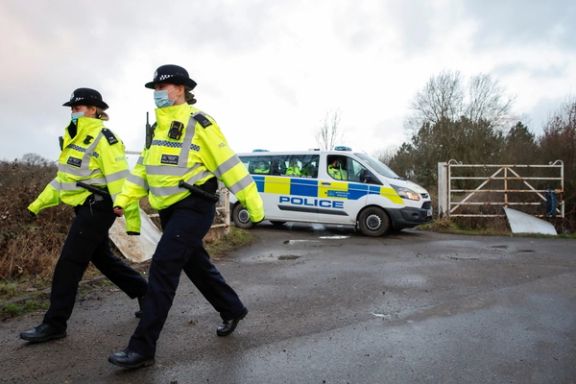
File photo of UK Police officers in Ashford
At least one of the five Iranian nationals arrested in the United Kingdom over the weekend in connection with an alleged terror plot has close ties to the Islamic Republic, The Telegraph reported citing an informed source.
The man, whose family reportedly owns prominent businesses in Iran, is described as “very well connected” to Tehran’s leadership.
His arrest was part of a coordinated national operation involving Counter Terrorism Policing and UK Special Forces that resulted in raids across several cities, including London, Rochdale, Manchester, Stockport, and Swindon, according to the Met Police.
Authorities believe the group was just hours away from launching an attack on what police described as a “specific premises.”
Four of the men, aged between 29 and 46, continue to be held under the Terrorism Act 2006 after police secured extended detention warrants. A fifth man, aged 24 and arrested in Manchester, has been released on conditional bail.
The potential involvement of the Iranian suspects in a plot marks a concerning shift in Iran’s tactics, which have typically relied on criminal proxies to carry out operations abroad.
This case, if confirmed, could point to a more direct engagement in overseas activities by Iranian nationals themselves.
Commander Dominic Murphy, head of the Met’s Counter Terrorism Command, said the investigation remains in its early stages but stressed its complexity and national scale.
“We are working incredibly hard, with public safety at the forefront of our ongoing efforts,” he said, urging the public to avoid speculation and report any suspicious activity.
Home Secretary Yvette Cooper praised the work of security services, calling it one of the most significant counter-terrorism and counter-state threat operations in recent years.
As Tehran and Washington cautiously inch forward their nuclear negotiations, the United Kingdom is positioning for a stronger hand in shaping any potential agreement amid Iranian-linked security threats and a standoff over detained Britons.
British Foreign Secretary David Lammy’s high-level meetings with Omani officials on April 27—just one day after Iran and the United States held indirect talks in Rome under Omani mediation—underscored the United Kingdom's efforts not to remain a bystander in one of the region’s most consequential diplomatic processes.
The UK was also set to meet Iranian officials along with France and Germany on May 2 just before the planned fourth round of US-Iran talks in Rome. However, that meeting was canceled following the postponement of the latest round of Tehran-Washington negotiations. No further plans have been announced yet.
The UK or any of the other signatories to the 2015 nuclear deal (JCPOA) has until October to activate the JCPOA’s so-called snapback mechanism which would reimpose all UN sanctions on Iran.
Lammy had already signaled alignment with Washington in late March, expressing a shared commitment to ensuring Iran "never develops or acquires a nuclear weapon." On April 15, he also discussed Iran’s nuclear program with Israeli Foreign Minister Gidon Saar during a meeting in London.
Iran’s foreign ministry and state television have remained silent on the arrests. While some domestic outlets cautiously reported the news by citing international coverage, they refrained from offering analysis or commentary. In contrast, the hardline Quds daily responded swiftly and critically on Monday.
In a commentary titled “Security Dossier to Disguise Diplomatic Blackmail,” Quds accused the UK of exploiting the arrests for political leverage in the nuclear talks. “The latest move comes at a time when indirect nuclear talks between Tehran and Washington are taking place, and in this context, London's decision seems meaningful.”
Tehran-based analyst Sohrab Sadreddin quoted in the piece suggested that the arrests were intended as a signal to the US—especially Trump-aligned factions—that Iran remains a strategic threat to the West.
Sadreddin added that Britain, France and Germany are keen to be included in any future agreement between Washington and Tehran: "If an agreement is to be reached, Europe must also be included in it.”
Adding another layer of complexity and pointing to the recent arrest of two British nationals in Iran, the commentary also raised suspicions about a possible prisoner swap strategy.
The Foremans are not the only UK-linked detainees in Iran. Mehran Raouf, a 68-year-old British-Iranian labor activist, has been imprisoned since October 2020. He is currently serving a 10-year sentence on charges related to national security offenses.
Iran, which does not recognize dual nationality, has a long history of detaining dual citizens and foreigners on security-related charges, often using them as bargaining chips in its dealings with Western powers, including Britain.
In April 2022, British-Iranian nationals Nazanin Zaghari-Ratcliffe and Anoosheh Ashouri -- both accused of espionage -- were released following Omani mediation, after Britain settled a long-standing £400 million debt owed to Iran.
Iran’s Foreign Minister Abbas Araghchi is set to visit New Delhi on Thursday amid rising tensions between India and Pakistan after last month’s attack on tourists in disputed Kashmir.
Araghchi is currently in Pakistan, where he met with his counterpart Ishaq Dar. He is also scheduled to hold talks with President Asif Ali Zardari and Prime Minister Shehbaz Sharif.
Last month, five armed militants attacked tourists in the Baisaran Valley near Pahalgam, in Indian-administered Jammu and Kashmir, killing 26 civilians, including 25 Indian tourists and one local Muslim pony ride operator.
In the aftermath, India accused Pakistan of supporting cross-border terrorism, an allegation Pakistan denied.
Iran offered to mediate between India and Pakistan, though New Delhi has rejected any third-party mediation, according to The Times of India, citing government sources.
The report said that Araghchi’s visit on Thursday was organized before the attack in Kashmir and is focused on co-chairing the Iran-India Joint Commission meeting alongside Indian External Affairs Minister S. Jaishankar.
Discussions are expected to center on trade, energy, and infrastructure cooperation.
Iran remains committed to pursuing diplomatic engagement with the United States amid delays to talks, but expanding negotiations beyond the nuclear issue is unacceptable, the foreign ministry spokesman said on Monday.
“We have announced our commitment to continuing the path of dialogue and diplomacy. We have shown our full readiness by participating in several rounds of negotiations,” Foreign Ministry spokesperson Esmail Baghaei told reporters in Tehran.
“The decision regarding the timing of the negotiations was made based on the proposal of the Omani side and with the coordination of both parties," he said, Oman a key mediator.
"The decision to postpone was logistical,” Baghaei said.
Talks between Iran and the US remain focused on nuclear-related issues and sanctions relief, the spokesman emphasized, pushing back against French calls to expand the negotiations to include non-nuclear matters.
“Such statements are not new, and they are not acceptable to us,” he said. “The scope of the talks is limited and confined to the nuclear issue and the lifting of sanctions.”
Responding to US President Donald Trump’s recent comments that Iran does not need nuclear energy given its fossil fuel reserves, Baghaei said, “Our peaceful nuclear program is based on rights enshrined in international law and dates back to the 1970s, when Iran’s energy needs were even less than today.”
Addressing recent Israeli military threats, Baghaei warned that Iran would respond decisively to any aggression. “The Iranian armed forces will respond to any act of hostility or adventurism in the strongest possible manner. There should be no doubt about that,” he said.
Baghaei criticized what he called Washington’s mixed signals that include both sanctions and calls for dialogue but reaffirmed Tehran’s willingness to continue diplomacy.
“If the US is sincere in its claim that Iran should not possess nuclear weapons, many issues can be resolved,” he said. “We have already declared clearly, and shown in practice, that we are not seeking to weaponize our nuclear program.”
Baghaei maintained that Iran is not orchestrating military actions through proxies, particularly in Yemen. “Iran needs no proxies in the region,” he said. “Yemen’s decisions are sovereign and independent, and the accusations are baseless.”
The US, which has designated the group a terrorist organization, has repeated warnings to Tehran that a failure to curb the Houthis' military attacks on the US and Israel, in addition to the militant group's blockade on global shipping, will result in military consequences for Iran.
Iran’s multi-billion-dollar bid to rebuild postwar Syria and cement long-term influence has collapsed following the ouster of President Bashar al-Assad, according to documents obtained by Reuters from Tehran’s ransacked embassy in Damascus.
Modeled on the US Marshall Plan that helped rebuild post-WWII Europe, Tehran’s strategy sought to create political and economic dependency through reconstruction projects, religious diplomacy, and trade.
A 33-page Iranian policy study found in the looted embassy explicitly referenced America’s postwar blueprint, describing Syria as a "$400 billion opportunity" for Iran.
Instead, with Assad deposed by rebel forces in December and exiled to Russia, Iran’s assets in Syria were swiftly dismantled. Embassies were looted, paramilitaries withdrawn, and dozens of projects—including power plants, religious sites, and railways—abandoned.
Pieces of shredded documents are scattered on the floor of the Iranian embassy in Damascus, Syria, December 16, 2024.
Reuters reporters uncovered contracts, correspondence, and financial records showing Iran’s deep economic footprint and how it unraveled amid Western airstrikes, corruption, and internal mismanagement. The news agency used artificial intelligence tools to analyze nearly 2,000 documents.
One key project, a €411 million Latakia power plant built by Iran’s Mapna Group, remains half-finished. Other efforts, such as an oil venture in eastern Syria and a $26 million Euphrates rail bridge, were destroyed or halted. At least $178 million in unpaid debts to Iranian firms remain, though estimates of total losses exceed $30 billion.
The collapse comes as Iran faces regional setbacks, including heavy losses among its allies Hezbollah and Hamas, and growing diplomatic pressure from the US.
An exterior view of the abandoned Iranian embassy in Damascus, Syria, December 16, 2024.
“The Syrian people have a wound caused by Iran, and we need a lot of time to heal,” said new Syrian President Ahmed al-Sharaa, a former rebel leader, in an interview.
Iran’s foreign ministry declined to comment. Many Iranian officials involved, including Revolutionary Guard commander Abbas Akbari, did not respond to Reuters' inquiries.
For Syrians who worked on Iran-backed projects, the exit is bittersweet. “Iran was here, that was just the reality, and I made a living from it for a while,” said a Syrian engineer who worked on the stalled Latakia project.
A picture of Iran's Supreme Leader Ali Khamenei hangs on a wall in the Sayyida Zaynab neighborhood, in Damascus, Syria, December 14, 2024.
Tehran and Washington are set to resume talks this weekend, but growing calls to condition any agreement on the dismantling of Iran’s nuclear infrastructure are casting a shadow over early optimism.
The hard line on full dismantlement is the newly stiffened public stance of the White House and US envoy Steve Witkoff and has also been pushed by Israel's prime minister, Benjamin Netanyahu, who asserted on Monday that nothing less would be acceptable to his government.
His intervention did not sit well with Tehran.
“Israel’s fantasy that it can dictate what Iran may or may not do is so detached from reality that it hardly merits a response,” Iranian Foreign Minister Abbas Araghchi posted on X, calling Netanyahu "brazen" for telling a US president what to do.
Somewhat surprisingly, he went on to criticize the Democratic administration of Joe Biden in what appeared to be an attempt to court Donald Trump.
“Netanyahu’s allies in the failed Biden team—who failed to reach a deal with Iran—are FALSELY casting our indirect negotiations with the Trump administration as another JCPOA,” Araghchi wrote.
The significance of this public gesture from an Iranian official—at the expense of the man accused of appeasing Tehran almost every week of his term—cannot be overstated.
This shift in tone may be partly driven by the economic fallout from the port fire in Bandar Abbas, which observers believe has deepened Tehran’s financial strain.
The Islamic Republic, and its chief negotiator Araghchi, have every reason to be apprehensive about a breakdown in talks, given the "very bad" alternative mooted by Trump.
The desire to project cautious optimism was also evident in an editorial on Iran Diplomacy, a website closely aligned with the foreign ministry.
The article outlined two scenarios: the U.S. targeting Iran's nuclear sites, or accepting a “new regional order” in which Tehran becomes a key energy supplier to the West. The latter, it said, is the more likely outcome.
In this scenario, according to Iran Diplomacy, Iran-allied armed groups in the region would be redefined and gradually integrated into formal military structures.
Curiously, the piece framed all this as proof of Tehran's deterrent power and Washington's surrender to Iran’s demands, while cautioning against overconfidence when dealing with a president who has a “bad record of undermining commitments.”
Two reformist publications, Sharq and Etemaad, published similar stories on the same day.
Sharq said there was room for cautious optimism while talks continue, noting that major issues remain unresolved.
Etemaad reported that a recent poll showed 8 in 10 respondents support the talks and a potential agreement, provided it protects Iran’s interests and preserves advances in nuclear science and missile technology.
The pro-government publication pointed out that in a similar poll conducted just before the 2015 nuclear deal, fewer people - 7 in 10 - said they favored a deal.