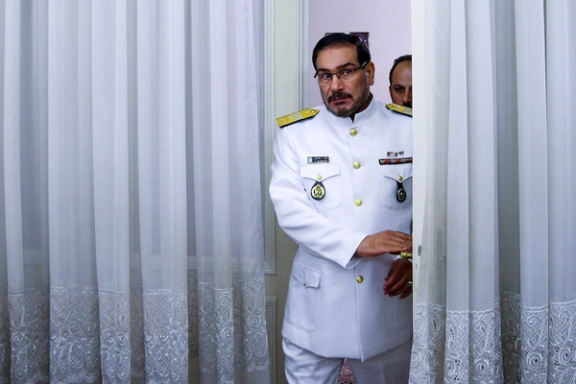
Iran's former defense minister and former national security chief Ali Shamkhani
Nearly two years after stepping down as the Secretary of Iran’s Supreme National Security Council (SNSC), Ali Shamkhani appears determined to maintain influence over Tehran’s evolving nuclear diplomacy.
The showy kingpin's sensitive interventions into the negotiations, through social media statements in his own name and high stakes leaks by his multi-lingual media outlet, signal he is determined to remain at the heart of diplomacy.
Though no longer officially at the helm of Iran's top security apparatus, Shamkhani retains considerable sway as a political adviser to Supreme Leader Ayatollah Ali Khamenei and a member of the Expediency Discernment Council.
His tenure as security chief ended in May 2023, but Nour News - the multilingual media outlet he founded in 2020 - ensured his public profile would continue to loom large.
Shamkhani and Tehran-Washington talks
Shamkhani’s comments are frequently picked up by Iranian and foreign media outlets, turning his posts into unofficial barometers of Tehran’s policy direction.
A prolific user of the social media platform X, Shamkhani regularly posts in a range of languages—Persian, English, Hebrew, Russian, and Chinese—indicating his wish to be recognized by international audience as an insider with close knowledge of the talks.
Ahead of the first round of indirect Tehran-Washington negotiations in Muscat last month, Shamkhani made headlines by declaring that Iran’s Foreign Minister Abbas Araghchi would attend the talks “with full authority.”
The phrasing, widely interpreted as confirmation that Araghchi was carrying a full mandate from Supreme Leader Khamenei himself, was seen as a rare public affirmation of Iran’s seriousness about reaching an agreement.
More recently, Shamkhani said that both the US intelligence community and the International Atomic Energy Agency (IAEA) had come to accept that Iran does not possess nuclear weapons.
“Both are determined to continue on the right path of talks,” he wrote in several languages, adding, “Sanction removal and recognition of Iran’s right to industrial enrichment can guarantee a deal.”
The tone of Shamkhani’s post suggested a softening of stance and marked a contrast between his earlier, more hardline tone and this new language suggesting diplomatic flexibility.
Shamkhani was among the officials who strongly supported a law that the Parliament passed in December 2020 against the wishes of then-president Hassan Rouhani--- named the Strategic Action Plan to Lift Sanctions and Protect the Nation's Interests.
The legislation required Iran’s Atomic Energy Organization to enrich uranium to 20 percent purity—well above the 3.67 percent limit set by the 2015 Joint Comprehensive Plan of Action (JCPOA)—and to install advanced centrifuges.
Nour News
Much of Shamkhani’s media influence flows through Nour News, a news outlet linked closely to his political network. Launched in Persian in early 2020 and later expanded into English, Arabic and Hebrew, Nour News plays an outsized role in shaping news on Iran’s nuclear talks.
The site frequently publishes exclusive reports on nuclear talks and other matters, often citing anonymous “informed sources.” These reports are widely shared by both domestic and international media, reinforcing the outlet’s reputation as a semi-official voice.
But the interventions have been less welcome at home.
Nour News cited an anonymous source saying the fourth round of talks would focus on “humanitarian and security concerns," without elaborating, suggesting discussions had expanded beyond the nuclear dossier—a detail never disclosed by negotiators.
“Agencies and esteemed officials who receive classified reports must protect them. Leaking information to favored outlets undermines national interests,” retorted Mohammad Hossein Ranjbaran, an adviser to Iran’s foreign minister Abbas Araghchi.
“There’s a difference between building media credibility and childish competition for scoops."
Skeletons in the closet
Shamkhani’s interventions could be aimed at repairing his stature after espionage and corruption controversies dented his reputation.
His departure from the SNSC in May 2023 came amid the fallout from one of the most sensitive espionage cases in the Islamic Republic’s recent history.
Akbari had long been known as a close associate and adviser to Shamkhani, raising questions about internal security breaches at the highest levels of the Iranian state.
Though authorities never directly linked Shamkhani to Akbari’s alleged espionage, the execution cast a pall over his continued leadership of the SNSC.
Shamkhani has also faced persistent allegations of corruption, particularly concerning his family's business dealings. These ventures have been linked to circumventing US sanctions by facilitating oil exports through so-called ghost fleets.
The initial consensus in Iran in support of nuclear talks with the United States is beginning to show signs of strain, as some hardliners express unease over what they see as a hardening tone from Washington.
Some warn that President Donald Trump is unpredictable and may change course at any moment; others go further, calling the talks a trap. There are even accusations of insider sabotage, with fingers pointed at those said to benefit from continued sanctions.
What are the doubters saying?
“The US government will block the lifting of sanctions on Iran’s oil sales and international banking,” vocal conservative analyst Foad Izadi asserted in an interview with the Didban Iran news outlet on Thursday.
Even if a deal is signed, Izadi warned, meaningful sanctions relief is unlikely because an entrenched hawkish faction in Washington is at work to undermine any agreement.
Recent comments by President Trump and his team—along with interventions from the likes of Senator Ted Cruz and Representative Mike Lawler—appear to have deepened concerns in Tehran, pushing hardliners like Izadi to break their begrudging silence.
“The Americans may attack Iran even in the middle of talks or afterward if they believe the costs of doing so are minimal. They did the same to Libya,” the US-educated pundit added.
What's the connection to Libya?
Slain Libyan leader Muammar Gaddafi gave up the North African nation’s nuclear and missile program in 2003 to improve ties with the West.
But in Tehran’s view he was betrayed once popular protests broke out in 2010, morphing into an armed revolution backed by NATO air strikes culminating in Gadaffi's grisly killing by rebels.
“Some Iranian politicians believe that if we abandon our nuclear and missile development programs, the US will treat us as favorably as it treats Saudi Arabia,” former MP Elias Naderan told Khabar Online on Thursday.
“But in reality, they will treat us just as they treated Syria and Libya.”
As long as the Islamic Republic is in conflict with Israel, there will be no rapprochement with the United States, Naderan asserted.
His comments signal a return to older hardline rhetoric that equates disarmament with vulnerability in the face of unwavering hostility from the US, hastening the downfall of the theocracy.
Who is being accused of sabotage?
Some moderate and centrist are accusing former security chief Ali Shamkhani of leaking confidential details about the ongoing talks.
The accusations have found more relevance because Shamkhani’s son is allegedly involved in exports of Iranian oil and his business could suffer, according to his critics, if sanctions are lifted.
Earlier this week, a website with links to Shamkhani published a report with some details from the ongoing talks between Tehran and Washington—including a claim that the US government had accepted that Iran does not possess nuclear weapons.
“Shamkhani’s disclosure … has fueled pressure from US neoconservatives on Trump and his Middle East envoy Steve Witkoff, thereby jeopardizing the negotiations,” centrist outlet Entekhab wrote in an editorial.
What do the critiques mean?
While Tehran continues its cautious diplomatic engagement with Washington, these public statements reflect a fractured elite struggling to agree on whether diplomacy is a shield or a trap.
The resurfacing of Libya parallels, warnings about war, and accusations of sabotage all point to a deeper anxiety about the outcome of the talks—and the fate of the Islamic Republic.
The mere possibility that US President Donald Trump may rename the Persian Gulf the Arabian Gulf has outraged both supporters and opponents of the Islamic Republic.
Trump, speaking on Wednesday, said he had yet to decide on the matter and would announce his position during an upcoming trip to the Middle East. “I don’t want to hurt anybody’s feelings,” he added.
Reports—first published by the Associated Press—about potential plans to officially adopt the name "Arabian Gulf" in official US parlance have drawn sharp criticism from Iranian officials and also sparked widespread backlash across social media.
Reactions have cut across political lines, uniting unlikely voices in outrage. Iranians across the political spectrum, from Islamic Republic apparatchiks to the US-based exiled prince viewed any such move as an affront to their historical and national identity.
Common cause
Describing the Persian Gulf as “the strongest factor in uniting the Iranian people” in a post on X, reformist former vice president Mohammad-Ali Abtahi warned about a negative impact of renaming on Tehran-Washington nuclear talks.
Even those who support negotiations with the US, Abtahi said, would be forced to stand in opposition.
Veteran diaspora opposition figure Mohsen Sazegara told Iran International TV that the move could be a boon to a hard Iranian line in talks.
"Trump would provide Khamenei with a great opportunity to use Iranians’ sense of nationalism to his own benefit," he said. "(It's) the best lever Khamenei has to back out of the negotiations."
Exiled crown prince Reza Pahlavi also said in a statement: “The reported decision by President Trump to abrogate history, should it be true, is an affront to the people of Iran and our great civilization."
“But, once again, the true culprit of this shameful act is Ali Khamenei and his anti-Iranian regime who have so weakened our nation that foreign powers dare make such transgressions against Iran’s national identity and world history."
The exiled opposition group Mujahedin-e Khalq also issued a statement warning that any effort to change the name of the Persian Gulf would only benefit Khamenei, giving him an opportunity to deflect from domestic dissent and redirect public anger toward a foreign enemy.
Some analysts suggest the controversy may be part of a deliberate psychological tactic to destabilize Iran’s negotiating position.
Shahram Kholdi, a Canada-based Iran analyst, pointed to Trump’s close ties with Arab states and argued the maneuver could be strategic. “Trump uses every tactic to psychologically confuse the other side and gain points,” he told Iran International TV.
Pressure to exit talks
Iran’s ultra-hardliners, who had tempered their opposition to US negotiations after Khamenei’s tacit endorsement, are now urging the government to withdraw from the talks.
Naser Mesdaghi, a journalist, urged President Masoud Pezeshkian to immediately walk away from the talks if the US deviates from historical nomenclature.
“All Iranians support this decision and will endure the hardship of sanctions and war for the sake of Iran’s integrity,” he said in a post on X.
Tehran-based commentator Ali Nasri went further, framing the issue as part of a broader disinformation campaign. “This ridiculous rumor … is the next stage of psychological warfare,” he posted on X.
"Having failed to stop the negotiations, the Israel lobby and its affiliated diaspora opposition are now trying to poison and anger public opinion at every stage.”
Nuclear talks between Iran and the United States are faltering over whether Iran will be permitted to enrich Uranium and fluctuating US demands, two diplomatic sources in Tehran told Iran International.
Despite Tehran agreeing to expanded inspections by the International Atomic Energy Agency (IAEA), the dispute over enrichment has cast doubt over the timing and direction of the next round of negotiations, originally scheduled to resume this week after being delayed in Oman.
“Iran has accepted strict and intensive inspections by IAEA inspectors, and the two sides have reached an understanding on verification and control mechanisms,” an Iranian diplomatic source familiar with the talks said on condition of anonymity.
“The key disagreement is over Iran’s right to enrich uranium domestically—something the American side opposes,” the source said, adding that the US team's shifting goals were complicating the negotiations.
“In every round, the Americans bring up new topics—missiles, proxies—without a consistent framework.”
A second diplomatic source confirmed that Iran had agreed to restrain its regional allies, including by asking the Houthis to temporarily halt attacks, partly to deny Israel what he called a "pretext" to obstruct diplomacy.
US officials contacted by Iran International declined to comment on the specifics of the talks but acknowledged the urgency and fragility of the moment.
“Time is short and we need to make progress quickly. To make that happen, the Iranians need to negotiate in good faith and sincerely desire to reach a deal,” a State Department spokesperson told Iran International.
Internal Divisions in Tehran
Meanwhile Iran too has fissures of its own on the talks dossier, with hardliners continuing to criticize the talks but negotiators still appearing determined to clinch a fair deal to avoid war.
“There’s a difference between building media credibility and childish competition for scoops,” Mohammad Hossein Ranjbaran, an adviser to Iran’s foreign minister Abbas Araghchi, posted on X on Tuesday.
“Agencies and esteemed officials who receive classified reports must protect them. Leaking information to favored outlets undermines national interests,” he added, in an apparent reference to a report published the day before by Nour News, a site close to Supreme Leader Ali Khamenei’s adviser Ali Shamkhani.
The outlet cited an anonymous source saying the fourth round of talks would focus on “humanitarian and security concerns," without elaborating, suggesting that the negotiations had expanded beyond the nuclear dossier—something never mentioned by officials involved in the talks.
A diplomatic source told Iran International that unauthorized disclosures could undermine the Iranian negotiating team.
The United States on Tuesday imposed fresh sanctions on another Chinese refinery and multiple logistics firms for facilitating the sale and shipment of Iranian oil, expanding its efforts to squeeze Tehran’s revenues.
The measure targets Hebei Xinhai Chemical Group Co., an independent refinery Washington asserts has received hundreds of millions of dollars’ worth of Iranian crude, some linked to the Islamic Revolutionary Guard Corps (IRGC).
Three Chinese port operators in Shandong province were also sanctioned for managing terminals that received sanctioned shipments from Iran’s shadow fleet, vessels used to hide the origin of shipments.
“The United States remains resolved to intensify pressure on all elements of Iran’s oil supply chain to prevent the regime from generating revenue to further its destabilizing agenda,” treasury secretary Scott Bessent said in a statement released on the website of the treasury's Office of Foreign Assets Control (OFAC).
Seven vessels and the companies that own them were also sanctioned, according to OFAC citing their role in transferring Iranian petroleum to China. Among those were tankers flagged in Panama and Hong Kong.
Two Indian ship captains were also designated for years-long involvement in steering sanctioned tankers carrying Iranian oil, the US treasury said.
The sanctions fall under executive orders by US president Donald Trump as part of his so-called maximum pressure campaign on Iran alongside the ongoing diplomatic push to resolve the standoff with Tehran over its nuclear program.
"We're trying to work on Iran to get that solved without having to get into any bombing," Trump said in his latest statement on Iran on Thursday.
"As we say, big bombing. I don't want to do that. I want them to be very successful," he added.
Iran’s capital is grappling with renewed electricity outages but growing evidence suggests the burden of power cuts is falling unevenly across the city, raising concerns over social equity and institutional bias in blackout management.
According to reports from Iranian media and residents, working-class neighborhoods in southern and western Tehran are experiencing up to four hours of daily blackouts, while more affluent districts in the north remain largely unaffected.
This disparity, once a topic of speculation among citizens, has now been corroborated by the reformist leaning Ham-Mihan newspaper, and acknowledged in comments by both energy officials and lawmakers.
A recent field investigation by Ham-Mihan found that nearly 75% of documented blackouts in Tehran province during the first two months of the Iranian calendar year (started March 20) occurred in lower-income areas. In contrast, power remained uninterrupted in wealthier northern districts, even during periods of peak demand.
While Tehran Electricity Distribution Company had released a blackout schedule for spring, residents across marginalized neighborhoods say cuts have been occurring unpredictably and far more frequently than indicated.
“We have power outages twice a day — sometimes lasting up to two hours each,” a resident of Islamshahr, a southern suburb, wrote online. Meanwhile, a resident in District 2, in northern Tehran, reported no outages since the start of the blackout cycle.
The discrepancies have sparked a wave of criticism on social media and from public figures.
Hossein Selahvarzi, a prominent economist and former head of Iran’s Chamber of Commerce, wrote: “If it is true that outages in the south of Tehran are more frequent than in the north, then our problem is not only energy imbalance — it is also a failure of social justice.”
In comments to Ham-Mihan, a senior official from Tehran’s regional power grid admitted the blackout pattern is not accidental. “To maintain network stability, we concentrate outages in outlying districts,” the unnamed source said.
“Blackouts in central or northern Tehran have political and media consequences that we try to avoid.”
The issue of unequal energy access is not confined to Tehran.
Hussein Haghverdi, a member of parliament representing the towns of Malard, Shahriar, and Qods in Tehran province, has publicly accused the Ministry of Energy of discriminatory energy allocation.
In a letter to Energy Minister Abbas Aliabadi, Haghverdi said that while the capital’s industrial zones faced a 50-megawatt blackout quota, neighboring residential and industrial towns were subjected to four times that amount.
“This vast disparity is unacceptable and has caused widespread dissatisfaction,” he wrote.
With temperatures rising and demand for cooling surging — particularly through water-intensive swamp coolers — Tehran’s daily water usage has already exceeded 3.1 million cubic meters.
Iran’s hydroelectric capacity — once a key component of the energy mix — has been severely curtailed by a historic drought.
Officials have warned that continued overconsumption could lead to even harsher cuts, with punitive 12-hour blackouts possible for chronic overusers.
But critics argue that the current approach to energy rationing lacks transparency and reinforces systemic inequalities.
“You can’t ask citizens to sacrifice while shielding elite districts from the consequences,” said an environmental policy expert in Tehran who requested anonymity. “This is not just a technical failure — it’s a governance issue.”
With no immediate relief in sight, the government is under mounting pressure to ensure that conservation efforts — and their consequences — are distributed fairly.
As one Ham-Mihan editorial put it: “The blackout map is becoming a social map — and it is illuminating more than just who has electricity.”