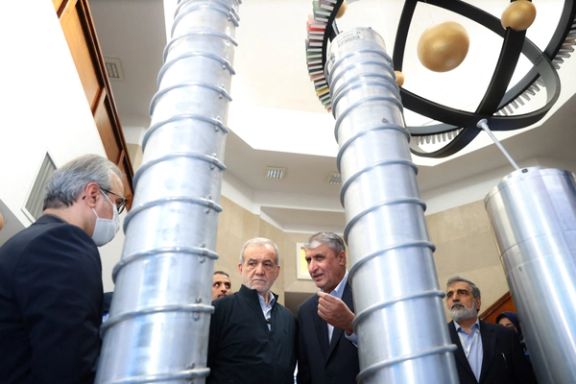
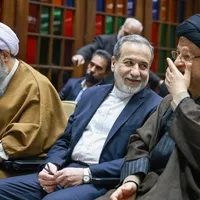
Iran's president Masoud Pezeshkian visiting nuclear facilities alongside nuclear chief Mohammad Eslami
Iranian commentators are floating a long-standing proposal to break the impasse in its nuclear negotiations with Washington: the formation of a regional nuclear consortium involving Iran, Arab states and the United States.
If Tehran has indeed introduced this idea in the fourth round of talks, it may represent new flexibility on the sticky point of enrichment and explain the positive assessment of both Iranian and American officials on the latest round of talks.
A commentary in the conservative Khorasan daily on Mondaysaid the idea of creating a consortium may have been among what Omani Foreign Minister Badr al-Busaidi referred to as “useful and original ideas reflecting a shared wish to reach an honorable agreement” after the completion of the fourth round of talks on Sunday.
Some signals suggest this idea may have been quietly floated in diplomatic channels: ahead of the Muscat talks on April 11, Iran’s Foreign Minister Abbas Araghchi visited Riyadh and Doha, followed by a trip to the UAE after the talks.
The idea was originally proposed by former Iranian nuclear negotiator Seyed Hossein Mousavian and Princeton physicist Frank von Hippel long before the current Tehran-Washington talks in an October 2023 article in the Bulletin of the Atomic Scientists.
Such a body consisting of Iran, Saudi Arabia,and other interested Middle Eastern countries would oversee enrichment under international safeguards and ensure that the enriched uranium it produced would be used only for peaceful purposes, they argued.
On the eve of the April 11 nuclear talks in Muscat, Mousavian addressed the risk of failure if the US refused to acknowledge Iran’s rights under the Nuclear Non-Proliferation Treaty (NPT).
“Steve Witkoff recently made an unreasonable statement, saying that Iran cannot benefit from the right to peaceful uranium enrichment technology. This stance is a clear violation of the NPT treaty. If this is the final US position, tomorrow's negotiations... will end in failure,” he warned.
In the same post, Mousavian again floated the consortium idea: “The solution is ... the establishment of a joint nuclear consortium among the Persian Gulf countries.” He argued this would resolve the US’s contradictory stance of supporting enrichment in Saudi Arabia while denying the same to Iran.
He also hinted at a broader vision: an Iran-US economic agreement worth up to $1 trillion, involving American investment in Iran’s nuclear, fossil, and renewable energy sectors. Such a deal, he suggested, could help “open the deadlock in US–Iran relations.”
Some commentators have described the idea as a possibility for a breakthrough.
“Araqhchi's visit to Saudi Arabia and the UAE is probably not unrelated to the proposal to create a joint regional enrichment consortium,” Rahman Ghahremanpour, a commentator and analyst of Middle East politics in Tehran, posted on X.
“Iran is trying to break the deadlock on zero enrichment, and if the countries in the region agree to this proposal, perhaps the Trump administration will change its position. This is an important confidence-building measure in arms control,” he added.
Abdolreza Davari, a conservative politician who supports Pezeshkian, also supported the idea in a post on X on May 10. This, he said, would be “similar to the model implemented in Europe that supplies fuel even to the United States.”
“This consortium could be the center of regional cooperation in the areas of nuclear technology exchange, safety, environment, production of fresh water and radiopharmaceuticals, and also include a regional non-proliferation regime," Reza Nasri, another commentator in Tehran, wrote on X before Araghchi’s visit to Riyadh.
Hossein Aghaei, a Turkey-based senior security and geopolitics analyst, referred to Saudi Arabia’s wish to create a consortium in collaboration with the US and possibly Russia in a post on X on May 8. He said Iran could be a participant in the consortium to ensure it will not be able to build nukes.
However, he warned that Israel’s vision is completely different. “In the nuclear matter, Israel may not even trust Saudi Arabia, let alone the Islamic Republic.”
Commentator in Tehran are warning that Iran’s economy has become to dependent on news from Washington, with markets reacting sharply even to personnel changes in the US president’s inner circle.
Iran's official strategy to jumpstart a sputtering economy must look beyond talks with Washington and address root problems, several analysts and editorials have said.
“The reality is that our economy reacts intensely to political developments,” former central bank deputy Kamal Seyyed-Ali told reporters in Tehran. “If the possibility of a full-scale war rises again, the dollar rate will once again break records.”
Seyyed-Ali, a senior economist, pointed to a March spike in the dollar-to-rial exchange rate—reaching 1.05 million—after Donald Trump warned of possible military action if Tehran refused to negotiate.
The rate dropped when talks began in Oman, then crept back up when negotiations stalled. This increasing sensitivity, he said, underscores how economic expectations in Iran have become “tethered to political headlines.”
Policymakers and markets alike, he added, are behaving as if diplomacy with Washington will dictate the fate of the economy.
The hardline daily Kayhan recently questioned the government’s economic strategy, asking in a published commentary: “What is the government doing besides negotiating with the United States?”
The paper argued that diplomacy should be a tool to improve economic performance, not a substitute for internal reform.
Inflated hopes for a post-deal recovery have masked structural failings—among them, a banking system in crisis, outdated industry, underinvestment in agriculture, and widespread dysfunction in pensions and public services.
Repeated blackouts caused by power shortages have disrupted everything from water distribution to digital connectivity, triggering price hikes in housing, transport, and healthcare.
Energy Minister Abbas Aliabadi admitted in April that Iran’s power plants can generate only 65,000 megawatts against annual demand of more than 85,000. A vicious cycle compounds the problem: water shortages disable power plants, while power cuts prevent water distribution.
Citizens have voiced growing anger through Persian-language media abroad. Callers to Iran International describe how outages in major cities now affect phone signals, Internet access, and even access to clean water.
The latest round of US sanctions targets the petrochemical sector—already plagued by multi-billion-dollar corruption scandals. While the judiciary has acknowledged these cases, many remain suppressed or unresolved, a fact critics say reflects both impunity and systemic failure.
Despite poor growth and repeated economic shocks—Iran’s industrial output contracted 1.6% in January—officials continue to blame sanctions alone. Few in power acknowledge the depth of mismanagement. Instead, each government accuses its predecessor, avoiding accountability as public frustration mounts.
Even if sanctions are eased, economists say, Iran’s crisis will not be resolved by diplomacy alone. Without tackling the roots—corruption, dysfunction, and decay—any recovery will be fragile, temporary, and externally dependent.
Iran warned that nuclear talks with the United States could collapse if Washington insists on what Tehran called “excessive demands,” as negotiators from both sides gathered in Oman for a fourth round of indirect discussions.
The talks, facilitated by Omani officials and held behind closed doors in Muscat, come amid escalating rhetoric from both capitals and ahead of a high-stakes Middle East trip by US President Donald Trump.
Before departing for Muscat, Iranian Foreign Minister Abbas Araghchi said Tehran had submitted a proposal intended to reassure the international community of the peaceful nature of its nuclear activities. He warned, however, that the talks would fail if the United States continues to push beyond nuclear weapon-related commitments.
“If demands exceed assurances against nuclear weapons, the talks could stall,” Araghchi told reporters in Tehran. “We hope the other side comes with a clear negotiating logic. Talks should remain at the table, not in the press.”
He added, "Iran has well-known positions based on clear principles... We hope to reach a decisive stance in Sunday's meeting.”
Araghchi also accused the United States of adopting contradictory positions. “There are actors pushing for conflict—we understand this, but it is their problem,” he said. “If there are concerns, we are ready to build trust.”
The latest discussions follow weeks of diplomatic shuttle visits and were initially scheduled to take place in Rome on May 3 but were postponed for logistical reasons.
Iran has emphasized that its delegation is operating “in accordance with directives and frameworks issued by the country’s decision-making hierarchy,” according to Foreign Ministry spokesman Esmail Baghaei.
“The team is committed to preserving Iran’s valuable achievements in peaceful nuclear energy while pursuing the removal of unjust economic sanctions,” he said.
Tensions have mounted in recent days following comments by US envoy Steven Witkoff, who told Breitbart News last week that Washington's red line remains “no enrichment,” effectively calling for the dismantling of Iran’s nuclear infrastructure in Natanz, Fordow, and Isfahan.
Iranian state media and outlets affiliated with the Islamic Revolutionary Guard Corps (IRGC) reacted sharply to Witkoff’s remarks. The hardline Javan newspaper dismissed them as coercive, saying: “This is no longer called negotiation, it’s a stick.”
A member of Iran’s negotiating team told Lebanon’s Al Mayadeen network that Tehran would walk away if the US deviates from previously agreed frameworks.
A separate source quoted by Iraq’s Baghdad Al-Youm said the talks could “fail before they even begin” if Washington refuses to acknowledge Iran’s right to peaceful uranium enrichment.
Iran, which has consistently maintained that its nuclear program is peaceful, says it will not relinquish its enrichment capabilities. “The blood of our nuclear scientists has been shed for enrichment. This right is not negotiable,” Araghchi said before leaving for Muscat on Sunday.
Iran has accelerated its enrichment activities since 2019, exceeding limits set under the 2015 nuclear deal, which the US exited unilaterally in 2018. The UN nuclear watchdog has confirmed Iran’s enrichment of uranium to levels approaching weapons-grade, a move Tehran says is reversible if sanctions are lifted and credible guarantees are provided.
Trump has signaled openness to a diplomatic resolution but also warned of potential military action if diplomacy fails.
Trump is scheduled to visit Saudi Arabia, Qatar, and the United Arab Emirates from May 13 to 16. Analysts say the outcome of the Muscat talks could influence the trajectory of regional diplomacy and the future of Iran-US engagement.
The surprise ceasefire between the United States and Yemen's Houthis this week underscored the unpredictability of diplomacy over Iran's nuclear talks as they head for crunch time over the weekend, experts told the Eye for Iran podcast.
The panel of Middle East specialists said the surprise deal mediated by Oman and announced by President Donald Trump highlights the US leader's maverick stances and Tehran's flexibility as it tries to clinch a deal to avoid war with Washington.
Iranian and US negotiators are due to meet in Muscat for a fourth round of talks on Sunday after Trump's special envoy Steve Witkoff rejected enrichment by Iran and for the first time mooted ending the talks if Tehran does not budge.
"Trump is totally unpredictable. Nobody knows what's going to happen with him the next day. This is something that is coming across all over the region," said Avi Melamed, a former Israeli intelligence official and current Mideast analyst.
Shock ideas like taking ownership of Gaza and the sudden end of American attacks on the Houthis keep friend and foe alike off balance, he added, and provide a moving target that may scramble any independent plans they have of their own.
"I don't know whether to even to call it policy but basically steps or measures that ... because they are so flexible, vague and unpredictable, create a dynamic that in a convoluted way could be sometimes constructively contributing to stability."
At the same time, according to Yemeni-American policy analyst Fatima Abo Alasrar, the Yemen truce likely signaled the influence of their Iranian backers over their armed proxies in the explosive region.
"It's an amazing strategy by Iran regime's officials to throw in something to show good faith and that they're serious, but also it shows power," said Abo Alasrar, a senior policy analyst at the Washington Center for Yemeni Studies.
"When you're able to stop your proxy... it shows how much power Tehran has in the region. This demonstrates to the US president, look at us, we can do this - we can turn this region upside down if we want to."
Wait and See
The truce between the theocratic guerrilla group and the populist president may prove fragile, and any breakdown between Tehran and Washington could inflame it anew.
"They are talking about nuclear agreement and a nuclear deal with Iran and that therefore Iran will make concessions, etc. And the Houthis maybe will be part of it," said Zineb Riboua, a research fellow at the Hudson Institute.
"It's more of a let's wait and see situation, precisely because a lot of these things are unpredictable."
Not just Washington's Houthi enemies but its Israeli allies seem not to be able to discern Trump's next move.
Israel pounded Yemen's main airport and several power plants the morning before Trump's truce announcement, escalating its military campaign just as their American backers ended theirs.
"This does suggest at least a certain amount of friction or a certain amount of uncoordination between the United States and Israel, at least when it comes to the policy towards the Houthis," said Gregory Brew, senior Iran analyst at Eurasia Group.
Iran’s Supreme Leader Ali Khamenei on Saturday endorsed chants of “Death to America” during a speech to workers, just a day before Iranian officials are set to resume nuclear negotiations with the United States.
“Your judgment is right,” Khamenei told the crowd after they chanted the slogan during a speech in Tehran.
“Americans fully support Israel — in the true sense of the word,” he added. “In the world of politics, things may be said that suggest otherwise, but that is not the reality.”
The remarks come as Tehran prepares to begin a fourth round of talks with the US on Sunday. Khamenei used the same platform to frame Israel’s campaign in Gaza as part of a broader Western war effort. “The people of Gaza are not facing Israel alone—they are facing America and Britain,” he said.
Hardline rhetoric extended into Iran’s state-aligned press. Kayhan, a daily overseen by Khamenei’s office, published a full-page commentary portraying Donald Trump as emblematic of US power.
“Trump is not a passing phenomenon,” the paper wrote. “He is a framework based on narcissism, superiority delusions, and threat-based tactics.” The editorial warned against mistaking diplomatic outreach for sincerity, calling American gestures “a tool for deception, not an indication of true boundaries.”
In Washington, Trump’s envoy to the talks set out maximalist conditions for a deal. “An enrichment program can never exist in the state of Iran ever again. That’s our red line,” Steve Witkoff told Breitbart News on Friday. “No enrichment. That means dismantlement.”
Witkoff said Iran’s nuclear sites in Natanz, Fordow, and Isfahan must be completely dismantled, and warned that if Sunday’s discussions are “not productive, then they won’t continue and we’ll have to take a different route.” He added, “They cannot have centrifuges, they cannot have anything that allows them to build a weapon.”
Nearly two years after stepping down as the Secretary of Iran’s Supreme National Security Council (SNSC), Ali Shamkhani appears determined to maintain influence over Tehran’s evolving nuclear diplomacy.
The showy kingpin's sensitive interventions into the negotiations, through social media statements in his own name and high stakes leaks by his multi-lingual media outlet, signal he is determined to remain at the heart of diplomacy.
Though no longer officially at the helm of Iran's top security apparatus, Shamkhani retains considerable sway as a political adviser to Supreme Leader Ayatollah Ali Khamenei and a member of the Expediency Discernment Council.
His tenure as security chief ended in May 2023, but Nour News - the multilingual media outlet he founded in 2020 - ensured his public profile would continue to loom large.
Shamkhani and Tehran-Washington talks
Shamkhani’s comments are frequently picked up by Iranian and foreign media outlets, turning his posts into unofficial barometers of Tehran’s policy direction.
A prolific user of the social media platform X, Shamkhani regularly posts in a range of languages—Persian, English, Hebrew, Russian, and Chinese—indicating his wish to be recognized by international audience as an insider with close knowledge of the talks.
Ahead of the first round of indirect Tehran-Washington negotiations in Muscat last month, Shamkhani made headlines by declaring that Iran’s Foreign Minister Abbas Araghchi would attend the talks “with full authority.”
The phrasing, widely interpreted as confirmation that Araghchi was carrying a full mandate from Supreme Leader Khamenei himself, was seen as a rare public affirmation of Iran’s seriousness about reaching an agreement.
More recently, Shamkhani said that both the US intelligence community and the International Atomic Energy Agency (IAEA) had come to accept that Iran does not possess nuclear weapons.
“Both are determined to continue on the right path of talks,” he wrote in several languages, adding, “Sanction removal and recognition of Iran’s right to industrial enrichment can guarantee a deal.”
The tone of Shamkhani’s post suggested a softening of stance and marked a contrast between his earlier, more hardline tone and this new language suggesting diplomatic flexibility.
Shamkhani was among the officials who strongly supported a law that the Parliament passed in December 2020 against the wishes of then-president Hassan Rouhani--- named the Strategic Action Plan to Lift Sanctions and Protect the Nation's Interests.
The legislation required Iran’s Atomic Energy Organization to enrich uranium to 20 percent purity—well above the 3.67 percent limit set by the 2015 Joint Comprehensive Plan of Action (JCPOA)—and to install advanced centrifuges.
Nour News
Much of Shamkhani’s media influence flows through Nour News, a news outlet linked closely to his political network. Launched in Persian in early 2020 and later expanded into English, Arabic and Hebrew, Nour News plays an outsized role in shaping news on Iran’s nuclear talks.
The site frequently publishes exclusive reports on nuclear talks and other matters, often citing anonymous “informed sources.” These reports are widely shared by both domestic and international media, reinforcing the outlet’s reputation as a semi-official voice.
But the interventions have been less welcome at home.
Nour News cited an anonymous source saying the fourth round of talks would focus on “humanitarian and security concerns," without elaborating, suggesting discussions had expanded beyond the nuclear dossier—a detail never disclosed by negotiators.
“Agencies and esteemed officials who receive classified reports must protect them. Leaking information to favored outlets undermines national interests,” retorted Mohammad Hossein Ranjbaran, an adviser to Iran’s foreign minister Abbas Araghchi.
“There’s a difference between building media credibility and childish competition for scoops."
Skeletons in the closet
Shamkhani’s interventions could be aimed at repairing his stature after espionage and corruption controversies dented his reputation.
His departure from the SNSC in May 2023 came amid the fallout from one of the most sensitive espionage cases in the Islamic Republic’s recent history.
Akbari had long been known as a close associate and adviser to Shamkhani, raising questions about internal security breaches at the highest levels of the Iranian state.
Though authorities never directly linked Shamkhani to Akbari’s alleged espionage, the execution cast a pall over his continued leadership of the SNSC.
Shamkhani has also faced persistent allegations of corruption, particularly concerning his family's business dealings. These ventures have been linked to circumventing US sanctions by facilitating oil exports through so-called ghost fleets.