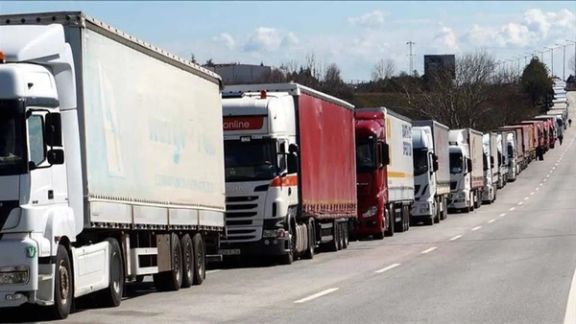
Iran arrests some striking truckers as protest reaches fifth day
Nationwide truckers’ strike in Iran enters fifth day
Authorities have arrested several striking truck drivers in the southern city of Shiraz, according to the provincial prosecutor, as a nationwide truckers’ strike entered its fifth day on Monday.
“Those who have blocked the movement of freight trucks have been identified and arrested under the supervision of security and law enforcement agencies,” Kamran Mirhaji, the prosecutor of Fars province said on Monday.
“Those who obstruct the delivery of goods and cargo by trucks will be dealt with seriously according to the law,” he said, according to Iran's semi-official Mehr news.
Launched on May 22 in the southern port city of Bandar Abbas, the coordinated protest has since spread widely across the country, with truckers pledging to hold out for a full week or longer if their demands remain unmet.
Drivers are demanding better working conditions, higher freight rates, and relief from high insurance costs and fuel restrictions.
The arrests come as videos obtained by Iran International on Monday show the strike entering its fifth day and continuing across multiple regions of the country, including Fars province, where the detentions took place.
A citizen who sent a video to Iran International on Monday described the Shiraz–Marvdasht road in southern Iran as completely deserted, saying, “There is not a single truck in sight.” The road connects Shiraz, a major commercial hub, to Marvdasht in Fars province and is normally a busy route for freight transport.
Other footage shows heavy vehicle drivers refusing to transport goods in cities such as Shahrud in north-central Iran, Torbat-e Jam in the northeast, and Meybod in central Iran.
In a statement on Monday, Reza Akbari, head of Iran’s Road Maintenance and Transportation Organization, downplayed the scope of the strike and blamed the unrest on foreign interference. “A limited number of drivers are trying to create unrest, and these actions are the result of incitement by hostile foreign media that seek to portray the country’s roads as unsafe,” he said.
Akbari said independent Persian-language media based abroad were inflating the scale of the protests and that some domestic outlets were inadvertently amplifying what he described as false narratives. He added that “truck drivers have been very cooperative in efforts to resolve the existing issues.”
Warnings of unrest are growing louder in Iran, with the hardline daily Kayhan the latest to raise the alarm—pointedly avoiding Tehran’s governance failures and instead pinning potential protests on Washington and its alleged scheming.
Warnings of unrest are growing louder in Iran, with the hardline daily Kayhan the latest to raise the alarm—pointedly avoiding Tehran’s governance failures and instead pinning potential protests on Washington and its alleged scheming.
“All evidence suggests that, contrary to its public posture, America is not genuinely focused on Iran’s nuclear issue or enrichment levels,” wrote Kayhan editor Hossein Shariatmadari, who is appointed by Supreme Leader Ali Khamenei.
“From America’s perspective, the final destination of the negotiations is inciting sedition and creating unrest inside the country,” Shariatmadari said, suggesting that Washington aims to drag out the talks until protests erupt.
The tone is notable. While Kayhan routinely blames foreign actors for domestic troubles, its explicit anticipation of unrest places it—at least on the outcome—in rare alignment with more moderate voices warning of a volatile summer.
“Chaos is imminent,” former vice president Eshaq Jahangiri told the reformist daily Arman Melli on Monday, “not just because of sanctions, but because public trust in the state has collapsed.”
Jahangiri blamed successive governments for failing to implement the 20-year development plan launched in 2005 to position Iran as the region’s leading economic and technological power.
“Not a single administration has carried out the vision set in the five-year strategies,” he said. “Iran was once on par with Saudi Arabia and Turkey… now we lag behind them—and behind smaller Persian Gulf states.”
Such warnings have intensified in recent weeks, as Iran’s energy crisis deepens. The country faces a 25-gigawatt electricity shortfall this summer, according to the influential economic daily Donya-ye Eqtesad, which on Monday warned of a looming “socio-economic explosion.”
The paper—typically technocratic in tone—now says the power shortage has escalated from a solvable issue to a full-blown national crisis.
In recent days, poultry farmers, bakers, and produce vendors have voiced their frustration in interviews with foreign-based Persian media. Meanwhile, truck drivers in over a hundred towns and cities continue their strike despite a police crackdown and arrests.
Touching on the broader climate of discontent, Jahangiri warned that the Islamic Republic’s social capital has been steadily eroding for two decades.
“This level of regression will not be easily remedied,” he concluded.
Roozbeh Parsi, head of the Middle East and North Africa Program at the Swedish Institute of International Affairs (UI), has stepped down following the conclusion of an internal investigation into his alleged links to an Iranian influence network.
The investigation found no evidence that Parsi was involved in a state-directed influence campaign orchestrated by the Iranian government. However, it concluded that aspects of his conduct were incompatible with his role at UI, according to a TV4 report.
The inquiry determined that Parsi, an adjunct senior lecturer at Lund University, failed to adequately inform both his university and the UI about his involvement in the Iran-Europe Initiative (IEI), a network linked to the Iranian Foreign Ministry aimed at expanding the country’s influence in the West.
The TV4 report that prompted the investigation cited emails provided by Iran International and followed a 2023 joint exposé by Iran International and Semafor that detailed Tehran’s efforts to cultivate relationships with academics and analysts abroad to expand its influence.
Despite being cleared of formal allegations of collusion with Iran, Parsi received strong criticism for his lack of openness regarding his role in the IEI and contacts with Iranian government representatives, the TV4 report said.
The investigators concluded that this lack of transparency conflicted with the standards expected of a senior official at UI.
UI Director Jakob Hallgren said that the situation had become “untenable” and confirmed that Parsi would leave his post.
“This has been, as I think everyone understands, a very difficult and stressful time for him,” Hallgren said. “We have jointly decided that it is time for a fresh start so that we can focus on the pressing issues concerning the Middle East.”
Hallgren also expressed disappointment over having not been informed that Parsi was involved in running an organization promoting closer ties between Europe and countries like Iran. “As a leader at UI, one is expected to be transparent about such engagements."
UK funding
Parsi has said that he was commissioned and funded by the British Foreign Office during his involvement in the IEI network in 2014–15. However, the investigation found his statement to be “misleading.”
According to the investigation, the IEI network was initially funded through an entity formed by Parsi called the European Iran Research Group (EIRG). “In 2014–15, EIRG received funding for this purpose from the Heinrich Böll Foundation, which is affiliated with the German Green Party,” the investigation said.
The EIRG was later renamed the European Middle East Research Group (EMERG) and received in total around 55,000 pounds from the British Foreign Ministry between 2017 and 2020, the investigation added, noting that the IEI’s contact with the Iranian officials continued in this period.
In a statement on X, Parsi confirmed he is leaving UI, and called the departure "incredibly sad."
"This investigation has been a great personal and professional strain. It was also preceded by a drive with a clearly political character in which influential people with great responsibility for the Swedish debate climate distorted the discussion," he said in his post in Swedish.
In 2023, the joint investigative report by Iran International and Semafor combed through thousands of emails from Iranian diplomats, revealing a network of academics and think tank analysts cultivated by Iran's foreign ministry to extend Tehran's soft power.
Members of the grouping, called the Iran Experts Initiative (IEI), were guided by Iran's Foreign Ministry in their public writing and media appearances. They were key voices in Western think tanks and policy institutions helping promote Iran's stances.
Parsi, listed in the leaked emails as an IEI member, attended its inaugural meeting in May 2014 at Vienna’s Palais Coburg hotel, coinciding with nuclear talks. Documents indicate that Iran’s foreign ministry covered the event’s costs.
Iran remains optimistic about ongoing nuclear negotiations with the United States but continues to reject US demands for halting uranium enrichment, the country's foreign ministry spokesperson said on Monday.
“Enrichment is an inseparable part of Iran’s nuclear industry and must be maintained. We are in no way permitted to show even the slightest flexibility on this issue,” foreign ministry spokesman Esmail Baghaei said Monday speaking at a press conference.
Baghaei denied reports suggesting Iran could freeze enrichment for three years to secure a deal.
“Iran will never accept that,” he said, adding that no date had yet been set for a sixth round of talks with Washington.
Baghaei's remarks come a day come after US President Donald Trump said that “real progress” had been made in recent talks with Iran and suggested there could be “some good news” in the coming days.
“Very importantly, we had some very good talks with Iran yesterday and today, and let's see what happens. But I think we could have some good news on the Iran front. We've had some real progress, serious progress," Trump told reporters in New Jersey before departing for Washington.
Referring to his threats in March that if a deal was not struck within a two-month deadline, there would be "bombing like they have never seen before", Trump said he hopes the diplomatic paths succeed.
"I’d love that to happen because I’d love to see no bombs dropped and a lot of people dead. I really would like to see that happen.”
Baghaei for his part said Iran is awaiting further details from mediator Oman regarding the next meeting. “If there is goodwill from the American side, we are also optimistic, but if talks are aimed at curbing Iran's rights then talks will get nowhere,” he added.
He said that if Washington's aim is simply to ensure Iran’s program remains non-military, that has already been achieved. “But if the goal is to deprive Iran of its rights, we do not believe this process will reach any outcome,” he said.
Enrichment remains a red line for Tehran. Iran is the only non-nuclear weapon state enriching uranium to 60% U-235, a level that causes "serious concern," according to International Atomic Energy Agency (IAEA) Director General Rafael Mariano Grossi.
The IAEA has consistently maintained that there is no credible civilian use for uranium enriched to this level, which is a short technical step from weapons-grade 90% fissile material.
Iran's stockpile of 60% enriched uranium had increased to 275 kg, enough to theoretically make about half a dozen weapons if Iran further enriches the uranium.
Drivers in at least 105 cities across Iran took part in the fourth consecutive day of a nationwide strike demanding better working conditions, the Union of Truckers and Drivers’ Associations said in a statement on Sunday.
“Today marked the fourth day of a strike that, with your dignity and perseverance, has become a historic moment for the transport sector,” the union said. “Drivers in 105 cities across Iran responded to this call for justice, showing that the voice of the driver can no longer be silenced.”
Launched on May 22 in the southern port city of Bandar Abbas, the coordinated protest has since spread widely across the country, with truckers pledging to hold out for a full week or longer if their demands remain unmet.
Drivers are demanding better working conditions, higher freight rates, and relief from high insurance costs and fuel restrictions.
Footage received by Iran International on Sunday showed strikes continuing in cities across the provinces of South Khorasan, Ardabil, Bushehr, Sistan and Baluchestan, Gilan, Fars, Isfahan, Qazvin, West Azarbaijan, Yazd, and Razavi Khorasan.
Videos show parked freight trucks, drivers refusing cargo, and protest actions such as horn-blaring. The strike has disrupted traffic on key highways and industrial zones.
A nationwide truck drivers’ strike in Iran entered its fourth day on Sunday, with protests spreading to dozens of cities and major highways despite a police crackdown and arrests.
The Union of Iranian Truckers and Heavy Vehicle Drivers said in a statement on Sunday that police used pepper spray on protesting drivers and arrested several of them.
Launched on May 22 in the southern port city of Bandar Abbas, the coordinated protest has since spread widely across the country, with truckers pledging to hold out for a full week or longer if their demands remain unmet.
Drivers are demanding better working conditions, higher freight rates, and relief from high insurance costs and fuel restrictions.
On Sunday, drivers in the southeastern cities of Jiroft and Sirjan, the western cities of Shabab in Ilam province and Asadabad in Hamadan province, and several locations in Tehran province, including Pakdasht, joined the strike.
Videos show parked freight trucks, drivers refusing cargo, and protest actions such as horn-blaring. The strike has disrupted traffic on key highways and industrial zones.
Footage received by Iran International on Sunday showed strikes continuing in cities across the provinces of South Khorasan, Ardabil, Bushehr, Sistan and Baluchestan, Gilan, Fars, Isfahan, Qazvin, West Azarbaijan, Yazd, and Razavi Khorasan.
Government response
Despite state media efforts to portray freight operations as normal, the scale of the strike has prompted responses from senior officials.
Parliament speaker Mohammad Bagher Ghalibaf on Sunday called truckers a “key link in the production and supply chain” and urged the government to act quickly. He cited high costs of vehicles and spare parts, insurance burdens, and unfair freight distribution.
Mehdi Khezri, deputy head of the Road Maintenance and Transportation Organization, said base fuel quotas would remain unchanged and that the issue was under review.
He added that meetings were being held with the Social Security Organization and the interior ministry, and that a cabinet-level proposal to reduce insurance costs was under discussion.
Khezri acknowledged that a 45% rise in insurance premiums earlier this year had triggered discontent.
Mohammad Mohammadi, deputy head of the Social Security Organization, said the government continues to pay 50% of the 27% insurance contribution for truckers and that this had not changed.
The IRGC-affiliated Fars News Agency called reports of steep insurance hikes “rumors.”
Previous truckers' strikes
Iran’s truck drivers have staged several large-scale strikes in the past.
In 2018, drivers across dozens of cities stopped work for several weeks over low freight rates, high insurance costs, and access to parts, leading to arrests and government warnings.
In 2022, truckers again walked off the job in solidarity with nationwide protests following the death of Mahsa Amini, who died in police custody over an alleged hijab violation.