Iran unleashes hundreds of missiles on Israel, killing one
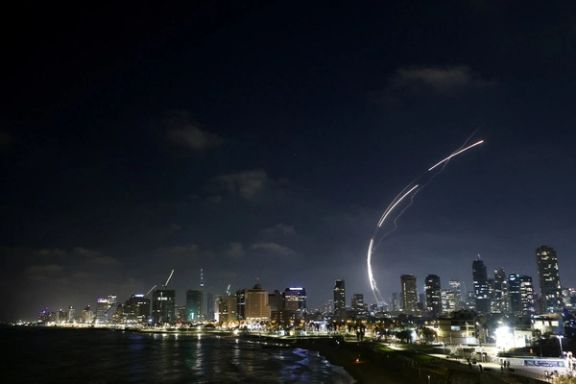
issiles launched from Iran are intercepted as seen from Tel Aviv, Israel, June 13.
Iran launched over 200 missiles at Israel killing one and injuring at least 60 people after Israeli attacks killed its top military leadership and pounded armed forces and nuclear sites leaving scores of Iranians dead.
A first wave of Iranian attacks comprised around 200 missiles, a source close to the Israeli government told Iran International, adding that fewer than 10 landed. Two more waves followed, residents and Israeli media reported.
Fourteen people were injured in a strike on a Tel Aviv building near the defense ministry, paramedics and Israeli media reported.
Several others were injured in other parts of Tel Aviv including a woman who succumbed to her injuries.
A source close to the Israeli government told Iran International that the "massive" hit to the building and the killing of and injuries to civilians meant the Jewish State would now consider targeting Iran's oil and gas infrastructure in retaliation, a potentially major escalation.
Israel's military urged residents to take shelter and said missile defense interceptions were ongoing.
Waves of Israeli airstrikes had hit nuclear facilities, military bases and the private homes of senior leaders all over Iran in an unprecedented attack by Israel against its Mideast arch-nemesis.
The strikes killed Hossein Salami, the head of Iran's Islamic Revolutionary Guard Corps, armed forces chief of staff Mohammed Bagheri, air force commander Amir Ali Hajizadeh, and several top nuclear scientists.
79 people were killed and hundreds wounded in Tehran alone, according to local health authorities, as a nationwide casualty count was yet to emerge.
US President Donald Trump on Friday lauded Israel's broad surprise attack against Iran which assassinated Tehran's top commanders, urging the Islamic Republic to sign a nuclear deal or face more punishment.
“They missed the opportunity to make a deal. Now, they may have another opportunity. We’ll see," US President Trump told NBC news in an interview on Friday.
Trump added added that Iranian officials were reaching out to the United States. "They're calling me to speak."
Supreme Leader Ali Khamenei survived and vowed to punish Israel for the attack.
Israeli forces say they intercepted incoming Iranian drones over neighboring Syria and Jordan on Friday and the Israeli military's head of operations Major General Oded Basiuk on Friday urged readiness because "the enemy’s response will come".
New Revolutionary Guards commander Mohammad Pakpour said Iran would respond to Israel's attacks and Tehran would open "the gates of hell", while Iran summoned the Swiss ambassador who represents US interests in Tehran and warned Washington against blocking Iranian counterattack.
An Israeli official told Iran International that Israel carried out a complex and multi-phase operation that disabled the launch of hundreds of Iranian ground-to-ground missiles aimed at Israeli territory.
"Painful fate"
Khamenei vowed retaliation, saying in statement, ""By God’s will, the powerful arm of the Islamic Republic’s armed forces will not let it go unpunished."
"With this crime, the Zionist regime has prepared a bitter and painful fate for itself—and it will undoubtedly face it."
A senior Israeli official told Iran International that leaders' homes and not civilians were targeted in the strikes in Tehran.
Iran's Natanz and Fordow nuclear sites were hit but only sustained superficial damage, a spokesperson for Iran’s Atomic Energy Organization said.
"Unilateral action"
Further Iranian retaliation could swiftly follow after it launched two direct missile attacks on Israel last year, and Washington began drawing down personnel in the region on Wednesday as tensions flared.
Iran's Persian Gulf neighbors Saudi Arabia, the United Arab Emirates and Qatar condemned the attack. Arab capitals, while often wary of Tehran, are keen to avoid a regional conflict or Iranian attacks on US bases in their countries.
"Tonight, Israel took unilateral action against Iran," Secretary of State Marco Rubio said in a statement issued by the White House on Thursday. "We are not involved in strikes against Iran and our top priority is protecting American forces in the region,"
"Let me be clear: Iran should not target US interests or personnel."
Israeli Prime Minister Benjamin Netanyahu gave a video address in which he said the operation was an open-ended campaign to remove what he called Iran's threat.
"Moments ago, Israel launched Operation Rising Lion, a targeted military operation to roll back the Iranian threat to Israel's very survival," Israeli Prime Minister Benjamin Netanyahu said in a video address on Friday local time.
"This operation will continue for as many days as it takes to remove this threat for decades, the tyrants of Tehran have brazenly openly called for Israel's destruction. They backed up their genocidal rhetoric with a program to develop nuclear weapons."
Confrontation stepped up
Tehran launched hundreds of missiles at Israel in October last year following Israeli military successes against its armed allies in the region and the assassination of a top Palestinian official on Iranian soil.
Israel retaliated with nationwide air strikes which hit Iranian air defenses but the confrontation quickly ended.
Iran and Israel are bitter foes whose decades of shadow conflict burst into the open last year after the October 7, 2023 attack on Israel by Iran-backed Hamas militants plunged the region into renewed conflict.
A senior Israeli official has warned that Israel is ready to launch a military strike on Iran if the next round of nuclear talks between Tehran and Washington, set for Sunday in Oman, fail to yield results.
The official, speaking to Iran International, said Israel is closely monitoring developments and could act unilaterally if necessary.
“The United States would require approximately three days to evacuate non-essential diplomatic personnel and their families from the region,” the source said. “That evacuation process reportedly began on Wednesday and is expected to be completed by Sunday, aligning with the timeline for the talks.”
According to multiple sources, the United States has already begun evacuating non-essential diplomatic personnel and their families from the region.
Israeli media reported Thursday that Strategic Affairs Minister Ron Dermer and Mossad Director David Barnea are set to meet US Special Envoy Steve Witkoff ahead of the talks in Oman.
Witkoff, speaking at an event for the Israeli medical charity United Hatzalah in New York on Wednesday, stressed that Iran must be permanently denied the ability to develop nuclear or missile capabilities.
“We must stand resolute and united against this danger and ensure that Iran never obtains the means to achieve its deadly ambitions no matter what the cost,” he said.
A senior Iranian official told Reuters that a regional ally had informed Tehran of the potential for an Israeli strike. "The tensions are intended to influence Tehran to change its position about its nuclear rights," the official said, but emphasized that Iran would not compromise on its right to uranium enrichment.
US President Donald Trump said Wednesday that American personnel were being withdrawn due to increasing threats in what he described as a “dangerous place.” He added that Washington remains committed to preventing Iran from acquiring a nuclear weapon.
Iran's Islamic Revolutionary Guard Corps (IRGC) issued a warning Thursday. “If our hands are untied, we will win victories that will make the enemy regret its actions,” IRGC commander-in-chief Hossein Salami said, signaling Iran’s readiness for any military confrontation.
An IRGC-affiliated outlet, Javan, warned that Tehran was prepared to walk away from negotiations if its national demands were not met, saying that Iran was negotiating “from a position of strength” and possessed sufficient nuclear expertise to act as a deterrent.
The New York Times, citing a senior Iranian official, reported Wednesday that Iranian military and government leaders had already held high-level meetings to discuss their response to any possible Israeli military strike.
Attacking Iran without US help
NBC News reported Thursday that while Israel would prefer to coordinate with the US, including intelligence or logistical support for strikes on Iranian nuclear facilities, it is prepared to act alone.
“While Israel would most likely prefer US military and intelligence support... it showed in October that it can do a lot alone,” the report said.
The same report cited five sources saying that Israel’s considerations of unilateral military action have intensified as the US inches closer to a preliminary deal with Tehran—one that reportedly includes provisions on uranium enrichment that Israel finds unacceptable.
US evacuating Baghdad embassy
Tensions have also led to regional security measures with the US embassy in Baghdad set to be evacuated partially.
Iraq’s state news agency also reported that steps to evacuate US personnel were underway not only in Iraq but across several Middle Eastern countries.
The UK Maritime Trade Operations (UKMTO) issued a security advisory on Wednesday, warning that increased regional tensions could impact maritime safety.
“UKMTO has been made aware of increased tensions within the region which could lead to an escalation of military activity having a direct impact on mariners,” the alert read.
The Washington Post reported Wednesday that the nuclear talks might not proceed as planned, citing two US officials who described the diplomatic environment as rapidly deteriorating.
Iran’s Defense Minister Aziz Nassirzadeh warned on Wednesday that Tehran would target American bases in the region if negotiations collapse and hostilities break out. “If a conflict is imposed on us... all US bases are within our reach and we will boldly target them in host countries,” he said.
Despite the rising tensions, Oman’s Foreign Minister Badr al-Busaidi confirmed Thursday that the sixth round of US-Iran nuclear negotiations will proceed as scheduled on June 15.
The top US military commander in the Middle East told Congress on Tuesday that Iranian weakness offers Washington a historic opportunity to advance its interests but a vulnerable Tehran may seek deterrence in nuclear weapons.
"We can seize the initiative to optimize our posture to defend the Homeland, strengthen our economic outlook, take back our right to freedom of navigation, and sustain the upper hand against an increasingly desperate Iran," US Central Command (CENTCOM) chief Army General Michael Kurilla said.
"Iranian leadership understands their acute vulnerability, and the precision of Israel’s response demonstrates that Iran will remain critically exposed to future Israeli operations, even if their former defenses are reconstituted," Kurilla said in a statement to the US House Armed Services Committee.
Israel launched air strikes on Iran in October in response to a missile attack on its soil, in an operation it said knocked out Iranian air defenses and missile production capacity.
"Significantly weakened, Iran finds itself with fewer options," Kurilla added. "In addition to an active chemical weapons program, there is one remaining pillar the Regime may consider its best chance at restoring deterrence and imposing its will on the Region – the threat of developing a nuclear weapon."
The US intelligence community assesses that Iran is not building a nuclear weapon nor has such a move been authorized by its Supreme Leader yet but that a taboo on discussing the bomb in public discourse was eroding.
Iran's proxies in Middle East
Kurilla said Tehran's attempt to capitalize on the Palestinian armed group Hamas's attack on Israel on Oct. 7, 2023 has largely failed after serial military setbacks.
"After Hamas's attack on Israel, Iran operationalized its entire proxy network and arsenal of standoff capabilities – two pillars of their strategic approach – in pursuit of one goal: to seize a once-in-a-generation opportunity to reshape the region to its advantage."
Iran's losses could be the United States' gain, Kurilla suggested, without mentioning any specific course of action.
"We now have an unprecedented opportunity to advance the vision of a prosperous and integrated Middle East in which US national interests are advanced and Iran’s violent attempts to upend this peaceful order are defeated."
Israeli Defense Minister Israel Katz said if the Iran-aligned Houthis in Yemen continue attacks on the Jewish state, they will respond with a naval and air blockade.
The warning follows overnight strikes on Monday, which for the first time saw Israel's navy target Yemen's Hodeidah Port in retaliation for continued strikes against Israel in the wake of the Gaza war, and a maritime blockade in the Red Sea.
"We warned the Houthi terrorist organization that if they continue to fire at Israel, they will receive a powerful response and enter a naval and air blockade. That's what we did today - and we will continue to do so in the future," Katz said.
According to the Houthi-run Al Masirah TV, Israel targeted the docks of Hodeidah port with two strikes.
Israel's military said: “The port has been struck by the IDF over the past year and continues to be used for terrorist purposes," saying it has been used to transfer weapons for the group, designated as a foreign terrorist organization by countries including the US.
The Houthis have become a serious force in the region. The Council of Foreign Relations says that “Yemen’s Iran-aligned Houthi movement has become one of the Middle East’s most potent non-state actors since Israel’s war against Hamas reignited in 2023”.
The Israeli military told Iran International that over 43 missiles have been launched against the Jewish state since January alone.
Since the outbreak of the Gaza war, Yemen’s Houthis have launched missiles, rockets, and drones toward Israel and enforced a maritime disruption in the Red Sea, in what it describes as support for Palestinians in Gaza. One of the most recent projectiles narrowly missed Israel’s main airport last month.
“Over the past year and a half, the Houthi terrorist regime has been aggressively operating under Iranian direction and funding in order to harm the State of Israel and its allies, undermining regional stability and disrupting global freedom of naval navigation,” the Israeli military said, warning of further strikes to come.
On Tuesday morning, Nasruddin Amer, from the Houthis' media authority, said on X that the latest strikes have "no significant impact on our operations in support of Gaza, nor on preparations for escalation and expansion of operations deep inside the Zionist enemy entity [Israel]".
Israeli security experts have cast doubt on Tehran’s recent claims of obtaining sensitive Israeli intelligence as exaggerated or psychological warfare while Iran’s intelligence minister says the documents will soon be made public.
Iran’s state broadcaster IRIB reported on Saturday that Iranian intelligence services had obtained a large volume of sensitive material from Israel, including documents related to the Jewish state's nuclear and strategic facilities.
Asher Ben-Artzi, a former head of Israel’s Interpol, told Iran International, “I know that the relevant information is well-guarded in Israel and it does not seem to me that hackers can access it."
He warned that the intelligence may not be as significant as claimed. “Iran wants to tell the world that their intelligence personnel are professionals, but they probably think that their use of disinformation will increase their achievements,” he said.
Intelligence analyst Ronen Solomon also said, “We don’t know if it’s something scientific or operational, and it could possibly be something like details of the supply chain. Nobody in Israel has confirmed this officially so it could also be a psychological operation.”
"Iran is attempting to replicate what Israel did to Tehran’s nuclear archives in 2018," he said, referring to the Israeli intelligence operation that allegedly seized Iranian nuclear files from a warehouse in Tehran.
In 2018, Israel said it had stolen Iran's nuclear documents including 55,000 pages and 55,000 digital files from a warehouse in Tehran's Shourabad area through an intelligence operation.
Iran has since been accusing the UN nuclear watchdog of using those documents in its reports about the Islamic Republic's nuclear activities.
Iran says it will release documents soon
Iran’s Intelligence Minister Esmail Khatib said on Sunday that Tehran had obtained “a vast collection of strategic and sensitive documents, including plans and data on the nuclear facilities of the Zionist regime,” referring to Israel. He added that the documents would be published soon.
According to Iran’s state news agency ISNA, Khatib said the material would enhance Iran’s “offensive power” and added that the documents also contained data about the United States, European countries, and others.
“Complete nuclear documents have been obtained and transferred,” he said.
He described the operation as broad, multi-dimensional, and complex, involving infiltration, recruitment, and increased access to Israeli sources.
“The transfer method is just as important as the documents themselves. We ensured the documents reached us securely, and we are protecting the methods as well,” Khatib said, adding that the transfer process itself would remain classified for now.
Iran’s state broadcaster IRIB had earlier reported that the documents were already outside Israeli territory and under review, but provided no evidence.
The reports come as Israeli authorities investigate the arrest of Roy Mizrahi and Almog Atias, two Israelis accused of conducting surveillance for Iran, allegedly in the town of Kfar Ahim, home to Israeli Defense Minister Israel Katz.
Iran’s media linked their arrest to the intelligence haul, saying it happened after the data had been exfiltrated.
Israeli officials have accused the two of cooperating knowingly with Iranian handlers, and that they carried out tasks including the transfer of a suspected explosive device.
A report by Microsoft last year that Israel had surpassed the United States as the primary target of Iranian state-backed cyberattacks following the war in Gaza.
Armed groups linked to Iran may have played a role in rising tensions between Syria and Israel, Reuters reported on Wednesday, after Israel launched airstrikes in response to what it said were two projectiles fired from Syrian territory.
Israel held Syria’s interim president Ahmed al-Sharaa responsible for the reported fire on Tuesday. It was the first Israeli strike in Syria in nearly a month.
The Syrian government said the Israeli attacks caused “heavy human and material losses,” denied posing any threat to regional parties, and stressed the need to dismantle armed groups and restore full state control in the south.
Reuters cited a Syrian official as saying that remnants of Assad-era militias with ties to Iran and operating in the Quneitra area may have an interest in provoking Israeli retaliation as a way to escalate tensions and undermine current stabilization efforts.
Several Arab outlets published a statement from a little-known group named "Martyr Muhammad Deif Brigades," an apparent reference to Hamas' military leader who was killed in an Israeli strike in 2024.
Around the same time that Israel reported the projectiles from Syria, the Israeli military said it intercepted a missile launched from Yemen.
Yemen’s Iran-aligned Houthis said they targeted the Israeli city of Jaffa with a ballistic missile, describing the attack as part of their support for Palestinians during the war in Gaza.