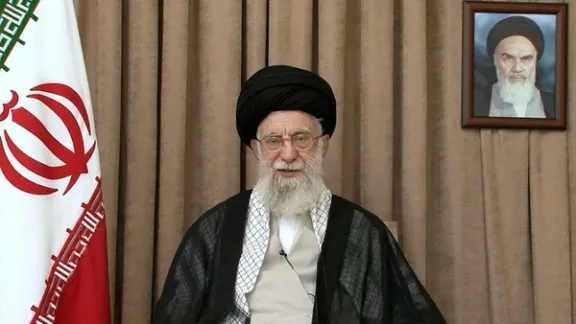
Khamenei claims victory over Israel and US in first public message since ceasefire
Iran’s Supreme Leader Ali Khamenei declared victory over Israel and said the United States was dealt a blow during the conflict, in a televised message aired Thursday—his first public remarks since a ceasefire took effect on Tuesday.
Khamenei said Israel was “crushed” under Iranian strikes and claimed the US failed to achieve its goals after entering the conflict to protect its ally.
“The Zionist regime, with all its noise and claims, was nearly brought to its knees,” he said, adding that the United States “gained nothing” and received “a harsh slap” in return.
The setting of Thursday’s video appeared identical to his previous wartime address. Iran International previously reported that Khamenei and his family were moved to a secure underground bunker in Lavizan, north of Tehran, shortly after the conflict began.
Iran’s supreme leader says US ultimately seeks 'surrender and defeat of Iran'
In his message, Khamenei responded to recent remarks by US President Donald Trump, who said Iran must “surrender.” Khamenei dismissed the demand as insulting and claimed it revealed the true objective of US policy.
Khamenei said Trump’s remarks revealed that the issue was not Iran’s nuclear program or missile development, but rather a broader effort to force the Islamic Republic into submission. “It’s no longer about enrichment or missiles,” he said. “It’s about surrender. That’s what they want.” He added that such language was “beneath the dignity of a president” and would only strengthen Iran’s resolve. “A country with our history and culture will never accept this kind of humiliation,” he said.
Last week, Trump wrote on Truth Social that the US knew Khamenei’s location and called him an “easy target,” adding, “We are not going to take him out—at least not for now.” He also warned that American patience was “wearing thin.”
Days later, Trump announced a ceasefire between Iran and Israel. Speaking afterward, he appeared to soften his tone, saying, “Regime change takes chaos, and ideally, we don't want to see so much chaos, so we'll see how it does.” He added that the US is preparing for a new round of talks with Iran next week.
US President Donald Trump has rejected a cautious early assessment by his own Pentagon on damage to Iranian nuclear sites and Democrats have doubted the success of air strikes, as Iran policy increasingly divides Washington.
"(The pilots) knew the Success was LEGENDARY, and then, two days later, they started reading Fake News by CNN and The Failing New York Times," Trump posted on social media on Wednesday.
He linked the success of the strikes to his own diplomatic prowess, hitting back at news outlets which published a leaked preliminary assessment by the Defense Intelligence Agency saying the air strikes only set Iran's nuclear program by months.
Trump said a press conference on the attacks' impact would prove "irrefutable."
Secretary of State Marco Rubio appeared to acknowledge the report's veracity but said leakers had "an agenda."
"I would say that story’s a false story, and it’s one that really shouldn’t be re-reported because it doesn’t accurately reflect what’s happening," Rubio told Politico.
The spirited defense came after Trump rounded on Republican critics of his decision to attack without Congressional authorization.
Sidelined Democrats clap back
As the nuclear attack unfolded, the Trump administration briefed Capitol Hill majority leaders from his own Republican Party but not Democrats.
The president's sharing of intelligence along party lines, if confirmed, would break with precedent of most of the recent decades where the commander-in-chief shared information on bipartisan lines.
Lawmakers from the minority criticized the move and wondered aloud what the strikes had accomplished.
"Iran’s highly enriched uranium could be moved in as little as 10 carloads," Democratic Senator Mark Warner of Virginia wrote on X.
"Do we really have confidence we know where this is? Do we really have confidence it wasn’t moved before our strikes?"
During two months of US-Iran talks, Democrats had largely remained silently supportive of Trump's diplomatic effort to end Iran's nuclear ambitions.
Democratic Senator Michael Bennett of Colorado accused the Trump administration of withholding classified information on Iran from Congress.
"The nation's intelligence agency leadership must attend tomorrow's Senate briefing in addition to Secretaries Hegseth and Rubio," he posted on X.
US President Donald Trump said on Wednesday he is not abandoning his maximum pressure strategy against Tehran but is also not aiming to cut off Iran’s oil sales as the country's reconstruction depends on those revenues.
“Iran just had a war. They fought it bravely,” Trump said Wednesday on the sidelines of the NATO summit.
“I’m not giving up (on the maximum pressure policy). I could stop their oil business if I wanted. (But) I don’t want to do that," he said when asked if he is easing sanctions on Iran.
"They’re going to need money to put that country back to shape. We want to see that happen. We’re not taking over the oil. We could have. But putting that country back into shape desperately needs money."
The remarks mark a notable shift in tone. Just weeks earlier, in early May, Trump had threatened to impose immediate secondary sanctions on any country buying “even small amounts of oil or petrochemicals from Iran.”
That warning was part of his administration’s revived maximum pressure campaign, reintroduced this February after a pause under the Biden administration.
The post drew immediate speculation about a possible rollback of sanctions.
However, the Wall Street Journal cited a senior White House official as saying Trump was “simply calling attention to the fact that, because of his decisive actions to obliterate Iran’s nuclear facilities and broker a ceasefire between Israel and Iran, the Strait of Hormuz will not be impacted, which would have been devastating for China.”
The official was quoted as saying that US sanctions on countries importing Iranian oil remain fully in effect.
In his Wednesday remarks, Trump did not clarify whether he plans to formally issue a sanctions waiver or simply return to what critics described as lax enforcement of US sanctions during the Biden era.
'Uncanny ability'
Trump's Mideast envoy for talks with Iran which are due to resume next week said the move is a sign of Trump's diplomatic prowess.
"It was a signal from the President, you know, he's got this uncanny ability to take the temperature of how people are feeling about certain things," he told Fox News.
"This was a signal to the Chinese that we want to work with you, that we're not interested in hurting your economy, we're interested in in working together with you in unison, and hopefully that becomes a signal to the Iranians," he added.
During Trump’s first term, strict sanctions enforcement had nearly eliminated Iran’s legal oil exports, bringing them down to 200,000 barrels per day. Under the Biden administration, the enforcement of sanctions eased, and exports to China surged — peaking at 1.7 million barrels per day in early 2025.
China is Iran’s primary oil customer, reportedly buying around 90 percent of its exports, according to Reuters.
Iranian crude is often shipped in shadow fleets that mask the origin of the oil before it arrives at China’s independent “teapot” refineries. These facilities frequently pay in Chinese yuan, bypassing the US dollar-based global financial system.
Donald Trump on Wednesday cited an Israeli government assessment to support his earlier remark that US strikes totally obliterated the Islamic Republic’s nuclear facilities, dismissing a conflicting assessment by the US Defense Intelligence Agency (DIA).
Early DIA intelligence assessments suggested the US attacks may have only delayed Iran’s nuclear program by a few months, falling short of the administration’s claims of long-term disruption.
President Trump and senior administration officials have rejected that conclusion.
"It is a manmade statement and if you read the document, the document said it could be severely damaged, but they did not take that. They said it could be limited or it could be very severe. You did not choose to put that, because it was soon after," Trump told reporters at a NATO summit in The Hague on Wednesday.
"Since then, we collected additional and we talked to the people who have seen the site, and the site is obliterated, and we think everything nuclear is down there."
Trump said Israel sent agents to Iran’s bombed nuclear sites to confirm their “total obliteration”.
“Israel is doing a report on it now, I understand, and I was told that they said it was total obliteration,” Trump told reporters.
“Iran’s nuclear program had been set back basically decades… It’s gone for years.”
The White House on Wednesday sent to reporters a statement by the Israeli Atomic Energy Commission (IAEC) that said American strikes on Fordow "destroyed the site's critical infrastructure and rendered the enrichment facility inoperable."
The move raised eyebrows as the Israeli government had not yet released the statement. However, Prime Minister Benjamin Netanyahu’s office, on behalf of the IAEC, officially published the assessment an hour later.
"We assess that the American strikes on Iran's nuclear facilities, combined with Israeli strikes on other elements of Iran's military nuclear program, has set back Iran's ability to develop nuclear weapons by many years," the statement read.
"The achievement can continue indefinitely if Iran does not get access to nuclear material."
White House spokeswoman Karoline Leavitt also denied the classified intelligence assessment by the Defense Intelligence Agency (DIA).
"The leaking of this alleged assessment is a clear attempt to demean President Trump, and discredit the brave fighter pilots who conducted a perfectly executed mission to obliterate Iran's nuclear program," she said in a post on X.
Rafael Grossi, Director General of the United Nations’ nuclear watchdog, told Fox News on Tuesday that the agency has not yet been able to fully assess the impact of the strikes due to lack of access.
He said Natanz was the first to be hit and sustained “very serious damage” in one of the centrifuge halls where enrichment was being carried out. He added that Isfahan also sustained damage but stressed that “nobody has been inside the halls to assess the damage.”
Iranian authorities said they have executed three men accused of smuggling equipment allegedly used in the assassination of Mohsen Fakhrizadeh, a senior figure in Iran's nuclear program who was assassinated in 2020.
The judiciary’s official news outlet, Mizan, reported on Wednesday that Edris Aali, Azad Shojaei, and Rasoul Ahmad Mohammad were put to death at Urmia Central Prison in northwest Iran.
The three were charged with "corruption on earth" and "enmity against God," accusations often levied in cases involving alleged collaboration with foreign governments.
Authorities said the men had worked to smuggle components hidden in shipments of alcoholic beverages, which they claim were ultimately used in the assassination of a high-ranking Iranian official.
While Iranian state media did not name Fakhrizadeh directly in its recent coverage, the allegations correspond with earlier reports linking the men to his killing.
Fakhrizadeh, a senior officer in Iran’s Revolutionary Guards and a prominent figure in its nuclear development efforts, was shot dead in an attack east of Tehran in November 2020. Iran has blamed Israel for orchestrating the assassination.
Edris Aali, Azad Shojaei, and Rasoul Ahmad Mohammad
Contested confessions and accusations of torture
Human rights organizations have raised concerns about the case. According to an exclusive report by Iran International, all three men—reportedly Kurdish cross-border porters known as kolbars—were convicted based on confessions obtained under severe duress.
Aali and Shojaei were reportedly detained for months in Ministry of Intelligence facilities before being transferred to Urmia Prison.
Family members told media outlets the men denied involvement and said their televised confessions were extracted under torture. Ahmad Mohammad, an Iraqi national from the Kurdish city of Sulaimaniyah, was arrested two years after the killing, allegedly after his phone number was found in Aali’s contact list.
Israel has not officially claimed responsibility for the assassination, though officials have not denied involvement. In the years following the incident, Israeli media and intelligence sources have described it as a remote-controlled, AI-assisted operation using a weapon smuggled into Iran in parts and reassembled inside the country.
An Israeli intelligence officer told Channel 12 in 2022 that the operation relied on facial recognition to avoid harming Fakhrizadeh’s wife, who was in the car with him, and took less than three minutes to carry out.
Iran’s former Intelligence Minister Mahmoud Alavi said in 2022 that efforts to apprehend the main perpetrators had failed, with several suspects fleeing the country shortly after the attack.
Fakhrizadeh, long described by Western intelligence agencies as the architect of Iran’s nuclear weapons program, was sanctioned by the United Nations and had survived previous assassination attempts.
Iranian intelligence forces have arrested more than 700 Iranians accused of acting as agents for Israel over the past 12 days, the IRGC-affiliated Fars News Agency reported on Tuesday.
According to the report, the arrests targeted what authorities described as an “active espionage and sabotage network” that intensified operations after Israel’s attack on June 12, which killed several senior Iranian military and nuclear figures.
Those killed included IRGC commanders Hossein Salami and Mohammad Bagheri, nuclear scientist Ali Akbar Tehranchi, and former nuclear chief Fereydoon Abbasi, the report said.
Those detained are accused of conducting intelligence operations for Israel, including controlling micro aerial vehicles (MAVs) and suicide drones, building improvised explosives, photographing sensitive military installations, and transmitting data to Israeli forces. Fars said more than 10,000 MAVs were seized in Tehran alone.
The arrests were based on public tips and security operations and were concentrated in the provinces of Kermanshah (126), Isfahan (76), Khuzestan (62), Fars (53), Lorestan (49), and the capital Tehran, where exact figures have not been released. The official numbers exclude detained foreign nationals.
The US-based human rights website HRANA reported on Wednesday that 823 Iranian citizens were on political or security-related charges since the outbreak of the war.
According to the report, 286 people were detained for their online activities, including sharing content about Israel’s attack on Iran.
The total number of arrests made by Iranian security and law enforcement forces on national security grounds has reached 537, HRANA said.
Iran’s judiciary announced that three men convicted of espionage for Israel — Majid Mosayebi, Esmail Fekri, and Mohammad Amin Mahdavi-Shayesteh — were executed over the past two weeks.
Mohammad Amin Mahdavi-Shayesteh
Emergency bill for war espionage
Iran’s parliament passed an emergency bill this week to increase penalties for espionage and collaboration with “hostile states,” allowing suspects to be tried under wartime conditions.
Judiciary chief Gholamhossein Mohseni-Ejei said those arrested in the context of Israel’s recent attacks would be prosecuted under “wartime legal provisions.”
Judiciary spokesperson Asghar Jahangir said on state TV that current espionage laws are “too general” and inadequate for addressing recent cases, adding that legal reforms are needed to handle detainees linked to the conflict with Israel.