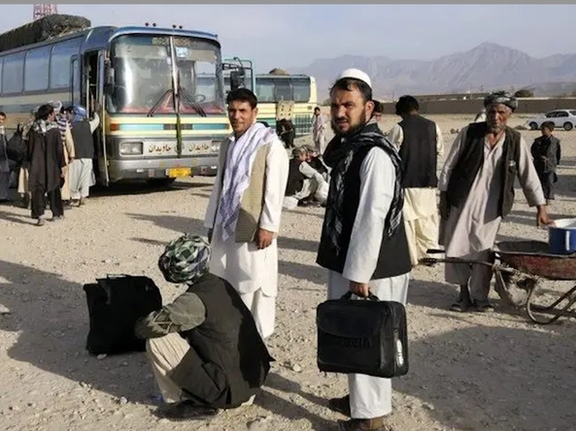
Iran has stepped up deportations of undocumented Afghans in the wake of the recent conflict with Israel, using unproven spying allegations to accelerate a longstanding deportation drive.
Authorities have given undocumented Afghans until July 6 to return to Afghanistan.
490,000 undocumented Afghan immigrants have left Iran over the past 100 days, a deputy governor general in Razavi Khorasan province said on Saturday.
Brigadier General Ahmad-Ali Goudarzi, the Border Guard Commander of Iran’s Law Enforcement Force (FARAJA) announced last week that all rental agreements with undocumented Afghans have been nullified.
Following the conflict with Israel, Iranian security forces arrested several Afghans who allegedly helped Israeli intelligence.
The accused, they said without providing evidence, participated in Mossad operations including surveillance and building drones to strike Iranian targets.
As Iranian officials and state media warned about the security threat undocumented Afghans could pose to the Islamic Republic, anti-Afghan sentiments surged on social media in the days leading to the ceasefire.
Speaking on state television on June 28, Interior Minister Eskandar Momeni said some Afghans who entered Iran in recent years came “with a specific intent to carry out sabotage operations” during the recent Iran-Israel conflict.
“We can’t accept some people to come into our country and harm our security," he said.
Increase in migrants
As inflation and unemployment has mounted in recent months, some Iranians and officials had already been calling to expel the millions of undocumented and impoverished Afghans to claw back jobs and government handouts for citizens
Until the Taliban's return to power in Afghanistan in 2021, the number of Afghans, including 780,000 who held official refugee status, rarely exceeded two million.
The number of Afghans living and working in Iran sharply increased during President Ebrahim Raisi’s tenure, who adopted what critics called an “open border policy.”
Under this policy, Afghans entering on a three-month tourist visa were allowed to extend their stay and obtain work and residence permits. Officials say as many as 4,000 visas per day were issued until recently.
Some officials say over 3 million documented Afghans and an additional 4 million undocumented economic migrants live in Iran now. A small minority of non-refugees are wealthier Afghans who fled after the Taliban takeover.
Surge in forcible returns in recent weeks
A June 25 flash update from the UN Migration Organization (IOM) reported that over 30,000 Afghans have returned from Iran daily following the ceasefire, compared to 3,000–4,000 per day before the conflict.
Returnees face heightened protection risks and require urgent access to safe accommodation, healthcare, and water, sanitation, and hygiene services upon arrival, the report said.
UNICEF reports that 5,000 unaccompanied children are among recent returnees.
Demand for Afghans’ return
Persian-language social media have been flooded with anti-Afghan posts in recent years. Calls for the expulsion of all Afghans were a major topic in last year’s snap presidential elections.
Critics argue that cheap Afghan labor deprives Iranians of jobs and strains healthcare and education systems while increasing government subsidies for essentials like bread, oil and fuel.
However, some Iranians express sympathy for Afghans and condemn their sudden, forcible repatriation. Others point out that life under the Taliban will destroy the lives of many Afghan women who will no longer be able to study or work.
“I am ashamed to see and hear about the manner of deporting Afghans, and I apologize to them. This way of sending them off is imprudent,” wrote Ali-Asghar Shafieian, managing director of the reformist Ensaf News.
“They worked hard in Iran and wouldn’t have migrated if conditions were favorable (at home)".
Warnings about labor crisis
Undocumented and many documented Afghans have provided cheap labor to Iran's industries, agriculture and services sector for decades.
Although employing undocumented immigrants is illegal and their presence is banned in over a dozen provinces, many government contractors for local governments rely heavily on their labor.
In a recent article, Donya-ye Eghtesad, an economic daily, argued mass deportation could create more jobs for low-income Iranians and reduce unemployment, but warned it may also cause labor shortages in construction and agriculture and drive up prices of goods and services.
Iran’s official unemployment rate stands at 7.6 percent, but many believe the real figure is significantly higher, as the government considers anyone working at least one hour per week as employed. Around one-third of Iranians live below the poverty line.
A new video showing two massive blasts near Tehran's Tajrish square has delivered a vivid illustration of the civilian toll a 12-day Israeli war wrought on Iran.
The video shows two powerful blasts roughly a second apart just steps away from the main hospital in the Tajrish area, near the capital's bustling Qods Square.
One hits a building, sending a huge cloud of smoke up on the other side of the street, and another lands between cars at an intersection.
The second blast hurls the vehicles and a huge plume of smoke high into the air.
At the time of the explosions, around 15:30 local time on June 15, the street was busy with vendors, shoppers, metro passengers and traffic as many had still not left the capital for safer places.
Other videos of the incident posted earlier on social media showed extensive flooding caused by damage to a major water pipeline from the second blast, adding to the chaos. A three-year-old child reportedly drowned in the flood.
The 12-second footage, released on social media on Thursday, appears to be from a traffic surveillance camera.
The footage emphasized the harm endured by Iranian civilians apart from Israeli strikes which assassinated commanders and nuclear scientists and pummeled key military and nuclear facilities until a June 24 ceasefire.
Iran's health ministry reported 610 people were killed in the conflict and 4,746 injured.
Independent tallies put the toll higher—1,190 according to the US-based human rights group HRANA, which reported military deaths just above 400, with the rest either civilians or yet to be determined.
Verified
Some activists and social media users allege that the video was digitally manipulated or AI-generated.
However, Factnameh, an Iranian fact-checking website, and BBC both deemed the footage genuine, comparing it with other images from the area of the impact.
Victims
Iran reported 18 people killed, including a pregnant woman and her child, and 46 injured in the strike but has not released a full list of victims.
The Israeli military reported the killing of Brigadier General Mohammad Kazemi, chief of the IRGC Intelligence Organization, his deputy Brigadier General Hassan Mohaqeq, and military intelligence officer Mohsen Bagheri on the same day.
Iran confirmed their deaths but neither side has disclosed the exact location of their deaths.
Among the dead were two prison officials, Ruhollah Tavasoli and Vahid Heydarpour, as well as Evin's top prosecutor Ali Ghanaatkar. Dozens of detainees, medical staff, visiting families — including a young child — and even a bystander were also killed.
Another Israeli attack on June 24 in Astaneh Ashrafieh in northern Iran killed 16 people, most of them from the same extended family, and completely destroyed several homes.
The bombing targeted nuclear scientist Mohammad-Reza Sadighi, who had survived an earlier Israeli attack in Tehran but lost his 17-year-old son Hamidreza in the airstrike.
Iran is losing over $1.5 million every hour to internet restrictions, the Internet Business Association said in an open letter, as media linked to the Revolutionary Guards said the disruptions may signal an intensifying cyber war.
The group urged the Communications Ministry and the Infrastructure Company to “immediately end the deliberate disruptions to online access.
“Over 400,000 small and medium-sized enterprises, whose livelihoods millions of Iranians depend on, are facing complete collapse," the open letter dated July 2 said.
Internet access in Iran was disrupted on June 13, the first day of the 12-day war with Israel, and was completely cut on June 17. Partial service has since resumed, but connection speeds and access remain severely limited.
State media defends blackouts citing cyber war
On Saturday, the IRGC-affiliated Fars News Agency said the disruptions may reflect a large cyber war targeting national infrastructure, describing the attacks as organized and part of a “hidden battle growing more severe by the day.”
During the war, officials justified the shutdowns as a measure to block Israeli reconnaissance drones allegedly using Iranian SIM cards and to disrupt intelligence gathering via WhatsApp. But military and communications experts have dismissed those remarks.
“I categorically reject the Islamic Republic’s claims. No evidence has been presented to show that Israel uses SIM cards for drones," Mehdi Yahyanejad, an expert in internet technologies, told Iran International.
"Even if that were the case, a nationwide internet shutdown is not a logical solution," he said.
The daughter of top military commander Ali Shadmani—killed shortly after his appointment to lead Khatam-al-Anbia Central Headquarters—said her father carried no smart devices during the war, and that “Israel’s precision targeting went far beyond WhatsApp or traditional espionage.”
Her remarks followed accusations from Gholamreza Jalali, head of Iran’s Passive Defense Organization, who said WhatsApp was used to locate and kill Iranian commanders—a charge Meta has denied.
Layoffs, collapse feared in tech sector
The Internet Business Association, in its letter, cited ongoing disruptions—DNS tampering, throttling, protocol filtering, and loss of global access—as already triggering mass layoffs, stalled investment, and startup shutdowns.
“We are witnessing a broad wave of job cuts, halted investment in the startup ecosystem, and announcements of company closures—that is to say, bankruptcies,” the letter said.
The group warned that continued interference “threatens public trust, accelerates elite migration, and risks the death of Iran’s tech sector,” demanding an immediate end to all forms of service degradation.
Iran ranked near the bottom in global internet freedom last year. According to the Tehran Electronic Commerce Association, the country is placed among the lowest in speed and reliability out of 100 surveyed nations.
United Nations experts on Friday urged Iranian authorities to end a post-ceasefire crackdown marked by executions, mass arrests, and hate speech, warning that the country risks repeating past cycles of repression.
“Post-conflict situations must not be used as an opportunity to suppress dissent and increase repression,” the experts said in a statement, referring to the aftermath of Iran-Israel conflict which began on June 13 and ended with a ceasefire.
The experts which included UN Special Rapporteur on the situation of human rights in the Islamic Republic of Iran, Mai Sato, said they were alarmed by reports that at least six individuals, including three Kurdish men, had been executed on charges of “espionage for Israel.”
They also cited the arrests of hundreds of people, including journalists, human rights defenders, social media users, foreign nationals — particularly Afghans — and members of ethnic and religious minorities such as Baha’is, Kurds, Balouchis and Ahwazi Arabs.
The experts expressed concern over the detention of human rights defender Hossein Ronaghi and his brother and Swedish-Iranian academic Ahmadreza Djalali who they said faced imminent execution with his whereabouts unknown.
The experts warned that Iran’s parliament was advancing legislation that would categorize intelligence activities on behalf of “hostile governments” as “corruption on earth” — a charge punishable by death under Iranian law.
“Criminalizing the sharing of information in broad language violates the rights to freedom of expression and information,” the statement said. “This legislation also represents a worrying expansion of the death penalty that violates international human rights law.”
They also condemned the deteriorating conditions of prisoners transferred from Evin Prison following Israeli strikes on its facilities.
Many detainees were moved to the Great Tehran Penitentiary and Qarchak Prison and held in inhumane conditions. The whereabouts of some prisoners remain unknown, the experts said, describing the situation as amounting to enforced disappearances.
Iran has transferred French nationals Cécile Kohler and Jacques Paris to undisclosed locations after they survived explosions during Israeli strikes on Tehran’s Evin prison on June 23, their family told Iran International.
“Iranian authorities don't tell [us] where they are being held,” Cécile’s sister Noémie told Iran International on Friday.
The couple were arrested in May 2022 while on a tourist trip to Iran.
Noémie said that since the Israeli strike, they have had only one consular visit, on July 1, when the family was relieved to learn that they were "at least still alive.”
She said that the couple had been held in Ward 209 — which operates under the oversight of Iran's Intelligence Ministry — at the time of the strike, and that they had remained there for more than three years.
“They were held in 209 for more than three years,” she said. “They were in solitary confinement several months.”
Ward 209 lies outside the prison's regular judicial oversight and has been described by Human Rights Watch as a “prison within a prison,” where detainees are frequently subjected to prolonged solitary confinement, denied legal access, and subjected to harsh interrogation that may amount to torture.
The couple were moved shortly after the blasts. “We understood [Cécile] was transferred to Qarchak prison,” Noémie said. “She was transferred to Qarchak prison for 24 hours. Then she was transferred to an undisclosed place — she was blindfolded so she doesn’t know where she is being held right now.”
“Jacques was transferred to an undisclosed location right after the bombings,” she added.
The family has not had direct contact with either of them since May 28.
Noémie said Iranian authorities recently charged the couple with “spying for Israel,” “conspiracy to overthrow the regime,” and “corruption on Earth” — charges that carry the death penalty under Iranian law.
“We don’t have more specific information. We only know a judge told them the charges,” she said.
She said the couple is not allowed independent legal representation and that “nobody has access to their case file.”
Psychological torture
During their last direct contact on May 28, Cécile told her family that a judge had warned them a verdict would be issued soon — and that it would be “very severe.”
“The judge had been telling them that for six months,” Noémie said. “Another example of psychological torture.”
Asked why Iranian authorities may be targeting the couple so harshly, Noémie said, “To put pressure on France, I assume. We don’t know what they want and why they persecute Cécile and Jacques this badly.”
She accused Iranian authorities of ongoing abuse. “The Iranian authorities are continuing to torture Cécile and Jacques psychologically after more than three years of detention in inhuman conditions, after they narrowly survived the bombings, with charges that carry the death penalty,” she said.
“They must stop trampling on Cécile and Jacques's rights, disclose their place of detention, allow them to contact their families, and above all hand them over to the French authorities as a matter of urgency.”
France has condemned the charges as politically motivated and continues to demand the couple’s immediate release. Foreign Minister Jean-Noël Barrot has called the accusations “unjustified and unfounded.”
Noémie said she believes the French government is making efforts to help, but called the lack of transparency “complicated and frustrating.”
“My message to Western leaders, especially European, is that they have to work together to put an end to hostage diplomacy,” she added.
Kohler, a teacher, and Paris, her partner, are the last known French citizens held in Iran. French President Emmanuel Macron has described them as “state hostages.”
France and other European Union members accuse Iran of practicing “hostage diplomacy” — detaining foreigners to pressure Western governments.
Iran denies the accusation. Its officials say the arrests followed legal procedures and reject claims of mistreatment.
Iran executed at least 21 people during its 12-day conflict with Israel last month including six men accused of spying for the Jewish state, according to a report by Oslo-based rights group Iran Human Rights (IHR).
IHR said many of the espionage trials were rushed and relied on confessions obtained under torture.
Among those hanged on espionage charges were political prisoners Esmail Fekri who was executed after a 10-minute trial without access to a lawyer, Mohammad Amin Mahdavi Shayesteh who allegedly confessed under torture and three Kurdish men including an Iraqi national accused of assisting in the 2020 assassination of nuclear scientist Mohsen Fakhrizadeh, according to IHR.
“The Islamic Republic is at its weakest point in its history, and in order to survive, it needs to carry out more executions to intimidate what it sees as its greatest threat: the Iranian people,” said IHR Director Mahmood Amiry-Moghaddam.
The group said 98 people were executed in total across Iran in June alone. Nearly half were executed for drug-related offenses, while 32 were carried out under the Islamic law of retribution for murder, IHR's report said.
Among those put to death were Afghan nationals, members of Iran’s Kurdish, Arab, and Baluch minorities and one woman.
IHR's report comes amid an escalating crackdown on dissent following the conflict in which Iran's military and nuclear program were dealt big setbacks.
Rezgar Beigzadeh Babamiri, a Kurdish political prisoner arrested during the 2022 nationwide protests, was sentenced to death on charges including plotting to assassinate Supreme Leader Ali Khamenei, his daughter told Iran International on Thursday.
At least 612 people were executed in the first half of 2025 — a 119% increase compared to the same period last year, the report added.
Iran accounted for 64% of all known global executions in 2024, with at least 972 people executed, according to Amnesty International, in what the rights group deems an ongoing official campaign to suppress dissent.