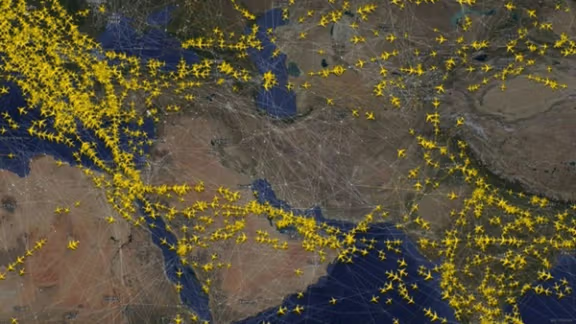
Iran reopens most airports, eases airspace restrictions
Most domestic and international flights in Iran will resume from Friday, with nearly all airports back online and daylight access restored to much of the country’s airspace, the country's Civil Aviation Organization said Thursday.
Tehran’s Mehrabad and Khomeini airports—alongside airports in the north, south, east, and west—are now operational and ready to serve both domestic and international traffic, according to the statement.
"From July 4, all airports except Isfahan and Tabriz will host daily flights between 5 a.m. and 6 p.m.," read the statement.
The skies over central and western Iran are also reopened during this window for international overflights, the statement added.
Eastern airspace, the organization said, remains open around the clock. Airports in the east continue to operate 24/7 under previous schedules.
The Civil Aviation Organization added that Isfahan and Tabriz airports will resume operations once infrastructure is restored and no further restrictions are in place.
The country closed its airspace on June 13 following Israeli airstrikes on Tehran and other areas. After a 12-day aerial conflict, the two countries achieved a ceasefire on June 24.
Israel will act if Iran resumes its pursuit of nuclear weapons, Israel’s ambassador to the United Nations Danny Danon said Thursday, adding that the country's policy of preempting Tehran's nuclear ambitions remains unchanged.
“We have the capabilities to know exactly what they are doing. If we see they are going back to the same track, when they are there, then we have to make a decision,” Danon told Iran International in an exclusive interview.
“I hope they’ve understood that not only Israel, but also the US, will follow closely what is happening on the ground,” he added.
Danon said Israel's posture remains one of strategic surveillance: “We’ve done this for many years—until we reached a point of no return, and then we acted. Now we are monitoring and watching closely what is happening on the ground.”
He declined to say whether Israel would replicate its targeted operations in Lebanon on Iranian soil. “I won’t go into what we might do in the future, but I look at the endgame: Iran will not have nuclear capabilities. That is something we cannot accept,” Danon said.
“When we saw the regime launching missiles at hospitals and civilian areas, we understood that they will use whatever they have against us,” he continued. “We cannot allow them to possess weapons of mass destruction or to threaten our existence.”
Israel and Iran are currently in a tenuous ceasefire following a 12-day military exchange. The Israeli campaign struck nuclear, military, and strategic sites across Iran. In response, Iran launched waves of ballistic missiles and drones toward Israeli cities.
The United States intervened in the final phase of the conflict, conducting targeted airstrikes on three Iranian nuclear facilities. It marked the first direct US military action on Iran's nuclear infrastructure.
France on Thursday called for the immediate release of two citizens imprisoned in Iran since 2022, rejecting Tehran’s charges against them as baseless and warning of consequences if the pair are not freed.
“It’s a provocation against France and an unacceptable choice of aggression,” President Emmanuel Macron told reporters. “It’s unacceptable for France.”
Cécile Kohler, a teacher, and her partner Jacques Paris were arrested during a tourist visit in May 2022 and remain in detention in Tehran’s Evin Prison. This week, Iranian authorities formally charged them with “espionage for Israel’s Mossad, conspiracy to overthrow the regime, and corruption on earth,” according to diplomatic and family sources cited by Agence France Presse.
“If it is indeed confirmed that they are facing these charges, we would consider those charges to be completely unjustified and unfounded,” French Foreign Minister Jean-Noël Barrot said.
Any decision on reimposing sanctions would depend on the outcome of their case, Barrot added, saying “We have always told our interlocutors from the Iranian regime that any decision on sanctions will be conditional on resolving this issue.”
The couple’s family says they have no access to independent legal counsel. Kohler’s sister told AFP that the two had appeared before a judge who confirmed the charges.
In May, France filed a case against Iran at the International Court of Justice, accusing Tehran of violating international law through arbitrary detention and the denial of consular access. Macron has previously described the couple as “state hostages.”
Their continued detention comes amid a wider crackdown in Iran following the 12-day Israeli military campaign in late June. Iran has since executed several individuals and arrested hundreds more on charges of espionage and collaboration with Israel.
Iranian state television aired an anthem, saying “we will uproot the Jews with power,” broadcast alongside images of Supreme Leader Ali Khamenei and the Islamic Republic’s armed forces.
“Behind Ali, obedient to the Leader’s command, we are all proud soldiers; we will uproot the Jews with power,” the song said.
The broadcast marks the latest in a longstanding state-backed campaign of antisemitic content in Iran, home to the Middle East’s largest Jewish population after Israel.
Iran’s state media has repeatedly promoted antisemitic themes across films, festivals, and official speeches. In 2001, the government aired a mini-series titled Saint Mary that depicted Jewish communities at the time of Jesus’s birth as “lacking compassion and rationality.” The Jewish Association of Tehran criticized the series for reinforcing harmful stereotypes.
In 2005, then-President Mahmoud Ahmadinejad hosted an international Holocaust cartoon competition. Ahmadinejad, who publicly denied the Holocaust, once said Israel should be “wiped off the map.” The contest continues today with backing from official cultural institutions.
Despite the state-sanctioned hostility, Iran maintains a Jewish population estimated between 8,000 and 10,000. The World Jewish Congress notes the community’s historical presence in Iran since 586 BCE, with roughly 100 synagogues still in operation.
Since the 1979 Islamic Revolution, Iran’s Jews have faced ongoing surveillance and periodic arrests.
Last week, authorities summoned and interrogated at least 35 Jewish citizens in Tehran and Shiraz over their contact with relatives in Israel, the US-based human rights group HRANA said.
Authorities have accused community members of “espionage, foreign ties, and collaboration with hostile states,” often with no evidence.
White House envoy Steve Witkoff is planning to meet Iranian Foreign Minister Abbas Araghchi in Oslo next week to relaunch nuclear talks, Axios reported Thursday, citing two sources familiar with the preparations.
The meeting would mark the first direct engagement since President Donald Trump ordered strikes on Iran’s nuclear facilities last month.
"We have no travel announcements at this time," a White House official told Axios. The Iranian mission to the UN declined to comment.
The discussions, brokered with help from Omani and Qatari officials, follow a 12-day war between Israel and Iran that ended under a US-negotiated ceasefire. Witkoff and Araghchi have maintained contact during and since that conflict, the sources said.
Israel's Channel 12 first reported the planned meeting.
A key topic will be Iran’s growing stockpile of highly enriched uranium, including 400 kilograms enriched to 60%. US and Israeli officials say the material is currently inaccessible, sealed off by rubble at the bombed enrichment sites in Natanz, Fordow, and Isfahan.
Iran has since announced the suspension of all cooperation with the International Atomic Energy Agency, citing a law passed by its parliament.
In a post on X, Araghchi said Iran remained committed to its Safeguards Agreement and the Nuclear Non-Proliferation Treaty, but added that any coordination with the IAEA would now be managed through Iran’s Supreme National Security Council.
“In accordance with the new legislation... our cooperation with the IAEA will be channeled through Iran's Supreme National Security Council for obvious safety and security reasons,” he wrote.
Araghchi told CBS on Monday that talks with the United States are unlikely to resume soon, following US airstrikes on three major nuclear sites during the 12-day war with Israel.
“I don’t think negotiations will restart as quickly as that,” Araghchi said in his first interview with an American news outlet since the June airstrikes.
“We will have to first ensure that America will not revert to targeting us in a military attack during the negotiations.”
No final date for the Oslo meeting has been confirmed, and neither side has publicly acknowledged the planned talks.
The US Treasury on Thursday sanctioned an international network smuggling billions of dollars in Iranian oil disguised as Iraqi.
The sanctions targeted companies linked to Iraqi-British businessman Salim Ahmed Said and expanding pressure on Iran’s petroleum trade and shadow fleet.
Said’s network, operating since at least 2020, used ship-to-ship transfers and forged documents to sell blended Iranian-Iraqi oil to global buyers, the Treasury said.
“Treasury will continue to target Tehran’s revenue sources and intensify economic pressure to disrupt the regime’s access to the financial resources that fuel its destabilizing activities,” said Secretary Scott Bessent.
The Treasury Department also sanctioned several vessels accused of secretly transporting Iranian oil, increasing pressure on Iran’s "shadow fleet," it said.
Several senior officials and one entity linked to the Iran-backed Hezbollah-controlled financial institution Al-Qard Al-Hassan was also targeted.
These officials conducted millions of dollars in transactions that ultimately benefited Hezbollah while concealing their involvement, according to the department.
This latest action, part of the US maximum pressure campaign on Iran, marks the eighth round of oil-trade-related sanctions since 2021.
All US-linked assets of the targeted entities are now frozen, and Americans are barred from dealings with them. The designations also expose foreign firms to secondary sanctions, heightening the cost of facilitating Iran’s oil trade.