Danish-Afghan man secretly visited Iran after spying on Jewish targets - Bild
An Afghan-Danish national arrested in Denmark for spying on behalf of Iran’s Revolutionary Guards had traveled covertly to Iran after gathering intelligence on Jewish sites in Berlin, German newspaper Bild reported Sunday.
According to Bild, the 53-year-old suspect, identified as Ali S., entered Iran in June 2025 under the cover of a family trip to Turkey.
He allegedly delivered surveillance photos, videos, and detailed information about potential targets in Berlin to a Quds Force officer in Tehran. He then left Iran using forged documents, avoiding any entry or exit stamps in his Danish passport.
The intelligence, Bild reported, included back entrances, security patrols, and suggested locations for placing incendiary devices or explosives. German authorities now believe he was planning or facilitating attacks on Jewish institutions in Germany.
According to the report, Ali S. had traveled to Berlin between June 4 and 6 with his wife and children, during which time German intelligence monitored him closely.
Bild said investigators observed him photographing at least ten sites, including the German-Israeli Society, the office of Josef Schuster—head of the Central Council of Jews in Germany—an Israeli restaurant, and a kosher supermarket near Kurfürstendamm.
Danish intelligence services first flagged the suspect after intercepting online messages between him and a known Quds Force officer.
German authorities then launched full surveillance and bugged his residence in Aarhus. After returning from Iran on June 23, he told his family he had handed over the intelligence to his handler in Tehran—information captured through wiretaps, according to Bild.
Germany’s Federal Prosecutor Jens Rommel issued an arrest warrant on June 24, saying Ali S. is “strongly suspected of working for a foreign intelligence service.” He now faces charges of espionage and planning attacks in Germany.
Bild report said the case is considered one of the most significant discoveries of Iranian intelligence activity on German soil in recent years.
A French man has gone missing in Iran since mid-June, France’s minister for citizens abroad said on Monday, raising concerns over Tehran’s history of detaining Western nationals.
“It’s a worrying disappearance, and we are in contact with the family,” Minister Laurent Saint-Martin, who oversees French nationals overseas, told RTL radio.
Saint-Martin stopped short of confirming whether the Iranian authorities were involved in the disappearance, but added: “It is worrying because Iran has a deliberate policy of taking Western hostages.”
The man, who also holds German nationality, has not been identified publicly.
French media reported on Sunday that he was an 18-year-old who had been on a solo cycling trip in the region and went missing a few days after Israeli airstrikes targeted Iranian sites in mid-June.
AFP reported that the French man has not contacted his family since June 16, citing a French diplomatic source.“We are in contact with the family about this,” the source was quoted as saying.
The source described the case as “worrying," and advised French nationals against travelling to Iran due to Tehran’s “deliberate policy of taking Westerners hostage.”
The missing person alert was first posted on social media by friends seeking help with locating the tourist.
While French authorities have not named the individual, the French daily Le Figaro identified the missing person as Lennart Monterlos, 18, citing a missing person alert posted on Instagram.
According to Le Figaro, Monterlos describes himself on Instagram as passionate about climbing and cycling. In June 2024, he announced plans for “a one-year cycling trip across Eurasia,” calling it a “dream” he hoped to fulfill before starting university.
His planned route spanned “400 days, 35,000 km,” across “35 countries.”
A screenshot of an Instagram post by Lennart Monterlos, according to French daily Le Figaro.
His last public location update, posted on the travel app Polarsteps, showed him in Shiraz, Iran, on June 3, with a planned stop in Kashan. The account has not been updated since.
Monterlos's disappearance follows recent developments in the case of Cécile Kohler and Jacques Paris, two French citizens arrested in Iran in 2022, who were recently notified of charges punishable by death—including espionage for Israel— after which they were moved to an undisclosed location.
Earlier on Sunday, Iran’s official IRNA news agency reported a phone call between French Foreign Minister Jean-Noël Barrot and his Iranian counterpart Abbas Araghchi, during which they discussed consular affairs and regional developments.
IRNA’s report did not specify whether the two diplomats discussed the cases of Lennart Monterlos, Cécile Kohler, or Jacques Paris. However, the term "consular affairs" usually refers to the cases of citizens detained in the two countries.
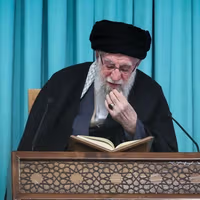
Iran’s Supreme Leader Ali Khamenei’s first public appearance in over three weeks has drawn mixed reactions, with state officials and media hailing his return as a sign of strength while some online reactions from Iranians were dismissive or critical.
Former Foreign Minister Mohammad Javad Zarif heaped praise on the leader who had not been seen in public since June 10 before his reappearance at a religious ceremony Saturday night.
“The fearless presence of Ali Khamenei in a traditional public gathering permanently shattered the delusional lies that paid pundits have been pushing. Time to wake up and admit that Iranians never surrender,” he said.
Throughout the three-week gap, social media users widely mocked Khamenei’s invisibility, some likening it to a contradiction of his own past rhetoric.
In a 2005 speech, Khamenei had derided US leaders for “disappearing” after 9/11 and said, “If a bitter experience happens to Iran, we ourselves will don battle garb and stand ready to sacrifice.”
Supporters hail ‘steadfast’ image
Government-aligned figures such as Zarif had earlier insisted that Khamenei’s absence was a leadership tactic, but shifted their tone following the ceremony on Saturday to label it a sign of bravery.
Foreign Minister Abbas Araghchi, called the reappearance “the most beautiful image I saw upon arriving in Brazil” as he arrived for the Brics summit, and added: “With you, one can brave the seas.”
Mehdi Fazaeli, a member of Khamenei’s office, wrote on X that "the mourning hall exploded", referring to the crowds' excitement for the reappearance of the elusive leader at the mourning ceremony held on the occasion of Ashura.
"The waves of this explosion will sweep through Tel Aviv and the White House. It was an explosion of love, devotion, and union," he said.
Mohsen Rezaei, a senior member of the Expediency Council and a former IRGC commander, portrayed the event as a rallying moment for a nation still suffering the fallout of the 12-day war launched by Israel on June 13.
“When people’s eyes fell on our Leader’s stature, all understood this house’s pillar is firm and no storm can uproot it,” he said.
Iran International editor Morteza Kazemian argued the reappearance is unlikely to restore the status quo of pre-war normalcy, citing the weight of insecurity now surrounding Iran’s defense posture.
“The war showed the country’s skies are defenseless, putting Khamenei squarely among Israel’s potential targets," he said.
Naim Qassem, the Secretary General of Iran's largest regional ally, Hezbollah in Lebanon, praised Khamenei for “his courage, faith, support, and guidance."
Yet while praise flowed from allies, Iranian state institutions remained notably silent on Khamenei’s prolonged absence. Neither his office nor official media offered explanations for his whereabouts during or after the Israeli strikes.
Critics cast ceremony as political theater
Some citizens saw Khamenei’s appearance not as courage, but desperation. A video submitted to Iran International mocked his choice of song, “Ey Iran”, a patriotic anthem rarely embraced by the clerical establishment.
One viewer's message to Iran International said, “If I were him, I’d have preferred to be killed by Israel than to return in this shameful way."
Iranian Nobel laureate and lawyer Shirin Ebadi criticized Khamenei on her Telegram page, saying that while he emerged from his bolthole, the Iranian public who had no shelter from the Israeli barrage were left mourning.
”History will record him as a dictator of the same era as Saddam Hussein, Gaddafi, and Mubarak—but one who lacked even a shred of dignity," Ebadi said.
"Unlike other dictators who at least believed in themselves, he begged for power, and in complete contradiction to the ideals he once shouted from the rooftops, appeared on the eve of Ashura with a smile among a group of hand-picked loyalists saying they were ready to sacrifice their lives for him—while political prisoners and ordinary people had already been sacrificed as his human shields.”
Human rights news agency HRANA said that 1,190 Iranians were killed in the war, 4,475 injured.
Another viewer of Iran International said, “After 20 days, the ‘Great Satan’ crawled out of his hole just to say he wasn’t scared. But we’ve already understood what we needed to—you are a coward and completely spineless.”
“He came out of hiding after 22 days. If I were in his place, I would’ve rather been killed by Israel than show up among the people like this,” said another.
”Since last night, ever since this 'Supreme Mouse' crawled out of his hole, the news has been subtitling it as 'his appearance in public'. But 'public' meant when he used to attend funerals for his commanders or visited missile-struck areas. This wasn’t a public appearance—it was more like a private gathering, where everything on land and in the air had been secured just so this mouse could come out,” said another citizen.
In Israel as news of Khamenei's reemergence broke, the Jerusalem Post called it a "rectifiable mistake" that Israel did not kill Khamenei and his son Mojtaba, a potential successor.
Iranian nationals and individuals linked to Hezbollah are suspected of playing a role in a €157 million cocaine trafficking operation intercepted off Ireland’s southern coast in 2023, the Irish Times reported.
The seizure—2.2 tons of cocaine aboard the MV Matthew, a Panamanian-flagged bulk carrier—marked the largest drug bust in Irish history. The vessel was intercepted in a joint operation involving the Irish Naval Service, police and customs officers following months of international intelligence-sharing.
According to the report, investigators believe the transnational operation was coordinated by a network involving the Kinahan organized crime group, associates in Venezuela, and alleged financial backers linked to Iran-backed Hezbollah, a Lebanese group designated as a terrorist organization by several Western governments.
Two Iranian nationals, Soheil Jelveh, 51, and Saeid Hassani, 39, were among eight men sentenced last week by Ireland’s Special Criminal Court. Jelveh, the ship’s captain, and Hassani, a senior officer, were found to have knowingly participated in the smuggling attempt.
The Irish Times said that the court heard of the involvement of “a major Iranian nexus in this operation.”
Prosecutors alleged that the two Iranians acted on instructions from individuals with suspected links to Hezbollah, including a coordinator known as "Captain Noah"—identified in court as Mehdi Bordbar, allegedly operating from Dubai.
According to court documents and law enforcement briefings, the cocaine was loaded onto the MV Matthew off the coast of Venezuela under the cover of night by armed men. The cargo was reportedly financed in part by €5 million in advance payments from organized crime groups, with profits to be distributed among the participants.
“Operations of this scale involve multiple players across continents,” said Angela Willis, Assistant Commissioner for Organized and Serious Crime. “We are continuing to investigate the financial and logistical links, including those with ties to the Middle East.”
Authorities in Ireland are also investigating two individuals who allegedly purchased a secondary vessel, the Castlemore, for €300,000 using funds transferred from Dubai. The boat, intended to collect the drugs offshore, ran aground on Ireland’s Wexford coast due to a mechanical failure, precipitating the unraveling of the trafficking plan.
Eight men—nationals of Iran, the Netherlands, the UK, Ukraine, and the Philippines—have received prison sentences of between 13 and 20 years. However, law enforcement officials emphasized that those convicted were largely mid-level operatives and not the primary architects of the scheme.
A widespread internet blackout hit Iran on Saturday night, disrupting global access for millions once more, the first such shutdown since mass outages across the country during the conflict with Israel.
NetBlocks, which monitors global internet freedom, confirmed the outage, noting “Live network data show a major disruption to internet connectivity in Iran.” The shutdown, which lasted roughly two hours, echoed user reports from across the country.
“The flow of messages in favor of the government increased after the blackout,” a user named Maryam posted on X, suggesting the internet restrictions were designed to “silence critics and opposition.”
NetBlocks also pointed to the recent conflict between Israel and the Islamic Republic, during which Iran’s security forces cut telecommunications nationwide; an action carried out by Iranian security officials under the pretext of “safeguarding national security,” but met with widespread negative reactions both domestically and abroad.
IRNA, Iran’s official news agency, cited the state-run Telecommunications Infrastructure Company, reporting a national-level disruption in international connectivity that affected most internet service providers Saturday night. Yet government officials have not publicly addressed the cause.
Many Iranian users complained that while ordinary citizens lost access, accounts linked to state figures continued operating normally. One user, Soheil, posted: “People don’t have internet, but government supporters still do. Cut theirs too, so they stop getting on everyone’s nerves.”
Another user, Masoud, questioned how prominent establishment figures like former ministers Mohammad Javad Zarif and Mohammad Javad Azari Jahromi remained active on X despite the blackout.
Zarif had earlier posted that his account was limited by platform owner Elon Musk—prompting backlash.
“Kicking 90 million Iranians offline, then crying about a missing blue check,” one user wrote in response.
It comes as the cyber warfare between Israel and Iran steps up in spite of the ceasefire.
A shadow war of mutual cyber-attacks between Iran and Israel has replaced missile fire and air strikes as a fragile truce holds, security experts told Iran International.
A shadow war of mutual cyber-attacks between Iran and Israel has replaced missile fire and air strikes as a fragile truce holds, security experts told Iran International.
"Although the Iran-Israel ceasefire has paused direct military engagement, cyber operations have intensified," Marwan Hachem, co-founder of FearsOff cybersecurity experts, told Iran International.
“Since the truce began, nearly 450 cyberattacks have been recorded against Israeli targets—many attributed to pro-Iran hacker groups,” he said.
Attacks on Iran's finance, infrastructure and energy complex, Hachem said, were fewer but more sophisticated and have been traced to actors linked to Israeli intelligence.
"Post-ceasefire, there are only about 10 known cyberattacks by pro-Israeli actors against Iran ... the fewer Israeli attacks tend to be more targeted and impactful.”
During the war, a pro-Israeli hacking group known as Predatory Sparrow claimed credit for a major cyberattack on Iran’s Bank Sepah.
The group also later said it had drained around $90 million from Nobitex, Iran’s largest cryptocurrency exchange, adding it had posted Nobitex source code lists on X.
In spite of a ceasefire, however, the cyber war goes on.
“The era of silent digital aggression has arrived, and even allies may become targets in this murky domain of quiet offensives. The illusion of peace doesn’t extend to cyberspace. In fact, we expect cyber operations to grow more aggressive—only more covert. Silence is no indicator of safety.”
Daily attacks
Israeli cyber expert Boaz Dolev, from Clearsky Cyber Security, said there are daily attempts to hack small to medium sized businesses in Israel, and as yet, have not succeeded in attacking critical infrastructure.
“There is a lot of smoke all of the time. Iran didn’t disrupt Israel’s infrastructure by cyber-attacks but some Israeli companies were hacked and some sensitive information was leaked."
“We think they’ve breached dozens of Israeli companies, small to medium sized ones," Dolev added. "Most of them are providing services to large organizations in Israel so there is some sensitive information that was inside."
“They tried to do it by using vulnerabilities in computer systems, or sending it as phishing, but as much as I can say, they didn’t succeed most of the time. The ones they breached and hacked, they can start the destruction process, and some companies have had servers hacked and deleted.”
One cyber expert in Israel who asked not to be named, said Israel remains “much stronger than Iran in the cyber arena”.
“They can do whatever they want in Iran. The question is how they’re using the power and who you’re going to attack, when, and what will be the damage,” he added.
“This is why they decided to attack the financial system in Iran," the expert added. "It was a message for Iran that said the infrastructure is more vulnerable than they can imagine.”