At least two killed and two missing in latest Houthi attack on ship off Yemen
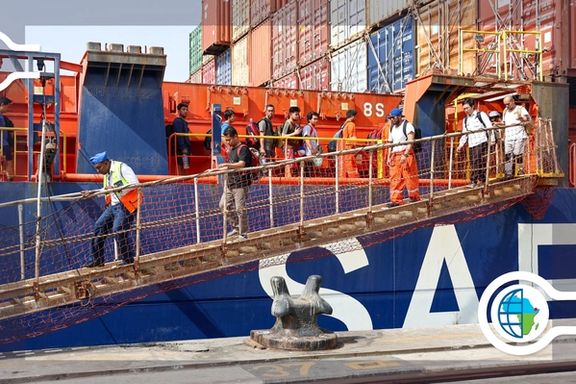
People disembark the MV Safeen Prism after the vessel picked up crew members of the MV Magic Seas bulk carrier, who were forced to abandon ship after an attack that the Houthis claimed responsibility for, at the port in Doraleh, Djibouti July 7, 2025 in this handout picture.
Two seamen are believed to have been killed and another two missing after an attack on a Greek-managed cargo ship off the coast of Yemen by the Iran-backed Houthis, according to Reuters.
This brings the death toll to six since the group began its maritime attacks in support of Iran-backed Hamas in Gaza in November 2023.
The attack came just hours after the group, which many Western countries have listed as a terrorist organization, claimed to have sunk a bulk carrier in the Red Sea.
According to the European Union’s Operation Aspides task group specializing on protecting shipping in the Red Sea region, the attack happened 50 nautical miles southwest of the port of Hodeidah.
The vessel, which was Liberia-flagged, had 22 crew members, 21 Filipinos and one Russian, as well as armed guards on board.
It was attacked with sea drones and rocket-propelled grenades fired from manned speedboats, sources said.
An official from Cosmoship Management, which manages the vessel, told Reuters that the vessel's bridge was hit and telecommunications were impacted.
While crew were told to abandon after it suffered serious damage, the lifeboats had been destroyed in the assault.
On Monday, the Houthis had claimed responsibility for sinking the MV Magic Seas, for what the spokesman for the group said was “repeated violations by its owning company of the ban on entering the ports of occupied Palestine.”
The raid involved gunfire and rocket-propelled grenades from eight skiffs as well as missiles and four uncrewed surface vessels.
The statement also warned: “We are not satisfied with sinking just one ship, there is more to come.”
While the Houthis said the group had sunk the ship, Michael Bodouroglou, a representative of Stem Shipping, one of the ship's commercial managers, said there was no independent verification, according to Reuters.
If proven to have been sunk, it would make it the third ship to be sunk since November 2023 when the group began the blockade, following a call by Iran’s Supreme Leader Ali Khamenei.
On Sunday morning, Israel announced it had struck multiple Houthi targets.
In May, the US made a ceasefire with the group after at least 174 attacks on US warships, in addition to the group's more than 145 attacks on commercial vessels, as of March figures. That ceasefire did not include other nations.
A media outlet affiliated with Iran’s Revolutionary Guards (IRGC) has openly called for the mass execution of perceived enemies of the state, invoking the precedent of mass killings carried out in 1988 following a decree by then-Supreme Leader Ruhollah Khomeini.
In an article published this week, the semi-official Fars News Agency described current detainees accused of collaborating with Israel and Western intelligence agencies as “deserving of execution in the style of 1988.”
“In the current conditions, when some mercenary elements—Iranians and foreign nationals—have enabled the killing of hundreds of Iranian citizens, including women, children and civilians, by transferring intelligence to the Zionist enemy and smuggling weapons into the country, they deserve to be executed in the manner of 1988," the article said.
The publication argued that the 1988 executions were a “brilliant chapter” in the Islamic Republic’s fight against terrorism and said that “society today recognizes the need for such proper measures against domestic terrorist networks.”
Between July and September 1988, thousands of political prisoners were summarily executed across Iran after a fatwa by Ayatollah Khomeini.
Amnesty International estimates the death toll at a minimum of 5,000. Victims, many of whom had already been serving sentences for political dissent, were subjected to secret trials and then executed. Their bodies were buried in unmarked graves, and families were never officially notified.
“The anguish caused to families by this ongoing crime constitutes torture,” Amnesty said in a 2023 report, adding that “the extrajudicial executions and the ongoing enforced disappearances amount to crimes against humanity.”
The Iranian authorities have never acknowledged the full scope of the killings. Families of the victims have been subjected to intimidation, denial of burial rights, and the destruction of mass grave sites. Amnesty International and other human rights groups continue to call for accountability.
In 2016, an audio recording surfaced in which Grand Ayatollah Hossein Ali Montazeri, once heir apparent to Khomeini, condemned the executions in a meeting with judiciary officials involved in the process. “I believe the greatest crime in the history of the Islamic Republic, for which history will condemn us, has been committed by you,” he said. “Your names will go down in history as criminals.”
Montazeri was subsequently dismissed from power and placed under house arrest until his death in 2009.
Calls for renewed repression
In its editorial, Fars revisited the history of the 1980s and described dissident organizations such as the Mojahedin-e Khalq (MEK) as armed insurgents who “attempted to hijack the revolution from within.”
The article said the MEK collaborated with Iraq during the Iran-Iraq war and “committed atrocities against civilians,” framing the 1988 executions as both justifiable and necessary for national security.
“Unlike the false portrayal by opposition media that the 1988 executions were against human rights, today the public sees the necessity of repeating such decisive actions,” Fars wrote, also defending the role of late President Ebrahim Raisi, who was one of the judiciary officials implicated in the process.
Iran is intensifying a nationwide crackdown in the wake of its 12-day war with Israel, targeting ethnic and religious minority groups as well as foreign nationals.
Late in June, Fars reported that Iranian intelligence forces arrested more than 700 Iranians accused of acting as agents for Israel.
No Iranian official has yet responded to or repudiated Fars’ latest statements. Iranian authorities typically avoid direct acknowledgment of the 1988 killings in public discourse, though some judiciary and government figures have repeatedly defended them as lawful.
Iran’s parliament passed an emergency bill late last month to increase penalties for espionage and collaboration with “hostile states,” allowing suspects to be tried under wartime conditions.
Judiciary chief Gholamhossein Mohseni-Ejei said those arrested in the context of Israel’s recent attacks would be prosecuted under “wartime legal provisions.”
Judiciary spokesperson Asghar Jahangir said on state TV that current espionage laws are “too general” and inadequate for addressing recent cases, adding that legal reforms are needed to handle detainees linked to the conflict with Israel.
In the last five years, Iran has stepped up its involvement in global terrorism, according to new research by the Institute for National Security Studies (INSS), an Israeli think-tank.
“Over the past five years, Iran’s activity in the arena of international terrorism has significantly intensified, spreading across vast geographic regions and incorporating criminal organizations in the execution of terrorist operations,” read the paper led by counter-terrorism expert Yoram Schweitzer.
“Although most Iranian terrorism attempts have been thwarted, there is no guarantee that this success will persist in the future.”
It comes as the UK parliament's Intelligence and Security Committee has just produced a report saying that Iran remains one of the country’s biggest foreign threats on domestic soil, as reported by The Telegraph, highlighting the targeting of Iranian dissidents in the UK and cyber attacks aimed at UK companies.
Last year, the head of Britain’s MI5 intelligence service also said Iran remains one of the country’s biggest foreign threats.
Arrests of people accused of involvement in alleged Iran-backed attacks have happened in countries around the world from Azerbaijan to Greece, and have stepped up since the Gaza war.
Last year, the European Parliament said: "The Iranian regime’s use of criminal networks as terrorist proxies in Europe poses a grave threat to our internal security."
Plots targeting Israelis abroad have also been exposed in countries such as Cyprus, Turkey and Georgia.
“An analysis of Iran’s terrorism policy reveals a troubling trend, illustrating that Iran remains committed to employing international terrorism and is even amplifying its efforts in this regard, demonstrating a willingness to risk friction with numerous states in order to pursue its policy,” the INSS report said.
The researchers said Iran has become more confident “in violating international norms” with most operations abroad carried out under the responsibility of the Islamic Revolutionary Guard Corps (IRGC), specifically the foreign branch known as the Quds Force, and the IRGC Intelligence Organization. Other attacks have fallen under the Iranian Ministry of Intelligence.
Last year, the European Parliament once again called to add the IRGC to the list of terrorist organizations, following the likes of the US and Canada.
"Iran’s hostile activities abroad are not a new phenomenon. The European Parliament has repeatedly called for the EU to take action against the Iranian regime, including by adding the Islamic Revolutionary Guard Corps to the EU terrorist list," a statement in October said.
The INSS paper also pointed out Iran's use of its military allies such as Hezbollah in Lebanon, and criminal organizations.
US President Donald Trump said on Monday that Iran has requested negotiations with Washington and expressed his willingness to lift sanctions “at the right time.”
“I would love to be able to take those sanctions off and give them a chance,” Trump said during a White House dinner with Israeli Prime Minister Benjamin Netanyahu. “They want to meet and make peace. We have scheduled Iran talks. They want to talk.”
US Special Envoy to the Middle East Steve Witkoff told reporters that nuclear negotiations between the two countries are expected to take place “in the next week or so,” in what would mark the first official diplomatic engagement between Washington and Tehran since the 12-day conflict between Iran and Israel.
Iranian Foreign Ministry spokesperson Esmail Baghaei on Tuesday denied that Iran had requested a meeting with the American side."No meeting request has been made to the American side from our end."
Trump, speaking to reporters before the dinner, said Iran had “taken a big drubbing” from joint US-Israeli strikes but now appeared ready for dialogue. “I hope the war with Iran is over,” he added.
When asked for a specific date for the talks, Trump declined to provide details. “I’d rather not say, but you’ll be reading about it tomorrow or seeing it tomorrow,” he said.
Iranian President Masoud Pezeshkian said this week that he believes Iran can resolve its differences with the United States through dialogue, but trust would be an issue after US and Israeli attacks on Iran.
"I am of the belief that we could very much easily resolve our differences and conflicts with the United States through dialogue and talks," Pezeshkian told conservative US podcaster Tucker Carlson in an interview released on Monday.
US President Donald Trump holds a bilateral dinner with Israeli Prime Minister Benjamin Netanyahu, at the White House in Washington, July 7, 2025.
The US president also spoke warmly about the Iranian potential. “They have the oil power. They have great people, smart people, energetic people—amazing,” he said.
“I would like to see Iran build itself in a peaceful manner. They were the bully of the Middle East and now they are not any more.”
During the dinner, Netanyahu said that Iran’s influence in Syria had waned and described the Islamic Republic as "out of the picture" there, suggesting that this shift could open the door for a new peace process between Israel and Syria. He also told Trump he intended to nominate him for the Nobel Peace Prize.
Trump said that Netanyahu had asked for US sanctions on Syria to be lifted—a request that Trump said was granted. “We took the sanctions off because we want to give them a chance,” he said, adding that similar relief could be considered for Iran if progress is made.
Mehrzad Boroujerdi, a US-based Iran analyst, said that the dinner remarks exposed a gap between American and Israeli positions on Iran.
“Netanyahu has never accepted any form of negotiation with Iran and has consistently advocated for the destruction of its nuclear program,” Boroujerdi told Iran International. “His comparison of Iran’s nuclear and missile ambitions to ‘cancerous tumors’ shows he seeks perpetual control over Iran’s military activities.”
However, he said that Trump’s remarks reflect a more pragmatic view from the White House. “Trump is entering these talks from a position of strength,” he said. “This isn’t about appeasement—it’s about leverage.”
The dinner was Netanyahu’s first in-person meeting with Trump since the strikes on Iran.
Iran’s state TV reported that Tehran believes Israel seeks further attacks which Trump is unlikely to oppose, as US news outlet Axios cited sources saying Israel sees Trump backing strikes on further nuclear activities.
“The (Israeli) regime seeks war, and we doubt Trump would oppose it. We, too, are in a state of full readiness,” state-run Press TV quoted what they called an informed Iranian source as saying.
Iran assesses the meeting due for Monday between Israeli Prime Minister Benjamin Netanyahu and US President Donald Trump will be no different from their consultations before the 12-day war, the report cited the source as saying.
The source described such meetings as “deceptive,” adding “everything has been agreed upon in advance.”
“If Trump believes that after a military strike on our nuclear program, we would trust a diplomatic agreement with them, then he is not a good dealmaker,” the source said, referring to the possibility of renewed nuclear talks between the United States and Iran.
The comments came as Axios reported Israeli officials believe Trump could give them the green light for renewed military action if Iran moves to restore elements of its nuclear program.
Israel is preparing for further strikes, with discussions between Trump and Netanyahu expected to focus on future US nuclear negotiations and potential triggers for renewed Israeli attacks, Axios cited two sources with knowledge of the matter as saying.
Israeli officials cited two scenarios: an Iranian attempt to extract enriched uranium from the damaged Fordow, Natanz or Isfahan sites, or efforts to rebuild enrichment facilities, the report said.
According to Axios, Netanyahu’s top adviser Ron Dermer told colleagues he left Washington last week convinced the Trump administration would support Israeli military action under certain conditions.
Dermer held meetings with Vice President JD Vance, Secretary of State Marco Rubio and White House envoy Steve Witkoff.
With the fighting paused, many in Tehran are taking stock of what the Iran-Israel conflict revealed, and Russia’s muted response is coming under growing scrutiny, especially in light of Moscow’s expanding defense ties with countries like India.
Long seen by hardliners as a strategic partner, Moscow is now facing criticism from Iranian media figures and former officials who accuse the Kremlin of offering symbolic support while withholding meaningful military backing.
President Vladimir Putin’s June 19 comments—downplaying the prospect of assistance and noting that Iran had not formally asked for help—have only deepened the sense of betrayal.
Russia, meanwhile, is offering India 117 Su-35 fighter jets and joint production of the Su-57 stealth aircraft with full technology transfer—the kind of advanced cooperation Tehran has long sought but failed to secure.
Backlash in Tehran
“Russia appears neither willing nor able to offer effective mediation or military backing,” Sohrab Saeddin, a European affairs researcher, told Khabar Online on June 30. “Alignment at the UN may raise Tehran’s diplomatic profile, but one cannot expect a more active role.”
Former deputy parliament speaker Ali Motahari was blunter in a July 1 post on X: “Russia gave the S-400 defense system to Turkey and Saudi Arabia but won’t provide it to Iran—because it might be used against Israel.”
He also reminded Moscow of the hundreds of Iranian drones allegedly used in Ukraine. “This is the kind of strategic cooperation Mr. Putin speaks about.”
Hossein Mousavian, a former Iranian diplomat now at Princeton, pointed to the India deal.
“Russia has offered India 117 Su-35M fighter jets and joint production of the Su-57 with full technology transfer—even though India is a U.S. ally,” he posted on X.
“Perhaps this reality can help Tehran gain a better understanding of the 'realities of international relations' and the 'imperatives of national interest.’”
Heshmatollah Falahatpisheh, former head of Iran’s National Security and Foreign Policy Committee, echoed the frustration.
“The Iranian nation has already paid more than its fair share of the price for the Ukraine war,” he told Rouydad24. “When Iran brought balance to the battlefield, the Russians simply said Iran hadn’t asked for anything.”
Foreign Minister Abbas Araghchi’s June 23 visit to Moscow—at the height of the fighting—was widely seen as a plea for stronger Russian backing.
But Moscow’s response remained limited, notably omitting any mention of the Su-35 or S-400. It condemned Israel’s attacks, offered to mediate, and proposed taking Iran’s enriched uranium in exchange for nuclear fuel.
Tehran and Moscow’s 20-year strategic partnership, signed in January and ratified in May, lacks a mutual defense clause but commits both sides to joint drills and military-technical cooperation.
Putin reiterated mid-war that the deal does not obligate Moscow to provide military support.
No fighter jets in sight
The stalled Su-35 deal has become another flashpoint. Finalized in late 2023, it was seen as critical to modernizing Iran’s air fleet and countering Israel’s air power.
“The story of the Sukhoi-35 is a tale of a one-sided alliance—one in which Iran delivers critical drones but receives nothing more than hollow promises,” Khabar Online wrote on July 1.
The article claimed Russia is using the jets as leverage in wider negotiations—on Syria, drone cooperation, and the Caspian Sea.
According to Kommersant, Iran received just two of the 50 Su-35s it expected. Delivered in December 2024, the aircraft were transported in parts to Iran’s 3rd Tactical Air Force Base near Hamadan for assembly.
There are no confirmed reports of their use in the conflict.
Russian sources cited production bottlenecks and the Ukraine war as reasons for suspending further deliveries—possibly for up to two years. Not many in Tehran are convinced.