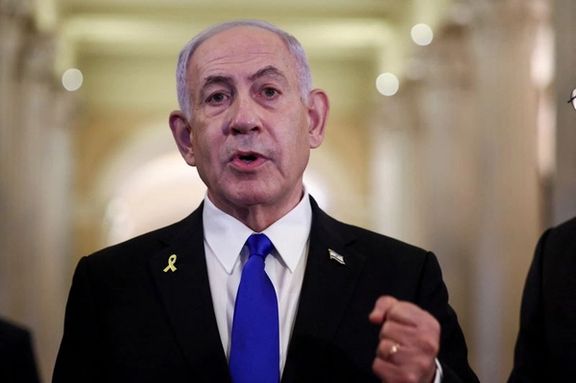
Netanyahu says Tehran incapable of peace with Israel, US
Israeli Prime Minister Benjamin Netanyahu on Wednesday said Tehran was implacably opposed to the the United States and Israel and could not be coaxed into a deal in which it abandons nuclear and military ambitions.
The comments suggested the Israeli premier, in Washington on a visit to meet President Donald Trump, remained deeply suspicious of any further US diplomacy with Tehran.
“A good deal with Iran means they stop all nuclear activity, all enrichment. They would stop building these ballistic missiles, which are against international treaties. They would also dismantle the terror axis," Netanyahu told Fox News in an interview which aired on Wednesday.
"That would be a good deal — but I think that’s not the regime we’re dealing with.”
“That regime has a built-in DNA, and that DNA says: ‘No America, no Israel,'" Netanyahu added.
"They want to get past Israel to reach America. They are developing long-range ballistic missiles with nuclear warheads to threaten you and every American. And that is what has been stopped.”
US forces targeted Iran’s nuclear sites at Fordow, Natanz, and Isfahan using bunker-buster bombs and Tomahawk cruise missiles on June 22, in a mission Trump said "obliterated" Iran's program.
Netanyahu, without citing evidence, said Iran had accelerated its nuclear program after Israel took military action against Hezbollah in Lebanon.
“They did that after we crushed Hezbollah and got rid of Nasrallah. The Iranian axis in the Middle East was broken. What did they have left? They rushed to nuclear weapons. That is one cancerous growth that could kill us,” Netanyahu said.
Israel killed hundreds of the Hezbollah fighters and leaders in a conflict which reach a crescendo late last year. A truce left Iran's old ally much depleted.
When asked how close Iran is to building a nuclear weapon, Netanyahu said: “About one year”.
A proposed Iranian law expanding espionage and national security charges and criminalizing ties with foreign entities has been halted for revision following a review by the country’s top oversight body.
The pause shows a swift post-war drive to crack down on alleged Israeli spying is hitting some obstacles even in the hardliner-dominated establishment.
Iran's Guardian Council sent back the controversial bill to parliament for revisions, citing ambiguities in definitions and potential conflicts with Islamic law and constitutional principles.
The draft legislation seeks to impose harsher punishments—including the death penalty—for a broad range of alleged activities defined as espionage or collaboration with Israel, the United States, and other “hostile” states or groups.
The bill, titled the “Intensification of Punishment for Espionage and Cooperation with the Zionist Regime and Hostile States Against National Security and Interests,” was approved by Iran’s parliament late June but faced scrutiny from the Guardian Council, which is tasked with ensuring that legislation complies with Islamic law and the constitution.
"The necessity of precision in legal definitions is critical," said Hadi Tahan Nazif, spokesperson for the Guardian Council. "There is ambiguity in identifying who determines 'hostile states and groups.' It must be clarified which official institution makes that designation."
Tahan Nazif further warned that vaguely defined terms like “creating division” or “undermining national security,” as used in Article 4 of the bill, could infringe on constitutionally protected rights. “Such qualitative language may, in practice, restrict legitimate freedom of expression. These ambiguities must be resolved,” he said.
Among the most contentious points is the bill’s expansion of the crime of “spreading corruption on earth” (efsadfel-arz)—a charge that can carry the death penalty.
The Guardian Council objected to Article 2, which equates“any direct or indirect assistance”to Israel with corruption on earth. The Council said this could lead to capital punishment for acts that do not meet the strict criteria for that charge under Islamic law.
“In Islamic jurisprudence, the conditions for establishing the crime of corruption on earth are specific and strict. Broadening its scope without meeting these conditions is contrary to Sharia,” Tahan Nazif explained.
At the same time, the Council criticized the bill for limiting some cases—such as widespread distribution of unlicensed communications equipment used in organized opposition—to prison terms, when it argued they could meet the threshold for corruption on earth.
Another key concern centers on retroactive enforcement. Article 9 of the bill says that the law applies to offenses committed before its ratification, contradicting Article 169 of Iran’s Constitution, which prohibits retroactive criminal laws.
“No act or omission may be considered a crime under a law enacted after the fact,” Tahan Nazif emphasized, echoing the constitutional safeguard.
Despite its critique, the Guardian Council affirmed the importance of robust legal tools to defend national security, particularly in the wake of the 12-day Iran-Israel war, the spur of the latest emergency legislation.
“Our intent is not to obstruct legislation but to ensure laws are both enforceable and aligned with the constitution and Sharia, while also safeguarding citizens’ rights,” Tahan Nazif said.
Mohsen Dehnavi, the spokesperson for Iran’s Expediency Council, said on Wednesday that its supervisory board supports the general framework of the bill but some provisions in the draft were ambiguous.
A legal path to expanded crackdowns?
The bill follows heightened internal security measures and increased arrests, particularly since last month's war which saw devastation wrought on both sides of the conflict.
On Wednesday, Tehran’s prosecutor Ali Salehi confirmed that several cases involving alleged espionage, intelligence leaks, and smuggling of explosives are under urgent investigation.
“These cases involve individuals accused of sending maps and GPS coordinates to the Zionist regime, as well as transferring explosive materials,” Salehi said at an event in Tehran. “With full support from the judiciary and security forces, investigations are proceeding swiftly.”
Salehi also addressed allegations of espionage tied to the recent conflict: “Once investigations are complete, the public will be informed. The judiciary will not tolerate any actions that compromise national security.”
Escalating rhetoric
The bill and judicial statements come amid intensified rhetoric in Iranian state media. This week, Fars News Agency, which is affiliated with the Islamic Revolutionary Guard Corps (IRGC), published an editorial calling for the mass execution of detainees accused of collaborating with Israel and Western intelligence services.
“In the current conditions, those who enabled the killing of hundreds of Iranian citizens through espionage and weapons smuggling deserve to be executed in the style of 1988,” the editorial said, referencing mass executions of political prisoners. Amnesty International estimates that at least 5,000 people were executed during that period, often following secret trials without due process.
The article described the 1988 executions as “a brilliant chapter” in Iran’s history and saying that the public supports similar action today against what it termed “domestic terrorist networks.”
Definitions and penalties
The legislation, in its current form, criminalizes a broad range of activities under national security offenses.
It introduces the death penalty for espionage or intelligence cooperation with Israel, the United States, or their affiliated entities. The same punishment would apply to the manufacture, transfer, or import of drones for military or surveillance purposes, if deemed to involve "malicious intent."
The bill also imposes prison terms of 10 to 15 years for disseminating content—such as news, videos, or images—considered to harm national security or sow division.
Penalties ranging from six months to 10 years would apply to the use or distribution of unauthorized communication equipment, including satellite internet services like Starlink, depending on scale and intent.
Additionally, the bill allows for retroactive prosecution of offenses committed before its passage, a provision that legal experts say violates constitutional safeguards.
The draft is expected to return to parliament for clarification and possible amendment before undergoing a final review by the Guardian Council.
Last month, in the wake of the war with Israel, Iran arrested over 700 people in a mass roundup, accused of working for the Jewish state.
An Iranian official said Donald Trump could face a drone attack while sunbathing at his Florida mansion, in the latest threat to his life after Iran was worsted in a 12-day war with Israel backed by the United States.
“Trump has done something so that he can no longer sunbathe in Mar-a-Lago," Mohammad-Javad Larijani, a former senior advisor to Iran’s Supreme Leader, said in an interview with state TV that has recently gone viral on social media.
"As he lies there with his stomach to the sun, a small drone might hit him in the navel. It’s very simple,” added Larijani, whose two brothers are among the Islamic Republic’s most powerful political figures.
US forces attacked three Iranian nuclear sites in a bid to disable Tehran's disputed program days after Trump said Washington was well aware of where Khamenei was sheltering during the war.
Larijani's comments came after an online platform calling itself "blood pact" began raising funds for what it calls “retribution against those who mock and threaten the Supreme Leader Ali Khamenei.” The site says to have collected over $40 million to date.
It was not immediately possible to verify the authenticity of the figure.
Bounty for Trump’s head
“We pledge to award the bounty to anyone who can bring the enemies of God and those who threaten the life of Ali Khamenei to justice,” a statement on the site said.
The campaign's stated aim is to raise $100 million for the killing of Donald Trump. It remains unclear who operates the site.
However, Fars News Agency, affiliated with the Revolutionary Guards, reported the launch of the Blood Pact initiative and called on religious groups in Iran and abroad to rally in front of Western embassies and central squares to express support for Khamenei.
The outlet also urged the application of “Islamic rulings on moharebeh” against both Trump and Israeli Prime Minister Benjamin Netanyahu.
In the Iranian legal system, moharebeh—literally “waging war against God”—is punishable by death.
President Masoud Pezeshkian sought to distance his government from the campaign, telling US commentator Tucker Carlson on Monday that “the fatwa of warfare has nothing to do with the Iranian government or the Supreme Leader.”
But Kayhan newspaper, overseen by a representative of Khamenei, dismissed the president's remark.
“This is not an academic opinion. It is a clear religious ruling in defense of faith, sanctities and especially the guardianship of the jurist,” it wrote in a Tuesday editorial, referring to Iran's system of clerical rule.
Any future “fire-starter” would face retaliation, the newspaper added concluding that “The Islamic Republic will drown Israel in blood.”
Former lawmaker Gholamali Jafarzadeh Imenabadi earlier condemned Kayhan’s position, saying: “I can’t believe Kayhan’s editor-in-chief Hossein Shariatmadari is Iranian ... saying Trump should be assassinated will bring the cost down on the people.”
In response, Kayhan wrote: “Today, avenging Trump is nearly a national demand. It is Imenabadi’s words that are out of step with Iranian values."
Trump has been a target for assassination threats since he ordered the 2020 killing of Islamic Revolutionary Guard Corps (IRGC) General Qassem Soleimani in Iraq.
Last year, US law enforcement accused the IRGC of organizing a plot to kill Trump in retaliation for his order to assassinate Soleimani.
This is Tehran, two weeks after the ceasefire with Israel. Shops are open, people are out, the air is as polluted as ever—and the dread that began last month still hasn’t lifted.
Many are convinced it will start again.
“More homes will collapse. More people will die,” says Masoud, the electrician fixing the lights in our building’s corridors. “We have our carry-on ready by the door.”
Fears aren’t as sharp as last week, but many in the neighborhood still talk about safe and unsafe spots. The strike on Evin Prison—and the video of a blast at a busy junction in northern Tehran—hammered home the reality of war.
“We were at my in-laws’, right next to the prison. We thought it was the safest place—no way they’d hit a prison. But they did,” says Shadi, who lives with her husband and their two children in the apartment above us.
“The chandelier broke off and glass shattered everywhere. My son and his grandma had surface cuts. It could have been far worse.”
The prison bombing has seeded a new fear, Shadi says. “If even the prison isn’t safe, then what is? Not hospitals, not universities, not schools, not kindergartens.”
Kindergarten—that’s another image that cannot be unseen: shattered dolls and toys flung across the room. By sheer chance, it had closed 15 minutes before impact.
'Did they hit again?'
Officials say over 3,200 residential units were destroyed in Tehran. Thousands are now homeless. The wreckage has chipped away at war supporters.
One of them is a close friend of mine from university—Yara.
Before, when I warned that war meant destruction, he’d say: “This isn’t war. It’s just precision strikes against officials and bases, not civilians.”
Yara was lucky not to be physically hurt, but he was close enough to enough loud explosions to have nightmares—per his partner.
“He still jumps up at night and asks me, zadan (did they hit?)”
'They're still here'
Not all war supporters have changed their minds. In many homes, even emotional bonds were frayed under the bombs. When the ceasefire came, some were relieved, others angry.
“We endured the war, and they’re still here,” you hear many say.
They—who are still here—refers to Iran’s ruling elite, the Islamic Republic, the regime, as many prefer to call it.
Quite a few people I know hoped a few days of bombing would force the regime to collapse or walk away. The further you get from the epicenter, the deeper the divide, perhaps because you haven’t heard the blasts or watched the walls crumble.
I remember a conversation on day two of the war, before the full fear had set in. I asked a cousin and his wife to leave Tehran with us, for the sake of their kids.
“What if there are evacuation alerts like Beirut?” I implored. “Tehran will lock down. You won’t be able to leave.”
They refused, pointing me to their conversations with ChatGPT.
In the worst-case scenario, you could grab your bag and walk a couple of blocks to safety, they argued. “Any such alert would cover a couple of alleys at most. That’s what a precision strike is.”
ChatGPT had reassured them.
A new reality
Later, they told me what happened when evacuation orders hit districts six and seven—two major parts of the city. They had stayed. We had left.
“People were fleeing in panic in the middle of the night. Car horns nonstop,” my cousin’s wife said. “I sat in the car with my head in my hands, hoping nothing would explode nearby.”
That’s everyone’s fear these days—that the pause in fighting ends and they, or someone they love, are near an unannounced target of another “precision strike.”
And then there are the costs few talk about.
Many companies have laid off staff. It’s peak moving season in Tehran—leases ending, rents rising. People don’t know whether to stay, sign, or leave.
We thought we were used to suspended life—constant inflation, sudden, irreversible shifts in the economy and politics. But this is something else. A new phase entirely.
Tucker Carlson's interview with Iran’s president Masoud Pezeshkian was all Tehran could wish for, experts told Iran International: a global stage, no pushback, and a direct line to Donald Trump’s base.
“This was a major victory for Iranian information warfare operations,” said Marcus Kolga, a leading expert on foreign disinformation. “Whether intentionally or not, Carlson is acting as a significant conduit and amplifier for Iranian government information operations.”
The interview was recorded remotely, unlike the one Carlson did with Russia's president Vladimir Putin in February 2024.
"(Carlson) offers Pezeshkian and the Iranian regime a platform—without context or pushback—allowing Tehran to shape the record to Carlson’s viewers and listeners unopposed,” Kolga added.
A moment highlighted by many critics was when Pezeshkian asserted that Israel had tried to assassinate him without offering any evidence.
“He was trying to... put forward the message that this is Israel tricking America into getting involved in this. This really isn't America's war. Iran and America, we have nothing to fight about.” director of the Yorktown Institute's Turan Research Center Joseph Epstein said.
Epstein argued the interview fit Carlson’s broader pattern of offering authoritarian figures a platform to rewrite narratives without scrutiny—an approach that often blurs the line between journalistic curiosity and ideological alignment.
MAGA :' forever wars'
That alignment, analysts say, extended deep into the language Pezeshkian used.
From “forever wars” to calls for dialogue, his remarks were crafted to appeal to Trump-aligned isolationists and feed growing calls for US disengagement from the Middle East.
The use of such language is no accident, said Holly Dagres, a senior fellow at the Washington Institute, who has long studied Iranian strategic messaging.
“One of the main goals of the Islamic Republic is to get the US out of the Middle East... and when you're pushing this isolationist rhetoric or America First, you're basically saying America needs to get out," Dagres told Iran International.
Dagres noted that Pezeshkian’s emphasis on business cooperation with the US and his softened tone on slogans like “Death to America” appeared to be an overture to Trump himself, even if the message didn’t land as clearly in today’s post-war political climate.
The interview was praised by Iran's moderates, but hardline voices slammed the president's for what they called 'appeasement'.
"A lot of conservatives condemned it because (they said) the US just bombed us. Why are you making these appeals to them?”
The messaging, several experts said, fits into a broader long-term goal: undermining the US-Israeli alliance.
“He used this as an opportunity to weaken and to increase America's skepticism of support for Israel,” said Casey Babb, senior fellow at the Macdonald-Laurier Institute. “In 50 years or 100 years, if America and Israel are not aligned the same way they are right now, Israel could be in a very precarious situation.”
Carlson, Babb said, handed that message a valuable platform by failing to press Pezeshkian on Iran’s human rights record, nuclear activities, or assassination plots.
“There were definitely softball questions with no follow-up,” said Dagres. “Carlson didn’t challenge Pezeshkian on well-documented plots to target American officials or on the regime’s broader ambitions.”
“In failing to counter these narratives,” Kolga said, “Carlson becomes a conduit for regime propaganda—allowing this high-profile ‘conversation’ to turn into a successful Iranian strategic disinformation operation.”
The US President and Secretary of Defense said the military operation targeting three nuclear sites in Iran sent a strong message to the world, including US adversaries.
"Our so-called enemies were watching. They watched every minute of it," Trump said at a televised Cabinet meeting on Tuesday.
"It was a perfect military performance, the likes of which we haven't seen in a long time," he added recalling the operation codenamed Midnight Hammer.
“What was demonstrated on the world stage was American military might and capability,” Pete Hegseth said in his brief before the president spoke.
“It was not just Fordow and Isfahan and Natanz, but the whole world took notice of that.”
The June 22 strikes targeted Iran's three key nuclear sites with bunker-buster bombs. It was hailed "perfect" by the Trump administration but questioned by some Democratic lawmakers citing an early intelligence assessment.
Trump rejected doubts about the strikes' impact, praising the pilots and others involved.
“Those machines flew for 37 straight hours. They didn’t stop. They went skedaddle... They dropped the bombs, and somebody said skedaddle... And every bomb hit its mark—and hit it incredibly,” he said
"They were right in the most dangerous airspace in the world…and they went right through…by the time they (Iran) found out they were there, they were already gone. That was the word, skedaddle, get the hell out of here," he added.