Iran may approach bomb-grade enrichment if UN sanctions restored – IRGC media
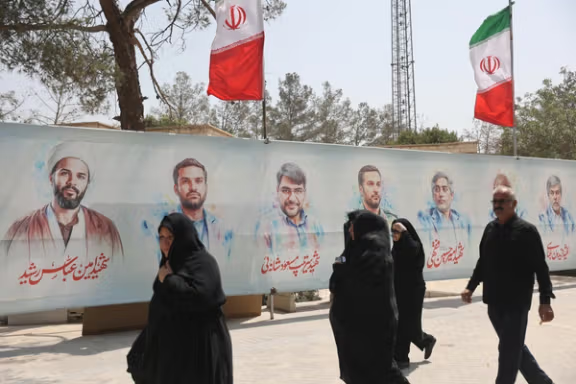
Pictures of Iranian military commanders, nuclear scientists and others killed in Israeli strikes are displayed in Behesht Zahra Cemetery in southern Tehran, Iran, July 11, 2025.
Iran could boost its uranium enrichment to 90%, weapons-grade level, and consider exiting the Nuclear Non-Proliferation Treaty (NPT) if European powers move to trigger the UN snapback sanctions mechanism, Tasnim News reported on Tuesday.
The report came as France said it would trigger the UN snapback mechanism against Iran by the end of August if no tangible progress is made on a nuclear deal.
French Foreign Minister Jean-Noel Barrot said Tuesday that Iran has violated its commitments under the 2015 agreement and that France, the United Kingdom, and Germany, known as the E3, are justified in reapplying global embargoes on arms, banks, and nuclear equipment. “Without a firm, tangible, and verifiable commitment from Iran, we will do so by the end of August at the latest,” Barrot told reporters in Brussels.
In response, Tasnim warned that Iran could raise uranium enrichment from 60% to 90%, and may use its enriched uranium stockpile for what it called “non-prohibited military purposes.”
The outlet also said that while exiting the Nuclear Non-Proliferation Treaty (NPT) would be a major step, it remains one of several options Iran is considering.
Snapback seen as 'military aggression' by Iranian officials
Foreign Minister Abbas Araghchi last week warned that triggering the snapback would be viewed by Iran as equivalent to a military strike. “This move would mark the end of Europe’s role in Iran’s peaceful nuclear file,” he said, calling it a “historic mistake” that could irreversibly damage ties.
Tasnim echoed that view, saying that the US strikes on Iran’s nuclear infrastructure, combined with European inaction, have shifted Tehran’s strategy from "political patience to strategic deterrence".
Iran may expand nuclear activity, restrict IAEA oversight
In its report, Tasnim said Iran "should halt dilution of 60% enriched uranium, accelerate advanced centrifuge deployment, expand research into uranium metal production, and scale back cooperation with the International Atomic Energy Agency (IAEA)."
“These responses are lawful and proportionate,” the outlet said, while warning that Tehran would not accept any further Western pressure without consequences.
Iran may approach bomb-grade enrichment if UN sanctions restored – IRGC media | Iran International
France, Britain, and Germany will activate the United Nations snapback mechanism against Iran by the end of August if no tangible progress is made on a nuclear deal by then, French Foreign Minister Jean-Noel Barrot said on Tuesday.
"France and its partners are... justified in reapplying global embargoes on arms, banks, and nuclear equipment that were lifted 10 years ago. Without a firm, tangible, and verifiable commitment from Iran, we will do so by the end of August at the latest," Barrot told reporters ahead of a meeting with EU Foreign Ministers in Brussels.
The snapback mechanism is part of UN Security Council Resolution 2231, which endorsed the 2015 Joint Comprehensive Plan of Action, or JCPOA. It allows any participant in the nuclear agreement to reimpose sanctions if Iran is deemed non-compliant. If no resolution to maintain sanctions relief is passed within 30 days, all previous UN measures return automatically.
Barrot said earlier in June that France and its European partners can reinstate a global embargo on weapons, nuclear equipment, and key financial sectors in Iran through a simple letter.
France announces EU sanctions on Iranians tied to killings, demands hostage release
As part of a broader EU action, the European Council has sanctioned nine Iranian individuals and entities accused of carrying out assassinations and transnational repression on European soil. Barrot announced the measures on Tuesday, saying the listed individuals were responsible for “violating the interests of France and Europe.”
“We are freezing the assets and banning the entry into Europe of nine Iranian individuals and entities responsible for assassinations on European territory,” Barrot said. “This is the result of efforts I personally led, and I welcome their outcome.”
Barrot also called for the “immediate and unconditional release” of French nationals held in Iran and demanded Iran resume cooperation with UN nuclear inspectors. He said Tehran’s “destabilizing activities” would not go unanswered.
Iran warns of ‘appropriate response’ if Europe triggers sanctions
Iran will respond proportionately if the European parties re-activate the snapback mechanism, Foreign Ministry spokesman Esmail Baghaei said on Monday.
He dismissed the legal basis of the measure and accused the European parties of violating their own JCPOA obligations. “They have no standing to invoke the mechanism,” he said at a weekly briefing. “The so-called snapback has no legal, political, or ethical justification.”
Baghaei reiterated that Iran still considers itself a JCPOA signatory, despite scaling back commitments after the US withdrawal in 2018 and what he called Europe’s failure to uphold its end of the deal.
Iran accuses Germany and IAEA of double standards
Baghaei also criticized Germany for hosting US nuclear weapons and backing Israeli military operations, calling its position a violation of the Non-Proliferation Treaty (NPT). He accused Berlin of “supporting violations of international law” while taking a hard line on Iran’s nuclear activity.
He further accused the International Atomic Energy Agency (IAEA) of “instrumental and selective behavior,” alleging that information provided by the agency had been used in recent military strikes against Iran’s nuclear sites. He condemned the IAEA’s silence over those attacks, including the US bombing of the Fordow facility, whose damage he said is still being assessed.
No new nuclear talks planned, Iran says
Baghaei said no date or venue has been set for nuclear talks, though consultations with China and Russia are ongoing. He called recent reports of new intermediaries “speculative” and stressed that Iran makes independent decisions on its nuclear policy.
He also said Iran remains open to diplomacy but will not re-enter talks until there is “confidence in the effectiveness of diplomacy.” He cited a coordinated Israeli-US military strike just before the sixth round of negotiations as a key turning point.
An Iranian doctoral student arrested in Louisiana following US airstrikes on Iran must be released and protected from deportation, a federal magistrate judge ruled on Monday, the New York Times reported.
Pouria Pourhossein Hendabad, 29, was arrested on June 22 in Baton Rouge, where he was pursuing a PhD in mechanical engineering at Louisiana State University. He and his wife, Parisa Firouzabadi, were detained after reporting a car accident. According to his lawyers, officers posing as state police lured the couple out of their home and handed them over to a waiting team of ICE agents in tactical gear.
He had a valid student visa through 2030 and faced no known criminal charges. His attorneys called the arrest “an unconstitutional ruse,” and said it was carried out without a warrant or legal justification.
Pouria Pourhossein Hendabad
On Monday, Magistrate Judge Joseph H.L. Perez-Montes ordered his immediate release and barred the government from deporting or transferring him, citing a “grave risk” of irreparable harm.
Part of a growing pattern
Pourhosseinhendabad’s case is the latest in a string of arrests of Iranian students and nationals in the US this year.
In March, Alireza Doroudi, a PhD student at the University of Alabama, was arrested by ICE without formal charges and held for six weeks before choosing to self-deport.
His lawyers said the government admitted it had no evidence he posed a national security threat, but prolonged detention and pressure forced him to leave the country.
More than 130 Iranians arrested after US strikes
In late June, more than 130 Iranian nationals were detained across the country in a sweeping enforcement operation, according to Fox News. Federal officials said some had ties to the IRGC or Hezbollah, but many of those arrested, including students and recent immigrants, faced no public charges.
Iran's defense minister on Monday said the Islamic Republic does not trust the current ceasefire with Israel and has prepared multiple military scenarios in anticipation of renewed hostilities.
“The Islamic Republic does not trust the ceasefire,” Aziz Nasirzadeh said in a phone call with Turkey’s defense minister Yasar Guler on Monday, according to the state-run IRNA news. “We have therefore anticipated various scenarios for any new adventurism.”
“We are not seeking to expand war and insecurity in the region, but we are ready to give a firm and regret-inducing response to any act of aggression,” he added.
Nasirzadeh also criticized the timing of the strikes, saying, “The attack on Iran took place during negotiations. We have proven to the world that we are not opposed to dialogue and negotiation.”
On June 13, Israel launched a large-scale surprise air campaign against Iran, striking multiple nuclear and military sites as part of the opening phase of what became a 12‑day conflict.
Hundreds of Iranian civilians were killed in the Israeli airstrikes. Iranian missile attacks also killed 27 Israeli civilians.
Following the Israeli strikes, Iran–US nuclear talks scheduled for June 15 in Muscat were called off.
The United States joined the offensive on June 22 with its own strikes—dubbed Operation Midnight Hammer—involving B‑2 bombers and Tomahawk cruise missiles targeting Natanz, Fordow, and Isfahan.
A ceasefire came into effect on June 24, brokered by US President Donald, marking the end of the fighting. While the ceasefire ended the air war, its long-term viability remains in doubt.
Last month, Iran’s reformist daily Shargh described the ceasefire as legally fragile and unpredictable.
“The ceasefire is not based on any international legal standards, regulations, or the rules of official global organizations and institutions,” the newspaper wrote.
“In fact, it is a temporary and ambiguous ceasefire, and there can be no serious certainty about its durability.”
Last week, Prime Minister Benjamin Netanyahu said in an interview that Israel had rolled back Iran's nuclear program but implied the Jewish state had not yet finished its confrontation with the Islamic Republic.
Ali Khamenei’s office has responded to an open letter sent by former Israeli defense minister Yoav Gallant to Iran's Supreme Leader, calling it propaganda and a “full-scale psychological operation.”
In an op-ed published Monday on Khamenei’s official website, his office issued a rare rejoinder to Israeli officialdom in which it dismissed Gallant's assertions of overwhelming Israeli military and intelligence superiority.
The statement described Gallant's message as part of “a conflict whose primary battlefield is not border zones, but public perception and the realm of awareness.”
“What unfolded in June 2025 was not merely a military campaign. It was the strategic collapse of a system you spent four decades constructing,” Gallant wrote, referring to the 12-day Iran-Israel war last month.
Israel launched a series of strikes on June 13 which pounded military and nuclear sites, assassinated senior commanders and killed hundreds of civilians. Iranian missiles killed 27 Israeli civilians.
Gallant warned Khamenei that Israel has full access to Iran’s inner workings, including military planning and high-level decision-making.
“We knew your schedules. Your sites. Your communications. Your conversations with your closest allies — most of whom are no longer with you — in Beirut, Damascus, and Tehran. Your timelines. Your fallback plans. And your blind spots,” he wrote.
The letter also highlighted weaknesses in Iran’s air defenses and warned that any attempt to restore the nuclear program would invite future attacks.
“Abandon your war against a small, determined country a thousand miles from your border," Gallant said, "and focus instead on the welfare and future of your own people.”
Iran’s nuclear program was a threat to the United States, US Senator Cynthia Lummis told Iran International, adding that last month's US attacks against Iranian nuclear facilities were further justified by Tehran's avowed hostility.
“The Iran nuclear program was a threat to the United States because Iran voices ‘Death to America’ and ‘Death to Israel.’ And It was a direct threat to us," Lummis said.
"It was the right thing to do to take it out on a very targeted basis and then hope that the Iranian people, who are not our enemies, can reclaim their government and participate in a global economy that is robust and that is good for the Iranian people.”
The administration of US President Donald Trump has counted the attacks on the Natanz, Fordo and Isfahan nuclear sites dubbed Operation Midnight Hammer as a historic victory.
Trump had mooted killing Iran's Supreme Leader Ali Khamenei in the early days of the US-backed 12-day Israeli war and had broached regime change but swiftly called for a ceasefire after the US attacks which continues to hold.
Trump asserted Iran's nuclear program was “obliterated”. However, subsequent US intelligence assessments have varied.
An initial assessment from the Defense Intelligence Agency (DIA) said the attacks may have set Iran's nuclear program back by only months. A subsequent Pentagon report concluded the strikes hindered Iran’s nuclear progress by up to two years.
The Central Intelligence Agency and Director of National Intelligence Tulsi Gabbard also said the Islamic Republic's nuclear infrastructure had been severely damaged and set back by years.